
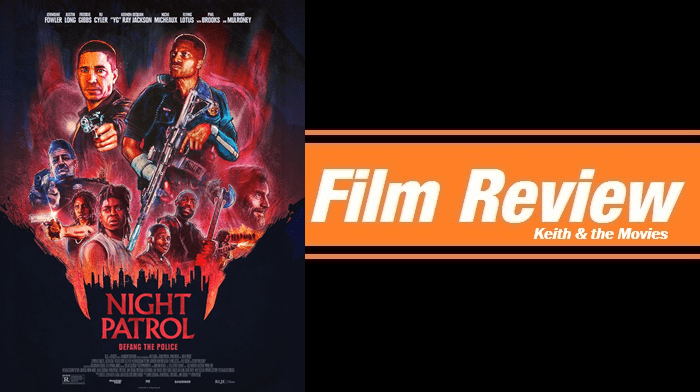
“Night Patrol” shouldn’t be confused with the 1984 comedy of the same name that could be called a “Police Academy” knockoff if the two films hadn’t released mere months apart. No, this is a much different animal – a movie that defies categories. It’s as if you threw multiple genres and sub-genres into a blender and out came “Night Patrol”. Regardless of how you categorize it, this wild confection will still find ways to surprise you.
Directed by Ryan Prows, “Night Patrol” features equal helpings of supernatural horror, pitch-black comedy, social commentary, graphic gore, family drama, exploitation excess, and more. The story (written by Prows, Shaye Ogbonna, Tim Cairo, and Jake Gibson) comes packed with a wealth of themes that involve police corruption, racial injustice, gang violence, fractured families, economic disparity, and more. And they’re accompanied by no shortage of blood-spraying and gut-slinging.
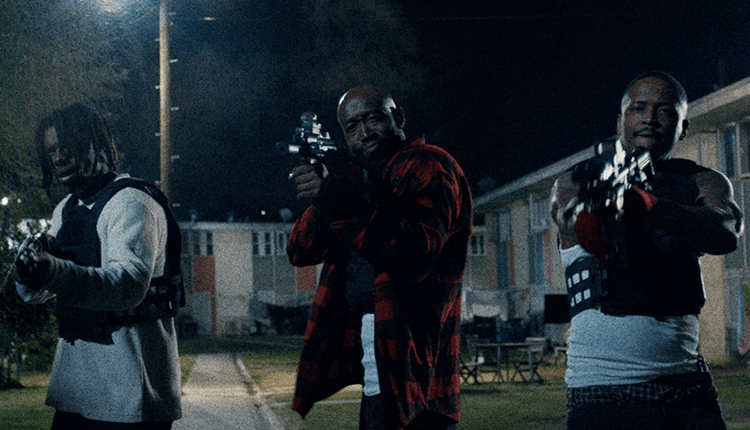
The movie begins with Wazi Carr (RJ Cyler) sitting in an interrogation room at the LAPD police station, bleeding from the jagged black shard protruding from his side. As the questioning begins, Prows uses Wazi’s telling of events to frame his gonzo story. A fun ensemble fills it out, playing a medley of colorful characters that includes police officers, gangbangers, family members, and neighbors.
Much to the chagrin of his family, Wazi’s big brother Xavier (Jermaine Fowler) is an ambitious LAPD cop who’s hungry to climb the ladder. He’s jealous of his partner Ethan (played by scream king Justin Long) who was recently invited to join an elite anti-gang task force called Night Patrol. Not much is revealed about Night Patrol other than they’re intensely exclusive and they have their run of the police department. Oh, and they’re also secretly vampires.
Lest you feel that last sentence was a spoiler, Night Patrol’s identity is revealed pretty early on. It’s their ultimate goal that’s the bigger mystery. Prows uses Ethan’s initiation to plunge us into the dark, twisted, and zany world of Night Patrol. Overseeing the group’s operations is a street-tough cop called Deputy (Phil Brooks aka wrestling’s CM Punk). He reports to the organization’s mysterious leader referred to as “Sarge” (Dermot Mulroney). It only gets crazier (and bloodier) from there.
Things ratchet up pretty kick, especially after Wazi witnesses the brutal murder of his prospective girlfriend, Primo (Zuri Reed) at the hands of Night Patrol. The killing draws the attention of two rival gangs, both neighborhood offshoots from the Bloods and the Crips. The comically superstitious Bloods are led by Bornelius (Freddie Gibbs) and are always on the watch for demons, shapeshifters, and lizard people with acid tongues. The local Crips are headed by Wazi and Xavier’s mother, Ayanda (Nicki Micheaux), a Zulu mystic who always seems to know more than she’s letting on.

Everything ultimately propels us forward to an inevitable showdown at the Colonial Courts housing project. It’s there that secrets are revealed, new alliances are formed, and gallons of blood is shed. On the way there the pacing is a little wobbly, but it’s undeniably fun regardless of how bonkers things get. Visually, Prows gives his film a gritty and grainy texture. And the choice to employ practical effects ends up paying huge dividends.
“Night Patrol” tackles more themes than you can count on two hands with most handled surprisingly well. It also employs just as many metaphors, some of which start strong but get sillier over time, and others that veer close to heavy-handedness. Still, the film maintains a self-awareness that keeps things fun. And Prows’ clear love for exploring genres produces an infectious energy and a go-for-broke uniqueness that gives the movie an identity all its own.
VERDICT – 3 STARS










 Keith & the Movies