REVIEW: “Never Let Go” (2024)

French filmmaker Alexandre Aja steps back into the genre he cut his teeth on with “Never Let Go”, a lean and atmospheric survival horror thriller energized by the star power of its lead, Halle Berry. It’s a film that doesn’t see the need in soaking its audience in blood or jolting them with cheap jump scares (with one lone exception). Instead “Never Let Go” is more of an old-fashioned chiller. It plays like a creepy bedtime story that grabs your attention and your imagination.

“Never Let Go” is built upon a fairly simple premise yet it’s surprisingly cerebral. Aja and the film’s screenwriters Kevin Coughlin and Ryan Grassby take a very deliberate approach to their storytelling. They hint at and tease the threat of something sinister. But more of their time is spent developing a secluded and tight-knit family, laying out their complex relationships, and setting up their eventual fight for survival against a malicious Evil and themselves.

Image Courtesy of Lionsgate

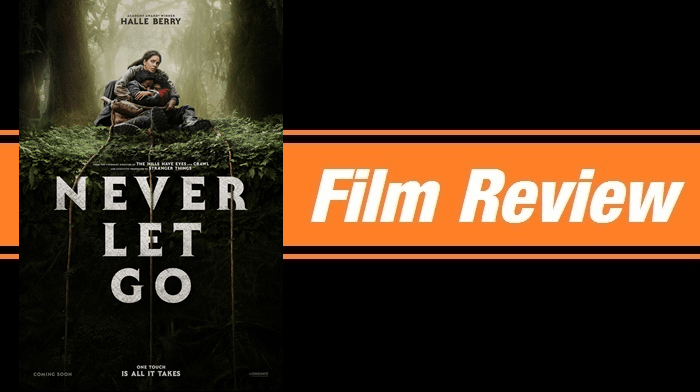
Berry gives an intensely heartfelt performance playing Joan, the mother of two young boys, Samual (Anthony B. Jenkins) and Nolan (Percy Daggs IV). Along with their dog Koda, the three live in an old house deep in the woods. We listen in as Joan tells her sons that the world has ended and now an ominous Evil lurks in the woods. She remains vague, sparing Samuel and Nolan the disturbing details and leaving an air of mystery for the audience to ponder.

Joan has taught her sons that their house is their only safe haven and they can’t be harmed as long as they remain connected to it. And not just figuratively but literally. Whenever they leave their home to scavenge for food, they tie heavy ropes around their waists that are bound to the house. “That rope is your lifeline,” Joan fervently preaches to her boys.

Little is ever revealed about the Evil, even by the time the closing credits begin to crawl. What we do learn is that it feeds on fears and insecurities and takes hideous forms for those who can see it. Joan is tormented by the Evil but has managed to shield Samuel and Nolan from it. But the boys soon find themselves at a crossroads. Do they keep putting faith in their mother’s claims? The more inquisitive Nolan begins to doubt the Evil’s existence which adds tension to an already stressful household.

Image Courtesy of Lionsgate

Aja does a terrific job immersing us into his mostly single setting. He uses the house and the gnarled forest surrounding it to generate feelings of isolation and unease. He also uses his technical savvy to produce some real edge-of-your-seat chills (go see it in a theater with quality surround sound). And of course Aja knows what he has in Halle Berry who anchors a big part of the story.

While “Never Let Go” has a lot to love, it also seems to be holding back on us. There are rich themes galore woven into story (mental illness, maternal bonds, the existence of evil, just to name a few) but they’re present more than considered. And by the end not everything revealed makes sense. But the movie still clutches you and (pardon the pun) never lets you go. After seeing it you may want to leave an extra light on for a couple of nights, and it may have you second guessing going outside after dark. And that’s the kind of response that makes the film so much fun. “Never Let Go” opens in theaters today.

VERDICT – 3.5 STARS

REVIEW: “Nowhere Special” (2024)

Italian producer-writer-director Uberto Pasolini gives a master class on handling emotionally heavy subject matter in “Nowhere Special”, a heartbreaking drama that never turns melodramatic or schmaltzy. Internationally co-produced, the film pulls inspiration from a true story which Pasolini intimately and emphatically shares. He hones in on the humanity at the story’s center, examining it in a deeply organic way with a Dardennes-like approach. The results are both beautiful and heart-shattering.

The film is anchored by a piercing James Norton whose lead performance matches the restraint Pasolini is going for. Set in Northern Ireland, Norton plays a 34-year-old single father named John who has devoted his life to raising his 4-year-old son Michael (Daniel Lamont). John’s wife and Michael’s mother abandoned them after giving birth, but John remained committed to giving his son the best life he could.

Image Courtesy of Cohen Media Group

John works as a window washer and we often see him gazing through the glass at different establishments, observing various lives he wishes he could provide for his son. It’s a motif that is never overused and is made all the more affecting by the early revelation that John has a terminal illness. With only a few months left to live, he’s faced with the biggest and most agonizing decision of his life. He must pick the very best foster family for his son.

But while that choice weighs on him, John is faced with even more painful questions. How do you personally come to grips with your impending death? How do you prepare? Even more, how does a loving father inform his 4-year-old son of what’s to come? John is helped by a compassionate social worker named Shona (Eileen O’Higgins) who bends countless rules to help him search for the right family. But it’s his internal struggle between sheltering his son and readying him for reality that gives the film such an emotional punch.

Image Courtesy of Cohen Media Group

Norton is fittingly understated yet he brilliantly conveys a father’s efforts to conceal his inward conflict behind a veil of normalcy. Small details in his performance do so much of the emotional heavy-lifting. And as the story thoughtfully moves towards the inevitable, Norton remains grounded and naturalistic. Meanwhile Lamont’s quiet soft-spoken demeanor reveals an inquiring young soul that observes more than expresses. The two make for a compelling and soul-stirring pair.

Handling material like this isn’t easy, and there are countless temptations to follow more conventional formulas. “Nowhere Special” works so well because Uberto Pasolini keeps his focus firmly on the people at the story’s core. His interests are internal and more human. As a result he wins our investment and keeps it for the duration. We feel the weight of every choice, we relish every tender moment, and we hurt with the inevitability of reality.

VERDICT – 4 STARS

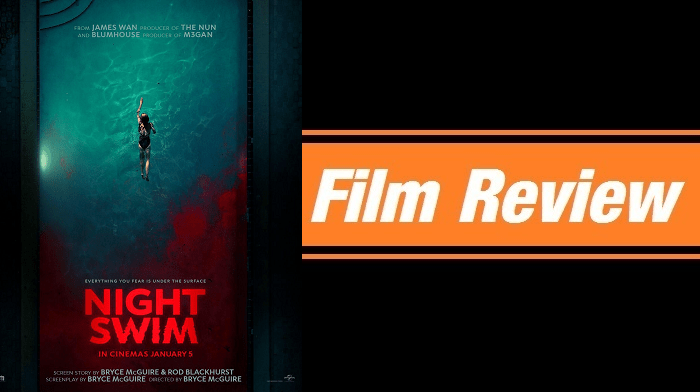
REVIEW: “Night Swim” (2024)

The 2024 year in horror kicks off with the mediocre and noticeably muted supernatural chiller “Night Swim”. It marks the feature film directorial debut for Bryce McGuire who also penned the script. The movie is based on a five-minute short film of the same name made back in 2014 by McGuire and his close friend Rod Blackhurst. McGuire stretched their idea into a feature film with James Wan and Jason Blum signing on to produce.

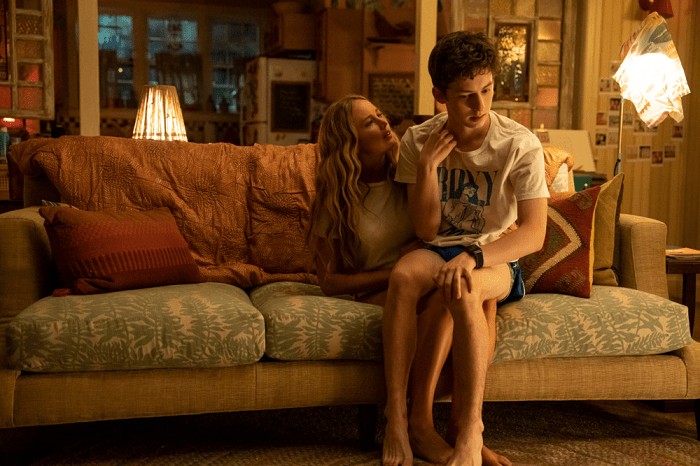
Set in Milwaukee, Ray Waller (Wyatt Russell) and his family are looking for a new home around the city. Ray is a Major League Baseball third baseman attempting to recover from a debilitating ailment. His wife Eve (the always great Kerry Condon) is tired of constantly moving every time her husband gets traded. She’s ready to put down some roots and provide some stability for their teen daughter Izzy (Amélie Hoeferle) and younger son Elliot (Gavin Warren).

Image Courtesy of Universal Pictures

After Ray gets some bad news about his condition he decides it may be time to settle down. He and his family move into a cozy suburban home with plenty of space and in a nice community. Even better it has a spacious swimming pool in the backyard. It hasn’t been used in 15 years, but they put in the work to get it cleaned up and ready to use. Soon they’re having friends over to swim and hosting neighborhood pool parties.

But as is the case with so many movies like this one, we learn the pool has a dark and deadly history. In the summer of 1992 a young girl named Rebecca disappeared after trying to retrieve her sickly brother’s toy boat from the pool. Of course that’s something their bubbly real estate agent (Nancy Lenehan) failed to mention. Before you know it weird things start happening, from flickering pool lights to creepy underwater visions. And it only gets worse from there.

Image Courtesy of Universal Pictures

The question becomes is the pool helping or haunting this family. Ray begins seeing dramatic improvements in his condition since swimming twice a day. But Izzy and Elliot are terrified by something they experienced in the deep end. As her kids grow more frightened and her husband creeps towards Jack Torrance mode, it’s left to Eve to hold her family together and get to the bottom of this killer pool.

Eve’s digging reveals a deeper and noticeably goofier history surrounding the pool – one that dates back centuries. McGuire attempts to build a compelling mythology, but it’s paper-thin and far more preposterous than interesting. The same could be said for the disjointed way the story ultimately plays out. Condon (who should have won the Oscar last year for “The Banshees of Inisherin”) is the biggest draw despite being handed a thankless task. She helps us stay fairly engaged, but keeping the movie afloat is simply too much to ask. “Night Swim” is in theaters now.

VERDICT – 2 STARS

REVIEW: “No Hard Feelings” (2023)

Of the many movies I watched in 2023 I’m not sure I saw one at odds with itself quite like “No Hard Feelings”. This tonally challenged cringe comedy from director Gene Stupnitsky can never seem to settle on what it wants to be. So much of its energy is spent being pointlessly crass as if desperately trying to earn the ‘raunchy comedy’ tag. But then it will almost randomly shift to a warm-hearted sentimental drama. Unfortunately for it (and us) the two mix together like water and oil.

Jennifer Lawrence plays 32-year-old Maddie Barker, an Uber driver and bartender living in the touristy and pricey Montauk, New York. Maddie is in a financial bind. Her car has been repossessed and she is in danger of losing the cozy house left to her by her late mother due to unpaid property taxes. She has three months to pay or she’ll lose her home. That’s when she spots and answers a rather odd posting on Craigslist.

Image Courtesy of Sony Pictures Releasing

Allison and Laird Becker (Laura Benanti and Matthew Broderick) are secretly looking for a young woman to help bring their shy and socially awkward 19-year-old son Percy (Andrew Barth Feldman) “out of his shell”. Percy has never been on a date, doesn’t have a driver’s license, and spends most of his time in his room playing video games and practicing on his keyboard. He’s set to go to Princeton in the fall and his parents (for some bizarre reason) believe he needs to drink, party, and most importantly have sex to be ready for college. Brilliant. Whoever completes the “job” gets a Buick Regal as payment.

Desperately needing a car, Maddie takes their offer with little consideration or shame. She quickly begins putting together a plan to seduce the much younger Percy. The ickiness of the premise is hard to get by especially when the movie makes it the centerpiece for much of its humor. Of course when in skilled hands comedy can be used to critique. But “No Hard Feelings” doesn’t feel like it’s critiquing anything.

Image Courtesy of Sony Pictures Releasing

It takes a few mindless mishaps, but Maddie eventually finds herself growing fond of Percy. Never to the point of ruling out having sex with him, but fondness to some degree. Stupnitsky (who co-wrote the script with John Phillips) throw in a handful of scenes that put aside the unfunny nonsense and tease what the movie could have been. They show a more sympathetic side of Maddie as she realizes her own need to grow up and mature. Sadly there just isn’t enough of that which is a big reason the story’s nice and tidy ending doesn’t work.

“No Hard Feelings” gives us glimpses of heart. But it’s almost always snuffed out by the witless physical comedy or the lazy raunchy gags which often seem to come out of nowhere. And of course it’s hard to shake the film’s premise. It does nothing to challenge or inform. It opens up no conservations and offers no real critique. Instead I was left wondering if this movie would have ever been made if the gender roles were reversed. Would anyone green-light a film about a 32-year-old man tricking and seducing a withdrawn and inexperienced 19-year-old girl? That question offers more food for thought than anything we get in “No Hard Feelings”.

VERDICT – 2 STARS

REVIEW: “Napoleon” (2023)

I admit, it brings my heart joy that at 85 years old the great Ridley Scott is still making movies. And not just run-of-the-mill movies, but big, sweeping, and ambitious movies. He’s the filmmaker behind such memorable favorites as “Alien”, “Blade Runner”, “Gladiator”, “Black Hawk Down”, and “The Martian”. And that’s only a sample size from what is a stellar 46-year filmography.

“Napoleon” sees the prominent director working comfortably inside his wheelhouse. It’s a massive historical epic that tells the story of the eponymous French emperor through Scott’s uniquely cinematic lens. He hits on handpicked high and low points in Napoleon’s life as a brilliant military strategist, an overly zealous ruler, and an insecure husband to Empress Josephine. It’s a crazy mixture of psychological study and made-for-the-big-screen spectacle. Best of all it sees Scott tossing the conventional biopic formula to the wind. The results are a little messy. But so was Napoleon.

Image Courtesy of Apple Original Films

Scott’s approach to telling Napoleon’s story is a lot like reading CliffsNotes. It gives you a general idea but it’s far from the full picture. It’s an approach that works in several ways, but that also gives rise to what becomes the movie’s biggest problem. Scott and screenwriter David Scarpa rapidly hop from one historical point to the next, bypassing important information needed to make the scenes feel connected. So we end up with a movie of loosely tethered vignettes.

This becomes more of a problem as the film progresses. I found myself routinely questioning how we got from there to here, what brought this situation on, where did that person go, etc. Major events such as Napoleon’s rise to emperor, his exile to Elba, and Josephine’s final days are mere blips and get no buildup and very little explanation. Meanwhile the many supporting characters have a hard time registering because so little is shared about them. In most cases we have no idea who they are outside of having their name stamped on the screen when they first appear.

In what may be a hurdle for some, “Napoleon” is marked by some wild shifts in tone. But Scott knows what he’s doing. He strategically uses them as a means to both elevate and mock his notorious subject. It results of some scenes of unbridled intensity while others are laced with jolts of unexpected humor. It gives the movie a quirkiness that (in its own peculiar way) works very well.

And then you have the spectacular battle sequences – Ridley Scott’s bread and butter. To no surprise they are fierce, violent, and immaculately presented. Surprisingly we don’t get many of them. There’s the Siege of Toulon, the Battle of Austerlitz, and of course Waterloo. None of them get much of a buildup, but once Scott is on the battlefield he’s clearly in his comfort zone. What follows is extraordinary.

Image Courtesy of Apple Original Films

As for Napoleon himself, Joaquin Phoenix (mumbling aside) is a solid fit for showing off the strengths, weaknesses, and all-out eccentricities of the infamously complex ruler. Though several years older than Napoleon for the bulk of the movie, Phoenix proves to be the right guy for Scott’s portrayal which has no interest in empathy or glorification. Vanessa Kirby is equally good as the equally contradictory and ultimately tragic Josephine. So much so that we’re left wishing she had more screen time.

The lavish set designs, exquisite costuming, and the overall grand scale, added to the inherently fascinating story of Napoleon Bonaparte, makes Ridley Scott’s latest an automatically intriguing endeavor. But the movie demands (at the very least) a working knowledge of the brutish but passionate sovereign and his toxic yet intimate relationship with Josephine. Without it chances are high that “Napoleon” will leave you more confused rather enlightened. “Napoleon” is in theaters now.

VERDICT – 3.5 STARS

REVIEW: “Next Goal Wins” (2023)

My biggest question going into “Next Goal Wins” was simple. Is this a return to form for director Taika Waititi. The director of such deliciously quirky treats such as “What We Do in the Shadows”, “Hunt for the Wilderpeople”, and “Jojo Rabbit” found himself drawn into the moneymaking blockbuster machine known as the Marvel Cinematic Universe. The results weren’t great. “Thor: Ragnarok” was tolerable yet frustrating. “Thor: Love and Thunder” was an abysmal mess.

So following on the heels of “Love and Thunder” is the feel-good sports comedy “Next Goal Wins”. So I ask again – is it a return to form for the undeniably talented Waititi? Well, not exactly. Instead it’s a mind-boggling misfire that sees the filmmaker more absorbed in his preoccupations than with telling a good story. It’s even more bewildering that a filmmaker so notorious for doing his own thing would make a film this glaringly by the numbers.

Image Courtesy of Searchlight Pictures

The movie has a great lead in Michael Fassbender and the story (written by Waititi and Iain Morris) starts promising. Inspired by true events and (at least for a time) laced with Waititi’s wacky sense of humor, “Next Goal Wins” sees Fassbender playing Thomas Rognen, a volatile American soccer coach on the outs with the United States Soccer Federation. But rather than straight-up fire him, the board, which includes his estranged wife and her new beau (played by the woefully underused Elisabeth Moss and Will Arnett), assign him to the most undesirable job in all of football.

In the 2001 World Cup Qualifiers the American Samoa national team suffered the worst defeat in the history of international football – a 31-0 drumming by Australia. Believe it or not, since then they’ve only gotten worse. In fact, we learn they’ve never scored a goal in the history of their team. Enter the boozy, soured, and frustrated Thomas who has been sent to American Samoa to coach their national team.

Early on Waititi teases us with an amusing fish out of water culture-clash comedy. There are some hilarious bits with Fassbender’s embittered and self-centered Thomas clanging against the deeply religious and hard-working Samoan locals. Equally funny are some of the early scenes with Thomas and his team, a talentless but good-hearted bunch who are as bad on the field as their reputation says. Yet they never lose the support of Tavita (Oscar Kightley), the President of the Football Federation of American Samoa who gives Thomas a single task – just score one goal.

But this is where the storytelling starts to go off track as Waititi’s more obsessive interests derail other facets of his movie. Take Thomas and his team. You would think their relationships would form the core of the story. Well, they do but only in a broad sense. Instead Waititi gets caught up in telling an on-the-nose side story involving a transitioning faʻafafine player named Jaiyah (played by Kaimana). So much so that most of the other players are nothing more than faces. We’re supposed to care about them, but hardly anyone other than Jaiyah gets a backstory or even a personality. Even Waititi’s camera stays so fixated on Jaiyah that the rest of the team feel like tag-alongs.

Image Courtesy of Searchlight Pictures

But not only do the majority of the relationships get shortchanged, so does the entire sports angle itself. Nothing about it comes across as authentic mainly because Waititi doesn’t put the time or effort into making it believable. We never see any kind of practice or preparation that would make us believe the American Samoan team could ever function in a qualifying match much less score a goal. That’s because Waititi’s interests are elsewhere.

That would be fine except Waititi wants us to buy into the film’s big feel-good finish – a lazy, super cheesy, emotionally inert retread of ground covered by countless other sports movies. We get the big game, the lovable underdogs, the mean and overly cocky opposing team, the moment where all seems lost, the big inspirational speech, and the rousing triumph where the music swells as everyone goes wild. It’s a surprisingly unoriginal and frustratingly hollow ending from a filmmaker trying to skate by on just representation and a few good gags. Or maybe he doesn’t expect much from his audience. Either way, Waititi’s latest misses the net by a mile. “Next Goal Wins” hits theaters November 17th.

VERDICT – 2 STARS