
REVIEW: “One Battle After Another” (2025)

It feels as if Paul Thomas Anderson’s “One Battle After Another” runs the risk of facing two different knee-jerk responses, each driven by contrasting views of current events. The angry and cynical-minded folks, who look for politics in everything they watch, might see the film as an dire reflection of a dubious America and an urgent call to action. The equally angry but more defensive crowd, who want to excise politics from everything they call entertainment, might dismiss it as another vain expression of Hollywood’s growing disdain for the country. Whatever.

But then there’s a third contingent – the PTA faithful, whose love for Anderson’s movies transcends politics or worldviews. They find their happy place in everything PTA does and often grade his movies on a curve. For me, there’s a level of self-indulgence that can often plague PTA’s filmmaking and storytelling. It’s an issue that’s noticeable (and by extension, frustrating) in some films more than others. At the same time, Anderson has made one of the greatest movies of our time with “There Will Be Blood”. And the sheer genius of “Phantom Thread” can’t be overstated.

So what to make of Anderson’s latest, “One Battle After Another”? Inspired by Thomas Pynchon’s 1990 novel “Vineland”, this proudly defiant and slightly neurotic concoction has more stuffing than a Thanksgiving turkey. At times it wants to be an action movie. At other times a bonkers black comedy. It even shoots for being a thoughtful daddy-daughter drama. But more than anything it’s a surprisingly one-the-nose political jaunt that only sees our modern times through one restricted lens. And in its desperate efforts to ‘say something’ at every turn, it forsakes simple things like character building and narrative cohesion.
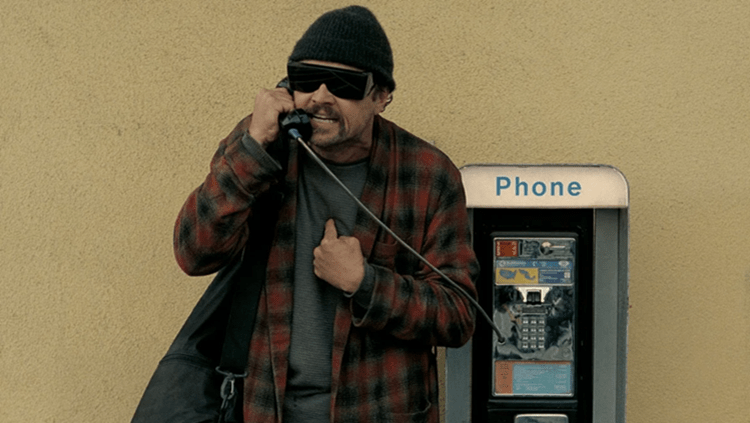
Image Courtesy of Warner Bros. Pictures

The movie’s problems start early and pretty much persist for the duration of the film’s lengthy 160 minutes. First there’s Anderson’s struggle with juggling his film’s abject absurdity and finger-wagging seriousness. The lines frequently blur together, making it too preposterous to be taken seriously and too serious and self-important to be funny. Then there’s Anderson’s chaotic storytelling which bounces us from one point the next while rarely slowing down to let anything develop organically.

The film opens with an extended prologue where we’re introduced to the French 75, a domestic terrorist group hiding behind the gentler title of “revolutionaries”. They’re a sundry yet organized faction with plenty of weapons and all the favorite hashtagged anti-establishment slogans. They blow up buildings, rob banks, and invade outposts (with very little condemnation), all under the emotionally charged leadership of Perfidia Beverly Hills (Teyana Taylor). She has a relatively small amount of screen time, but she ends up driving much of the story in some really bizarre ways.

Perfidia is tough as nails and extremely dedicated to her radical cause. But as we watch, Anderson seems conflicted on how to portray her. For the most part he’s smitten to the point of venerating her despite her unhinged antics which don’t always make sense. Look no further than her wacky first encounter with one of the more ridiculous characters of the year, Colonel Steven Lockjaw (Sean Penn). During a raid on a detention center, Perfidia apprehends Lockjaw. Her bizarre actions trigger some weird psychosexual infatuation within him that sets his course for the remainder of the movie.

The bulk of the story unfolds 16 years later with Perfidia long gone, leaving her tag-along lover and former French 75 member, Bob Ferguson (Leonardo DiCaprio) to raise their daughter Willa (Chase Infiniti). A teenager now, Willa spends more time looking after her perpetually paranoid and stoned father than enjoying her high school years. But their lives are rattled when Bob gets word that Lockjaw has discovered their location. Still driven by his twisted (and quite baffling) obsession with Perfidia, Lockjaw gives orders to kill Bob on sight and take Willa alive.

Image Courtesy of Warner Bros. Pictures

From there Anderson bops across his vision of America with the Bob-Perfidia-Lockjaw triangle in tow. As he does, his heroes are helped by an assortment of allies including a karate teacher who moonlights as a Harriet Tubman for illegal migrants (Benicio del Toro), a former French 75 loyalist (Regina Hall), and a convent of pot-growing nuns. As for PTA’s villains, they’re all very bad and very white. They range from cops, soldiers, and congressmen to the Christmas Adventurers Club, a cartoonishly silly and shallow white supremacist outfit so weakly sketched they would’ve been better left on the cutting room floor.

As for the talent-rich cast, no one is given much room to deliver a truly great performance. DiCaprio is the biggest victim, spending the film’s first half developing a unique and intriguing character only to spend the rest of his time frantically running around and clownishly yelling into oblivion. Del Toro is briefly terrific but is firmly handcuffed to Bob’s erratic story. As for Penn, he does what he’s asked. Sadly for him it results in nothing more than a farcical one-note caricature who’s too vile to be funny and too ludicrous to be menacing. The true bright spots come from Infiniti’s strong feature debut, and Hall who routinely grounds the film in some semblance of reality.

“One Battle After Another” is the kind of movie custom-made for an awards season push. It’s certain to be heralded as a modern “masterpiece”, an “important” film, an “essential” movie of our time, etc. Frankly, it’s none of those things, falling well short of PTA’s finer works. There are a couple of well-staged car chases and an invigorating score from Jonny Greenwood. But the film is 160 minutes of unfocused energy, fueled by plot gimmicks, careless romanticizations, and pulpit pounding that takes lazy potshots at real-world issues rather than actually examining them.

VERDICT – 2 STARS

REVIEW: “One Night in Tokyo” (2025)

Channeling the hypnotic vibes of such gems as Wong Kar-wai’s “In the Mood for Love” and Richard Linklater’s “Before” trilogy, writer-director Joshua Woodcock’s “One Night in Tokyo” is an aching drama full of humanity and heart. And despite its modest budget, the film exquisitely captures the pulse of the culturally rich and vibrant city from its title.

“One Night in Tokyo” marks Woodcock’s feature film debut and from its opening few sequences you see the kind of assured hand and keen instincts usually found in the most seasoned filmmakers. What makes it even more impressive, Woodcock serves as his own cinematographer and editor, both of which prove to be among the movies many strengths.

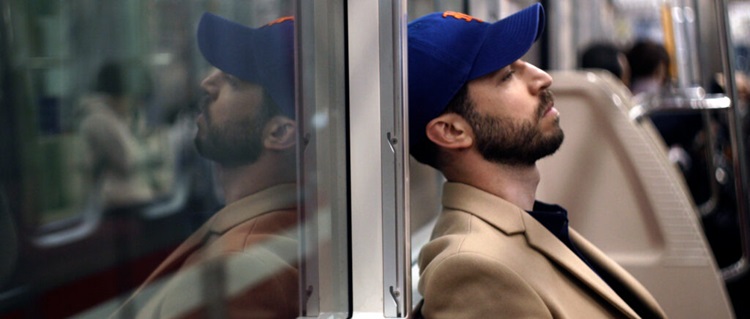
The story starts by introducing us to a New Yorker named Sam (Reza Emamiyeh) shortly after he arrives at the Tokyo airport. He’s there for a week to spend time with his girlfriend Becca (Cailee Oliver) who has been away in Japan for six months. But he’s surprised to find that she’s not there to meet him and she’s not answering her phone, leaving Sam to feel his way around a foreign country on his own.

With the help of his phone’s GPS and the kindness of a few strangers, Sam finally makes his way to Becca’s apartment where he immediately notices something is off. Becca comes across as chilly and detached before finally telling Sam she wants to take some time apart. Perplexed and downcast, Sam leaves and wastes no time booking a next-day flight back to New York.

Sam gets a call from his local buddy Jun (Shinichiro Watanabe) who he was set to meet up with for some drinks. But Jun has to cancel after getting tied up at work. So he makes arrangements for Sam to join his girlfriend Ayaka (Tokiko Kitagawa) and her friends for some drinks. Sam doesn’t know Ayaka or her friends and doesn’t feel like socializing. And after meeting Ayaka it’s clear she isn’t happy with the arrangement either.

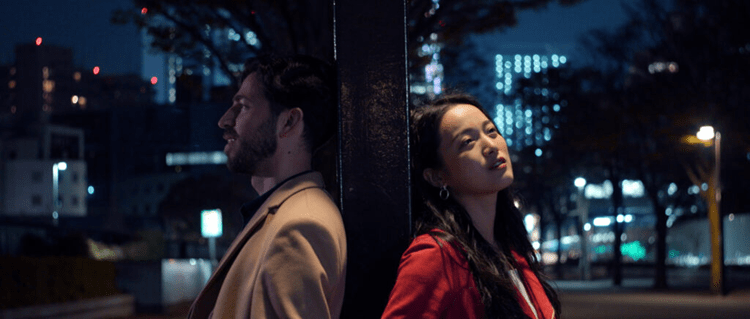
But Sam and Ayaka’s night together takes a number of unexpected turns starting with a shocking betrayal that leaves them both heartbroken. The two hurt and angry souls go to a bar together to drown their sorrows despite Sam not speaking Japanese and Ayaka not speaking English. But with the help of Google translator, they begin communicating. It’s the first step in what becomes a life-altering night together across Tokyo.

I don’t want to spoil where things go, but Woodcock takes his characters on an intoxicating journey full of bittersweet emotion and unvarnished humanity. Soon the two are walking the late-night streets like Linklater’s Jesse and Celine, opening themselves up through extended conversations while Tokyo provides a sparkling backdrop. Woodcock’s camera discreetly follows along in observation mode, elegantly relaying the range of feelings his characters express.

Equally important are the lead performances from the soulful Emamiyeh and the spirited Kitagawa. Individually they penetrate to the heart of their characters, patiently peeling back layers to show us who they really are. Together they share an organic chemistry, especially once the Google translator suddenly vanishes and the two begin communicating effortlessly. It’s a magical touch that allows the movie to evolve into something unexpected.

“One Night in Tokyo” is yet another example of how a filmmaker can overcome nearly any hurdle if he or she has a good story to tell and the cinematic knowhow to tell it. A healthy budget and studio support certainly helps. But nothing can top vision and talent. Woodcock possesses both as evident by this well-made and moving first feature. It’s a movie full of longing and desire yet with an impressively grounded approach to romance. It had its hooks in me from the very start. “One Night in Tokyo” releases in theaters and on VOD February 14th.

VERDICT – 4 STARS

REVIEW: “One of Them Days” (2025)

Dreux and Alyssa are best friends and roommates who are in a pickle and need money fast in “One of Them Days”, a female buddy comedy from first-time feature film director Lawrence Lamont. Even more, the script is from first-time feature screenwriter Syreeta Singleton. What’s best is that despite their film’s flaws, you get the sense you’re seeing two emerging filmmakers with big things ahead of them.

“One of Them Days” gets a lot of its comic energy from its terrific cast. Keke Palmer plays Dreux and SZA plays Alyssa and both share a fun chemistry that is essential to making the movie work. Dreux is a hardworking waitress who’s about to interview for a franchise manager position. Alyssa is a talented and aspiring artist who is struggling to get her work noticed. The pair share a Los Angeles apartment with Alyssa’s deadbeat sneaker-obsessed boyfriend, Keshawn (Joshua Neal).

Image Courtesy of Sony Pictures Releasing

Dreux and Alyssa find themselves in trouble after Keshawn takes their rent money and disappears. They plead for more time, but their impatient landlord (Rizi Timane) only gives them nine hours to pay their rent or they will be evicted. This sets the best buddies on a whirlwind adventure across town that starts with finding Keshawn. To no surprise, they discover he has blown their money which means they need some way to make $1500 before 6PM or they’ll be out on the streets.

“One of Them Days” is highlighted by an entertaining collection of supporting characters, from the other tenants in Dreux and Alyssa’s apartment complex to the colorful variety of people they meet across town. Some add hilarious sparks including an obnoxious loan officer, Kathy (Keyla Monterroso Mejia), a pseudo street prophet, Lucky (Katt Williams), and their oblivious white neighbor, Bethany (Maude Apatow). But others can be overcranked to the point of being one-note caricatures.

Image Courtesy of Sony Pictures Releasing

As far as the humor, the film delivers some legitimate laugh-out-loud gags and there are funny lines scattered throughout the dialogue. At the same time not everything works, most notably some cringe-worthy raunch and a few instances of slapstick that falls flat. But Palmer and SZA keep the comedy anchored and afloat. Either individually or together, they both are well-calibrated for what the filmmakers are going for.

The movie is almost undone by an over the top final act and an ending that’s way too tidy. It’s unfortunate and a bit deflating, but it doesn’t fully undo the better parts that come before it. And it doesn’t undermine how good Palmer and SZA are or how much promise is shown from Lamont and Singleton – two legitimate up-and-comers worth keeping your eye on.

VERDICT – 3 STARS

REVIEW: “The Order” (2024)

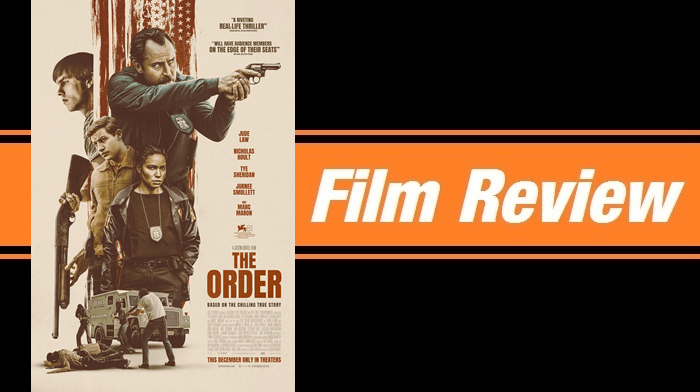
Out of the many features premiering this Fall movie season, few have peaked my curiosity quite like Justin Kurzel’s “The Order”. Based on the 1989 non-fiction book “The Silent Brotherhood” by Kevin Flynn and Gary Gerhardt, Kurzel’s period crime thriller sets out to tackle some potent subject matter. And with Jude Law, Nicholas Hoult, Tye Sheridan, and Jurnee Smollett starring, he has the cast to pull off what is one of the best thrillers of the year.

Kurzel has had a fascinating career. He emerged in 2015 with his powerful “Macbeth”. The very next year he hit a speed bump with “Assassin’s Creed”, a video game adaptation that has more strengths than it gets credit for. But he picked back up in 2019 with his gritty “True History of the Kelly Gang” and earned critical acclaim with 2021’s “Nitram”. Every film he has made is well worth watching and that remains true with “The Order”.

Set to a striking 1980s backdrop, Jude Law delivers one of the year’s best performances playing Terry Husk, an accomplished FBI agent who reopens the Bureau’s one-man office in the small rural town of Coeur D’Alene, Idaho. He’s come to investigate murmurings of rural neo-Nazi activity which the local Sheriff Loftlin (Philip Granger) is quick to downplay. But he finds an ally in Deputy Jamie Bowen (Sheridan), a clean-cut family man with his finger on the pulse of the area.

Image Courtesy of Amazon MGM Studios

Terry is a compelling central character as seen through Law’s richly lived-in performance. He’s someone who has been around the block, building cases against the New York mafia and the Ku Klux Klan. But while he is driven by his work, it has also taken a heavy toll as evident by his lingering health problems and the allusions to his estranged wife and daughters. Sporting a thick mustache and a world-weary veneer, Terry is an honest and savvy agent who knows how criminals think.

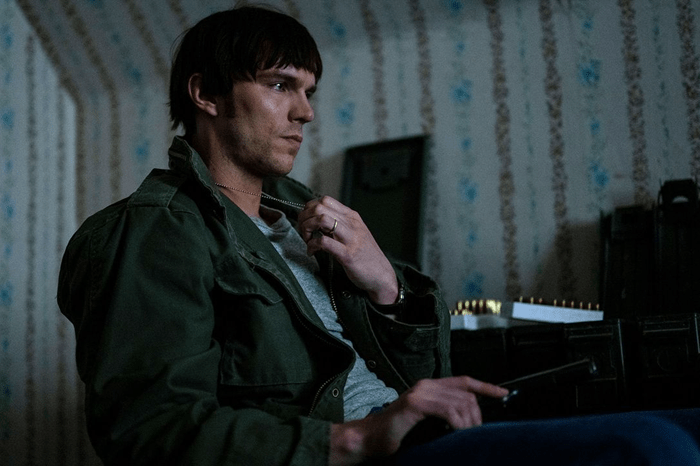
Elsewhere we’re introduced to Bob Mathews played by a captivating Nicholas Hoult. He’s an attractive young man with an all-American smile and disarming sincerity that hides his more disturbing convictions. Bob is the leader of a neo-Nazi splinter group whose hate-fueled agenda is inspired by white supremacist William Luther Pierce’s 1978 novel “The Turner Diaries”.

In the film’s most unsettling scene, Bob has a secret roadside meeting with Rev. Richard Butler (a slyly chilling Victor Slezak), a religious zealot and the leader of Aryan Nations. Both share the same racist worldview but differ on how to bring it about. Butler is shrewd and meticulous, working under the firm belief that the political system is their best way forward. Bob is tired of talking and is ready to put words into action. He’s busy recruiting a militia; robbing banks and armored trucks to fund his revolution. But he’s drawing unwanted attention in the process.

Image Courtesy of Amazon MGM Studios

Screenwriter Zach Baylin shapes their internal tension with a resonating urgency while defining their characters through their single-minded ambitions. As Butler sinks into the backdrop (a terrifying thought once you think about it), Bob’s fervor earns him a small but loyal group of followers who help him carry out a series of heists and soft-target bombings. But when his group (who calls themselves The Order, taken from Peirce’s book) murder Jewish talk-radio host Alan Berg (Marc Maron) in cold blood, it gives Terry and the FBI all they need to make Bob their #1 target.

As the “based on true events” story unfolds with a realistic tenor, the characters careen towards an inevitably violent conclusion. Along the way a handful of side characters provide the film with some welcomed context and depth. Smollett sheds some needed light on Ted playing his old friend and fellow agent, Joanne. In the same way, Bob is opened up more through his frustrated wife Debbie (Alison Oliver) and his pregnant side dish Zillah (Odessa Young). All three could use more screen time, but they have important roles and serve Kurzel’s laser-focused purpose well.

In every revolution someone has to fire the first shot.” By the time those chilling words pass through Bob’s lips we fully understand the lengths he will go for his cause. And on the other side, Terry is just as committed to bringing Bob to justice. Both raise the stakes in what becomes a simmering cat-and-mouse thriller set within the stunning vistas of the Pacific Northwest. Law deserves an Oscar nomination for his performance while Hoult continues his tremendous 2024 run. As for Kurzel, he adds yet another compelling entry into his already strong filmography.

VERDICT – 4.5 STARS

REVIEW: “On the Wandering Paths” (2024)

Director Denis Imbert teams with Academy Award winner Jean Dujardin in “On the Wandering Paths”, a soulful adaptation of Sylvain Tesson’s 2016 autobiographical travel journal of the same name. Tesson’s book was based on his own deeply personal experience which led to a life-changing and contemplative journey of self-discovery.

Imbert eloquently captures the human pulse of Tesson’s story via a thoughtful script (which he co-wrote with Diastème) and a beautifully introspective performance from Dujardin who is the centerpiece of every scene. In addition to the stunning photography of the French countryside by DP Magali Silvestre de Sacy, “On the Wandering Paths” is built upon the self-reflections and philosophical meditations from one wayward man’s soul-searching odyssey.

Dujardin plays Pierre Girard, an accomplished writer with an adventurous lifestyle whose backstory plays out through a collection of memories and reflections. Pierre has enjoyed a successful life, but it is forever changed in one ill-fated moment of recklessness. While drunk, Pierre falls three stories from a balcony to the unforgiving pavement bellow. The accident leaves him with a broken leg and a serious back injury. He also loses his hearing in one ear and even his sense of smell is affected.

As he endures multiple surgeries and a lengthy recovery, Pierre falls into despair which costs him his relationship with his girlfriend Anna (Joséphine Japy). While bed-ridden, Pierre makes himself a promise – if he is ever able to walk again he will set out to cross France on foot. He eventually regains his ability to walk and immediately begins to fulfill that pledge. He plots himself a 1,300 kilometer route starting at the Italian border and across to the Cotentin Penisula.

His friends and family think he’s crazy. But for Pierre, his journey has a significantly deeper meaning. It’s not only about finding himself, but also proving himself to himself. And while there may be physical and emotional dangers with such off-the-grid solitude, Pierre sees it as a means of self-redemption and as an opportunity to close troubling chapters in his whirlwind life.

Imbert’s ability to immerse his audience in Pierre’s personal pilgrimage proves to be one of the film’s great strengths. He makes us feel like quiet observers, following closely as Pierre climbs each mountain, navigates each forest, and passes through each eroding village. We sense every bolt of pain that courses through his barely mended body, each threatening to end his mission. Yet he’s propelled by an unbending determination that often gives way to obstinacy, testing fate with each step and content with its final judgement.

Pierre’s trek isn’t one of complete isolation. He talks with several locals he encounters along the way. He pays a visit to his Aunt (Anny Duperey). He’s helped by a Good Samaritan (Dylan Robert) who accompanies him for a leg of his journey. And for a brief stretch he’s joined by his friend, Arnaud (Jonathan Zaccaï), and a little later by his concerned sister, Céline (Izïa Higelin). Though most of his time is spent alone, Pierre gleans something new from every person he spends time with.

“On the Wandering Paths” may be light on story but it’s full of spirit. It’s a visually delightful movie full of eye-catching landscapes and beautifully rugged vistas. But there is a lot more beyond the pretty scenery. In addition to chronicling Pierre’s stirring self-exploration, Imbert and Diastème offer a handful of economic and societal observations, mostly surrounding the depopulation of rural France. And it all funnels through Dujardin whose textured performance thoughtfully conveys the movie’s soul.

VERDICT – 4.5 STARS

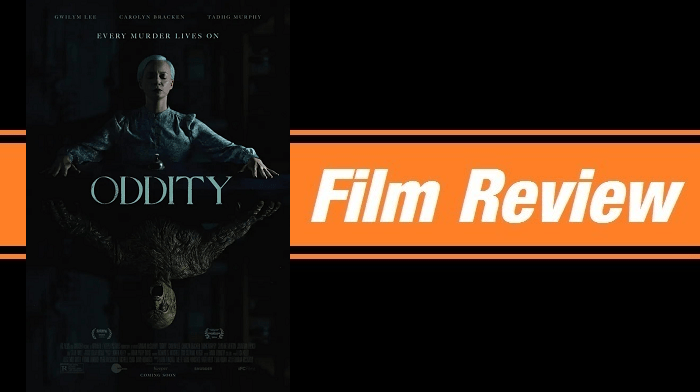
REVIEW: “Oddity” (2024)

2024 has been a surprisingly rich and diverse year for horror movies. We’re only in July yet there have already been strong entries into nearly every possible horror movie sub-genre. Writer-director Damian Mc Carthy adds another gem to this year’s catalog with “Oddity”, a spooky and atmospheric Irish chiller that builds some genuine suspense while keeping us guessing right up to its final frame.

“Oddity” is a cunningly crafted indie feature that adds a supernatural spin to a surprising straightforward murder mystery. As compelling as it is disquieting, Mc Carthy’s story is one of human wickedness and paranormal retribution. His direction is shrewd and methodical, often embracing elements of the horror genre but never held captive by them. That’s a big reason why “Oddity” stands out as unique despite its familiar dressings.

Image Courtesy of IFC Films

The movie is anchored by a brilliant dual performance from Carolyn Bracken. She plays Dani Timmis, the wife of psychiatrist Ted Timmis (Gwilym Lee). The couple recently invested in an old country house which they are in the process of remodeling. While Ted works the night shift at an area asylum, Dani decides to spend the weekend working on and enjoying their new home.

Dani is startled late one night by her husband’s former patient, Olin Boole (Tadhg Murphy). He appears at her door frantically claiming someone has slipped into her house while she wasn’t looking. A frightened Dani is confronted with a critical choice. Does she believe the man outside her door or does she stay locked in her house until Ted can get home? Her decision proves to have heavy consequences as she is violently murdered.

A year later we’re introduced to Dani’s blind and eccentric sister, Darcy (also played by Bracken). She owns and operates a small shop that sells oddities of all kinds, many of which she claims are cursed. She also claims to be psychic which keeps Ted at arms length. Meanwhile Ted has a new girlfriend, a co-worker named Yana (Caroline Menton) who just recently moved in with him. They’re caught by surprise when Darcy shows up unannounced, determined to stay the night. And that’s when things get really uneasy.

Image Courtesy of IFC Films

While Ted is off working his night shift, Yana is forced to stay at the house with the suddenly more hostile Darcy. To make things even eerier, Darcy brought Ted and Yana a present – a ghoulishly life-sized wooden mannequin from her shop, marked by its uncomfortable frozen scream and five finger-sized holes drilled in the top of its head. What’s the mystery of the wooden man? Is its agonized face telling a haunting story of pain? Is the carved creation housing something malevolent? Or does it represent something else entirely?

With his pieces in place, Mc Carthy begins playing with our minds by patiently revealing truths that were hidden right in front of our eyes. At the same time he does a good job ratcheting up the dread, often by something as a simple as a static shot of a door or through his clever use of lighting, shadows, and deafening silence. As you watch “Oddity” you’ll notice there’s a simplicity to Mc Carthy’s approach yet he is remarkably sure-handed. That, along with some pitch-perfect performances, helps make this another stand-out chiller from 2024. “Oddity” is now playing in select theaters.

VERDICT – 4 STARS