
REVIEW: “People We Meet on Vacation” (2026)

Netflix had a tremendous year last, specifically when it comes to original movies. They delivered the best movie of 2025 with “Train Dreams”. But right behind it were several other outstanding features including three that also made my Top 10, “Nouvelle Vague”, “Frankenstein”, and “Jay Kelly”. Not to mention Kathryn Bigelow’s “A House of Dynamite” and “Wake Up Dead Man”, the latest and best Knives Out film so far.

Netflix kicks off 2026 with a romantic comedy that certainly doesn’t reach the heights of the above movies. But for most of its running time, “People We Meet on Vacation” is an unexpected delight. Much of its success hinges on the sparkling chemistry of its two stars, Emily Bader and Tom Blyth. It’s only later, when the script slips into that all too familiar romcom formula, that the movie starts to come unglued.

Image Courtesy of Netflix

“People We Meet on Vacation” is based on Emily Henry’s 2021 novel of the same name. This light and breezy adaptation is directed by Brett Haley who’s working from a script by Yulin Kuang, Amos Vernon, and Nunzio Randazzo. The film stars Bader as Poppy, a free-spirited New York City travel writer. Nine years earlier, Poppy met the tightly wound Alex (Blyth) met while sharing a ride from their college in Boston to their home in Lynnfield, Ohio. Despite being polar opposites, Poppy and Alex become unexpected best friends.

For nearly a decade the (ahem) strictly platonic friends have taken summer vacations together. A series of flashbacks take us back to several of their trips – camping in Canada, partying in New Orleans, and an especially relationship-changing summer in Tuscany. But something happened leading Poppy and Alex to have a falling-out. They haven’t spoken in two years, but they’re given a chance to reconnect after Alex’s brother David (Miles Heizer) invites Poppy to his wedding in Barcelona.

Image Courtesy of Netflix

For the majority of its 118 minutes, Haley manages to keep things surprisingly fresh. There is never a time when we don’t know where things are going or how it’s going to end. But the road to that point is littered with good laughs while maintaining a believable romantic spark. Alan Ruck and Molly Shannon get one lone yet hysterical scene as Poppy’s parents. But the heavy lifting is done by Bader and Blyth who win us over and earn our affection.

Yet along with its predictability, “People We Meet on Vacation” also leans on a few easy to recognize romcom tropes that come off as a little lazy. But its biggest issue comes in the final act where the story completely gives way to the Hallmark formula. It’s as if the filmmakers lost faith in everything that had worked so well. Still, you could do a lot worse than “People We Meet on Vacation” – a romantic comedy that depends on good characters, strong chemistry, and crisp dialogue right up until it doesn’t.

VERDICT – 3 STARS

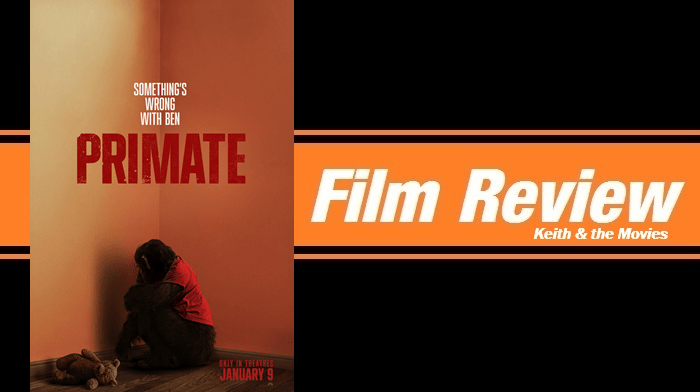
REVIEW: “Primate” (2026)

After spending nearly two months cramming everything from big studio prestige films to small moody indies for award season consideration, it’s nice to recline back and take in an unashamed genre blast like “Primate”. Make no mistake, this bonkers horror confection knows exactly what it is and it doesn’t pretend to be anything else. The best part – director Johannes Roberts mostly hits his mark, delivering exactly what fright fans will be expecting.

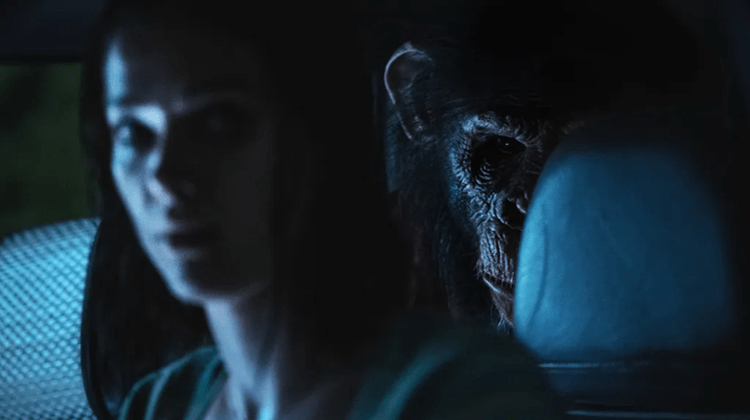
“Primate” is a bit like blending “Cujo” with a 1980s slasher flick. Its main antagonist may be a chimpanzee named Ben, but he might as well be Michael Myers or Jason Vorhees once the grisly monkey mayhem begins. But here’s the trick, Roberts and his co-writer Ernest Riera completely sell Ben a terrifying threat. But they manage to make him a sympathetic figure as well, which gives the film an added punch, especially in its final act.

After finishing her freshman year at college, Lucy (Johnny Sequoyah) invites her best friend Kate (Victoria Wyant) and Kate’s brother Nick (Benjamin Chang) to join her at the swanky cliffside Hawaiian home belonging to her father, a workaholic author named Adam (Oscar-winner Troy Kotsur). Kate throws a curveball when she invites the assertive Hannah (Jessica Alexander) to come along, causing an immediate friction, especially when Hannah starts flirting with Nick who Lucy has been crushing on for years.

Once home, Lucy faces the ire of her little sister Erin (Gia Hunter). We learn Lucy hasn’t been home in a long time, leaving Erin and their father to navigate the tragic passing of their mother by themselves. We’re also introduced to the other family member, Ben (convincingly played by Miguel Torres Umba in a chimp suit). Years earlier, Ben was brought home by their mother who was a linguistics professor. So in many ways he represents a connection to her which adds an extra layer to drama.

But sweet Ben’s demeanor changes after he’s bitten by a mongoose that creeps into his cage. Before leaving for a book signing, Adam calls a veterinarian and instructs the girl’s to leave Ben locked up until the doctor can check him out. But when the now feral Ben manages to escape, Lucy, Erin, and their friends become his prey. Utilizing Ben’s fear of water, the group seeks refuge in an enclosed pool, but not before Erin is bit. They’re left stranded in the water with no way to call for help, while the viciously aggressive Ben waits to tear them to shreds.

Amusingly, all of the budding rivalries and interpersonal tensions that are established in the opening fifteen minutes are instantly tossed aside and never revisited. Instead “Primate” turns into an unabashed horror romp that wastes no time going for the jugular. The mostly single location setting is both fitting and effective. And the characters manage to be more than disposable fodder. We actually want to see everyone survive, minus the two obnoxious frat guys (Charlie Mann and Tienne Simon) who show up at the worst time (we immediately root for their deaths).

Perhaps most impressive is the film’s reliance on practical effects, from Umba’s astonishing work as Ben to the film’s savage go-for-broke gore. As silly as the story may be, the practical effects turn Ben into a true terror. There’s no glaring digital gloss over him or the kills. As for those kills, they are as creative as they are brutal, with Roberts serving up the kind of carnage that should satisfy the appetites of horror fans looking to start their year with a blood-soaked bang.

VERDICT – 3.5 STARS

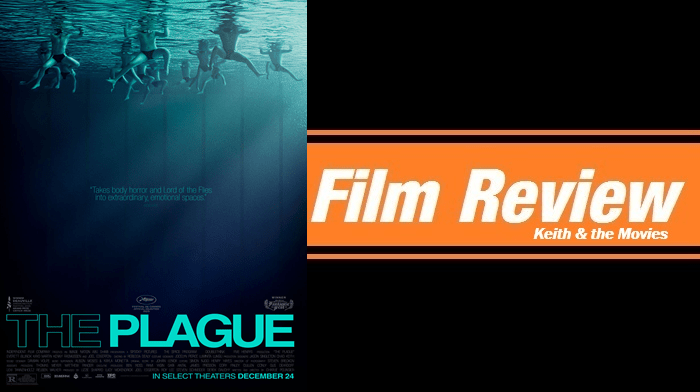
REVIEW: “The Plague” (2025)

There’s so much to admire about Charlie Polinger’s gripping directorial debut, “The Plague”. It may also be one of the toughest films you watch due to its uncomfortably honest treatment of its serious subject matter – preteen bullying. This psychological drama pulls no punches in its depiction of cruelty masked as horseplay. And it doesn’t shun from showing the consequences. It can be bleak, but urgent and enlightening as well.

Polinger writes and directs the film which takes place in the summer of 2003 at the Tom Lerner Water Polo Camp for Boys. Ben (Everett Blunck) is a sensitive twelve-year-old who recently moved to the area from Boston. Ben’s home life isn’t the best, which is why he doesn’t mind going away to summer camp. But not knowing anyone has its challenges, especially for the anxious and awkward Ben. He finds support with his coach (Joel Edgerton), but fitting in with the other boys proves difficult.

Image Courtesy of Independent Film Company

Among the many compelling elements to Polinger’s story is his recognition of social structures, even among preteens. Here it’s a tight-knit group of six boys, who by shallow external measures might be considered the “cool kids”. Ben desperately wants to join their ranks, even enduring mockery from the pack’s alpha, Jake (Kayo Martin) in order to be accepted into their circle.

But deep down, Ben is a good kid, which is why he’s alarmed when witnessing some of the group’s antics. They’re openly loud and rowdy. But Ben learns they’re also crude and vulgar. Much worse is their cruelty which is seen most in their targeting of Eli (Kenny Rasmussen), an eccentric and introverted outcast. Jake claims Eli is the carrier of a highly contagious “plague” which the group uses to mock and ostracize him. As for Ben, his desire to win the group’s approval ends up blinding him to his own complicity.

Yet Ben’s conscience weighs on him which keeps him from being as cold and callous as the others. But his internal conflict seeps through to the surface after he dares to show compassion to Eli, even befriending him when no one else is looking. It immediately puts him in Jake’s crosshairs. Suddenly the group Ben desperately wanted to join has made him their prime target. It all makes for a heartbreaking chain of events that moves towards a finish that is as inevitable as it is troubling.

Polinger’s stylish and confident direction is helped by some truly standout performances from the mostly young cast. Blunck and Martin are especially strong, with each being fully convincing in dramatically different roles. Blunck conveys as much through observations as interactions, expressing Ben’s insecurities and anxiety despite his character working hard to conceal them. It can be a quietly devastating performance, but not without nuance. Martin is surprisingly sinister, hiding his ruthlessness behind a seemingly harmless smirk and curly mop of blonde hair. He’s both infuriating and terrifying.

Image Courtesy of Independent Film Company

As the film plays its hand, any obviousness is discarded in the final act. What begins as a unique spin on the coming-of-age formula turns darker, using dashes of shock and body horror to make us squirm. But Polinger never loses his grip on the material. And the final shot offers a ray of hope, depending on your interpretation. DP Steven Breckon shines, especially with his otherworldly underwater photography, while Johan Lenox’s score offers an unnerving mix of experimental and orchestral.

“The Plague” can feel a bit too broad at times, both with its handling of certain characters and anything resembling their motivations. It will also leave you with a handful of questions, none bigger than wondering where is the adult supervision? It can also be tough distinguishing between the real and metaphorical. But Polinger shows himself to have a remarkable vision, using the various arms of cinema to open our senses to a profoundly serious topic. Overall, “The Plague” is a remarkable and significant big screen debut.

VERDICT – 4 STARS

REVIEW: “Predator: Badlands” (2025)

For us film critics, November and December are the busiest months on the calendar. It’s when studios and distributors send us their biggest movies of the year for awards consideration. So we go on a two-month cram session, watching every big or small awards contender before our voting deadlines. These are often more serious-minded movies. And after 15 or 20 in a row, you’re often looking for an escape. Enter “Predator: Badlands”.

Dan Trachtenberg continues to re-energize the Predator series with his third entry into the franchise. After two direct-to-Hulu hits (2022’s “Prey” and the animated “Predator: Killer of Killers” from earlier this year), Trachtenberg brings Predator back to the big screen with “Badlands”, and he doesn’t disappoint. His latest takes us to a new setting yet features the same feral action the movies are known for despite its surprising PG-13 rating.

Image Courtesy of 20th Century Studios

The setting isn’t the only thing fresh about “Badlands”. Thematically, Trachtenberg takes his film in a slightly new direction, tapping into such themes as family strife, forging your own path, and finding the will to trust others. But fear not, “Badlands” serves up a steady diet of gritty action that fans will expect. And Trachtenberg leaves the door wide open for more of the traditionally ruthless Predator stories. Simply put, the franchise is in great hands.

On the distant planet Yautja Prime, a young Predator named Dek (Dimitrius Schuster-Koloamatangi) is considered the runt of his Yautja Clan. His older brother Kwei (Mike Homik) tirelessly trains him, but Dek is never able to earn his chieftain father’s approval. Kwei tells Dek he can earn his place in the clan by traveling to the deadly planet Genna and hunting an unkillable beast known as the Kalisk. Dek eagerly accepts. But before he can depart, his father arrives and orders Kwei to kill his weaker brother. Kwei defies his father and is executed on the spot. But before he is, Kwei manages to seal Dek in their ship and launch him to Genna.

Genna is a planet of beauty and peril. It has lush forests and vast mountain ranges which Trachtenberg exquisitely captures. It’s also a planet where both flora and fauna can be a threat. The rage-fueled Dek immediately finds himself fighting for his life. But he gets help from the most unexpected source – Thia (Elle Fanning), a Weyland-Yutani synthetic who had her bottom half torn off during an encounter with the Kalisk. The comically cheerful Thia convinces the comically gruff Dek that she can be a useful “tool”. So he (literally) carries her with him on his hunt.

But creatures and plant life aren’t the only dangers on Genna. Thia’s synthetic sister, Tessa (also played by Fanning) leads an army of androids from Weyland-Yutani’s bioweapons division to capture the Kalisk for the company’s own nefarious purposes. This puts them at direct odds with Dek and Thia, setting up the film’s second-half conflict which is loaded with sci-fi action of all sorts. We get a little bit of everything from primal combat to giant creatures versus mechs. And of course there are the Predator favorites – shoulder-mounted cannons, triangulated laser sights, retractable blades, etc.

Image Courtesy of 20th Century Studios

“Badlands” takes the series in a unique direction by having a Yautja become a protagonist rather than the antagonist. It also injects a healthy dose of humor, much of which is implemented well. Most of it comes through Dek and Thia’s oddball partnership (you can’t help but laugh as he carries her around on his back as Luke Skywalker did Yoda on Dagobah). Less effective is an indigenous CGI creature dubbed Bud who is a bit too cutesy and who visually stands out against the otherwise extraordinary digital effects.

But again, the franchise faithful shouldn’t worry and no one should give air to the knee-jerk negativity on social media. “Badlands” offers a new kind of story within the Predator universe that adds more depth and dimension to its eponymous hunter than we’ve ever seen. Yet it doesn’t forsake the sheer ferocity and (in some cases) brutality that has been a signature of the series. “Badlands” doesn’t come close to reaching the heights of the 1987 original. But to Trachtenberg’s credit, he doesn’t try to. He simply shows there are a variety of stories to tell within this growing franchise. And I’m thrilled that he has the keys to it.

VERDICT – 4 STARS

REVIEW: “Prisoner of War” (2025)

Back in the 1980s there was a wave of Vietnam War era action movies that focused on the P.O.W. experience. They included such poppy franchise flicks as “Missing in Action” and “Rambo: First Blood Part II”, smaller star-driven films like “Uncommon Valor”, and more obscure Cannon Group titles like “P.O.W. the Escape”. I admit to endlessly absorbing these movies as a kid, repeatedly renting them on VHS from our favorite video store.

The vanilla titled “Prisoner of War” hearkens back to those movies of old, proudly possessing many of their strengths and weaknesses. The film does distinguish itself in one key way – rather than Vietnam, its story is set in Japan during the waning days of World War II. It’s directed by Australian actor turned director Louis Mandylor and written for the screen by Marc Clebanoff. It stars English actor and martial artist Scott Adkins who also originated the story.

Image Courtesy of Well Go USA Entertainment

Adkins plays James Wright, a Wing Commander in the Royal British Air Force. In April of 1942, his plane is shot down while carrying out a mission over the Bataan Peninsula in the Philippines. Wright survives but is quickly captured and taken to a Japanese prison camp ran by Lieutenant Colonel Ito (Peter Shinkoda). After evading an attempted execution, Wright gains the attention of Ito who pits him in a series of fights against the Colonel’s best warriors. For Wright, they are fights for survival. For Ito, it’s the opportunity to publicly strip his prisoner of his honor.

When not fighting, Wright is on work detail where he gets to know the other POWs. They’re a mostly generic group of captives with only a handful of them sketched enough to stand out. They’re led by an American, Captain Collins (Cowboy Cerrone) who’s light of personality but heavy on brawn. Other prisoners such as Sergeant Villanueva (Michael Copon) and Beard (Michael Rene Walton) get a little to do. But most are faceless fodder to be killed at certain intervals to show Ito means business.

The same can be said for the Japanese soldiers. Aside from Ito, there is the short-tempered Captain Endo (Masanori Mimoto) who bullies his way to an evitable showdown at the end. And there’s the woefully underdeveloped Hiroshi (Atsuki Kashio) who is sympathetic to the prisoners and their plight. The rest of the soldiers are little more than faceless targets for Wright and company to take out. The movie attempts to add more humanity via a kindly nurse named Theresa (Gabbi Garcia). But she too is trapped in a fairly shallow supporting role.

Image Courtesy of Well Go USA Entertainment

Overall the story follows a fairly conventional blueprint, finishing off with a predictable big escape that goes exactly as we expect. Along the way there are a few references to the greater war and more specifically the Bataan Death March. But it’s never enough to add much weight. And it’s all bookended by two post-war scenes of Wright seeking some closure. But most of the storytelling revolves around the dynamics at play within the camp.

While “Prisoner of War” may struggle in the narrative department, it excels with the action, especially the well-choreographed and deftly shot fight sequences. Adkins is a formidable martial artist and a convincing presence in front of Mandylor’s camera. The director locks onto the action rather than chopping it to death with quick cuts. Meanwhile the hard-working Adkins does most of the heavy lifting, impressively kicking and punching life into this serviceable throwback action movie.

VERDICT – 2.5 STARS

REVIEW: “Primitive War” (2025)

Since Steven Spielberg’s original “Jurassic Park” first blew up the global box office, there has been no shortage of feature length knockoffs. They’ve come in all varieties, bearing such hilariously corny titles as “Jurassic Galaxy”, “Jurassic Shark”, “Jurassic Thunder”, and so on. As Oscar Wilde so eloquently put it, “Imitation is the sincerest form of flattery that mediocrity can pay to greatness“. For the most part that certainly fits when it comes to Spielberg’s 1993 blockbuster classic.

In some ways “Primitive War” may fall into the knockoff category. It has the CGI dinosaurs and its story revolves around humanity’s clash with these beasts from the past. Even some of its shots directly call back to the Jurassic Park movies. Yet dismissing “Primitive War” as nothing more than a knockoff would be a disservice considering how the film takes so many wild swings all its own. To be clear, this is no clone of “Jurassic Park”, not in style, tone, narrative, or ambition.

“Primitive War” is an Australian production helmed by Luke Sparke. A man of many hats, Sparke serves as the film’s director, writer, producer, editor, visual effects supervisor, and production designer. On paper there’s no way “Primitive War” should work. But Sparke’s craftsmanship does wonders in many of the areas mentioned above. His direction is solid, his editing is crisp, his production design is superb, and his budget special effects impress more than they let down (more on them in a second).

Image Courtesy of Fathom Entertainment

Arguably the film’s biggest strength involves its time and place. Sparke gets a ton of mileage out of his Vietnam War setting. Set in 1968, the story (based on a 2017 novel of the same name by Ethan Pettus) follows Vulture Squad, a well-oiled elite unit of highly trained Army outcasts who conduct dangerous missions deep behind enemy lines. Sparke smartly lets us spend some time with the seven men early on, both in the field and in the barracks. It’s a choice that adds some needed weight to what’s to come.

After a Green Beret unit goes missing in occupied territory, Vulture Squad is called on by their commander, Colonel Jericho (played by Jeremy Piven brandishing an unfortunate Southern accent). He tasks them with discovering the whereabouts of the missing soldiers and reporting back. But Jericho gives them practically no intel, content with saying everything is “classified”. So Vulture team leader Sergeant Baker (Ryan Kwanten) and his ragtag unit are sent deep into the jungle under the cover the night. And what they discover isn’t the Viet Cong. It is in fact (as you’ve probably guessed) dinosaurs.

Sparke wastes no time putting Vulture Squad in danger. They immediately discover a massive animal track, a giant feather, a heaping pile of dung, and a journal with the slightly ambiguous words “we are being hunted” scribbled inside. Those words become a reality after the soldiers are attack by a ravenous pack of Deinonychus. During the chaos, Baker and a rookie named Leon (Carlos Sanson) are separated from their squadmates. They have a harrowing encounter with a Tyrannosaurus Rex before being saved by a stranded Russian scientist named Sofia (Tricia Helfer) who takes them to her heavily fortified research station.

Image Courtesy of Fathom Entertainment

From there the movie takes one of its several genre turns, introducing a stone-cold crazy science-fiction twist. I won’t spoil it, but you have to respect the audacity while you’re audibly laughing out loud. It’s utterly preposterous, yet the movie’s earnest treatment of it makes it work within the confines of the story. And the entire cast is fully onboard, embracing the nuttiness through characters who have just enough individual personality for us to care. That sounds like a small thing, but it makes a difference in a movie like this.

As mentioned, Sparke squeezes a lot out of the story’s Vietnam War setting. He puts plenty of effort into recreating it, as seen in his choices of shooting locations, the carefully detailed sets, the authentic uniforms, gear, vehicles, and weaponry. As for the visual effects, Sparke doesn’t let his modest budget stymie his vision and what he is able to do with $8 million is pretty remarkable. Without question, some of the CGI isn’t up to snuff. But for the most part, the dinosaurs look great with Sparke and DP Wade Muller often using their camera in a number of clever ways to enhance what we see. It’s pretty impressive.

As for the script, it not only presents a gonzo premise – it fully embraces it. It does so by weaving together a war movie, a gory creature feature, and sci-fi action, putting its own spin on each in the process. At the same time, it tries a little too hard to be grounded and gritty – an issue that shows itself most in the dialogue. Sure, you can pick apart certain things (such as the squad’s seemingly endless supply of ammunition). But those issues are trivial in a movie that succeeds in being exactly what it wants to be – two fun-filled hours of pure genre entertainment.

VERDICT – 3.5 STARS