
While Carey Mulligan has received her share of accolades and most consider her a good actress, in some sense she remains underappreciated and is rarely considered among the best of her craft. She’s certainly proven herself and her last four lead performances alone should be enough to quell any hesitation. Of the many things likely to come from her new film “Promising Young Woman”, hopefully one will be a deeper and fuller appreciation for just how good the 35-year-old London-born star really is.
“Promising Young Woman” is the feature film debut for director and screenwriter Emerald Fennell. The actress and author (currently appearing as Camilla in the hit Netflix series “The Crown”) has crafted a blistering #MeToo era revenge fantasy that defies all labels and expectations. It’s a wily and rightfully angry thriller soaked in style and with a disarming candy-colored coating. At the same time it’s darkly funny and its humor often hits at the most unexpected times. And all of it is anchored by Mulligan’s fierce and uncompromising lead performance.
Storywise Cassandra Thomas (Mulligan) had everything going for her. She was a college medical student with top-of-her-class smarts and a promising future ahead. But then something happened on campus, a sexual assault involving her childhood friend and med school classmate Nina. It led to both Cassie and Nina dropping out while the perpetrators went unprosecuted, graduating magna cum laude and set for a life of upper-class bliss.
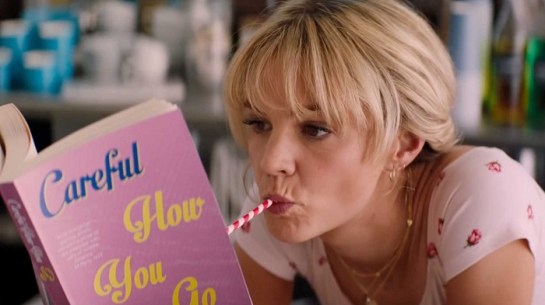
Image Courtesy of Focus Features
That was seven years ago. Now the 30-year-old Cassie works at a dead-end coffee shop, still living with her parents (wonderfully played by Jennifer Coolidge and Clancy Brown) and with no ambition or real relationships to speak of. The details of Nina’s fate trickle out over time but they have clearly left Cassie in a dark hole. They also fuel what you might consider her unconventional night job.
Roughly once a week Cassie enters a nightclub dressed to the nines and pretending to be so drunk she can’t stand on her own. Wielding her beauty like a weapon, Cassie lures in self-proclaimed “nice guys” who feign compassion and offer to help her home. To no surprise they magically end up taking her to their apartment. Once their poorly veiled predation reaches a certain point, Cassie snaps out of her faux drunkenness like a bear jolted from its hibernation, forcing the offenders to reckon with their deeds.
Enter comedian Bo Burnham playing Ryan, an old college classmate who has always had a thing for Cassie. He’s a self-depreciating and playfully charming guy; the kind that might actually break through Cassie’s hardened defenses. It helps that there is a tangible chemistry between Burnham and Mulligan. They’re also really funny together. It’s quite the opposite with Cassie’s secret darker side which sees her moving away from catching random slugs in a bar to targeting all those who wronged her friend in school. Fennell digs equally into both sides of the character, leaving us wondering which will ultimately win out.
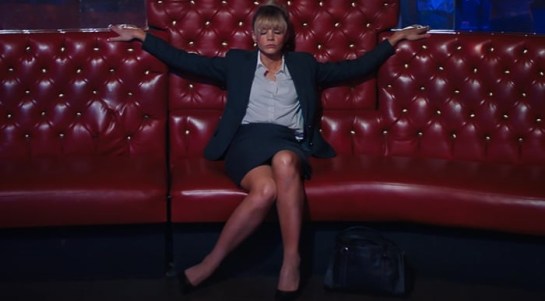
Image Courtesy of Focus Features
But none of it works without Mulligan who is convincing at every turn. Whether it’s a moment of vulnerability revealing glimpses of potential happiness or when she’s the unhinged antihero uncoiling in front of her prey with sociopathic glee. Mulligan never overacts or underplays which isn’t easy with this kind of material. And it helps to be surrounded by such a well-tuned supporting cast. In addition to the terrific Burnham is a number of familiar faces: Adam Brody, Alison Brie, Alfred Molina, Christopher Mintz-Plasse, and Connie Britton to name a few.
“Promising Young Woman” is a movie full of misdirections and ruses. One of my favorites is the film’s undeniable girly aesthetic set atop of its grittier subject matter. Deliciously snide confections like an intentionally corny pharmacy scene playing out to Paris Hilton’s “Stars Are Blind”. It’s a scene that could be yanked from any number of cookie-cutter rom-coms. And how can you not appreciate a film that gleefully kicks in the groin any notion of expectation? One of the real treats from Fennell’s film (much like its main character) is the utter unpredictability. And there are so many fun comedic touches. Such as Cassie’s parents spending an evening watching Robert Mitchum’s “Night of the Hunter”.
Without question Fennell takes her subject seriously but she’s also having a wickedly good time. Occasionally the tones clash a bit, but I do enjoy watching a filmmaker buck conventions and stick with original ideas. And Fennell has plenty of ideas, from the way she shoots the movie to the way her story is told. You also have to admire a movie that can land this many well-placed shots at such a slimy and abusive subculture. “Promising Young Woman” opens December 25th.
VERDICT – 4 STARS