
2016 Blind Spot Series: “Paths of Glory”

PATHS POSTER

It was 1957’s “Paths of Glory” that first placed Stanley Kubrick among cinema’s prominent directors. It was his first true commercial success and critics praised it for its bold and unflinching anti-war message. But not everyone loved it. In a very crafty way the film would be banned in France until 1975 due to its depiction of the French military and government. In some ways you could say that is a testament to the power of its message.

The film is based on a 1935 novel by Humphrey Cobbs. MGM heads were impressed with Kubrick’s previous film “The Killing”so they hired him to write and direct a film which would later become “Paths of Glory”. But the project was almost derailed by MGM’s reluctance to finance another war picture. That changed when new heads were brought in and Kubrick was able to entice Kurt Douglas to star in the film. He and his production buddy James B. Harris were then given the green light.

PATHS1

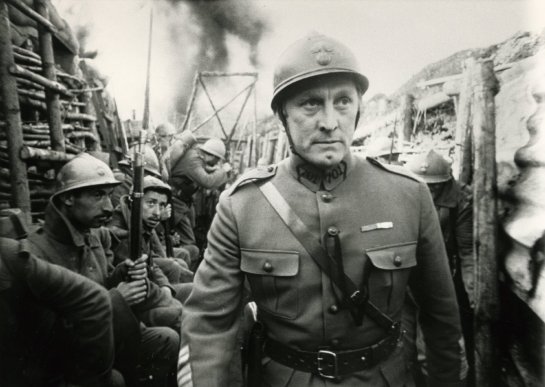
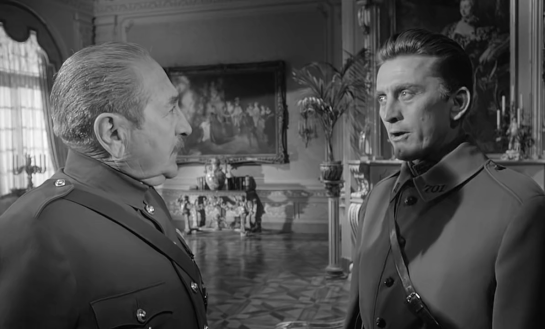
The story is tight and straightforward. It’s about a French military unit led by Colonel Dax (Kirk Douglas) who are given an impossible mission. General Mireau (George Macready) is offered a nice promotion by his superior General Broulard (Adolphe Menjou) in exchange for taking a German fortification known as the Anthill. That would require Mireau’s men led by Colonel Dax to sustain substantial casualties.

There is a great early scene where Mireau weighs the loss of so many soldiers against the glory of a new promotion. In a cold and callous conversation he and Broulard estimate as many as 55 percent of Dax’s men would lose their lives. For Mireau it’s a worthy risk especially when the personal gain is so significant. He agrees to the mission knowing the costs but also aware of the probability of failure.

PATHS2

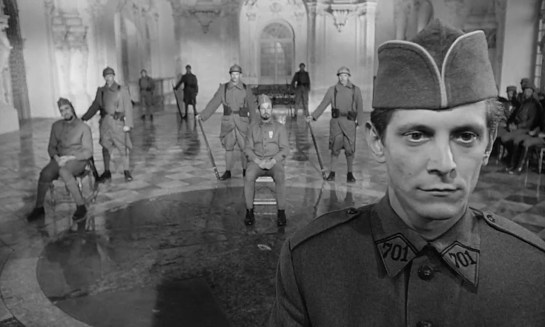
I won’t give too much away, but suffice it to say the mission goes poorly and a livid General Mireau takes action to protect his reputation and his promotion. Colonel Dax who has fought for his men on the battlefield now finds himself fighting for them in a kangaroo court of French military officers hungry to make examples. In many ways this battle is more appalling and vicious than the one on the battlefields. In one scene a general causally reasons “One way to maintain discipline is to shoot a man now and then.”

There are several different ways this movie could have went but Kubrick deserve credit for not caving in to a more conventional approach. I think I have been wired by many contemporary filmmakers to expect the routine and the predictable. Here Kubrick stays true to the film’s intent by not wimping out and abandoning the story’s sharp and pointed commentary. To have done differently would have dulled the edge and made this a much lesser picture.

PATH3

The film also excels thanks to Kubrick’s visual choices particularly his decision to shoot in black and white. It is perfect considering the harshness of the material and the morally murky waters we navigate through. There are also a number of scenes that stand out due to Kubrick’s cameras. The well known battle sequence was shot with six cameras placed around a huge war-torn battlefield. It offers up one of the most intensely arresting war scenes you’ll see.

The ending is a bit of a strange shift that may at first catch you off guard. It features a young German woman singing a song to Dax’s men in a small club (the woman is Christiane Harlan who later married Kubrick). Within this scene is a subtle shift in mood that works perfectly as a conclusion to this story. It’s a satisfying fit with Kubrick’s fluid and economic storytelling and it ends this powerful film with a poignant prick of the heart.

VERDICT – 4 STARS

4 Stars

REVIEW: “Le Passé” (“The Past”)

PAST poster

Asghar Farhadi is without question one of my favorite working filmmakers. Watching a Farhadi film is unique. He doesn’t make movies intended as escapes. He offers intense examinations filled with truth and reality. Farhadi possesses a sensibility towards the human experience that you rarely sense from other filmmakers. He features a bold and unbridled approach to storytelling that focuses on complex relationships and deep personal narratives.

While his brilliant 2009 picture “About Elly” opened in the United States last year, technically Farhadi hasn’t made a film since 2013’s “The Past”. Like his previous work, “The Past” is a dialogue-rich, plot-driven film focused on the secrets and inner turmoil of its connected characters. The film marked Farhadi’s first cinematic venture outside of Iran. The French language film was shot in Paris but it intentionally strips away any glamorous or romantic view of the city. It is said Farhadi directed through an interpreter since he didn’t speak French. It’s also said that he lived in Paris for two years prior to filming in order to get a better gauge of the French life and the flow of the language.

PAST1

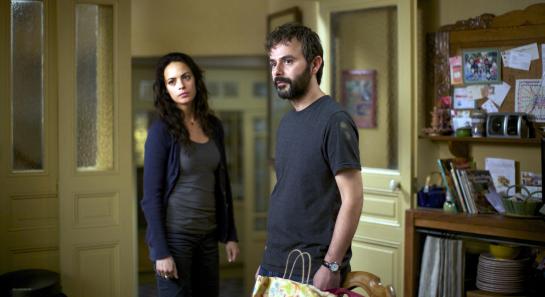
The story begins with an Iranian man Ahmad (Ali Mosaffa) arriving in Paris after a four-year absence to finalize the divorce with his wife Marie (Bérénice Bejo). Marie has two daughters from a prior marriage including the embittered Lucie (Pauline Burlet). Marie and Lucie have a strained relationship mainly due to Marie’s live-in boyfriend Samir (Tahar Rahim). Samir struggles to balance running a cleaning business with raising his discouraged pre-teen son (played with stinging authenticity by young Elyes Aguis). Even more, Samir’s legal wife has been in a coma for eight months following a failed suicide attempt.

Each of these interconnected characters are effected in different ways by ‘the past’. Each are damaged either by their own poor choices or, in the case of the young children, the choices of others. Each are also carrying their own burdensome secrets which Farhadi reveals in small and strategic doses. This great approach allows for the characters to slowing unfold for us over time. And in doing so, the script (written by Farhadi) causes our sympathies to change as we get more information.

Farhadi’s labyrinthine story gives us a lot to navigate and process. It is rich with heavy dialogue and plot that is constantly building upon itself. It takes no ‘feel good’ shortcuts. The piercing reality of its topics and themes leaves an ever-growing cloud of depression and sadness over the characters. But every ounce of it feels earned and natural. Farhadi has a knack for drawing us in and wrapping us up in his characters, their situations, and their moral complexities.

PAST2

“The Past” features several other Farhadi signatures. His use of reaction and expression sometimes tell as much as his dialogue. Also there may be no director as adept and effective at shooting in tight, confined spaces. Farhadi forces his characters together and places us among them. He forces them to deal with each other on a close personal and emotional level. It offers up a unique intimacy but also a boiling intensity. So many scenes in the film employ this technique but not without a point or reason.

As with his other films, Farhadi allows “The Past” to show a social conscience that speaks to greater ills in modern society. At the same time this is a very ground-level story between several damaged yet culpable characters and the young innocent casualties caught in the crossfire. In the beginning everyone is a mystery. Over time we learn alarming secrets. We witness emotionally toxic exchanges. We see one bad decision after another. All of it is linked to the brutal consequences of the past. This is the where the film takes us, and it pulls no punches and gives us no passes. I appreciate that.

VERDICT – 4.5 STARS

4.5 STARS

REVIEW: “Phoenix”


PHOENIX poster

It seems that any movie that deals with the Holocaust, either directly or indirectly, automatically assumes a special level of scrutiny. Undoubtedly the solemnity of the subject matter comes into play. There is also a caution towards anything that may be deemed exploitative or irreverent. I respect that although I do think the defensive stance can sometimes be a bit too harsh in judging a creative vision. That being said, I like that filmmakers are still exploring the Holocaust in unique ways.

Christian Petzold does just that. He directs and co-writes “Phoenix”, a simmering drama set in post-World War 2 Germany. Petzold favorite Nina Hoss plays a Holocaust survivor named Nelly who sustains a gunshot wound to her face while at Auschwitz. Once the concentration camp is liberated Nelly is cared for by her friend Lene (played with a calculated quietness by Nina Kunzendorf). Lene arranges for Nelly to have reconstructive surgery in hopes that she will look exactly as she did before. Unfortunately the trauma is too extensive and the surgeon can’t quite recreate her past appearance.

Phoenix1

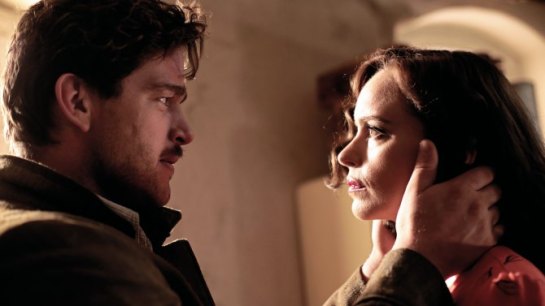
The two return to Berlin where Lene finds them an apartment. Lene tells Nelly that she is due a substantial inheritance and recommends using it to go to Palestine where as Jews they can feel safe. But all Nelly can think about is her husband Johnny (cryptically played by Ronald Zehrfeld). Against Lene’s wishes, Nelly seeks out Johnny who is working at a night club called Phoenix. What follows is a twisty, melancholic story that plays with the ideas of identity, betrayal, loss, and discovery.

One of my favorite things about “Phoenix” is the ever-present cloud of uncertainty and mystery. I wouldn’t call this a thriller, yet it has this potent, understated suspense that exudes an almost Hitchcockian vibe. We even get this from the characters particularly Johnny. The film lures us in to make judgements about him only to later cast doubt on our perceptions.

PHOENIX2

And then there are the performances, a collection of some of the year’s best. Hoss’ tempered, haunting portrait conveys a woman who is a shell of her former self but who desperately grasps to reclaim her former life. Hoss visualizes her mental trauma without an ounce of flashiness or mendacity. Kunzendorf is equally good in her handling of a character hurt and hardened by the atrocities and frustrated by the quick willingness to forgive. And then there is Zehrfeld who flawlessly works with the material to give us a character so fully hard to read.

These three performances keep the story moving at a hypnotizing slow boil right up to what is the most subtly devastating final scene of the year. The story sometimes pushes the bounds of implausibility yet it is never a problem within the film’s parable-like framework. “Phoenix” deals with the aftereffects of the Holocaust without digging too deeply into the particulars. Instead it stays focused on Nelly, a character every single one of us will have no trouble sympathizing with.

VERDICT – 4.5 STARS

4.5 STARS

2015 Blind Spot Series: “The Pride of the Yankees”

YANKS poster

The are some actors who are forever connected to their movie characters and you can’t fathom anyone else in the role. Harrison Ford as Indiana Jones. Marlon Brando as Vito Corleone. Jon Heder as Napoleon Dynamite? For me Gary Cooper as Lou Gehrig in “The Pride of the Yankees” is another prime example. Cooper has that all-American quality that seemed to be present in Lou Gehrig. It also didn’t hurt that Cooper was a fantastic actor with the exact personality the role required.

“The Pride of the Yankees” is unique within its genre. It’s not your prototypical biopic. It’s more of a memorial to the beloved and respected star player from the New York Yankees. The film was released in 1942, only one year after Lou Gehrig died of amyotrophic lateral sclerosis (what is now commonly known as Lou Gehrig’s disease). He was only 37 years old. Naturally his death was fresh on the minds of audiences and there were reservations about the film. Producer Samuel Goldwyn had the now famous opinion that baseball movies were “box office poison”, but he was convinced to go along with it and the end results were respectful and satisfying.

YANKS1

The film doesn’t spend much time following the baseball aspect of his life. Instead the intent is to show his relationships with his wife, his parents, and his teammates. It puts the spotlight on his rectitude and character, on his rise from an unassuming and earnest New York City boy to an unassuming and earnest Major League Baseball player. Screenwriters Jo Swerling and Herman Mankiewicz and director Sam Wood clearly understand Gehrig’s popularity and beloved status. Instead of trying to exploit or manipulate that, their movie aims to build upon the public’s respect by opening up Gehrig’s life which in turn validates his veneration.

The film spends a little time with Lou Gehrig as a young boy before moving to his days at Columbia University. Gehrig (Cooper) has already shown the knack he has for playing baseball, but it conflicts with the plans of his muleheaded but well-intended mother (Elsa Janssen) who wants him to be an engineer. Lou pursues baseball behind her back with the help of his more objective father (Ludwig Stossel) and soon finds himself in the New York Yankees minor-league system. It doesn’t take long for the shy and nervous Lou Gehrig to make it to the big leagues.

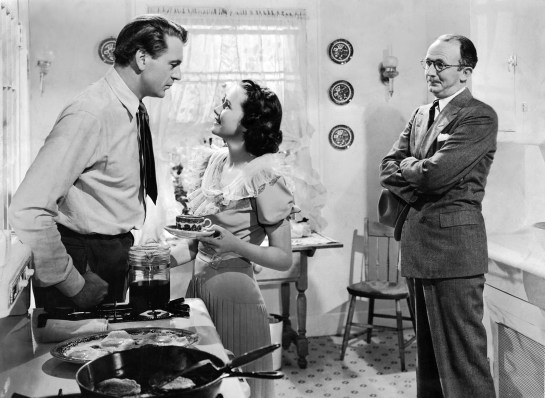
Lou is like a child among his heroes. Actual Yankee players Babe Ruth, Bill Dickey, Bob Meusel, and Mark Koenig play themselves which had to be a ton of fun. At first Lou is treated with the normal rookie disregard, but before long his talents on the diamond earns him the respect of his teammates. He quickly becomes one of their best players and a fan favorite. It’s at a game in Chicago where he meets a woman named Eleanor (Teresa Wright). Their playful relationship soon blossoms into a full blown romance and soon they are married. It’s easy to believe and invest in them which makes it tougher once the news of Lou’s illness comes and it makes the ending absolutely perfect.

YANKS2

The movie spends a lot of its time developing the relationship between Lou and Eleanor. From the awkward but charming dates to their lives as a loving and devoted married couple. At first the two couldn’t be more opposite, but over time the film reveals the confident and spirited Eleanor and the shy and reserved Lou to be “companions for life”. Cooper is such a perfect fit sporting a tall athletic build with that signature common man personality. Surprisingly he knew nothing about baseball and had to learn the game for the role. He even learned how to bat left-handed – not an easy task. And the more I watch Teresa Wright the more I think she is one of the true greats. She received an Oscar nomination for this performance. She was also nominated that very same year for “Mrs. Miniver” and won. Several other supporting performances really work including the previously mentioned Babe Ruth as himself and Walter Brennan as a sportswriter and close friend to Gehrig.

It would be easy for a cynical moviegoer of today to dismiss the emotional pull of “The Pride of the Yankees” especially after being nurtured by modern biopic formulas. It would be easy to dismiss it as overwrought melodrama or cheesy sentimentality. But this is a movie that should be looked at through a unique lens. Its sensibility and relevance to the audiences of 1942 cannot be understated and that is an impact the filmmakers were specifically targeting. While I certainly wasn’t around during the time it was released, I’m still easily able to make that connection. That’s just one reason “The Pride of the Yankees” works so incredibly well.

VERDICT – 4.5 GAMES

4.5 STARS

2015 Blind Spot Series – “Paris, Texas”

PARISposter

From the film’s first scene we know that “Paris, Texas” is something unique. A sprawling overhead camera combs a sparse desert landscape to the ominous twanging of an acoustic guitar. The camera settles on a thin, disheveled man with a straggly beard, dusty suit, tattered shoes, and a red ball cap. He drinks the last of his water from an old milk jug and then heads on his way.

Immediately we find ourselves asking a number of questions. Who is this man? Is he looking for something? Where has he been? Where is he going? He seems lost, like a wanderer. But at the same time he’s heading in a specific direction, his eyes fixated on the horizon. These early scenes highlighting the South Texas desert are filmed with an almost postapocalyptic perspective. The rugged and bleak terrain that Travis roams offers no sense of hope or life. This landscape is captivating and we are instantly drawn into the mystery of this man.

PARIS1

“Paris, Texas” was directed by German filmmaker Wim Wenders and written by “Kit” Carson and Sam Shepard. The film was a big winner at the 1984 Cannes Film Festival and over the years it has been heralded as a true film classic. The movie has often been singled out for its striking score from acclaimed guitarist Ry Cooder and its mesmerizing cinematography from long time Wenders collaborator Robby Müller.

After its brilliant setup, the story doesn’t leave us in the desert long. In a surprisingly brisk fashion the film begins feeding us morsels of information about this man whose name is Travis. He’s played by the great Harry Dean Stanton, an actor who has always been able to speak volumes through his expressive face. It turns out Travis disappeared four years ago and no one has seen him since. We learn that he had a wife and son but something happened and he lost them. In fact, in some ways this gets to the key focus of the film – loss, fear, insecurity, sacrifice.

PARIS2

The slow and methodical unveiling of information begins in the desert and then picks up when Travis is found by his brother Walt (Dean Stockwell). Walt, his wife Anne (Aurore Clément), and their son Hunter (Hunter Carson) each play a part in putting together this complex human puzzle that is Travis’ life. They are keys, each unlocking new portions of his backstory while also moving the narrative forward. Nastassja Kinski appears later to offer an even different layer to the Travis character.

The movie is basically broken down into three chapters. The first chapter follows the desert wanderer. The second chapter spotlights the time Travis spends with Walt and his family. The third chapter turns into an unexpected road trip. I won’t spoil a thing, but the film makes an interesting shift and the story sets its focus in a new direction while still maintaining its very grounded and cliche-free structure. The third act is the most fascinating and compelling even though it has a fairly glaring narrative hiccup and a couple of lapses in logic.


PARIS3

“Paris, Texas” has so many unique features that differentiated it from the majority of movies being made at that time. And the film’s captivating uniqueness still makes an impression today which is a testament to its quality. The cinematography is sublime, never using camera trickery or gimmicks. It visualizes truth and authenticity. The story is simple but emotionally rich and pure, again focusing on truth. It stumbles in a few places but never loses itself. Most of the performances hit every right note especially Stanton, Kinski, and young Carson. All of this is brought together under the management of Wenders who tells a living, breathing story free of contrivances and artifice.

The film never sets foot in Paris, Texas. It’s a mirage that sits in the back of Travis’ mind. It serves as a connection to his past. It serves as a small hope for a potential future. For a time it gives Travis a sense of direction, a purpose to follow. But over the course of the film we see Paris, Texas replaced. He finds a new purpose at least for a time. But Paris, Texas still lingers for Travis, and by the film’s end we fully understand its importance.

VERDICT – 4 STARS

4 Stars

REVIEW: “Pompeii”

POMPEII PoSTER

I’ve always thought that the story of Pompeii was prime material for a big budget motion picture. Without getting too deep into the history, Pompeii was a Roman city nestled at the base of Mount Vesuvius. In 79 AD Pompeii and its inhabitants were decimated when Vesuvius suddenly erupted sending tons of ash and volcanic rock showering down. At the time somewhere between 12,000 and 20,000 people lived in Pompeii. Obviously it’s a sad and tragic story and I’m surprised that modern Hollywood hasn’t tackled it before.

Enter Paul W.S. Anderson and his succinctly titled “Pompeii”. Not exactly my first choice to direct such a potentially intriguing project, and once you start watching this film you quickly realize that this isn’t the smart and engaging historical epic it could have been. Instead it’s a silly and cliched exercise featuring numerous borrowed plot points and loads of cheese. It’s the kind of film you’re used to getting from Anderson – not totally unwatchable but far from being as good as it could have been.

POMEII1

“Pompeii” plays like a poor man’s “Gladiator”. The problem is here we have no Ridley Scott, no Russell Crowe, no engaging and emotional story, no epic feel, none of the things that made “Gladiator” such a good film. But its clear aim is to be an action film first and foremost. The story starts with a flashback that shows us a young boy witnessing the brutal deaths of his parents on the battlefield at the hands of the Romans, particularly their evil field leader Corvus (Keifer Sutherland). Jump ahead 17 years later. The boy, whose name is Milo, is now a man and has been raised as a Roman slave and gladiator. Milo (played with the emotion of a brick by Kit Harington) and his unmatched fighting skills are noticed by his slave owner who then takes him to Pompeii to fight in their gladiator arena.

On the way there Milo catches the eye of the Pompeii governor’s daughter Cassia (Emily Browning). Can’t you see where this is going? Forbidden love springs up between a beautiful woman with status and a lowly slave with six pack abs and nice hair. We’ve seen this many times before. But what makes this worse is that the love story is so rushed and underdeveloped. The characters are already flimsy and then to have practically no attention given to building up their relationship. Everything about their love for each other feels phony and false.

In addition to being a “Gladiator” wannabe and a lightweight romance, it also becomes a revenge flick once Corvus shows up in Pompeii. Milo certainly hasn’t forgotten the man who slaughtered his family and added fuel comes in the form of Corvus’s affection for Cassia. And once Mount Vesuvius erupts it becomes a CGI heavy disaster movie. Oddly enough Vesuvius takes a back seat to all of the other stuff going on. Occasionally director Anderson throws in a brief scene to remind us of the ominous mountain, but for the most part its threat is terribly underplayed. And even when the eruption does happen the film wanders all over the place and the disaster element feels wasted.

POMPEII 2

Even more disappointing are the special effects. You would think that this film would at least provide some spectacular visuals. Well, there are moments that look really good, but there are just as many that are underwhelming. Quite frankly sometimes the effects look cheap and they resemble a television show instead of a motion picture with an $80 million budget. There are other glaring issues such as the clunky half-baked dialogue that spells out every thought and every emotion for the audience. We are rarely allowed to feel or think for ourselves. We are rarely allowed to glean emotional information from the character’s actions. It is all told to us.

Yet it’s funny, despite all of these gripes “Pompeii” still isn’t as bad as it could have been. There is an old fashioned quality to it that made it at least entertaining (in an odd sort of way). Also at just over 100 minutes it doesn’t drag itself out and overstay its welcome. Unfortunately its blunders are aplenty and it’s impossible to take anything the film does seriously. It copies off of so many overused storylines and none of the performances are good enough to energize the film. It’s a subpar concoction that is easy to digest, but you won’t care if you ever go back and taste it again.

VERDICT – 2 STARS

2 Stars