REVIEW: “The Princess” (2022)

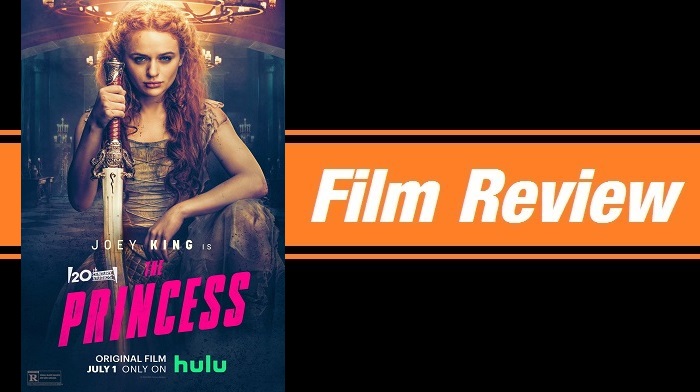
Don’t let its name fool you. The new Hulu Original “The Princess” is no bubbly family-friendly Disney fairytale. Nope, this proudly bloody and brutal medieval action-thriller goes out of its way to buck every possible expectation people usually have for ‘princess movies’. Director Le-Van Kiet goes for the jugular (quite literally) and his star Joey King is certainly committed. But it’s hard to get past how silly and simplistic this girl-power period piece turns out to be.

Calling the film “silly” seems trivial considering at times the movie itself not only acknowledges its silliness but embraces it. But the “simplistic” part is harder to shake. There’s very little character-building (and what we get never gets beyond surface-level) and there is no world-building whatsoever. An unnamed princess trying to save an unnamed kingdom from a remarkably bland villain (but hey, at least he has a name).

Image Courtesy of 20th Century Studios

In reality, all of that story stuff is simply there to serve the movie’s greater interest – scene after scene of hack-and-slash action. It’s like “Tangled” meets “Die Hard” but minus the interesting characters and entertaining hook. “The Princess” feels like one single act of a movie stretched out to feature length. Admittedly, it has a fun bit or two and there’s nothing inherently wrong with one-note movies like this. But “The Princess” simple doesn’t have enough meat on its bones to give this attempt at an empowerment tale any substance.

In a chamber high atop a giant tower, the eponymous princess (King) wakes up in a white silk wedding gown with her hands shackled. Over a series of convenient flashbacks we learn that she refused to marry the power-mad Julius (Dominic Cooper) to whom she was betrothed. After leaving him at the alter, our princess (who the movie goes to great lengths to show is no damsel in distress) is kidnapped and locked in the tower. Meanwhile, her father the King (Ed Stoppard), who is benevolent towards everyone other than his eldest daughter, watches as his crown and family are taken captive by Julius.

After waking up, breaking free from her shackles, and violently dispersing of the first of many medieval meatheads, the princess begins her descent down the tower, offing foes and symbolically tearing off strips of her dress along the way. There are some good fights. There’s one against a horned gladiator; another versus a gold-armored knight. And there’s one set in the castle’s kitchen against Julius’ whip-cracking consort, Moira (Olga Kurylenko in a thankless role). But as we venture down the tower, the fight scenes tend to get clumsier and cornier (there’s one involving a string of pearls that’s so utterly ridiculous you can’t help but roll your eyes).
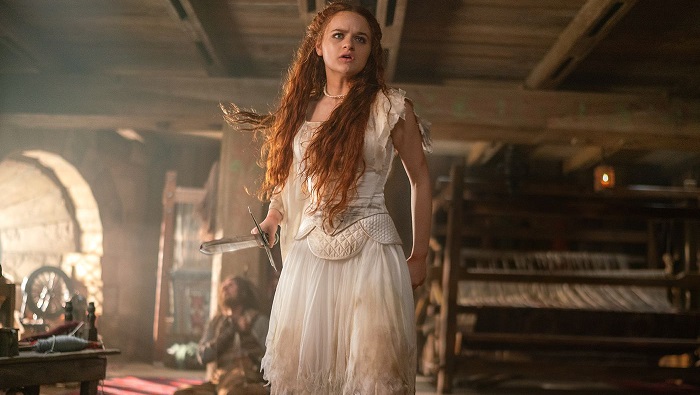
Image Courtesy of 20th Century Studios

And that’s really all there is to the story. Co-writers Ben Lustig and Jake Thornton attempt to add a little depth by showing how the princess became such a capable fighter. But it’s hard not to laugh at the hilariously bad flashbacks especially when the hokey talk of “a warrior’s heart” begins. Yet there’s so much the movie doesn’t reveal. Take Julius, how did he gain so much power? How did he amass such an army? Or why did he even want the throne (other than the generic lust for power)? None of it is ever addressed.

While its blood-splattered, patriarchy-pounding energy carries “The Princess” for a while, its barebones story eventually runs out of gas. So it ends up hinging on the combat which ranges from occasionally electric to flat-out goofy. Sadly that’s not really enough to recommend this movie of moments but little else. Kudos to King though. This may not be the grandest introduction to the action genre, but she shows some chops. Enough for us to be curious for what her future in the genre holds. “The Princess” is now streaming exclusively on Hulu.

VERDICT – 2 STARS

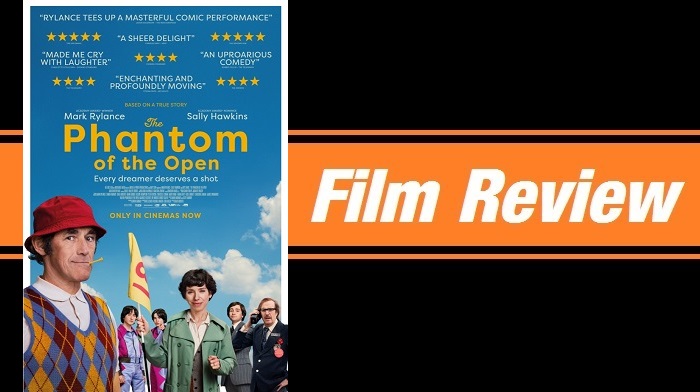
REVIEW: “The Phantom of the Open” (2022)

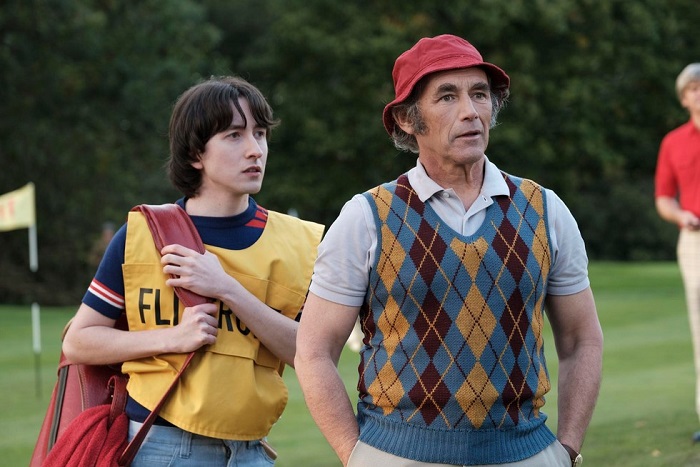
Mark Rylance finds another custom-fit role in “The Phantom of the Open”, a biographical dramedy that you can file in the “so crazy that it must be true” category. Directed by Craig Roberts, this delightful stranger-than-fiction tale takes the true story of golf enthusiast/hoaxer Maurice Flitcroft and gives it its own hearty fictional spin. What we get is a warm and effortlessly witty crowd-pleaser anchored by yet another great performance from the always satisfying Mark Rylance.

If you’re like me, the name Maurice Flitcroft may not immediately ring a bell. But his story is one to remember. Flitcroft was a crane operator at a shipyard in the English port town of Barrow-in-Furness. But he’s most known for his successful attempts at gate-crashing The British Open golf tournament, the oldest and arguably most prestigious golf tournament in the world. His claim to “fame” came in 1976 when posing as a professional he secured a spot in the qualifying round of The Open Championship. Flitcroft’s lack of skill became shockingly evident after he shot an abysmal 49 over par, the worst score in tournament history.

The Open’s rules were promptly changed to keep Flitcroft from entering again, but that didn’t stop him. The next several years saw him continuing his attempts to enter, often under ridiculous aliases such as Gene Paychecki and Arnold Palmtree. He would even use physical disguises to hide his appearance from the tournament officials. Flitcroft earned himself a following of fans who saw him as the antithesis to the game’s more upper-crust reputation.

Roberts smartly latches onto the ever amiable Rylance who fits so snugly into the skin of Maurice Flitcroft (or at least the movie’s version of him). The story is penned by Simon Farnaby and based on a 2010 biography he wrote with Scott Murray. Farnaby is also the co-writer of 2017’s infectiously charming “Paddington 2”. And you can tell. There are some amusing similarities between Maurice and the anthropomorphic bear in the blue raincoat. Both bumble through their circumstances with a big-hearted naïveté, all while showing what a little kindness can do in the world.

The movie takes its share of liberties, downplaying the more mischievous side of Flitcroft’s personality and settling on his earnest dream of winning the British Open. Roberts and Farnaby have a lot of fun exaggerating the inherent zaniness of Flitcroft’s underdog story while also building up a playful family dynamic. Ultimately, its the film’s mix of heart and humor that makes it irresistible. And there’s such earnestness in Rylance’s performance that you can’t help but root for him, even in the final act where the schmaltz really kicks in.

The mustachioed Rylance endows Maurice with a lovable awkwardness both in manner and appearance. He’s humble and kind – traits that really come through in his relationship with his family. He married his wife, Jean (the always great Sally Hawkins) while she was a struggling single mother and adopted her bright young son Michael as his own. He and Jean later had twin boys together. Maurice would set aside his own big dreams in order to care for and support his family.

But everything changed during the summer of 1975 after Maurice has a late night epiphany. After watching Tom Watson win the Claret Jug, he decides to take up golf with plans of winning the Open Championship and its $10,000 top prize. And when I say epiphany, I mean we get a literal dreamlike sequence full of wacky imagery including Maurice being hit through the air like a golf ball and him ascending a staircase to the heavens made of green Bermuda.

Maurice buys himself a cheap set of clubs and a rule book and sets out to realize his newfound dream. And through a series of comical misunderstandings and a little willful ignorance, he finds himself in the qualifying round of the British Open. But his shockingly bad 63 on the opening nine holes sends the tournament heads (led by a hysterically conceited Rhys Ifans) into a tizzy while the media brands him as everything from “the people’s golfer” to “the great pretender”.

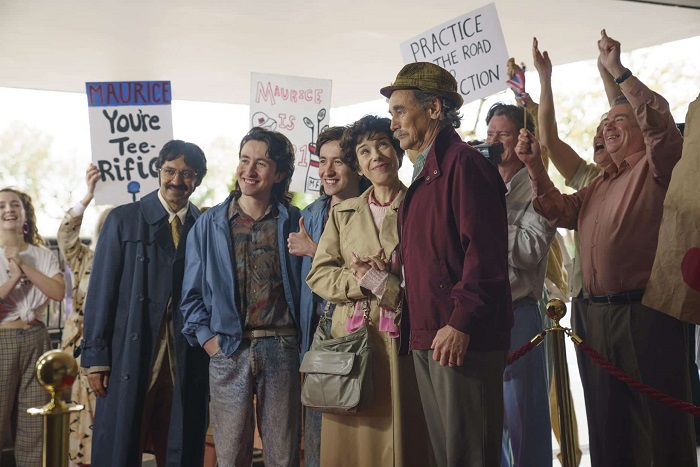
Back home, Maurice’s “fame” inspires his disco-loving twins, Gene and James (Jonah and Christian Lees) to pursue their dreams of becoming professional dancers. But the ambitious Michael (Jake Davies) is more interested in climbing the corporate ladder and is embarrassed by his father’s sudden notoriety. It creates a pretty obvious tension that goes in an obvious direction before reaching its obvious finish. But by the time we reach its syrupy ending, the film has earned so much goodwill that it’s hard not to be moved by it.

I wasn’t quite sure what to expect from “The Phantom of the Open”. It turns out to be a feel-good movie with a light and easy sense of humor. And while the biographical elements are present, there’s also a stretch where the movie takes the story’s goofiness and runs with it, delivering some pretty good laughs. And how can you not love Mark Rylance who always manages to find roles tailor-made for his strengths. He’s such a treat here and you can’t help but to fall under his spell, regardless of how silly or sappy things may get. “The Phantom of the Open” is out now in select theaters.

VERDICT – 4 STARS

REVIEW: “Parallel Mothers” (2021)

Even at 72, Spanish filmmaker Pedro Almodóvar is still churning out his unique brand of movies at a strong and steady rate. It’s clear the two-time Oscar winner still relishes the opportunity to tell specific stories stamped with his own distinguishing marks. His films often revisit the same handful of repackaged themes, and they often feature the same stylistic flourishes, both narratively and visually. Reoccurring motifs, vibrant colors, and creative indulgences are key ingredients to the veteran filmmaker’s mise-en-scène.

Almodóvar’s latest is “Parallel Mothers”, a percolating melodrama about motherhood that once again echoes much of the style and many of the interests from the writer-director’s past projects. As someone who tends to be ambivalent towards his films, I feel this is easily one of Almodóvar’s more accessible features, with characters and a story audiences should immediately connect with. Yet it’s a movie with pieces that don’t always click into place. One with a sublime first hour that’s among the filmmaker’s best work, but a spotty second half where some of Almodóvar’s storytelling choices makes things needlessly messy.

Shot in just one month during the pandemic, “Parallel Mothers” stars Penélope Cruz, a terrific actress who seems to do her best work under Almodóvar’s direction. This is their seventh film together and the two possess an almost symbiotic chemistry as filmmaker and performer. Here the sure-footed Cruz takes on a meaty role and turns in an emotionally rich performance – one that won her the Volpi Cup for Best Actress at Cannes.

Image Courtesy of Sony

Cruz plays Janis, an accomplished professional photographer living in Madrid. Single and approaching 40, Janis longs to start a family but worries her window for having children is closing. We first meet her at a photo shoot for a handsome forensic anthropologist named Arturo (Israel Elejalde). After the shoot she approaches Arturo about helping her with a personal matter. Janis tells him about her great grandfather and several other men from his village who were killed in a state-sanctioned slaughter during the Spanish Civil War. She asks if he would lead an excavation of an unmarked mass grave where the victims are believed to be buried.

As Janis and Arturo work through the details of the potential excavation, it’s pretty obvious there’s a spark between them. Before long the two begin an affair, and shortly after that Janis learns she’s pregnant. The problem is Arturo is married and doesn’t want a child (go figure). But Janis chooses to have her baby and frees Arturo of any obligations.

In the first of several leaps forward in time, it’s suddenly nine months later and Janis is in a maternity ward about to give birth. She shares a room with Ana (Milena Smit), a much younger soon-to-be single mother. “I don’t regret it”, an enthusiastic Janis tells Ana. “I do,” replies the frightened teen whose pregnancy we learn was the result of a traumatic encounter. The two new mothers bond as a sympathetic Janis comforts and assures the apprehensive Ana. But they quickly fall out of touch once they leave the hospital with their newborn daughters.

As Janis settles into single motherhood, Arturo pops back into the picture, casting doubts on whether the baby is his. Meanwhile Ana has went from an insecure teenager to a responsible mom. Her scenes unpack her backstory which includes a troubled family life. We hear about her vindictive absent father and see her tense relationship with her mother (Aitana Sánchez-Gijón) who can’t let something like her daughter’s pregnancy hinder her acting career.

Predictably Janis and Ana’s paths inevitably cross again, but to say much more would undermine the big soapy twists the story hinges on. Some of them work well and add layers that feels rooted in real world truth. They’re helped by Cruz who’s as assured as she is luminous. She shrewdly portrays every facet of Janis, from her sophistication to her vulnerability. And despite her character’s seemingly dubious choices, Cruz still captures our empathy. Smit’s performance starts strong, especially as she conveys Ana’s fear and doe-eyed naïveté. But later, as the story takes some unusual turns, Smit can seem stiff and cold, especially when next to Cruz.

Image Courtesy of Sony

But not every twist works. Well into the second half, Almodóvar wedges in an out-of-the-blue romantic angle that never fully rings true. Aside from being woefully underdeveloped, it needlessly complicates an already compellingly intricate relationship. Even worse, the movie all but forgets about it almost as quickly as it’s introduced. Clearly Almodóvar wants there to be a lingering affect, but it’s handled so casually that it comes across as superficial.

And then there’s the jarring transition back to the excavation storyline. It doesn’t return until the very end where it feels like an afterthought. It’s a shame because the prospect of Almodóvar digging into Franco’s reign of terror is a fascinating one. And the notion of not only exhuming loved ones, but exhuming a country’s painful past – a past that has yet to be fully reckoned with – is riveting. But those final scenes, though really good on their own, don’t connect to the rest of the film quite the way Almodóvar wants. Nor do they haunt the overall story as effectively as they could have with just a little more attention.

“Parallel Mothers” shines brightest as a female-centric examination of motherhood, complete with all its joys and heartaches. Single parenting, absent fathers, family history – they all factor in. Yet Almodóvar’s scattershot second half wastes time tacking on half-baked layers to the melodrama rather than connecting us to the more serious story that bookends the movie. It left me admiring what he was going yet frustrated by his inability to fully convey it. “Parallel Mothers” is now out in limited release.

VERDICT – 3 STARS

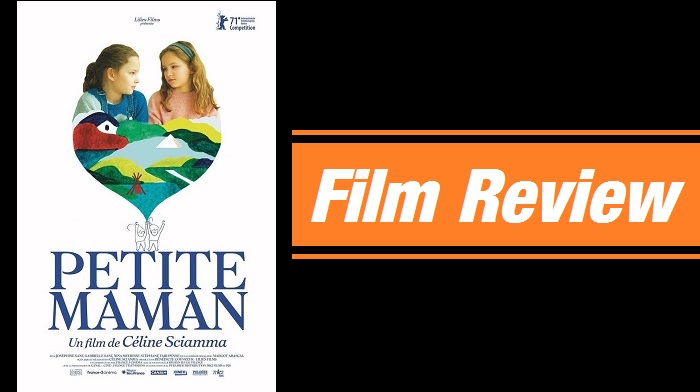
REVIEW: “Petite Maman” (2021)

French filmmaker Céline Sciamma’s follow-up to her highly acclaimed “Portrait of a Lady on Fire” isn’t the big audacious next film you might expect after a big success. In fact the beautifully intimate “Petite Maman” couldn’t be more different. With its small scope and Sciamma’s delicate touch, this warm and aching fable examines coping with loss and mother/daughter bonds in a voice that should speak viewers to all ages.

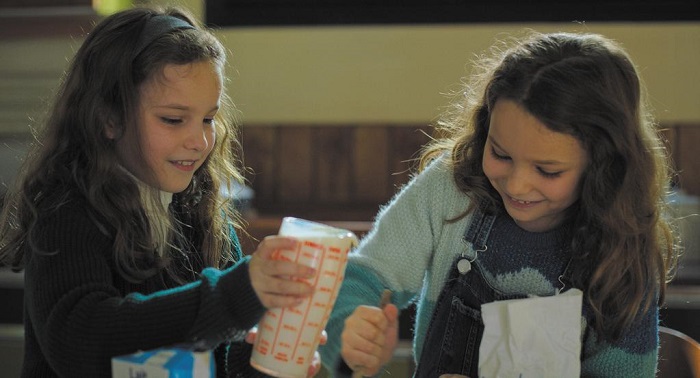
The movie opens in a nursing home with an eight-year-old girl named Nelly (Joséphine Sanz) walking from room to room saying goodbye to each of the elderly residents. As she enters her grandmother’s room near the end of the hall she sees her mother (Nina Meurisse) removing pictures from the wall. We learn that Nelly’s grandmother has passed away and they’re there to collect the last of her things.

Image Courtesy of NEON

Sciamma wastes no time earning our empathy as we watch this young girl try to process everything she’s seeing. You can practically see her mind at work as she quietly lays on her grandmother’s bed or as she watches her parents’ sorrow-drenched embrace. And then we get one of the film’s most beautiful scenes as the camera hones in on Marion’s sad face as she’s driving down the road. A little hand from the back seat comes into the frame and feeds her a chip, then another. The hands return with a juice box and finally a warm heartfelt embrace. It’s a sweet child’s effort to comfort her hurting mother.

These small but meaningful touches can be found all through Sciamma’s swift and compact 72 minutes. Her simple yet full-hearted mothers-and-daughters story may have death as a central ingredient, but it blossoms into a beautiful and poignant blend of reality and fantasy. This fully comes into focus when Nelly and her parents travel to her grandmother’s rustic country home for the unenviable task of clearing out her things. After a couple of days it becomes too much for her mother who suddenly heads back to the city. That leaves Nelly and her father (Stéphane Varupenne) to finish things up.

Image Courtesy of NEON

While walking in the nearby woods, Nelly notices a little girl about her age dragging a large tree limb. She asks Nelly for help and two carry the limb to a hut the girl in building. The next day Nelly heads back into the woods where she meets the girl again. They strike up a conversation and we learn the little girl’s name is Marion. That name is significant, but I’ll let you discover why for yourself. Sciamma soaks us in the girls’ budding friendship, offering a number of charming scenes that are sweet and tender on the surface, but that also explore their deeper relationships with their mothers.

It’s hard to say much more without spoiling the film’s low-key yet enchanting twist. The movie itself doesn’t wait long to show its cards, but it’s still better left for you to discover on your own. Me? I was swept away by the genuineness of its emotions which range from heartwarming to heartbreaking. The simplicity of Sciamma’s storytelling and her unfussy presentation may not stand out in a crowd. But they serve this story perfectly and show us a filmmaker with a grounded, true-to-life vision – one that penetrates your soul and sticks with you for days after watching.

VERDICT – 4 STARS

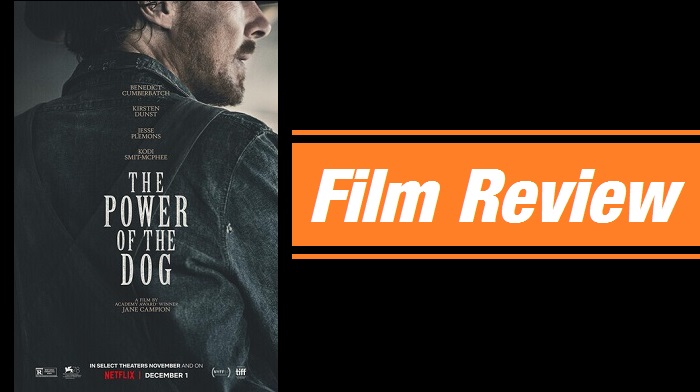
REVIEW: “The Power of the Dog” (2021)

(CLICK HERE to read my full review in the Arkansas Democrat-Gazette)

Based on Thomas Savage’s 1967 novel of the same name, Jane Campion’s “The Power of the Dog” is a crafty anti-Western with all the visual flavor of John Ford, Sam Peckinpah, or Delmer Daves. But at its core Campion’s film (she both writes and directs) is a slow-boiling psychodrama that seeks to explore the darker shades of human nature. It’s a master-class of tone management and the patient steady rhythm of Campion’s storytelling keeps us glued to every frame even as the story butts heads with itself later on.

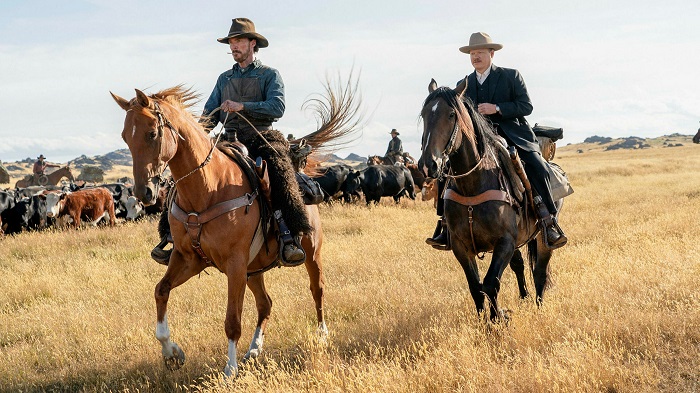
With New Zealand posing as Montana, the movie is set in 1925. The Burbank brothers, Phil (Benedict Cumberbatch) and George (Jesse Plemons), run a profitable cattle business off their sprawling family ranch in the heart of beautiful Big Sky Country. While they’re good business partners, they couldn’t be more opposite. George is the gentlemanly sort; mild-mannered and soft-spoken but with a deceptively fervid aspiration to climb up the social ladder. He’s sensitive and gentle, tending to the business side of the ranch while brushing off his brother’s relentless insults.

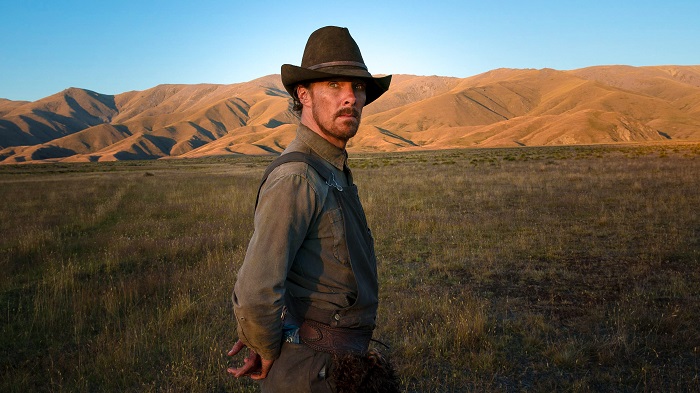
Phil is a hardened cowboy whose cauterized emotions have turned him into a cold calloused brute. With thick brown chaps, a thick layer of grime caked on his face, and a constant scowl, Phil moves with a stiff-shouldered gait as if forcefully projecting a distinct image. His ranch-hands follow him like disciples, listening close as he recalls the wisdom of his late mentor and friend Bronco Henry. His men also channel their alpha-male leader’s bullish antagonism towards anyone who doesn’t meet their hyper-masculine standard.

Image Courtesy of Netflix

Phil and George live on a slippery slope. But the tension between them reaches a simmer while taking a herd of cattle to market. The brothers and their cowhands visit a restaurant owned by a young widow named Rose (Kirsten Dunst) and her awkward teenage son, Peter (Kodi Smit-McPhee). Repulsed by what he perceives as weakness, Phil pounces on the shy lanky boy, viciously mocking his slight lisp and burning an intricate paper flower Peter made as a centerpiece. It’s an unsettling sequence, but also one that highlights Campion’s remarkable control.

Later, a sympathetic George returns to the restaurant to see Rose and apologize for his brother’s cruelty. It sparks a sweet romance that eventually leads to marriage. With Peter off to medical school, Rose sells her restaurant and moves to the ranch. This triggers a jealous and embittered Phil who makes it his goal to crush his brother’s newfound marital bliss. To Phil, Rose (and later Peter) are threats to his manly order of things. That conflict drives the remainder of the film and sends the movie careening down a path with no happy ending in sight.

While some find a critique of masculinity in nearly every movie these days, Campion provides one of the most vivid and clear-eyed examinations yet. She uses Cumberbatch’s commanding and at times terrifying performance to not only reveal what warped manhood looks like, but to also show the destruction it can leave in its path. Cumberbatch’s Phil is a blunt force with a domineering aura and his methodical psychological assault can be hard to watch. Dunst gives a devastating portrayal of a woman who is both a victim of Phil’s unyielding harassment and of the era’s oppressive societal norms.

Image Courtesy of Netflix

Things only intensify once Peter arrives to spend the summer at the ranch. Smit-McPhee’s poker-faced presence and (again) Campion’s confident control keeps the character at an arm’s length. This makes Peter impossible to read; every bit as enigmatic as he is peculiar. It also makes him a prime target for Phil’s abuse. With a tormented Rose withering away from depression and alcoholism, the story shifts towards Phil and Peter. Meanwhile Plemons gets the short end of the stick as George (sadly) all but vanishes for much of the second half.

While the film’s exploration of masculinity is a good one, it’s undone a bit by the implications of another theme that comes fully into focus late in the story. I won’t spoil it for those unfamiliar with Savage’s book, but it’s a “twist” that adds a new layer to Phil while inadvertently giving him an excuse for his emotional savagery. I doubt that’s the intent and it won’t play that way for some, but I couldn’t shake the feeling that Campion’s attempt at adding richness to her story ends up undermining one of its biggest strengths.

Tangled themes aside, “The Power of the Dog” ends on a strong note as the movie’s Psalm-inspired title clicks firmly into place. It’s a finish that again showcases Campion’s deft management of her scenes and her audience. Accompanied by the painterly beauty of Ari Wegner’s cinematography (among the year’s best), the simple yet haunting Jonny Greenwood score, and superb performances top to bottom, Campion has crafted a striking Western with all the leathery textures of the genre, but with the assured and probing touch of an auteur. “The Power of the Dog” is now showing in limited release and streams on Netflix starting December 1st.

VERDICT – 4 STARS

REVIEW: “Paranormal Activity: Next of Kin” (2021)

Confession time: I have no real attachment to the “Paranormal Activity” franchise. I haven’t seen any of the films past the first two. I couldn’t tell you anything about the timeline or how any of the six movies connect (if they connect). Even more, the entire found-footage phenomenon ran its course for me years ago. It was cool for a movie or two, but like many I grew tired of it pretty quick.

So what on earth would entice me to watch “Paranormal Activity: Next of Kin”, the seventh installment in the supernatural horror franchise? First, producer Jason Blum announced that the film would be a reboot of the series rather than a direct sequel. So no attachments needed. Next, I was intrigued by the premise and the setting, both of which actually fit well with the whole found-footage thing.

Image Courtesy of Paramount+

“Next of Kin” sees the PA franchise remodeling itself, using some of the series’ usual techniques but telling a new kind of story. It begins at a Denny’s in Scottsdale, Arizona where a young woman named Margot (Emily Bader) is about to meet her “first biological relative”, a young man named Samuel (Henry Ayres-Brown). He’s around Margo’s same age and recently left the Amish community where her family originated. Adopted as a baby, Margot is anxious to find out where she came from and more specifically what happened to her mother who disappeared years earlier. Videoing the occasion is her friend Chris (Roland Buck III), who is collecting footage for a “prestige documentary” she’s making about her experience.

Samuel agrees to take Margot, Chris, and their goofball (because there always has to be a goofball) sound guy Dale (Dan Lippert) to the snowy secluded Baylor Farm. Once there the crew is greeted by the community’s cautious elder Jacob (Tom Nowicki) who reluctantly allows them to stay and shoot for a couple days. The aggressively private farm folk are leery of the outsiders but slowly warm up to them.

At first Margot and her friends are drawn to the group’s simple way of life. But to absolutely no one’s surprise, she and her crew begins noticing some eerie happenings around the farm – sinister red lights glowing in the night, strange animal howls, and what’s with that creepy old church in the woods. They all lead to a messy final third that really leans into the movie’s cool blood-curdling setting. Unfortunately it also features a handful of missteps, most notably the mind-boggling decision-making from the characters that turns curiosity and investigative into glaring stupidity.

Image Courtesy of Paramount+

To director William Eubank’s credit, “Next of Kin” makes for a nice change of atmosphere. I say that fully realizing that franchise faithfuls may see it differently. It shares some of the same tricks as its predecessors, but the welcomed new environment is part of what made it appealing. I also liked that (thankfully) it’s not entirely found-footage. Mostly for sure, but there are a handful of welcomed breaks that also help the look of the film. And this is a nice looking film. From the warm orange glow of kerosene lamps in the interior shots to the icy harshness of the outdoors, the visuals prove to be a real strength.

There are a few other interesting touches (such as the early references to COVID-19 that forever ties the movie to our current day). But there are too many elements of film that never quite land, specifically the mystery of Margot’s mom. You get a feeling for what’s going on pretty early so it comes down to waiting for it to finally be revealed. In the meantime, the characters do one dumb thing after nothing. It’s something you find baked into too many horror movies, and it doesn’t really help Eubank and company here. “Paranormal Activity: Next of Kin” is streaming now on Paramount+.

VERDICT2.5 STARS