REVIEW: “Queen of the Ring” (2025)

“Queen of the Ring” takes us on a historical journey through the underground turned mainstream world of women’s wrestling. Writer-director Ash Avildsen does so by telling the story of Mildred Burke, a pioneer of her day who overcame a litany of obstacles and biases to put women’s wrestling on the map. From the early 1930s to the late 1950s, Burke would earn multiple championships and draw big crowds wherever she wrestled. She would go on to become the first million-dollar female athlete in sports history.

“Queen of the Ring” is inspired by journalist Jeff Leen’s 2009 book “The Queen of the Ring: Sex, Muscles, Diamonds, and the Making of an American Legend”. It stars a spirited and intensely committed Emily Bett Rickards who plays Mildred “Millie Muscles” Burke with tenacity and grit, capturing what made the legend special both inside and outside of the ring. It’s a breakout performance from Rickards who wonderfully balances sheer physicality with emotional vulnerability.

Image Courtesy of Sumerian Pictures

Avildsen chronicles different phases of Burke’s remarkable career, beginning with her time as a single mom working as a waitress in a diner owned by her mother, Bertha (a very good Cara Buono). Her dream is born after attending a Kansas wrestling event led by mid-tier wrestler turned manager Billy Wolfe (Josh Lucas). Later, Billy and his son G. Bill (Tyler Posey) come into their diner where Millie introduces herself and begs for Billy to train her. It takes some convincing but he eventually agrees.

Millie proves to be quick learner and she and Billy fall in love. Millie agrees to marry Billy much to the chagrin of her disapproving mother. They end up taking her act on the road, working carnivals across the Midwest where Millie would wrestle (and beat) men for paying audiences. Billy sees there’s money to be made and begins adding more lady wrestlers to his stable. Among them is the plucky Mae Young (Francesca Eastwood), the ambitious Elvira Snodgrass (Marie Avgeropoulos), and the driven Gladys Gillem (Deborah Ann Woll).

But Millie’s rise to stardom has its obstacles. First, in many territories it was illegal for two women to wrestle each other which made it difficult for Billy to showcase her talent in certain big venues. Then there is a brutal knee injury she suffers at the hands of a brawny Texan named June Byers (a striking Kailey Farmer) which puts her out of commission for several months. But the biggest obstacle is Billy, whose rampant infidelity and suffocating control leads to a marriage that’s nothing more than a business arrangement.

During a festival presser, Avildsen revealed that at least an hour of footage had been cut from the final release and you can tell. For example, the movie speeds through Millie’s entry into wrestling at such a rapid pace that we never get a good sense of what drew her to wrestling or what inspired her to push forward in the early days. And later on there are noticeable gaps in the timeline which you can’t help but miss.

Image Courtesy of Sumerian Pictures

But honestly, those things piqued my interest more than hurt my experience with the movie. That’s because there is so much else to keep you involved, starting with Rickards standout performance. The supporting cast are fantastic as well, with especially strong turns from Lucas, Eastwood, Buono, Farmer, and Woll. We even get the great Walton Goggins as crafty wrestling promoter Jack Pfefer. Then you have Sofija Mesicek’s impeccable costumes, Molly Coffee’s period-perfect production design, and Andrew Strahorn’s rich cinematography – all key reasons why we feel transported from the first to last frame.

With “Queen of the Ring” Ash Avildsen pulls us into a world that may be foreign to many. He takes several liberties (some pretty significant) in chronicling Mildred Burke’s fascinating true account. But most of his choices add to the drama without taking away from the trailblazing spirit of her story. The wrestling scenes inside the ring are thrilling, the bonds that form outside the ring are authentic, and Millie’s resilience in the face of countless adversities is nothing short of inspiring. “Queen of the Ring” hits select theaters March 7th.

VERDICT – 4 STARS

REVIEW: “Quiz Lady” (2023)

The hilarious duo of Awkwafina and Sandra Oh lead the smart(ish), funny, and effortlessly charming “Quiz Lady”, the new comedy from director Jessica Yu. Written by Jen D’Angelo and featuring a collection of small yet wonderfully cast supporting roles, “Quiz Lady” is a welcomed late year addition to a genre that needed a boost. This breezy entertaining crowdpleaser takes a whimsical but heartfelt look at sisterhood through two dramatically different yet joyously compatible siblings.

Playing against type, Awkwafina plays a socially awkward 33-year-old introvert named Anne Yum. When not working her mundane office job at an accounting firm, Anne spends her time at home with her adorable pug named Linguine. Her one passion is the television game show “Can’t Stop the Quiz”. Since she was a child Anne loved “Can’t Stop the Quiz” and its gentlemanly Alex Trebek-ish host Terry McTeer (a wonderfully silly Will Ferrell).

Anne’s somewhat estranged sister Jenny (Oh) is a blustering ball of chaos. She’s erratic and irresponsible despite being ten years older than her kid sister. The two come together after getting news that their elderly mother has busted out of her nursing home and taken off to Macau with her new boyfriend Jeff. And this is where things get a little wacky.

Image Courtesy of 20th Century Studios

We learn that Anne and Jenny’s mother left after amassing a hefty gambling debt with a local loan shark (Jonathan ‘Dumbfoundead’ Park). He and his goons kidnap Linguine and give the sisters two weeks to pay off the $80,000 their mom owes otherwise the dog gets it. So Jenny comes up with a plan – get super-fan Anne to audition for “Can’t Stop the Quiz”. With her obsessive knowledge of the show, winning $80,000 should be a piece of cake. Of course there’s that whole issue of Anne’s social anxiety. Hijinks ensue.

Yu and D’Angelo have a lot of fun playing around with the wacky dynamic between the two sisters. The two central performances show off a great comedic chemistry with Oh getting the more in-your-face material and Awkwafina in the straight-man role. Then you have the supporting cast who routinely steal scenes. Along with Ferrell there’s also a priceless Jason Schwartzman playing the game show’s schmoozing returning champion. Holland Taylor is a hoot as Anne’s cranky neighbor Francine. We even get a zany turn from Tony Hale who plays the proprietor of a colonial-themed inn where he role-plays as Benjamin Franklin.

I laughed a lot during “Quiz Lady”, but not all of its jokes land. Some are a little too outrageous; others go the unfortunate and obvious cheap route. But for the most part Yu has a good grip on things as seen in the fleet-footed pacing and crisp comic timing. Meanwhile D’Angelo gives her characters some legitimately funny material to work with. Some may have a hard time buying the feel-good ending. But like the bulk of the comedy, it’s easy to swallow in large part thanks to the film’s two endearing and enjoyable leads. “Quiz Lady” premieres November 3rd on Hulu.

VERDICT – 3.5 STARS

REVIEW: “The Quiet Girl” (2022)

Let me just say, “The Quiet Girl” crushed me. Based on a 2010 Claire Keegan novella called “Foster”, this tender, absorbing feature debut from Colm Bairéad follows a young girl named Cáit who experiences a warm, stable, and loving home for the first time in her life. It’s a simple premise. But with the precision and patience of a seasoned filmmaker, writer-director Bairéad shows remarkable restraint, allowing his story the room to unfold organically while trusting his instincts and his audience. The results are sublime.

As its title may hint, “The Quiet Girl” basks in the richness and simplicity of movie quietude. Everything including the beautifully understated performances, the deftly written screenplay, and the compelling visual language shows how a movie can relay an extraordinary amount of information and emotion by simply turning down the volume and observing. It’s not as easy as it sounds, but Bairéad’s shrewd control of the storytelling (both narratively and visually) keeps us locked in and communicates everything we need to know about his characters and their circumstances.

Image Courtesy of Super LTD

Nine-year-old Cáit (Catherine Clinch in her remarkably delicate and earnest debut) is practically invisible to her neglectful family which includes her sad and melancholy mother Marie (Kate Nic Chonaonaigh) who’s pregnant with yet another child, her cold and detached father Dan (Michael Patric) who blows money gambling rather than investing in their struggling farm, and her three rowdy sisters who overlook her both at home and at school. It’s far from a joy-filled life which is why Cáit prefers hiding in the tall grassy fields, alone with her thoughts rather than being around those who are supposed to be closest to her.

Cáit is surprised when she’s unceremoniously sent to stay with some relatives for the summer while her mother prepares for their new baby. The childless couple, Eibhlín (Carrie Crowley) and Seán (Andrew Bennett), have a much more even-tempered and ordered life. It’s a far cry from the cold and prickly ‘home’ Cáit is used to. The kindhearted and motherly Eibhlín seems especially happy to have Cáit around while Sean seems more uncertain (our first hint at the couple’s backstory which fully surfaces later and adds a touching emotional layer).

Though shy and trepidatious at first, Cáit slowly begins to warm up to her new surroundings, not used to such stability and compassion. Over time she even begins to thaw Sean’s icy exterior. Bairéad spends a big chunk of the film building these new relationships and showing us both the beauty and the power of human kindness. His unhurried and uncomplicated storytelling allow the characters to open up at their own speeds. And as they inevitably draw closer, we can’t help but be moved thanks to how honestly Bairéad depicts everything we see.

But “The Quiet Girl” is also a film about finding the courage to communicate. And that’s a theme not just designated for the young title character. Eibhlín and Sean (we learn) have their own suppressed feelings they keep bottled up deep inside, unwilling to share them with Cáit or each other. But again, its acts of kindness, here more often shown rather than spoken, that nurture a sense of letting go and moving on.

Image Courtesy of Super LTD

Cinematographer Kate McCullough is crucial, especially in a film that leans so heavily on our observation. As sumptuous as they are revealing, her images are shot in Academy aspect ratio (which is suddenly popular again, especially on the indie circuit) and help express what the characters can’t bring themselves to say. Also, McCullough frames and shoots Eibhlín and Sean’s rural farm in a way that helps us (much like Cáit) feel at home, with her camera often returning to their long beautiful driveway shaded with tall overhanging trees, their small but cozy 80s-era kitchen, their tranquil path to a nearby slurry, etc. And her images are often bound together by the gentle chords of Stephen Rennicks’s score – minimal, but exactly what the film needs.

Some might be tempted to call it slow or even slight. But doing so dismisses so much of what makes “The Quiet Girl” special. First-timer Colm Bairéad clearly understands there is poetry in silence and his film embraces it to the fullest, building towards what’s arguably the most affecting final shot I’ve seen this year or in recent years. It’s such a perfect punctuation mark for a movie that doesn’t need pages upon pages of dialogue or cranked up melodrama to convey emotion and truth.

VERDICT – 4.5 STARS

REVIEW: “Quo Vadis, Aida?” (2020)

QUOpost

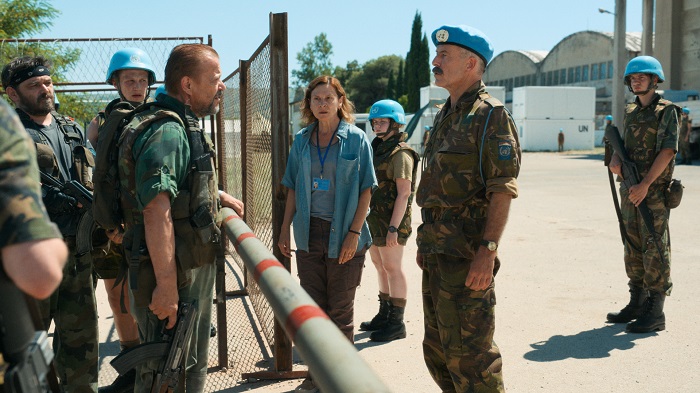
The harrowing war drama “Quo Vadis, Aida?” uses a carefully fictionalized story to set our feet in the Bosnian war and more specifically an atrocity known as the Srebrenica massacre. This weighty material is presented through the clear-eyed, unvarnished lens of writer, director, and producer Jasmila Žbanić. Her film has received worldwide acclaim topped off by a recent Academy Award nomination for Best Foreign Language Film. Hopefully that will lead to more exposure and more people seeking out this gripping eye-opener.

Set during the tumultuous July of 1995, “Quo Vadis, Aida?” takes place in and around the small mountain town of Srebrenica. Tensions were high between Bosnian Serbs and the Muslim Bosniaks with civilians (as they often are) caught in the middle. As war brewed, Srebrenica had been declared a UN safe area by the United Nations. But that didn’t stop Serb forces under the command of General Ratko Mladić (Boris Isaković) from marching in and taking over the town. It resulted in a flood of Srebrenica refugees fleeing their homes and seeking refuge at a nearby UN base camp.

QUO1

Image Courtesy of Super LTD

Undermanned, undersupplied and overwhelmed, the UN base was ill-equipped to handle the tens of thousands of people at their gate. A couple thousand were allowed in while the rest were left outside the gate under the hot sun with no food, water or toilets. Much worse, the small Dutch unit who manned the base where there to protect the local civilians in the ‘safe area’ yet they were never given the authority to use force and calls for airstrikes to drive back Serb forces went unanswered. This led to their utter inability to defend against the atrocities that would soon take place right under their noses.

Žbanić pulls us into this shattering real-life story through the fictional character Aida (played with such passion and emotional intensity by Jasna Đuričić). She was a school teacher before the Bosnian Wars, now she works as an interpreter for the UN. She’s the backbone of her family and a large part of the story followers her as she tries to ensure the safety of her timid but loving husband Nihad (Izudin Bajrović) and their two sons Hamdija (Boris Ler) and Sejo (Dino Bajrović). We see everything through Aida’s eyes – the Serb army’s march on Srebrenica, the UN camp crisis, and the horrors that come once General Mladić and his troops arrive to “relocate” the refugees.

Both Žbanić’s direction and Christine A. Maier’s cinematography organically creates a nail-biting tension and a truly ominous sense of dread. Aside from history informing us, we know things are heading in a grim direction. We experience Aida’s increasing desperation as she scrambles around the base using her UN badge and any shred of privilege to get her family inside the gates. Then when that illusion of safety begins to crumble both her survival and maternal instincts kick into another gear as she searches for a way to get her family out of the base before Mladić’s murderous soldiers arrive. Đuričić empties herself into this emotionally and physically demanding role and the camera keeps us by her side most of the way as pressure mounts and her hard-to-hide terror sets in.

QUO2

Image Courtesy of Super LTD

The Srebrenica massacre resulted in the slaughter of over 8,000 men and boys. They were separated from the women and loaded onto buses by Mladić’s soldiers at the UN base as the Dutch unit watched helplessly. They were then transported to other towns and savagely executed. It’s here that Žbanić holds back, never showing the slaughter but leaving no doubt in our minds of their fate. Interestingly there are elements to the atrocities that Žbanić chooses to stay away from. Namely the numerous testimonies of violent abuse the women faced – countless rapes, the slaughter of children in front of their mothers, and so on. It’s stomach-churning material for sure, but it would put an extra emphasis on what these women were subjected to. The restraint is admirable, but this is a part of the account that needed stressing.

From the very first frame “Quo Vadis, Aida?” comes across as a deeply personal film. It has a lot it wants to say and more it wants to expose. In one sense it is a stinging indictment of the UN’s mishandling of conflicts and of international apathy which often allows these kinds of atrocities to take place. But it’s also meant to honor the survivors and pay tribute to those lost. In terms of cinema, its a well-made and utterly distressing movie chronicling an unspeakable series of events that are still freshly etched into many minds. The Oscar-nominated “Quo Vadis, Aida?” is now streaming on VOD.

VERDICT – 4 STARS

4-stars

REVIEW: “The Quarry” (2020)

QuarryPOSTERWhen the South by Southwest film festival was cancelled due to the COVID-19 pandemic a lot of movies missed their planned world premieres. One was “The Quarry”, a mystery thriller from director and co-writer Scott Teems. His last dramatic feature was the terrific “That Evening Shade” way back in 2009. His latest sees him back in a rural setting, a place where he clearly feels at home.
Guilt’s a heavy burden, isn’t it? Most men can’t carry it alone.” That line comes near the start of the third act and nicely sums up a driving theme of “The Quarry”. Guilt is interwoven into the very fabric of Teems and his co-writer Andrew Brontzman’s story. It’s all over the place, guilt of all varieties, and nearly every character is weighted down by it to some degree.

The movie opens with the image of a house engulfed in flames. There’s no context for it whatsoever, but it’s there for us to stick in the backs of our minds for later. Next we’re in a beat-up van traveling down a rural two-lane highway with a whiskey-swilling preacher named David Martin (Bruno Birchir). He’s on his way to the dried up bordertown of Bevel to take a church pastorate when he comes across a man (Shea Whigham) near dead on the side of the road. He stops to help but his acts of kindness turn violent, leaving him crudely buried in a shallow grave at the bottom of a quarry.

The unnamed mystery man (literally listed as “The Man” in the credits) assumes David’s identity, takes his van full of belongings, and heads off for the preaching gig in Bevel. It may not sound like the most rational next move but for a man riddled with guilt and regret, what starts as a desperate cover story turns into a potential saving act of penance. But as a character rather pointedly reminds us later on, “The past is always with us.”

Quarry1

Photo Courtesy of Lionsgate Films

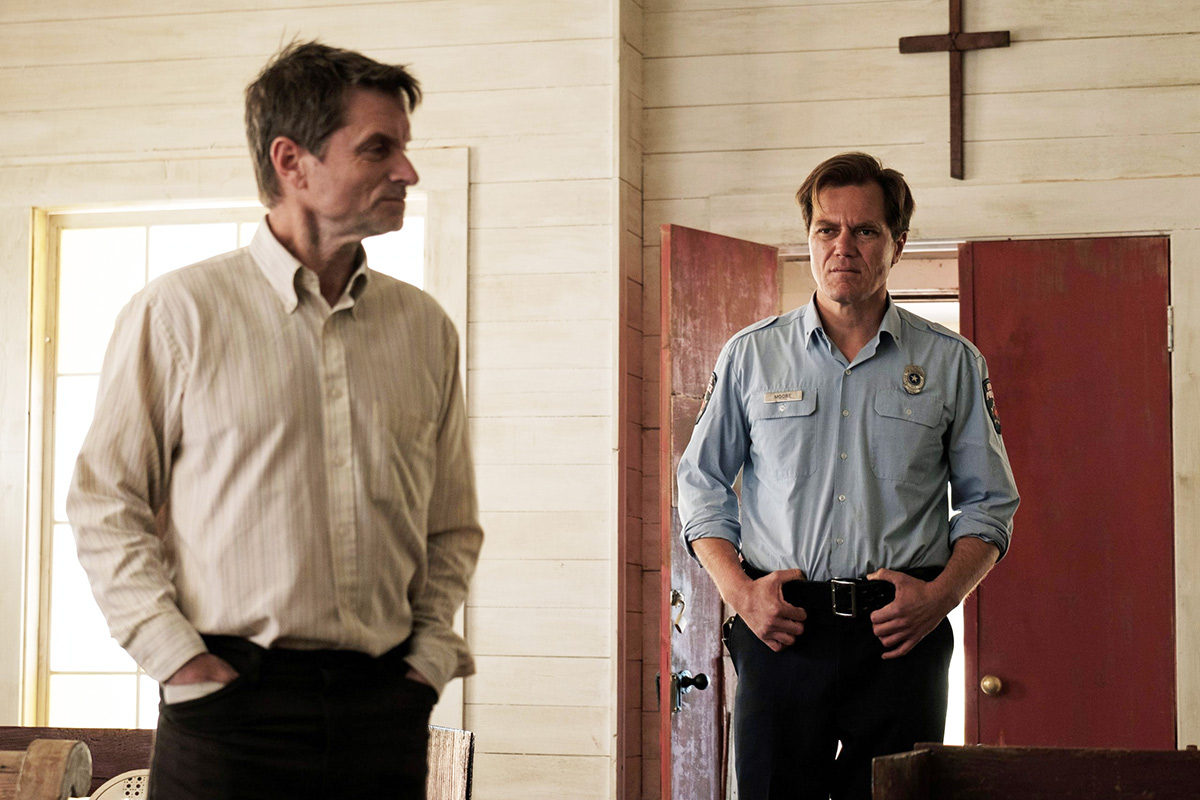
Once in town the pseudo preacher meets Celia (Catalina Sandino Moreno), a disillusioned local who provides room and board for the church. And little does the man know, he’s been marked by a 12-year-old named Poco (Alvaro Martinez) who scouts easy targets for his thieving, pot-growing big brother Valentin (Bobby Soto). The two loot the stranger’s van and in the process find something linking him to the quarry. Enter Police Chief John Moore (Michael Shannon), a bit of a miscreant himself, who oversees the investigation. He doesn’t like the brothers, isn’t crazy about preachers, and has a thing for Celia.

Despite having all of these combustible elements in place, “The Quarry” turns out to be a slow-burning southern noir that’s often content with just setting us down with its characters rather than spinning some thorny, tightly wound mystery. There is some genuine suspense especially when the real David’s body is discovered. And you have the lingering question about Whigham’s character. Is he a murderous psychopath or a well-meaning loner in over his head? Perhaps neither, maybe a bit of both.

Whigham’s understated approach doesn’t offer us many clues. And while I really like the performance, there’s not a lot of meat to it. We’re basically kept wondering about him until the very end when Teems tries to unload too much too quickly. Still the gravelly man-of-few-words method fits, veiling secrets but occasionally teasing us with glimpses of redemption. A baptism scene hints that maybe the man has found happiness while his straightforward plain-speak from the pulpit spurs growth in the congregation. Glimmers of light? Maybe.

Quarry2

Photo Courtesy of Lionsgate Films

Shannon’s Chief Moore is the exact opposite. Outspoken and transparent to a fault, Moore is an open book, ugly pages and all. He’s a man stuck in a rut and destined to stay there; trashing the very idea of an idyllic small town Americana and letting his own apathy effect his policing. It’s a role handmade for Shannon and grooved towards his strengths, much like the various characters he has played for Jeff Nichols. With this film many of the best moments are spent watching and absorbing two wily pros like Shannon and Whigham work out a scene.

You could argue that “The Quarry” is too pensive to be called a tense crime thriller and not deep enough to be considered a brooding, existential meditation. Yet I enjoyed the space it occupies in between the two as well as the ideas it explores. Can you have forgiveness without confession? Is there absolution without atonement? Can you ever really escape your past? Add to it the rich and rugged texture of the setting accompanied by the effective groans of Heather McIntosh’s aching score. They work together to maintain a bleak, melancholy tone befitting its characters and the dead-end roads they seem to be traveling.

VERDICT – 4 STARS

4-stars