REVIEW: “Sharknado” 10th Anniversary Edition (2013/2023)

If ever there was a cinematic poster child for B-movie schlock it would have to be 2013’s disaster comedy “Sharknado”. First airing ten years ago on the Syfy channel, this utterly shameless, gleefully self-aware, and proudly mindless concoction has gone from made-for-television dreck to a full-blown cult classic that has spawned a total of five sequels and three spin-offs. Who saw that kind of success coming?

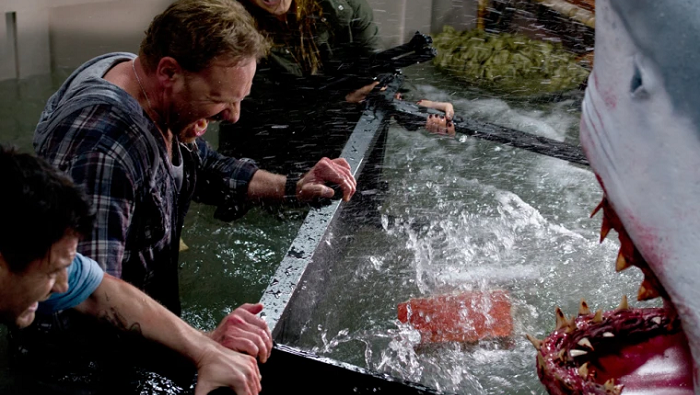
Now independent film distributor The Asylum is celebrating the movie’s 10th Anniversary with an all new 4K remastered version of “Sharknado” that features new visual effects and never-before-scene footage. Better yet, they’re bringing it to over 500 big screens across the country for a special two-night engagement. Talk about a movie custom-made for a late-night screening with an energized crowd.

Image Courtesy of The Asylum

As for the story, it is unbelievably silly and completely implausible in every possible way. Everyone involved in the film knows it and that’s a big part of what makes it entertaining. Yet there is an illusion of seriousness that actually makes it even funnier than it naturally is by concept alone. Director Anthony C. Ferrante and screenwriter Thunder Levin throw all sorts of ingredients together and end up with something you can’t help but enjoy.

How’s this for a wild weather anomaly – twenty miles off the coast of Mexico a massive waterspout forms and begins sucking sharks out of the ocean. Somehow it turns into a dangerous hurricane (I think) and quickly heads up the coast towards California. Now in case you’re tempted to delve into the science of such an anomaly, don’t. Remember, the name of the movie is “Sharknado” so looking for logic is missing the point. Just know the movie attributes it all to global warming and then quickly moves on.

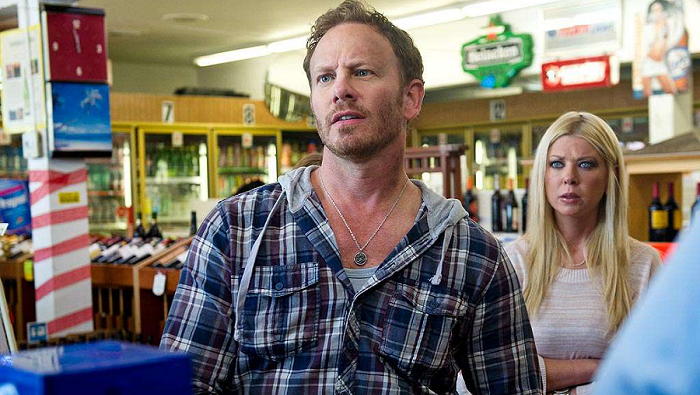
Fin Shepard (Ian Ziering) is an ex-professional surfer who now owns a restaurant and bar on the Santa Monica Pier. With the killer hurricane bearing down on the shore, Fin, his best chum Baz (Jaason Simmons), his loyal barmaid Nova (Cassie Scerbo), and a handsy local lush named George (the late John Heard) flee the pier and head inland. But floodwaters full of frenzied man-eating sharks is soon rushing into the city. Yikes.

Fin and his crew head to Beverly Hills (a funny little in-joke for fans of the 90210 zip code) to warn his ex-wife April (Tara Reid), their daughter Claudia (Aubrey Peeples), and April’s jerk of a boyfriend Collin (Christopher Wolfe). But in a snap the storm is on top of them, bringing not only the floodwaters but sharks to their posh, upscale neighborhood. To make matters worse, three enormous waterspouts hit downtown Los Angeles sucking up more sharks and slinging them across the city.

Image Courtesy of The Asylum

So yes, it’s remarkably silly but Ferrante, Levin, and (as mentioned) the entire cast is completely aware of it. And the story’s goofiness is only accentuated by everything surrounding it – the hilariously bad one-liners, the stilted overly dramatic performances, the cheap special effects and gobs of glaringly fake gore. You’ll find yourself giggling at nearly every facet of this bonkers creation.

But again, that’s pretty much the point. “Sharknado” is the epitome of “so bad it’s good”. Maybe not good enough to watch again and again, but plenty good enough to do what it sets out to do – entertain in its own offbeat cockamamie way. Don’t overthink it. Just have fun laughing at it. It certainly has fun laughing at itself. “Skarknado 10th Anniversary Edition” will be in select theaters August 15th and 16th.

VERDICT – 3 STARS

REVIEW: “Sound of Freedom” (2023)

Easily one of the biggest surprise hits of the 2023 movie year is “Sound of Freedom”, a gripping fact-based thriller that was completed five years ago but struggled to find distribution. With the help of crowdfunding rather than big studio backing, “Sound of Freedom” has finally made its way it to theaters and has found itself a passionate and vocal audience. To no surprise the movie has also found plenty of detractors.

Unfortunately slanted positions on politics and faith have clouded much of the discourse surrounding the film to the point that its overarching message is often being overlooked. That’s a shame because “Sound of Freedom” strikes up a sensitive yet necessary conversation about the world’s fastest growing international crime network – the under-reported human trafficking trade. It’s an issue we all should be affected by, and the film’s clear-eyed perspective shines a much-needed light on this horrifying reality.

Directed and co-written by Alejandro Monteverde, “Sound of Freedom” doesn’t sugarcoat the very real subject matter at its center, addressing it with an almost uncomfortable clarity. At the same time there is a deep sense of compassion that comes through in both Monteverde’s focused direction and the intense performance from the film’s lead, Jim Caviezel.

Image Courtesy of Angel Studios

Caviezel plays Tim Ballard who in real-life quit his job as a Department of Homeland Security Agent in 2013 and founded Operation Underground Railroad, a non-profit organization dedicated to stopping human sex-trafficking. The film dramatizes his days working on the Internet Crimes Against Children Task Force. We’re also given a good grasp of the frustration that led him to break off on his own to track down and save captives (many of them children) and bring to justice their captors.

The film begins with a devastating gut-punch of an opening that paints for us a clear picture of how crafty traffickers can be in luring children into their webs. In this case it’s an 11-year-old girl Rocio (Cristal Aparicio) and her 7-year-old brother Miguel (Lucás Ávila) who are abducted in Honduras. In California, Ballard and his team arrest a local pedophile who they discover has deep ties with Central American human traffickers. Through the creep (and in a way I won’t spoil) Ballard finds out about Miguel and manages to rescue the young boy.

Afterwards Ballard learns of Miguel’s sister, Rocio who he pledges to find and bring home. He tracks her to Cartagena, Columbia where he teams up with a local police officer named Jorge (Javier Godino) and Vampiro (Bill Camp), a former cartel collaborator seeking to atone for his past sins. After landing some strong leads, the trio put together an ambitious plan. But just as they’re about to pull the trigger, Ballard’s agency pulls his funding and orders him back to California. Tired of the bureaucracy, Ballard promptly resigns and begins working on another way to save Rocio before it’s too late.

Image Courtesy of Angel Studios

The film’s riveting first half is followed by a second half that draws itself out a little too long. Yet it remains enthralling throughout largely thanks to Caviezel. His performance is a captivating mix of steely determination and heartfelt vulnerability. Better yet, he’s no Rambo archetype. Instead we’re given wisely grounded portrayal that is exactly what the story needs.

And despite its meager backing and modest budget, the movie looks as good (and as expensive) as most Hollywood studio productions. Much of it is due to Monteverde’s keen instincts with the camera and the stellar lensing from cinematographer Gorka Gómez Andreu. Shooting on location in Cartagena only adds to the visual authenticity.

“Sound of Freedom” is a tough movie to watch and it should be. At the same time it never overplays the dangers or milks the audience’s emotions. Yes, it has specific scenes that are sure to provoke responses from those watching. But they’re mostly well earned rather than manipulative, especially if your heart is in the right place while watching. So say what you will about the movie. In the end it rises above the dubious claims and disingenuous concerns to offer a compelling and at times unflinching exposé that will stick with you for a long time. “Sound of Freedom” is in theaters now.

VERDICT – 4 STARS

RETRO REVIEW: “Serpico” (1973)

1973’s “Serpico” was almost a much different movie. By that I don’t mean a different spin or a different genre. I mean there were some dramatically different creatives first attached to the gritty biographical crime drama. Sam Peckinpah was once in line to direct but eventually backed out. But the kicker was Robert Redford and Paul Newman, both relatively fresh off working together in “Butch Cassidy and the Sundance Kid” and “The Sting”, were set to star with Redford playing the titular character Frank Serpico. They too left the project.

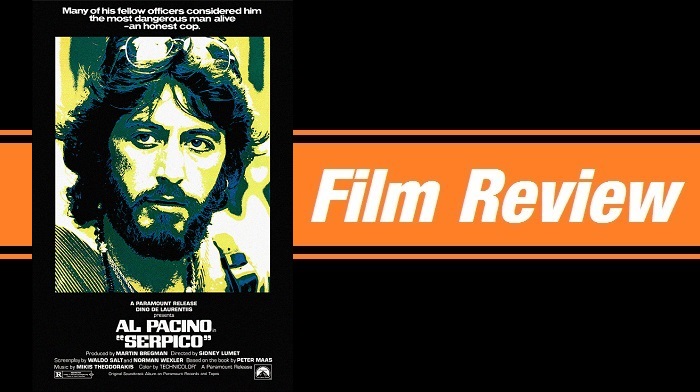
It was a bumpy road, but soon Sidney Lumet was brought in to direct. Even more notable, Al Pacino was given the lead role. Written by Waldo Salt and Norman Wexler, “Serpico” was an adaptation of a 1973 book by author Peter Maas. It told the true story of New York City police officer Frank Serpico who came face to face with rampant police corruption. It was a gutsy film for its time and it received criticism from some within the NYPD and other groups who claimed the feature overlooked key parts and underrepresented key people from the true account.

Early on we see Frank Serpico as a young ambitious Italian who graduated from the New York Police Academy and was eventually stationed at a hopping downtown precinct. He starts as a patrolman but his feel for the street gets him promoted to a plainclothes officer. But he quickly begins seeing the underside of the department. And when he refuses to take a $300 payoff, Frank breaks an unwritten rule within the fraternity that puts him at odds with many of his fellow cops.

Image Courtesy of Paramount Pictures

Pressure mounts for Frank to fall in line but he continues to resist, going as far as to become the eyes and ears of the commissioner. With a target on his back from both within and outside the department, Frank finds himself buckling under the pressure. Pacino’s performance organically evolves throughout the movie, turning his character from a well-intended but naive idealist to a hardened and stressed-out cynic. Pacino’s appearance mirrors the change, going from clean and buttoned-up to blousy shirts, bucket hats, and sandals.

Pacino would go on to win a Golden Globe and be nominated for an Academy Award for his performance. While the script doesn’t always do his character favors, Pacino is able to keep both his character and the story itself centered. He’s helped by a solid supporting cast featuring John Randolph, Jack Kehoe, Barbara Eda-Young, Tony Roberts, and Biff McGuire. Look close and you’ll also catch a couple of fun uncredited appearances by Judd Hirsch and F. Murray Abraham.

“Serpico” certainly had its detractors mainly among those who felt it veered too far away from the true account and was a little too selective in how it chose to focus its story. But as entertainment goes it works well as a big city crime drama with a sprinkle of neo-noir flavoring. And in the end the strengths of Lumet’s direction, Pacino’s performance, and Arthur J. Ornitz’s gritty cinematography are more than enough to get past the film’s handful of stumbles.

VERDICT – 3.5 STARS

REVIEW: “Spider-Man: Across the Spider-Verse” (2023)

I won’t lie, I still feel a bit left out when it comes to 2018’s “Spider-Man: Into the Spider-Verse”. The animated superhero film from Sony Pictures Animation released to near universal acclaim with many immediately christening it as a modern day masterpiece. Me, I didn’t quite get it. In fairness I liked much of what the creators were going for. That is until its dizzying and indulgent second half kicked in.

“Into the Spider-verse” was a box office hit, earning over $380 million. Of course as with anything superhero related, that success has led to a second movie with more sequels and spin-offs already in the works (at least as long as the money keeps rolling in). That second movie is “Spider-Man: Across the Spider-Verse” and it has received similar adoration with the ‘M’ word already floating around in ether.

For many it seems the Spider-Verse films have become the cool ‘anti-superhero movie’ movies. At least that’s what I get from much of the fan chatter. It’s kinda funny considering how much they pull from other superhero flicks. But to its credit the Spider-Verse has its own distinct style and flavor. And it has shown to have a broad appeal. Those who are all-in on it (as many people seem to be) have pretty much loved whatever the creators have thrown at the screen. But the first film wasn’t without its issues, and the same could be said for its sequel.

Image Courtesy of Sony Pictures Releasing

“Across the Spider-Verse” clearly subscribes to the idea that more is better. It takes pretty much everything from the first film and goes further. It’s more ambitious and has a much bigger scope. Even the running time beefs up by an extra 20+ minutes. Unfortunately the filmmakers waste too much of that time self-admiring their work. Yet even at 140 minutes it doesn’t feel long. Instead the frustration is in the ending – a maddening cliffhanger to a story that could’ve possibly had a conclusion if they had cut back on the excess.

What excess you ask? Much of it comes in the film’s hyper-stylized animation. Let me be clear, much of the movie looks incredible and there’s a painterly quality to many of the images on screen. But some of the choices feel like attention grabs rather than bold creative strokes. And some are just straight-up distracting. Take the backgrounds which sometimes change depending on which “earth” we’re on. Sometimes they’re washed out like bad watercolor paintings. Other times they’re like looking at a fuzzy 3D screen without 3D glasses. Then you have the action scenes. Some are nothing short of spectacular. Others are chopped up and edited within an inch of their lives.

All of that said, Sony Animation deserves most of the praise they’ve been getting. As a whole “Across the Spider-Verse” is a visual stunner and there are so many cool eye-popping flourishes. And there are several clever touches that play like odes to classic comics. The film may be absorbed in its own style, but that doesn’t mean there aren’t extremely talented artists at work. They lay out a visual feast that is a major accomplishment within the realm of animation that people will be talking about for some time. The directing trio of Joaquim Dos Santos, Kemp Powers, and Justin K. Thompson understand that and really lean into it.

Image Courtesy of Sony Pictures Releasing

The story (written by Phil Lord, Christopher Miller, and David Callaham) is a far cry from the simple, intimate tales of a neighborhood teen from New York City balancing his urge to be a kid with the greater responsibility of protecting his home city. Instead we live in the day of expanded universes, interconnected universes, variant universes, etc. etc. etc. Nearly everything in the superhero movie world has shifted towards something bigger and (because the business side is a real thing) more profitable. “Across the Spider-Verse” is no different.

Because of that we get a story inevitably seasoned with multiverse mumbo-jumbo and talk of inter-dimensional danger. But of all the multiversing going on in the genre today, here the writers have crafted something remarkably compelling. They do so through their intense focus on the personal stakes. The film is overstuffed with too many characters, some with storylines that do little more than fill space or check boxes. But it always finds it’s emotional center each time it gets back to 15-year-old Miles Morales (voiced by Shameik Moore), Gwen Stacy (Hailee Steinfeld), and one of the biggest surprises – Miguel O’Hara (Oscar Isaac) aka Spider-Man 2099.

As with the previous film, the best stuff in the sequel revolves around Miles and his parents (Bryan Tyree Henry and Lauren Vélez). There is so much genuine feeling in their scenes together. And watching Miles try to navigate his relationship with his parents in light of the superhero secret he’s keeping from them allows the filmmakers to explore some family dynamics that resonate today. Their relationships are very well developed and are a driving force behind much of the action that comes later.

Image Courtesy of Sony Pictures Relesing

It’s the same with Gwen but on a smaller scale. On her earth she was the one bitten by the radioactive spider therefore becoming Spider-Woman. But hiding her secret has made things difficult with her father (Shea Whigham). Much like Miles’ story, Gwen’s delves into issues of fatherhood, trust, and communication. Then you have Miguel. He comes from a darker earth which has left him cold and hardened. He’s the leader of an elite team of dimension-hopping spider people tasked with the difficult job of protecting the Spider-Verse. But his methods prove to be a little suspect.

There are a slew of other side characters introduced along the way. Some are interesting and leave you curious to know more about them (such as Issa Rae as Jessica Drew). Others, not so much (Daniel Kaluuya’s Spider-Punk got old fast). Jake Johnson returns to voice our earth’s Peter Parker. And Jason Schwartzman as the film’s unlikely villain The Spot is pretty great (the animators have a blast with him and arguably the very best action scene features him and Miles duking it out around Brooklyn).

In addition to the issues mentioned earlier, the film occasionally gets too carried away with fan service, logic sometimes gets tossed for other interests, and there’s some pretty on-the-nose messaging. Yet “Across the Spider-Verse” is a mesmerizing cinematic tapestry of imagery, character and story – one that is a bit jumbled and even messy in spots. Yet one with such artistic verve and heart that you can’t but help but be drawn into its weird yet endearing web. “Spider-Man: Across the Spider-Verse” is in theaters now.

VERDICT – 4 STARS

RETRO REVIEW: “Straw Dogs” (1971)

Sam Peckinpah’s “Straw Dogs” was a provocative and (as a result) controversial movie of its time. Yet after watching it just a few days ago (some 52 years after its original release), I was surprised by how startlingly contemporary (and urgent) its themes happen to be. Take something like “toxic masculinity”, an issue which is routinely examined today and almost always through the same lens. Peckinpah approaches it much differently. He not only explores a warped vision of masculinity, but also what can happen when masculinity is lost.

“Straw Dogs” is an undeniably hard watch and was censored in some places and outright banned in others. The pushback came from the film’s disturbing violence, in particularly a challenging rape scene that upset people for a variety of reasons. Peckinpah scoffed at the criticisms in his notoriously abrasive, no-nonsense style. Yet many of the film’s more vocal critics accused Peckinpah of things like endorsing violence and glamorizing rape. Of course neither are accurate, but it was enough to earn the movie quite a reputation.

Written for the screen by Peckinpah and David Goodman, “Straw Dogs” is an adaptation of the 1969 Gordon M. Williams novel The Siege of Trencher’s Farm. Peckinpah infamously disliked the book. But following an ugly falling out with Warner Bros. he was left with limited opportunities. So he took off for England to create his galvanizing version of Williams’ story. It would end up leaving some critics and audiences shocked despite coming from a filmmaker not exactly known for his delicacy.

Dustin Hoffman delivers one of his very best performances playing David Sumner, an American mathematician who has received a grant to research and study stellar bodies. He and his attractive wife Amy (an indelible Susan George) leave the States for her small hometown village in Cornwall where they move into a rustic two-story cottage once owned by Amy’s father. David hopes the quiet rural setting will be a perfect place to study. But things sour pretty quick.

We quickly notice that the village folks aren’t high on outsiders, especially a milquetoast intellectual from America. First David and Amy run into her ex-boyfriend Charlie Venner (Del Henney) and his four ruffian friends. They’re lifelong locals whose eyes are filled with an unnerving mix of resentment and lust. They lock onto Amy with an uncomfortable gaze, setting the table for a cat-and-mouse game that quickly gets out of control.

Charlie and his friends work under a brutish drunk named Tom (Peter Vaughan) who barely attempts to veil his animosity towards David. Tom send his guys to finish putting a roof on David and Amy’s garage. But they spend more time yucking it up and catching glimpses of Amy than actually working. Rather than call them out, David let’s their behavior go, revealing a side of his character that has serious implications on how the story unfolds.

As we spend more time with David and Amy, the cracks in their relationship begin to show. Amy resents her milksop of a husband, calling him a coward for running away from an America amid the chaos of campus war protests, the civil rights movement, and violent riots across the country. David rejects the label even though he proves her right time and time again. For example, she pleads with him to confront Charlie and the other workers; to say something about their lewd catcalling; to threaten to fire them if they don’t finish their work. But David, as self-absorbed as he is spineless, refuses. From there things only escalate, eventually giving way to a combustible third act.

While David’s contempt and cowardice ensures he’s no hero, Amy is far more complex. She rightly calls him out for his haughtiness and condescension. She’s right for expecting him to stand up and defend her and their home. But she’s not above rubbing his insecurities in his face. She’s alluring and vivacious and her provocations range from mocking to suggestive (I’ll leave you to discover what I mean).

Nothing about what happens next is remotely pleasant or cathartic. First is the film’s notorious rape scene – a fixture of controversy as much today as it was in 1971. It’s a fittingly troubling but surprisingly layered sequence that has prompted numerous interpretations over the years. Then there’s the film’s final 30 minutes – a violent siege on the couple’s home where the pacifistic David finally takes a stand. But not out of some noble concern for his wife’s well being. It’s more out of ego and rage which unleashes his own primitive inner violence.

Amy may show bad judgement and sometimes act petulant and juvenile, but make no mistake, she’s the victim of the film. Despite some claims, the film doesn’t cast the blame on her and the complexity of her character doesn’t equal guilt. There’s never a sense that ‘she got what was coming to her’. Peckinpah’s vision isn’t that shallow or misogynistic. Well before the physical and psychological violence Amy is treated with little regard by her husband. She yearns for his attention but David keeps her at a distance, leaving her to feel alone and disconnected. David’s negligence and self-absorption sets into motion much of what follows.

“Straw Dogs” is ugly, disturbing, and hard to take in, just like a story of this nature should be. It’s also hard to turn away from thanks to Peckinpah’s direction, John Coquillon’s fiercely hypnotic cinematography, and great performances especially from Hoffman and George. The film’s ambiguity may be a stumbling block for some, but it has long been a key part of the film’s allure. It opens up the movie to a number of thoughtful (and frankly discomforting) considerations which only intensify as things move from a slow simmer to a scalding boil.

VERDICT – 4 STARS

REVIEW: “Sisu” (2023)

(CLICK HERE to read my full review in the Arkansas Democrat-Gazette)

“Sisu” is every bit as violent and gory as its red band trailer teased. Gleefully so which turns out to be a big part of its twisted charm. Writer-director Jalmari Helander goes all out with a movie that can be defined a number of different ways. It’s a Finnish World War II film. It’s a grindhouse genre flick with a slick coat of studio paint. And it’s a rousing crowdpleaser full of over the top action aimed at getting visceral responses from its audience. It’s pure genre spectacle, and I had a blast with it.

In case you’re wondering about the title, we get an opening card that reads “Sisu is a Finnish word that cannot be translated. It means a white-knuckled form of courage and unimaginable determination. Sisu manifests itself when all hope is lost.” There’s certainly gravitas in those words. But the movie itself is much more straightforward. It’s about Nazis getting their comeuppance through a delightful assortment of gruesome means. It’s lean, it’s brash, and it has a crystal clear vision of what it wants to be. And boy does it realize that vision.

Image Courtesy of Lionsgate

Broken down into chapters with straight-to-the-point titles like “The Gold”, “The Nazis”, and “The Minefield”, the story unfolds during the late months of 1944 in Finland’s Lapland region. Historically, Finland had recently signed the Moscow Armistice. Among the agreement’s stipulations was that Finland must drive out all remaining German troops from their country. It led to a four-month conflict called the Lapland War. And that’s the setting for Helander’s simple yet invigorating story.

Far away in the sparse Lapland wilds we’re introduced to an old man who we later learn is named Aatami. He’s played with a hushed ferocity by Jorma Tommila in what is a mostly dialogue-free role. Aatami has tried to distance himself from the war, choosing to spend his time prospecting for gold in the quiet company of his loyal dog and horse. While Aatami enjoys his solitude, remnants of the war still lingers, from the roars of aircraft flying overhead to the occasional echo of gunfire to the ominous glow of artillery on the horizon.

While digging deep into the earth Aatami happens upon a huge deposit of sparkling yellow gold. After chiseling out his new found fortune he washes up, hops onto his horse, and heads off with his pup following along. His idea is to cash in at the nearest town, but along the way he encounters a company of Nazis led by a ruthless SS Obersturmführer named Bruno Helldorf (Aksel Hennie). They’re essentially a brutal death squad carrying out Hitler’s ‘scorched earth’ tactics, burning and killing everything in their path on their way out of Finland. They’ve even taken some local women as souvenirs – something that’ll come back to haunt them.

At first it looks as if their encounter with Aatami will only consist of a little ridicule and mockery. But you know movie Nazis – they just can’t help themselves. In their arrogance they pick a fight with what they perceive to be easy prey. Of course they learn the hard way that Aatami isn’t some frail old relic. In fact, they’ve crossed paths with a lethal killing machine who quickly begins dispatching his Third Reich adversaries through a grisly array of methods. Rifles, pistols, a pickaxe, a landmine, a knife the length of your forearm – they all come into play.

Image Courtesy of Lionsgate

“Sisu” quickly settles into its gritty one-man-army mode. It’s as straightforward as a movie can be and its lack of pretension is actually one of its biggest strengths. Simply put, it’s a movie about a grizzled old man impaling, beheaded, eviscerating, and blowing up Nazis. We root for him every step of the way because…well…they’re Nazis. And Helander paints them with as broad of a brush as possible. Secrets are revealed about Aatami’s violent past, but that doesn’t sidetrack the movie’s bigger interest – righteous carnage.

“Sisu” is superbly shot and teeming with bravado and style. It resembles what you might expect if Sergio Leone and Quentin Tarantino had co-directed a John Wick movie set in the waning days of World War II. It’s a hardcore genre flick through and through and it’s great seeing something like it getting a wider release. How it will do at the box office is anyone’s guess. But it’s a bloody good time that begs to be seen with an energized audience who know exactly what to expect. “Sisu” opens in theaters today.

VERDICT – 4.5 STARS