REVIEW: “Spider-Man: Across the Spider-Verse” (2023)

I won’t lie, I still feel a bit left out when it comes to 2018’s “Spider-Man: Into the Spider-Verse”. The animated superhero film from Sony Pictures Animation released to near universal acclaim with many immediately christening it as a modern day masterpiece. Me, I didn’t quite get it. In fairness I liked much of what the creators were going for. That is until its dizzying and indulgent second half kicked in.

“Into the Spider-verse” was a box office hit, earning over $380 million. Of course as with anything superhero related, that success has led to a second movie with more sequels and spin-offs already in the works (at least as long as the money keeps rolling in). That second movie is “Spider-Man: Across the Spider-Verse” and it has received similar adoration with the ‘M’ word already floating around in ether.

For many it seems the Spider-Verse films have become the cool ‘anti-superhero movie’ movies. At least that’s what I get from much of the fan chatter. It’s kinda funny considering how much they pull from other superhero flicks. But to its credit the Spider-Verse has its own distinct style and flavor. And it has shown to have a broad appeal. Those who are all-in on it (as many people seem to be) have pretty much loved whatever the creators have thrown at the screen. But the first film wasn’t without its issues, and the same could be said for its sequel.

Image Courtesy of Sony Pictures Releasing

“Across the Spider-Verse” clearly subscribes to the idea that more is better. It takes pretty much everything from the first film and goes further. It’s more ambitious and has a much bigger scope. Even the running time beefs up by an extra 20+ minutes. Unfortunately the filmmakers waste too much of that time self-admiring their work. Yet even at 140 minutes it doesn’t feel long. Instead the frustration is in the ending – a maddening cliffhanger to a story that could’ve possibly had a conclusion if they had cut back on the excess.

What excess you ask? Much of it comes in the film’s hyper-stylized animation. Let me be clear, much of the movie looks incredible and there’s a painterly quality to many of the images on screen. But some of the choices feel like attention grabs rather than bold creative strokes. And some are just straight-up distracting. Take the backgrounds which sometimes change depending on which “earth” we’re on. Sometimes they’re washed out like bad watercolor paintings. Other times they’re like looking at a fuzzy 3D screen without 3D glasses. Then you have the action scenes. Some are nothing short of spectacular. Others are chopped up and edited within an inch of their lives.

All of that said, Sony Animation deserves most of the praise they’ve been getting. As a whole “Across the Spider-Verse” is a visual stunner and there are so many cool eye-popping flourishes. And there are several clever touches that play like odes to classic comics. The film may be absorbed in its own style, but that doesn’t mean there aren’t extremely talented artists at work. They lay out a visual feast that is a major accomplishment within the realm of animation that people will be talking about for some time. The directing trio of Joaquim Dos Santos, Kemp Powers, and Justin K. Thompson understand that and really lean into it.

Image Courtesy of Sony Pictures Releasing

The story (written by Phil Lord, Christopher Miller, and David Callaham) is a far cry from the simple, intimate tales of a neighborhood teen from New York City balancing his urge to be a kid with the greater responsibility of protecting his home city. Instead we live in the day of expanded universes, interconnected universes, variant universes, etc. etc. etc. Nearly everything in the superhero movie world has shifted towards something bigger and (because the business side is a real thing) more profitable. “Across the Spider-Verse” is no different.

Because of that we get a story inevitably seasoned with multiverse mumbo-jumbo and talk of inter-dimensional danger. But of all the multiversing going on in the genre today, here the writers have crafted something remarkably compelling. They do so through their intense focus on the personal stakes. The film is overstuffed with too many characters, some with storylines that do little more than fill space or check boxes. But it always finds it’s emotional center each time it gets back to 15-year-old Miles Morales (voiced by Shameik Moore), Gwen Stacy (Hailee Steinfeld), and one of the biggest surprises – Miguel O’Hara (Oscar Isaac) aka Spider-Man 2099.

As with the previous film, the best stuff in the sequel revolves around Miles and his parents (Bryan Tyree Henry and Lauren Vélez). There is so much genuine feeling in their scenes together. And watching Miles try to navigate his relationship with his parents in light of the superhero secret he’s keeping from them allows the filmmakers to explore some family dynamics that resonate today. Their relationships are very well developed and are a driving force behind much of the action that comes later.

Image Courtesy of Sony Pictures Relesing

It’s the same with Gwen but on a smaller scale. On her earth she was the one bitten by the radioactive spider therefore becoming Spider-Woman. But hiding her secret has made things difficult with her father (Shea Whigham). Much like Miles’ story, Gwen’s delves into issues of fatherhood, trust, and communication. Then you have Miguel. He comes from a darker earth which has left him cold and hardened. He’s the leader of an elite team of dimension-hopping spider people tasked with the difficult job of protecting the Spider-Verse. But his methods prove to be a little suspect.

There are a slew of other side characters introduced along the way. Some are interesting and leave you curious to know more about them (such as Issa Rae as Jessica Drew). Others, not so much (Daniel Kaluuya’s Spider-Punk got old fast). Jake Johnson returns to voice our earth’s Peter Parker. And Jason Schwartzman as the film’s unlikely villain The Spot is pretty great (the animators have a blast with him and arguably the very best action scene features him and Miles duking it out around Brooklyn).

In addition to the issues mentioned earlier, the film occasionally gets too carried away with fan service, logic sometimes gets tossed for other interests, and there’s some pretty on-the-nose messaging. Yet “Across the Spider-Verse” is a mesmerizing cinematic tapestry of imagery, character and story – one that is a bit jumbled and even messy in spots. Yet one with such artistic verve and heart that you can’t but help but be drawn into its weird yet endearing web. “Spider-Man: Across the Spider-Verse” is in theaters now.

VERDICT – 4 STARS

RETRO REVIEW: “Straw Dogs” (1971)

Sam Peckinpah’s “Straw Dogs” was a provocative and (as a result) controversial movie of its time. Yet after watching it just a few days ago (some 52 years after its original release), I was surprised by how startlingly contemporary (and urgent) its themes happen to be. Take something like “toxic masculinity”, an issue which is routinely examined today and almost always through the same lens. Peckinpah approaches it much differently. He not only explores a warped vision of masculinity, but also what can happen when masculinity is lost.

“Straw Dogs” is an undeniably hard watch and was censored in some places and outright banned in others. The pushback came from the film’s disturbing violence, in particularly a challenging rape scene that upset people for a variety of reasons. Peckinpah scoffed at the criticisms in his notoriously abrasive, no-nonsense style. Yet many of the film’s more vocal critics accused Peckinpah of things like endorsing violence and glamorizing rape. Of course neither are accurate, but it was enough to earn the movie quite a reputation.

Written for the screen by Peckinpah and David Goodman, “Straw Dogs” is an adaptation of the 1969 Gordon M. Williams novel The Siege of Trencher’s Farm. Peckinpah infamously disliked the book. But following an ugly falling out with Warner Bros. he was left with limited opportunities. So he took off for England to create his galvanizing version of Williams’ story. It would end up leaving some critics and audiences shocked despite coming from a filmmaker not exactly known for his delicacy.

Dustin Hoffman delivers one of his very best performances playing David Sumner, an American mathematician who has received a grant to research and study stellar bodies. He and his attractive wife Amy (an indelible Susan George) leave the States for her small hometown village in Cornwall where they move into a rustic two-story cottage once owned by Amy’s father. David hopes the quiet rural setting will be a perfect place to study. But things sour pretty quick.

We quickly notice that the village folks aren’t high on outsiders, especially a milquetoast intellectual from America. First David and Amy run into her ex-boyfriend Charlie Venner (Del Henney) and his four ruffian friends. They’re lifelong locals whose eyes are filled with an unnerving mix of resentment and lust. They lock onto Amy with an uncomfortable gaze, setting the table for a cat-and-mouse game that quickly gets out of control.

Charlie and his friends work under a brutish drunk named Tom (Peter Vaughan) who barely attempts to veil his animosity towards David. Tom send his guys to finish putting a roof on David and Amy’s garage. But they spend more time yucking it up and catching glimpses of Amy than actually working. Rather than call them out, David let’s their behavior go, revealing a side of his character that has serious implications on how the story unfolds.

As we spend more time with David and Amy, the cracks in their relationship begin to show. Amy resents her milksop of a husband, calling him a coward for running away from an America amid the chaos of campus war protests, the civil rights movement, and violent riots across the country. David rejects the label even though he proves her right time and time again. For example, she pleads with him to confront Charlie and the other workers; to say something about their lewd catcalling; to threaten to fire them if they don’t finish their work. But David, as self-absorbed as he is spineless, refuses. From there things only escalate, eventually giving way to a combustible third act.

While David’s contempt and cowardice ensures he’s no hero, Amy is far more complex. She rightly calls him out for his haughtiness and condescension. She’s right for expecting him to stand up and defend her and their home. But she’s not above rubbing his insecurities in his face. She’s alluring and vivacious and her provocations range from mocking to suggestive (I’ll leave you to discover what I mean).

Nothing about what happens next is remotely pleasant or cathartic. First is the film’s notorious rape scene – a fixture of controversy as much today as it was in 1971. It’s a fittingly troubling but surprisingly layered sequence that has prompted numerous interpretations over the years. Then there’s the film’s final 30 minutes – a violent siege on the couple’s home where the pacifistic David finally takes a stand. But not out of some noble concern for his wife’s well being. It’s more out of ego and rage which unleashes his own primitive inner violence.

Amy may show bad judgement and sometimes act petulant and juvenile, but make no mistake, she’s the victim of the film. Despite some claims, the film doesn’t cast the blame on her and the complexity of her character doesn’t equal guilt. There’s never a sense that ‘she got what was coming to her’. Peckinpah’s vision isn’t that shallow or misogynistic. Well before the physical and psychological violence Amy is treated with little regard by her husband. She yearns for his attention but David keeps her at a distance, leaving her to feel alone and disconnected. David’s negligence and self-absorption sets into motion much of what follows.

“Straw Dogs” is ugly, disturbing, and hard to take in, just like a story of this nature should be. It’s also hard to turn away from thanks to Peckinpah’s direction, John Coquillon’s fiercely hypnotic cinematography, and great performances especially from Hoffman and George. The film’s ambiguity may be a stumbling block for some, but it has long been a key part of the film’s allure. It opens up the movie to a number of thoughtful (and frankly discomforting) considerations which only intensify as things move from a slow simmer to a scalding boil.

VERDICT – 4 STARS

REVIEW: “Sisu” (2023)

(CLICK HERE to read my full review in the Arkansas Democrat-Gazette)

“Sisu” is every bit as violent and gory as its red band trailer teased. Gleefully so which turns out to be a big part of its twisted charm. Writer-director Jalmari Helander goes all out with a movie that can be defined a number of different ways. It’s a Finnish World War II film. It’s a grindhouse genre flick with a slick coat of studio paint. And it’s a rousing crowdpleaser full of over the top action aimed at getting visceral responses from its audience. It’s pure genre spectacle, and I had a blast with it.

In case you’re wondering about the title, we get an opening card that reads “Sisu is a Finnish word that cannot be translated. It means a white-knuckled form of courage and unimaginable determination. Sisu manifests itself when all hope is lost.” There’s certainly gravitas in those words. But the movie itself is much more straightforward. It’s about Nazis getting their comeuppance through a delightful assortment of gruesome means. It’s lean, it’s brash, and it has a crystal clear vision of what it wants to be. And boy does it realize that vision.

Image Courtesy of Lionsgate

Broken down into chapters with straight-to-the-point titles like “The Gold”, “The Nazis”, and “The Minefield”, the story unfolds during the late months of 1944 in Finland’s Lapland region. Historically, Finland had recently signed the Moscow Armistice. Among the agreement’s stipulations was that Finland must drive out all remaining German troops from their country. It led to a four-month conflict called the Lapland War. And that’s the setting for Helander’s simple yet invigorating story.

Far away in the sparse Lapland wilds we’re introduced to an old man who we later learn is named Aatami. He’s played with a hushed ferocity by Jorma Tommila in what is a mostly dialogue-free role. Aatami has tried to distance himself from the war, choosing to spend his time prospecting for gold in the quiet company of his loyal dog and horse. While Aatami enjoys his solitude, remnants of the war still lingers, from the roars of aircraft flying overhead to the occasional echo of gunfire to the ominous glow of artillery on the horizon.

While digging deep into the earth Aatami happens upon a huge deposit of sparkling yellow gold. After chiseling out his new found fortune he washes up, hops onto his horse, and heads off with his pup following along. His idea is to cash in at the nearest town, but along the way he encounters a company of Nazis led by a ruthless SS Obersturmführer named Bruno Helldorf (Aksel Hennie). They’re essentially a brutal death squad carrying out Hitler’s ‘scorched earth’ tactics, burning and killing everything in their path on their way out of Finland. They’ve even taken some local women as souvenirs – something that’ll come back to haunt them.

At first it looks as if their encounter with Aatami will only consist of a little ridicule and mockery. But you know movie Nazis – they just can’t help themselves. In their arrogance they pick a fight with what they perceive to be easy prey. Of course they learn the hard way that Aatami isn’t some frail old relic. In fact, they’ve crossed paths with a lethal killing machine who quickly begins dispatching his Third Reich adversaries through a grisly array of methods. Rifles, pistols, a pickaxe, a landmine, a knife the length of your forearm – they all come into play.

Image Courtesy of Lionsgate

“Sisu” quickly settles into its gritty one-man-army mode. It’s as straightforward as a movie can be and its lack of pretension is actually one of its biggest strengths. Simply put, it’s a movie about a grizzled old man impaling, beheaded, eviscerating, and blowing up Nazis. We root for him every step of the way because…well…they’re Nazis. And Helander paints them with as broad of a brush as possible. Secrets are revealed about Aatami’s violent past, but that doesn’t sidetrack the movie’s bigger interest – righteous carnage.

“Sisu” is superbly shot and teeming with bravado and style. It resembles what you might expect if Sergio Leone and Quentin Tarantino had co-directed a John Wick movie set in the waning days of World War II. It’s a hardcore genre flick through and through and it’s great seeing something like it getting a wider release. How it will do at the box office is anyone’s guess. But it’s a bloody good time that begs to be seen with an energized audience who know exactly what to expect. “Sisu” opens in theaters today.

VERDICT – 4.5 STARS

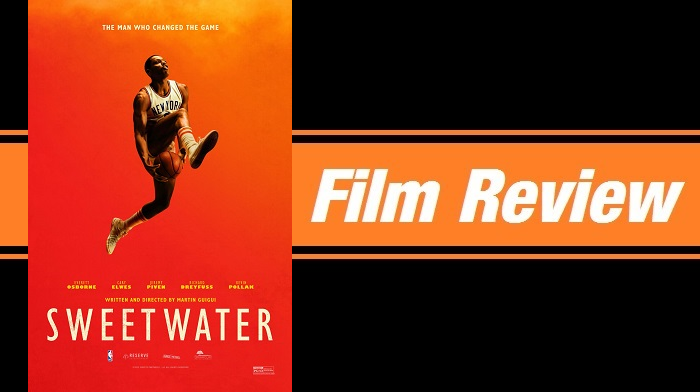
REVIEW: “Sweetwater” (2023)

(CLICK HERE to read my full review in the Arkansas Democrat-Gazette)

“Sweetwater” from writer-director Martin Guigui tells the powerful true story of Nathaniel ‘Sweetwater’ Clifton, a naturally gifted and talented basketball player who was among the first African Americans to play in the National Basketball Association. Born October 13th, 1922 in England, Arkansas, Nate Clifton earned his nickname “Sweetwater” from his unquenchable love for sugar water and his kindhearted and easygoing demeanor. He and his family would eventually move to Chicago where he excelled in high school basketball and football.

Clifton would go on to attend college at Xavier University of Louisiana before serving three years in the Army during World War II. After playing for the Harlem Globetrotters, he would sign a contract with the New York Knicks. He played his first game in the NBA on November 4, 1950, helping to break the color barrier and open the door for countless other players.

Image Courtesy of Open Road Films / Briarcliff Entertainment

In many ways “Sweetwater” fits right into that familiar sports drama mold. It has a moving true story as its inspiration. There’s plenty of drama added in for effect. It has that uplifting crowd-pleasing ending that we’ve come to expect from these kinds of movies. Yet there’s something truly endearing about Guigui’s storytelling (minus a small hiccup or two).

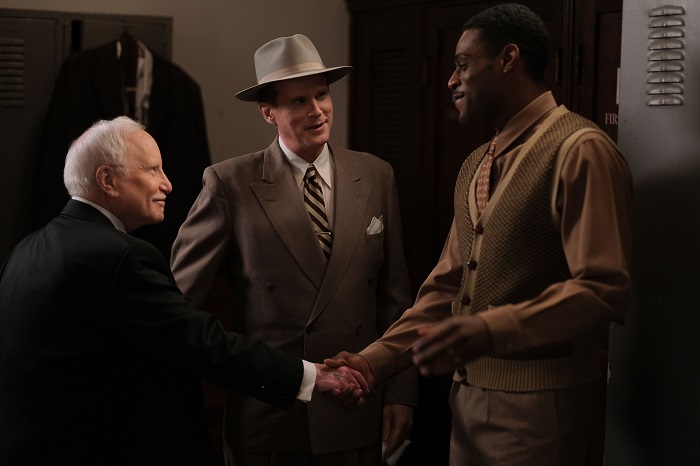
The story takes us back to New York City, 1949. The Harlem Globetrotters and their star Nate “Sweetwater” Clifton (well played by Everett Osborne) are taking on the NBA Champ Minneapolis Lakers in front of a packed house at Madison Square Garden. In attendance is Ned Irish (Carl Elwes), the owner and president of the NBA’s New York Knicks, and Joe Lapchick (Jeremy Piven), a former player and the Knicks’ head coach.

The Globetrotters were a traveling basketball team founded and owned by businessman Abe Saperstein (Kevin Pollak). Despite being considered by many to be the best team in the world, the Globetrotters were denied entry into the all-white NBA simply because their players were Black and they played a “razzle-dazzle” style of basketball. So Abe took them on the road where they played in everything from big city arenas to small barns in the boondocks.

While basketball plays a big part of the story, Guigui often looks beyond the sport, putting a lot of effort into portraying the various shades of racism these young men faced. While people loved to watch the Globetrotters play for their entertainment, the team still couldn’t get a hotel room or buy gas at a country gas station. They were turned away from certain clubs and were denied tables at restaurants. Even their payouts for performing were far less than the predominantly white teams they were playing against.

Image Courtesy of Open Road Films / Briarcliff Entertainment

After watching Sweetwater play, Ned and Joe immediately realize he’s something special. Joe wants him to play for the Knicks, but Ned is a bit hesitant, unsure of the kind of heat he’ll receive from the league’s other team owners. He does seem to have one ally – Maurice Podoloff (Richard Dreyfuss), the president of the National Basketball Association. A chunk of the film sheds light on the behind the scenes efforts to get Sweetwater into a Knick’s uniform, from the internal debates between Ned and Joe to the boardroom squabbles with other ownership. It’s not the most dramatic parts of the story, but I was glued to it.

While the movie does a good job capturing the essence of Nate Clifton’s journey, it dramatically changes many of the true-life details. This comes out most in the last 15 minutes when Sweetwater steps onto an NBA court for the first time. Guigui puts a lot of his own spin on the story, changing the team the Knicks played against and even the outcome of the game itself. There’s also some cheesy announcing thrown in and the final-act sentiment is knee-deep. Still it’s the ending we’re rooting for, especially after being given such a clear-eyed depiction of the racism, belittlement, and threats of violence Sweetwater faced. And all because he wanted to play the game of basketball. “Sweetwater” is in theaters now”.

VERDICT – 3.5 STARS

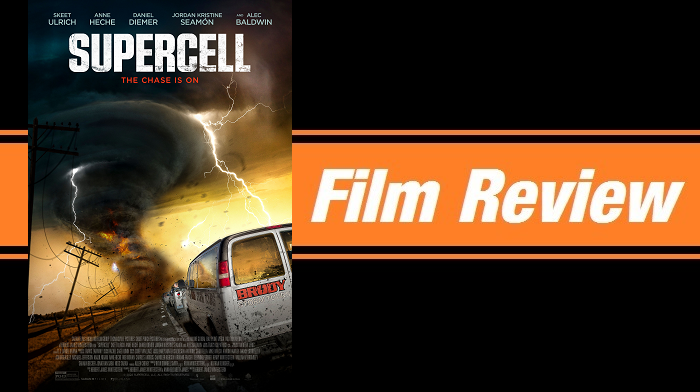
REVIEW: “Supercell” (2023)

Director Herbert James Winterstern takes a swing at the disaster genre (sort of) in his feature film directorial debut “Supercell”. As you can probably tell by the not-so-cryptic title, it’s a killer storm movie set in North Texas and the Midwest. That’s prime territory for a movie like this. Unfortunately the storm-chasing in this modestly budgeted feature never amps up the excitement the way it needs to. And the human drama (though well-intended) isn’t strong enough carry us through.

Winterstern knows his way around filmmaking, having worked as a producer, writer, editor, cinematographer, and in a number of other behind the scenes technical roles. Here he directs from a script he co-wrote with Anna Elizabeth James. Their story attempts to meld straight-up genre thrills with a rather tepid family drama. There’s certainly some heart behind certain characters and you can almost sense a Spielbergian influence in how Winterstern and James handle one teenage boy’s journey. If only the performances had the same voltage as the massive CGI storm cells looming over the plains.

“Supercell” features an interesting supporting cast. First is Skeet Ulrich (“Scream”) who has been popping up in several films lately. It’s good to see. Then you have Alec Baldwin who is currently embroiled in a legal battle following a fatal on-set accident while shooting the movie “Rust”. And there’s Anne Heche, appearing in one of the late actress’ final roles.

Image Courtesy of Saban Films

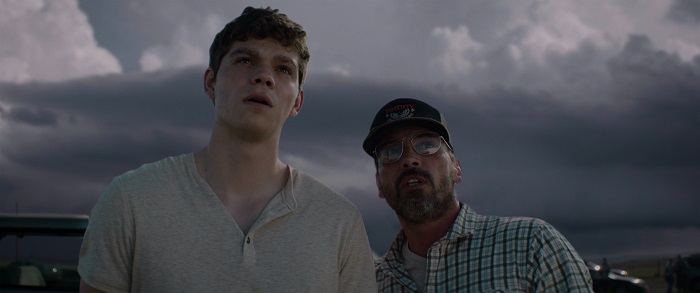
The lead is Canadian actor Daniel Diemer who plays Will Brody, the son of renowned storm-chaser Bill Brody. Ten years ago his father was killed chasing a massive tornado near Wichita Falls, Texas. Since then, Will has been raised by his struggling mother Quinn (Heche). She once worked side-by-side with her late husband studying storms. After moving to Florida and filing bankruptcy, she now works cleaning houses to provide for her son.

Lately Will has taken an interest in his father’s work, but Quinn is quick to discourage him. She wants Will to go to college. “It’s your way out, ” she reasons, fearing he’ll meet the same fate as his father. But one day Will receives an old journal in the mail that belonged to his dad. Ignoring his mother’s wishes, Will sneaks off and follows the return address to the Texas home of his uncle Roy (Ulrich).

Once a studier of storms himself, the embittered Roy now drives for a storm-chasing tour line (are those really a thing???) owned by the surly Zane Rogers (Baldwin). An angry Quinn gets word that her son is with Roy and heads to Texas with Will’s soon-to-be girlfriend (Jordan Kristine Seamón) in tow. But wouldn’t you know it, the mother of all storms is brewing which manages to bring all the parties together in its dangerous path for a predictable and rather hammy climax.

Image Courtesy of Saban Films

It’s hard to watch the movie and not see it as a low-budget take on “Twister” (there’s actually a terrific nod to that 1996 film and Bill Paxton that’s easy to miss). But to Winterstern’s credit he does a lot with the resources he has. There are some stunning wide angle shots showing off the ominous clouds building up across the horizons. And we get a couple of nail-biting moments of pure intensity, the best taking place during a brutal hail storm. Winterstern puts us inside Roy’s van as three-inch hail beats it to a pulp. His shooting and cutting of the scene is top-notch.

But too much of the story is handcuffed by predictability, contrivances, and some shaky character work. Ulrich is a nice fit for Roy, although the character could use more depth. Much the same, Baldwin gives a solid performance. But his character was all over the map and (especially in the final third) never made sense to me. Heche struggles and it’s hard to put a finger on why. Quinn in pretty straightforward, but Heche often feels out-of-sync. And poor Seamón is reserved to being a tag-along with no real story of her own.

There are a few other issues that bring the movie down a bit (getting off to a slow start, composer Corey Wallace’s dramatic yet overbearing score, etc.). But I do appreciate the movie’s attempt at making something other that digitalized disaster porn. While they aren’t quite realized the way they need to be, the characters are the centerpiece. Diemer is a sturdy enough lead and gives the movie a good anchor. But there’s only so much weight he can carry. Ultimately we’re left wanting more, both from the human drama and the computer enhanced storms. “Supercell” is now showing in select theaters and on VOD.

VERDICT – 2 STARS

REVIEW: “65” (2023)

(CLICK HERE to read my full review in the Arkansas Democrat-Gazette)

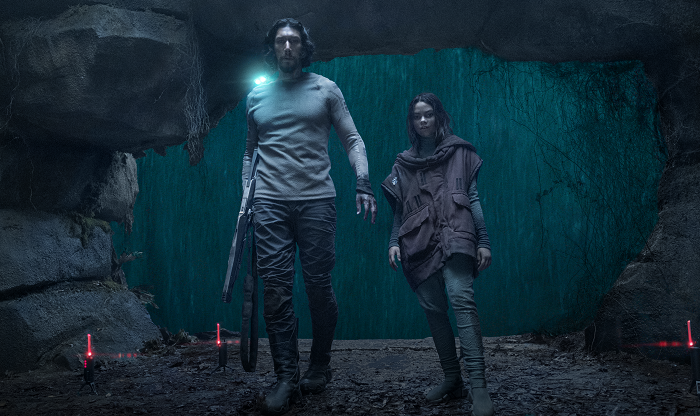
How does this sound to you: Adam Driver playing a space traveler who crash-lands on prehistoric planet earth and fights dinosaurs? There’s enough wackiness in that basic description to get me onboard with “65”, a lean, unambiguous, and all-around fun genre mash-up from the filmmaking team of Scott Beck and Bryan Woods. They’re the duo behind the tension-soaked 2018 horror-thriller “The Quiet Place”. Here they pluck genre ingredients of all kinds and mixes them together into an old-fashioned and surprisingly low-key stew. It’s a bit of science-fiction and a bit of horror. It’s a creature feature. It has a touch of character drama. There’s even a little B-movie schlock.

Some may be surprised to see Driver lend his sizable star wattage to a modest small-scale genre flick like this. And I can see where fans of his might go into it with bigger expectations than they should. But again, “65” delivers exactly what it advertises – nothing more and nothing less. It tells a linear story with no big surprises or unexpected twists. That may sound like a knock, but I actually like its simplicity and straightforwardness. I like its indifference to being something revolutionary or groundbreaking. And I like its taut 93-minute frame, which turns out to be all a movie like this needs.

Image Courtesy of Sony Pictures

If you haven’t already guessed, the “65” in the title is a reference to 65 million years ago “prior to the advent of mankind”. Driver plays a pilot named Mills. In a brief prologue we see him with his wife (Nika King) and their young daughter Nevine (Chloe Coleman) enjoying some family time at the beach on a faraway planet called Somaris. We learn Nevine is seriously ill, and Mills has accepted a job at triple his normal salary to help pay for his daughter’s treatment. The problem is, the job will keep him away from his family for two years.

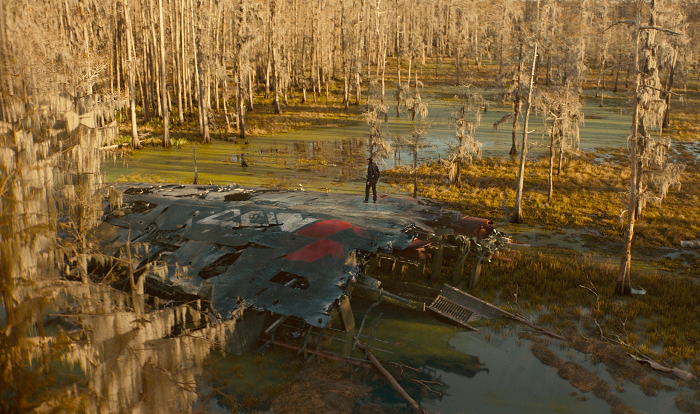
We then jump ahead one year. While his passengers and crew sleep in cryo-stasis, Mills pilots their long-range exploratory mission. Things are going smoothly until their ship flies into an asteroid field where they take catastrophic damage which sends them careening towards a nearby uncharted planet – our earth some 65 million years ago. The ship breaks apart while entering the planet’s atmosphere and violently crash-lands on the forest surface. Mills manages to survive but his human cargo aren’t so lucky.

Marooned on a mysterious unknown planet, all alone, and with no means of communication, Mills is content to resign all hope (we later see why he’s so quick to give up). But while exploring his strange new surroundings, he comes across a cryo-pod in some wreckage. Inside is a little girl close to his daughter’s age – her vital signs stable. From the ship’s manifest Mills learns her name is Koa (played wonderfully by Ariana Greenblatt) and she was traveling with her parents, both of whom were killed in the crash.

At first a reluctant Mills has no interest in taking on a father figure role. He finds communicating with Koa to be difficult (she speaks a language he doesn’t understand) and her presence sparks some painful feelings. Yet over time a bond forms between the two wounded souls. Even more, Mills feels a connection to his own daughter through Koa. So he determines to get Koa off the planet. But to do so will require them to journey nearly ten miles to the top of a mountain where a escape vessel from their ship has landed.

Image Courtesy of Sony Pictures

Of course they quickly learn that the planet they’re on is full of dangers and threats, many of the prehistoric kind. Soon they’re dodging scalding geysers, swatting massive bugs, and frantically running from carnivorous CGI dinosaurs of all shapes and sizes. Mills turns into the fatherly protector, blasting away at Raptors and T-Rexes with his space rifle and ushering Koa to safety. But Koa shows herself to be brave and resourceful. Together, Driver and Greenblatt have a warm chemistry, and they’re an easy pair to root for.

Filming took place in the pine-covered hills and hardwood bottoms of Louisiana’s Kisatchie National Forest which gives the 65 million-year-old landscapes both an alluring beauty and a forbidding sense of peril. DP Salvatore Totino bathes too many of his images in cold blues and grays, but the overall look is striking. And there’s a fun and ferocious variety of dinosaurs thanks to the teams at Framestore and Ghost VFX. It all adds a visual quality to a story that may be pretty light, but that is also very honest about what it is. And frankly, that was enough for me. “65” is out now in theaters.

VERDICT – 4 STARS