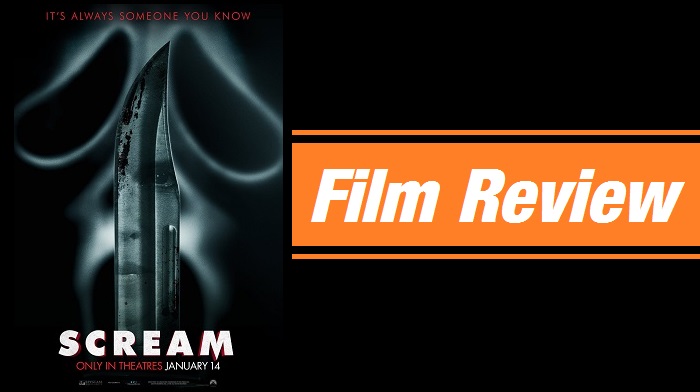
REVIEW: “Scream” (2022)

I still remember that December night in 1996. The late Wes Craven’s “Scream” had already been out a little over a week. I somehow convinced my wife of barely over a year to go see it with me. She didn’t like horror movies. I grew up on them. Thankfully we left the theater that night still happily married. That’s because not only did I enjoy “Scream”, but she did too. Well done Mr. Craven.

A fun, subversive and self-aware horror flick, the original “Scream” caught a lot of people by surprise. And while I never bought arguments that it dramatically changed the struggling genre, it certainly injected it with some much needed new energy. Not only did it launch its own series of sequels (one good, the others not so much), it also inspired a number of other blood-drenched young adult slashers, “I Know What You Did Last Summer” being the biggest.

But I don’t want to downplay the 1996 film’s impact. “Scream” was a blast and it knew how to utilize the genre’s strengths and have fun with all of its absurdities. It also did something that so many of its slasher predecessors couldn’t do – give us a broad cast of entertaining characters who we like being around and who are actually memorable. That’s a big reason why several careers were launched thanks to the movie.

Image Courtesy of Paramount Pictures

Co-directors Matt Bettinelli-Olpin and Tyler Gillett (“V/H/S”) set out to relaunch the series with their new film “Scream” (in keeping with the goofy horror movie trend of reusing the same title as the franchise’s first film). But the title isn’t the only thing they steal from the original movie. If you’ve seen the trailer you probably know it kicks off with a clear homage to the 1996 film’s iconic opening. The rest of the film features several other callbacks which range from fun fan service to unremarkably derivative. And then you get the final act which I won’t dare spoil. But let’s just say where the opening is a nice homage, the ending is a glaringly uninspired rehash.

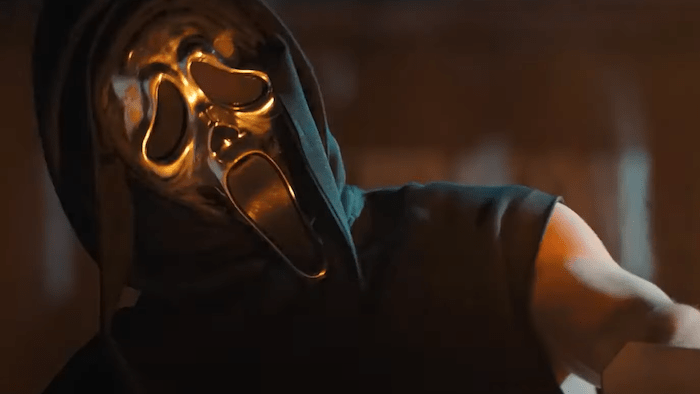
Storywise, it’s been twenty years since the last brutal killings in the little town of Woodsboro. But wouldn’t you know it, in the opening scene a teenager named Tara (Jenna Ortega) is terrorized and then violently attacked by a knife-wielding psycho in a Ghostface mask. Yet unlike the 1996 opening scene (which this one is clearly mimicking), here the victim survives despite being stabbed multiple times.

After getting word of the attack, Tara’s estranged sister Sam (Melissa Barrera), who works at a bowling alley in Modesto, rushes back to Woodsboro with her generic tag-along boyfriend Richie (Jack Quaid). While it first seems like a tender reunion, we soon learn there’s some serious baggage between the sisters which once unpacked gives us one of the film’s more outrageous twists.

Oh, and then there is Tara’s gaggle of friends, your normal group of twenty-something’s playing high-schoolers. I could list their names but there’s not much point. They’re basically just fodder for the killer, and each time one is savagely flayed we scratch them off the suspect list. And yes, the 1996 film had its group of party-hardy teens. But none in this new batch are remotely memorable or have half the personality and presence as Ulrich’s Billy, Lillard’s Stu, McGowan’s Tatum, or Kennedy’s Randy. The one saving grace from the new cast is Barrera who does the very best she can with the hit-or-miss material.

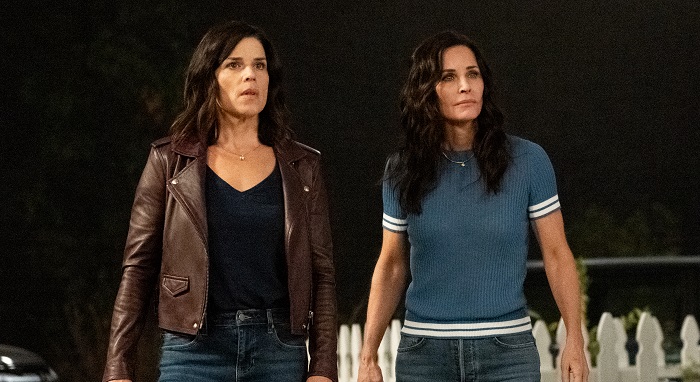
The biggest way “Scream” 2022 connects with the previous films is by bringing back the franchise’s most beloved legacy characters. Neve Campbell returns as Sidney, David Arquette as Dewey, and Courtney Cox as Gale. Without question it’s fun to see these three back in a “Scream” movie. At the same time, their roles here feel more nostalgic than important to the story.

This movie also embraces the same meta aspect which gave the original film its fresh and playful energy. But here it isn’t nearly as effective as the filmmakers want it to be. That’s because they go to it a few too many times. It often comes across as disingenuous, and while we see the actress speaking the words, all we hear are the writers trying to be clever. At other times it’s haphazardly crammed into scenes, to the point where the movie begins to resemble lazy self-parody rather than anything smart and/or creative. This is meta overload.

Image Courtesy of Paramount Pictures

While slasher movies aren’t known for having the smartest characters, I was surprised at the sheer number of dumb decisions people make in this one. Especially in a series that has made pointing out horror movie clichés and tropes a key part of its storytelling. It’s head-scratching to watch characters be so smart one minute and as dumb as a box of rocks the next; wisely suspicious for one scene but then forget to be in the very next one. You can argue that’s kinda the point,

Then you have equally baffling holes in the story’s logic. Like the police deciding to move Tara away from people to a completely empty floor of a hospital. Brilliant. Or the weird idea of hitting a wild party only a few hours after one of your best friends was brutally murdered. But my favorite might be Ghostface, not just taking four rounds from a .357 magnum at close range, but hopping back up like nothing happened? How does he survive? We don’t know. The movie forgets to tell us. Oh well.

A lot of this may sound like nitpicking, especially for a self-aware blood-drenched slasher movie. I don’t know, maybe I was expecting too much from “Scream” 2022. Perhaps I was wrong for thinking that resuscitating this old franchise meant they had something new to bring to it. Unfortunately, if you take out the handful of new faces and few grisly new kills, all you’re left with is a pretty run-of-the-mill horror flick. One that clearly respects Wes Craven’s original “Scream”, but spends too much time milking his ideas rather than coming up with fresh ones of its own. “Scream” is now showing in theaters.

VERDICT – 2 STARS

REVIEW: “Spider-Man: No Way Home” (2021)

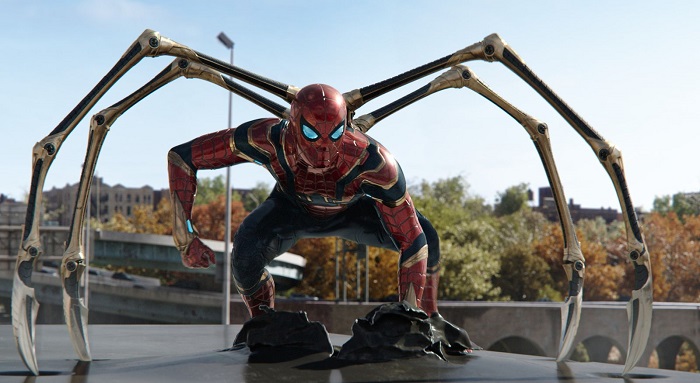
Another month, another new Marvel Cinematic Universe installment. But unlike the last two movies in the ever-growing MCU, this one actually feels important. The previous two films, “Shang-Chi and the Legend of the Ten Rings” in September and “Eternals” last month, were more about introducing new players and hinting at things to come. But “Spider-Man: No Way Home” had the feel of something significant, not only because it features one of Marvel’s most popular properties, but because its story felt like a genuine game-changer.

This is the third Spider-Man movie since Disney’s unorthodox partnership with Sony Pictures. Their first collaboration, 2017’s “Homecoming”, spent too much time rewriting Peter’s history in order to fit in the MCU. Their next film, 2019’s “Far From Home” felt more like a Spider-Man story and set things up nicely for what might be coming next. “No Way Home” not only pulls from those two movies, but from other films and streaming shows in the MCU catalog. And it definitely sets the table for some interesting but also confusing things to come.

Image Courtesy of Sony

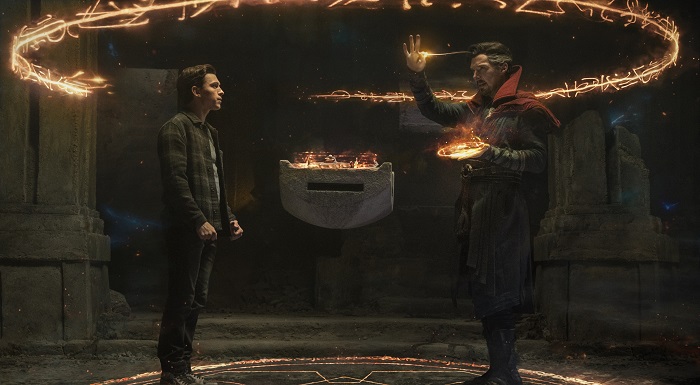
Tom Holland hops back into the red and blue spandex, but this time the stakes are more cosmic(ish). In fact, reality itself is in flux as Holland’s Peter Parker and a weirdly inept Doctor Strange (a returning Benedict Cumberbatch) botch a magic spell and inadvertently pull people from across the multiverse out of their worlds and into ours. How they do doesn’t make sense. Neither do the potential consequences. But returning director Jon Watts and screenwriters Chris McKenna and Erik Sommers are content with urging their audience to ‘just go with it’ and worrying about the explaining later.

The 25-year-old Holland effortlessly falls back into the role of Peter Parker, a character he has managed to make his own (And can we please get past the fruitless “Who’s the better Spider-Man” debate. Much like Tobey Maguire and Andrew Garfield, Holland offers his own fun and unique spin on the character). As the movie begins Peter is feeling defeated. Now that the world knows he’s Spider-Man (see the end of “Far From Home”) he finds himself thrust into the spotlight. Some call him a hero, others consider him a villain.

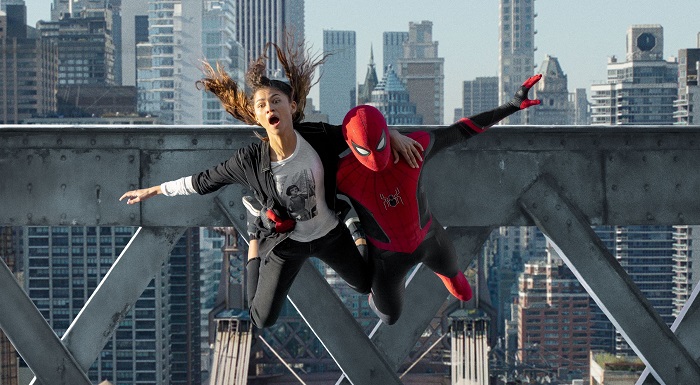
To make matters worse, those closest to him are starting to suffer due to his notoriety, especially his girlfriend MJ (Zendaya) and his longtime best friend Ned (Jacob Batalon). Tired of seeing his loved ones suffer, Peter seeks out Dr. Stephen Strange and asks him to conjure up a spell that would cause the world to forget he was Spider-Man. In a comically bumbling scene of hocus-pocus, the two accidentally open up the multiverse. Strange stops the spell and contains it before any damage is done.

Or so he thinks.

Image Courtesy of Sony

Soon villains from other universes (namely Sam Raimi’s “Spider-Man” trilogy from the 2000s and Marc Webb’s “Amazing Spider-Man” movies from the 2010s) begin popping up and terrorizing the city. Among them is Alfred Molina reprising his role as Dr. Otto Octavius, Willem Dafoe as Norman Osborn, Jamie Fox as Electro, and a few other unexpected surprises that’s better left unmentioned.

Watts is given a lot of story to cover and even more characters to manage. To his credit he mostly succeeds which is an impressive task in itself. There’s clearly broader franchise implications to what we see. But Spider-Man has always been best as a more intimate superhero story. Watts is able to balance both of those needs in a surprisingly satisfying way.

The movie is also helped by its terrific cast, most of whom know these characters like the back of their hands. I’ve talked about Holland, but the most pleasant surprise continues to be Zendaya and Batalon. I didn’t care for either of their characters in “Homecoming”. Both took a step up in “Far From Home”. Here they’re even better. Both Zendaya and Batalon have a good feel for who these characters are and they’re given material that really grounds them. Together with Holland, the three wonderfully convey one of the film’s most effective themes – friendship. Love, loyalty, sacrifice – it’s all captured in their relationships.

Image Courtesy of Sony

Also returning is Jon Favreau as Happy Hogan. And Marisa Tomei is back as the MCU’s unusual version of May (they drop the “Aunt” because it doesn’t carry as much sex appeal). Cumberbatch makes for a terrific Doctor Strange even if his role here is a pretty weird one. As for Dafoe and Molina, both veteran actors are terrific and you’d never guess it has been nearly 20 years since they last played these roles. There are some other performances I’d love to praise, but it’s best if you discover (and enjoy) them for yourselves.

“No Way Home” is a good looking movie with DP Mauro Fiore putting together some eye-popping action (there’s one sequence that takes place in a realm called the “mirror dimension” that is absolutely jaw-dropping). At the same time, the film has a lot of heart and it gives its characters more time to reckon with their emotions than the previous movies. It’s an emphasis on their humanity that I really responded to. There’s also some fantastic callbacks to previous Spidey films that not only excited me, but also the packed house of moviegoers I watched with.

Without question, there’s far more to like about “No Way Home” than to dislike. At the same time, parts of the story don’t really hold up once you start asking questions. Also, not every character decision works (sorry, I’m still not buying a Doctor Strange with so much ineptitude and such little foresight). And by the end, the direction of both the story and the MCU was murkier than before. But at some point all you can do is let the brains at the MCU hive-mind figure it out and then hope they’re able to bring it all together. It’s the best approach. Otherwise you risk missing out on all the enjoyment Spider-Man’s latest chapter has to offer. “Spider-Man: No Way Home” is now showing in theaters.

VERDICT – 4 STARS

REVIEW: “7 Prisoners” (2021)

Brazilian-American filmmaker Alexandre Moratto turned several heads at this year’s Venice International Film Festival with the world premiere of his piercing new film “7 Prisoners”. Set mostly in the backstreets of São Paulo, Brazil, the film sees Moratto and his co-writer Thayna Mantesso delving into the darker corners of the city and country to tackle some real-world issues that should shake us to our cores.

“7 Prisoners” is a tough-minded movie with a very no-nonsense approach to its subject matter. At the same time, Moratto makes sure that the human element remains firmly front-and-center. He does so through the character of Mateus played by the charismatic Brazilian newcomer Christian Malheiros. Mateus’ story is a painful and (hopefully) infuriating eye-opener that pulls back the veil on the abhorrent practices of slave labor, sweatshops, and human trafficking. These are horrors we tend to turn a blind eye to, mainly because they all too often contribute to our comforts. Moratto sets out to wake us up to the realities of what’s happening in São Paulo and across the world.

Image Courtesy of Netflix

The film opens in the rural Brazilian countryside where Mateus lives with his mother and two sisters. They are a loving group but they’ve had a hard life, doing their best to survive with what little they have. Mateus’ mother has labored to provide for her children, but years of low-paying farmwork has taken its toll. So 18-year-old Mateus jumps at the opportunity to go the city and do some contract work to support his family. In the film’s most tender and sobering scenes, Mateus’ mother gives him a new shirt for his trip. It’s hardly anything fancy, but its worth a month’s groceries to them. A van comes by to pick up Mateus and, along with three other area boys, he’s taken five hours away to São Paulo.

Moratto does a great job putting us in the shoes of these four young men. Not only by showing us where they’re from, but also during the van ride through the city. Their wide-eyed excitement as they’re driven through the bustling São Paulo sets us up for the unsettling reality that awaits them.

The driver drops them off at an inner-city scrapyard ran by a man named Luca (played by an excellent Rodrigo Santoro). The shady and evasive Luca gets the boys settled and gives them money to go out and enjoy themselves before their first day of work. But when he collects all of their IDs the next morning, we know this isn’t going to go the way the boys anticipated. In fact it’s much worse. Mateus and his friends find themselves caught in the gears of a modern-day slave system, one that’s driven and protected by people with enormous power.

Image Courtesy of Netflix

Moratto’s pacing is near perfect, shrewdly moving the story from point to point while pausing at just the right moments to uncoil the crumbling emotions of his characters. Mateus is especially compelling, caught in a no-win situation and eventually forced to make impossible decisions that will have painful repercussions regardless of what he chooses. To stress the point of his film, Moratto slyly gives us the occasional shot of the city’s bustling streets full of citizens freely walking about their normal days. It offers a sharp contrast to the cruel forced labor happening right under their noses.

With a bold and clear-eyed perspective, “7 Prisoners” offers a brutally honest challenge to a society’s apathy towards some well-documented abuses. Alexandre Moratto does a good job pulling us into his dark and ugly world that’s made all the more troubling by the fact that it’s very, very real. Great performances from Santoro and Malheiros anchor this revealing feature that’s not only a good pickup for Netflix, but a great opportunity for an important story to be told. “7 Prisoners” is now streaming on Netflix.

VERDICT4 STARS

Review: “Silent Night” (2021)

Camille Griffin’s “Silent Night” is a movie built around a compelling premise and with a great ensemble cast to see it through. Sadly, it’s a movie undone by some needless creative choices and a script that channels its ending well before the final act.

Griffin writes and directs this acidic dark comedy set predominantly at a remote country estate where a group of old boarding school friends come together for Christmas dinner. The weekend festivities are put on by Nell (Keira Knightley) and her husband Simon (Matthew Goode). They have three boys, the rude and dour Art (Roman Griffin Davis of “Jojo Rabbit”), and twins Thomas and Hardy (Gilby and Hardy Griffin Davis). Interestingly, the three boys are the director’s real-life sons.

Image Courtesy of RLJE Films

Within the first few minutes friends start to arrive. There’s the flirty and pointedly snobbish Sandra (a really good Annabelle Wallis) and her aggressively boring husband Tony (Rufus Jones). There’s James (Sope Dirisu) and his young American girlfriend Sophie (Lily-Rose Depp). And there’s the least interesting couple, Alex (Kirby Howell-Baptiste) and Bella (Lucy Punch). “Tonight is all about love and forgiveness,” Nell proclaims with both trepidation and uncertainty. Wishful thinking.

It doesn’t take long to realize that this gathering won’t be a joyous occasion. In fact, this is a dismal and toxic bunch whose friendly greetings quickly curdle into tactless insults and impudence. They would actually be fascinating to watch if Griffin’s writing didn’t handcuff them with her strange approach to dialogue. Every character (and I do mean every, including the children) spit profanity like they’re auditioning for a Tarantino movie. I’m not on a high horse, I just can’t figure out the point of it. The movie itself even makes an effort to reference its crude language more than once so it’s clearly an intentional decision. The problem is it feels intentional rather than natural and quickly becomes a distraction.

While the movie sets itself during Christmas, the holiday is nothing more than a plot device to get everyone together. A couple of ungainly gags and the strangely out of place Christmas music is really all the Yuletide allusions you can expect. Instead there’s something far more ominous behind their get-together. It turns out that they’ve gathered on the eve of the apocalypse. A noxious storm full of life-killing poison gas is sweeping across the globe. Scientists warn that inhalation is unavoidable and will lead to an excruciating death. As a result, the world’s governments have sanctioned a pill that will ensure a pain-free demise. It’s all part of their “Die With Dignity” campaign.

Image Courtesy of RLJE Films

As you can tell, the premise leaves plenty for Griffin to explore: moral questions, existential questions, sociopolitical questions, etc. Themes of mortality, government, science, and parenting just scratch the surface. It’s such fertile ground to dig into. Sadly, we have to wade through a lot of upper-crust bickering over petty nonsense to finally reach the point where the movie has something concrete to say. Yes there’s the occasional laughably one-the-nose conversation such as Simon talking to Art about immigration. But for the most part, it takes waiting for the final act to really get into the interesting stuff.

To the casts credit everyone gives it their all. Despite being handed mostly one-dimensional characters, there’s not a bad performance to be found. Knightley, Wallis, Dirisu, and Depp are especially good. But they can only carry so much of the load. While Griffin’s direction is savvy and efficient, her script is full of confounding choices that underserves the characters and squashes the film’s potential. It’s yet another example of a movie that left me wishing for what it could have been rather than enjoying what it actually is. “Silent Night” is set to release December 3rd.

VERDICT2 STARS

REVIEW: “Spencer” (2021)

(CLICK HERE to read my full review in the Arkansas Democrat-Gazette)

Kristen Stewart meets Diana, Princess of Wales in Pablo Larraín’s strange yet hypnotic “Spencer”, a hard to define psychological drama that describes itself as “A fable from a true tragedy.” In essence “Spencer” is a dark and sometimes gnarly fantasy taken as much from the imagination of a filmmaker as from the real-life history of one Britain’s most beloved yet troubled members of Royal Family.

With millions watching around the world, Diana Frances Spencer and Charles, Prince of Wales were married in 1981 at London’s St. Paul’s Cathedral. But after only a few short years the cracks in their marriage began to show largely due to the couple’s incompatibility along with their extramarital affairs. The press inevitably got wind of their strained relationship leading to them separating in 1992.

Larraín and screenwriter Steven Knight set their story in 1991, mere months before Charles and Diana’s highly publicized split. It’s Christmas time and the Royal Family are gathering at the Queen’s sprawling Sandringham House in Norfolk to celebrate the holiday in their own starchy and suffocatingly formal way. What Larraín gives us is a speculative imagining of what might have happened during that chilly three-day weekend.

Image Courtesy of NEON

Told almost entirely from Diana’s point-of-view, “Spencer” bucks the restraints of facts and uses its liberty to burrow into the murky psychology of the dispirited Princess. It has a lot in common with Larraín’s “Jackie” from 2016, another film about a prominent woman caught in the gears of a high-pressure machine. Here the storytelling uses everything from twisted dream sequences to blunt metaphors to the brooding and mannered Stewart in its efforts to get inside Diana’s head.

The movie opens with a series of spectacular shots of the Sandringham property, each bathed in a radiant dreamlike glow and accompanied by a cacophony of warped melodies from composer Jonny Greenwood. We watch as a convoy of military trucks loaded with what looks like weapons crates arrive on Christmas Eve. Soldiers march the crates to the kitchen where head chef Darren McGrady (Sean Harris) awaits. Inside them aren’t automatic rifles or explosives. Rather they’re full of exquisite edibles – iced-down lobster, fresh vegetables, exotic fruits. As the soldiers march out, McGrady’s brigade of cooks march in to begin preparations.

A short scene later, all the Royals have arrived with one exception. Diane zips along a country road in her black convertible, lost in an area that she should know well. It’s where she grew up as a child, only minutes away from Sandringham. She pulls into a small roadside cafe and steps out of the car. Her well-known face, stylish blonde bob and chic runway-ready wardrobe are dead giveaways. The Princess of Wales steps inside the meager establishment and casually asks the stunned patrons, “Where am I?”

The opening ten minutes give a good taste of the figurative language and dashes of absurdity sprinkled throughout “Spencer”. But it’s when Diane finally arrives at the Windsor estate that we get a better grip on what the movie is going for. Larraín’s camera stalks the unraveling Lady Di as she roams the long halls and shuffles from room to room (each adorned in stunning yet gaudy opulence by production designer Guy Hendrix Dyas). Diana skulks around to avoid the demanding first family, snapping at the unfortunate servants who come calling.

Image Courtesy of NEON

The stuffy unapproachable Royals are more story pieces than fleshed out characters. Charles (Jack Farthing) is portrayed as a leering unsupportive prig while Queen Elizabeth (Stella Gonet) is an imposing presence who speaks volumes with a look and a few words. But “Spencer” isn’t their story, it’s Diana’s. And the film takes aim at the Windsor’s haughty insulated existence every chance it gets. Only in the moments with her sons William (Jack Nielen) and Harry (Freddie Spry) do we see Diane happy, not as a princess but as a mother.

As the movie progresses it may seem like nothing’s going on, but eventually things come into focus. Larraín and Knight paint a vivid picture of a woman pushed to the brink by a smothering, oppressive aristocratic machine. Uncomfortable scenes revealing depression, self-harm, and bulimia highlight the depths of her decline. But then there’s a shift as Diana begins to take control of her life. And as the title suggests, she’ll need to look to her past before she can move forward.

The metaphors can get too obvious and not all of Larraín’s liberties work (most notably a peculiar and underdeveloped friendship between Diana and her fictional dresser played by Sally Hawkins). Yet it’s hard not to be sucked into this deliciously irreverent spin on British Royalty that won’t win any fans within the House of Windsor, but should win over any remaining Kristen Stewart skeptics. It’s the performance of her career and one that you’re going to hear a lot about this awards season. “Spencer” is out now in theaters.

VERDICT – 4 STARS

REVIEW: “Sweet Girl” (2021)

Netflix’s “Sweet Girl” starts with a bang. The very first scene sees none other than Aquaman himself Jason Momoa standing on the roof of PNC Park in Pittsburgh. The blinding spotlight from a police helicopter beams down on him while FBI agents quickly converge. “It wasn’t supposed to be like this”, he painfully utters before leaping off the ledge and plunging deep into the Allegheny River.

That harrowing opening will be revisited later in “Sweet Girl”, a fast-moving propulsive thriller from first time feature film director Brian Andrew Mendoza. The movie has a lot on its mind and is full of ambition which is something I always respect. But (of course) it’s possible to bite off more than you can chew and sometimes things look better on paper than they do on screen.

The story (co-written by Philip Eisner and Greg Hurwitz) follows its energetic opening by taking us back several years where a loving family of three unravels after the matriarch dies of cancer. To make matters worse, we learn that a generic version of a drug that could have extended her life was squashed by a wealthier and more powerful pharmaceutical company called BIOPRIME. These early scenes are some of the film’s best and they do a good job conveying the pain that drives her widow Ray (Momoa) and their daughter Rachel (Isabela Merced) through the rest of the movie.

Image Courtesy of Netflix

Six months pass and Ray is still mourning and hanging on by a string. He’s contacted by a spooked journalist with damning evidence linking the soulless and smarmy BIOPRIME CEO (Justin Bartha) to all sorts of nefarious shenanigans. Ray wants to hear more, but soon he finds himself and Rachel neck-deep in a conspiracy that very powerful people will do anything to keep quiet.

A dead body or two later and the daddy-daughter duo are on the run from the FBI, armed corporate goons, and one particularly psychopathic hitman (Manuel Garcia-Rulfo). Meanwhile big pharma and Congress buddy up and Ray learns the corruption goes a lot deep than one greedy company.

It goes without saying that “Sweet Girl” delves into a lot of relevant material worthy of exposure and critique. And does an admirable job pointing a finger at some very real issues. But that’s about all it does, and it’s surface treatment doesn’t really get to the heart of the problem much less how to fix it.

Image Courtesy of Netflix

But in the movie’s defense it’s not really going for anything like that. Instead Mendoza crafts what amounts to a throwback action thriller that allows the beefy Momoa to let loose in a number of intense and well-shot fight scenes. It’s a pretty solid performance from Momoa who’s only outdone by Merced who has a youthful innocence but also a grit and tenacity that really amps in the final act.

Aaaaand about that final act. It would be a dereliction of duty if I didn’t mention the ‘big twist’ that turns the entire movie on its head. In one sense I love the audacity and to be honest, I worked hard to try and make it work. But it’s such a wild and outrageous turn and making it fit with everything we’ve seen before is too much of a chore. A second viewing does make sense of a few things, but not enough to fully buy what the movie is trying to sell.

The film does have its share of good scenes (there’s a terrific diner scene yanked straight from Michael Mann’s “Heat”) and the action is exciting more often than not. There’s also a good father/daughter chemistry between Momoa and Merced that drives most of the story and legitimately makes us care. At least until the movie pulls the rug out from under us with a plot twist that’s far more gutsy than effective. Still, Mendoza kept me locked into his story, confused and frustrated at times, but entertained throughout. And sometimes that’s all I really need. “Sweet Girl” is now streaming on Netflix.

VERDICT – 3 STARS