REVIEW: “Stillwater” (2021)

Tom McCarthy’s new drama “Stillwater” turned several heads and caught many by surprise during its recent premiere at Cannes. On the surface the film looked and sounded like an action thriller about a father leaving his home and going abroad to save his daughter. But that tissue-thin reading misses what the movie is after. “Stillwater” is much more of a character piece and human study built around one of the best performances of Matt Damon’s career.

As an actor, Matt Damon‘s versatility is too often overlooked. From “Good Will Hunting” to the Bourne films; from “Oceans” to “The Martian”; from the grimy underworld of Scorsese’s “The Departed” to the offbeat zaniness of Soderbergh’s “The Informant!”. Damon has been in westerns, war movies, and biopics. And in just a couple of months we’ll see him as a medieval knight in Ridley Scott’s “The Last Duel”. That’s the kind of résumé he brings to “Stillwater” where he takes on the role of stoic Oklahoma roughneck Bill Baker.

Image Courtesy of Focus Features

Damon and McCarthy spent weeks imbedded with real Oklahoma oil drillers both at home and on the job in an effort to get Damon’s character right. Their research paid off and Bill Baker comes off as a real person rather than some bad Red State caricature. That’s crucial because the movie needs for us to believe in Bill but more importantly connect with him on a human level. It’s absolutely necessary.

McCarthy opens his story by giving the audience a snapshot not only of Bill‘s life, but of blue-collar living that will resonate with some and feel completely foreign to others. A shut-down oil rig leaves Bill unemployed and forced to take low paying construction jobs. In the opening scene he’s helping clean up debris in a tornado-ravaged trailer park. After getting paid he stops at a Sonic drive-in and orders a foot-long cheese coney with a large cherry limeade. He takes it home to his small wood-framed house, asks a blessing over his simple dinner and then eats. The evening ends with him sound asleep on the couch with nothing but the flickering glow of the television lighting the room.

That short but detail-rich opening gives us a good sense of the attention McCarthy and Damon give the character. And we get even more when Bill boards a plane and flies to Marseilles, France to visit his daughter Allison (Abigail Breslin) who’s in prison for a murder she says she didn’t commit. Allison has been behind bars for five years and her repeated claims of innocence falls on deaf ears. The local government has no interest in reopening or relitigating her case which is a position Bill just can’t accept. He gets nothing from Allison’s lawyers and he can’t afford the private detectives. So he sets out on his own following a trail that may or may not provide the answers he’s looking for.

There’s a fish-out-of-water element to “Stillwater” that’s essential to the story and rarely played for laughs. Back home Bill would effortlessly blend in, with the kind of average Joe appearance that people would pass and never take notice. But in Marseilles he sticks out like a sore thumb. His thick bushy goatee, a camo cap, his Carhartt button-up shirt tightly tucked into his dark blue Wrangler blue-jeans. And that’s just the physical barrier. There are also language and cultural walls that Bill runs into face-first. In many instances he tries to ram through them rather than look for a door. It’s a compelling part of the story, but it’s also where McCarthy’s scolding touch can get a little heavy.
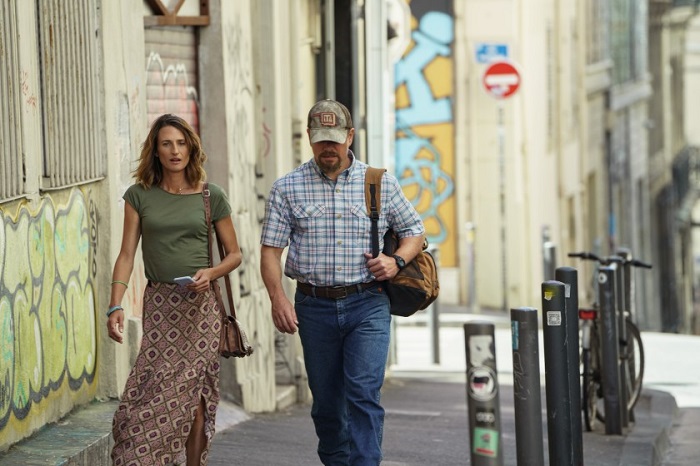
Image Courtesy of Focus Features

Some of Bill’s enlightenment is predictable – an unsophisticated Okie goes to a foreign country and has his eyes opened – you know the story. And we get some good scenes involving both Bill’s stateside smugness and the local condescension he faces. But much more interesting than Bill’s culture clash or his quest to exonerate his daughter is the deeper and more personal journey Bill takes. Much of this comes after he meets a sympathetic single mother named Virginie (a terrific Camille Cottin) and her precocious young daughter Maya (Lilou Siauvaud). The relationship Bill develops with them brings out a side he didn’t know he had while offering him a chance at personal redemption.

Much like he did with his 2015 film “Spotlight”, Tom McCarthy gives his story all the time it needs to play out. At a hefty 140 minutes, “Stillwater” may stick around a little too long for some audiences. You could probably prune several scenes and the movie would still be fine. But I prefer McCarthy’s approach which keeps the characters front-and-center, giving them and their relationships room to grow even if it means running a little long. “Stillwater” is now showing in theaters everywhere.

VERDICT – 4 STARS

REVIEW: “Snake Eyes: G.I. Joe Origins” (2021)

As an die-hard reader and fan of Marvel’s G.I. Joe comic series through most of 1980’s, it still blows my mind that the “Real American Hero” hasn’t had its own successful movie franchise. It’s not for lack of trying. The first attempt came with 2009’s tolerable but not great “The Rise of Cobra”. They tried again in 2013 with the hammy and utterly forgettable “Retaliation”. Considering the wealth of great material in Larry Hama’s terrific comic book run, it was a shame that they couldn’t get a film series off the ground.

It’s been eight years and they’ve decided to give it another go, this time by focusing on the franchise’s popular and most recognized characters. “Snake-Eyes: G.I. Joe Origins” is exactly what it sounds like. It’s a full-on Snake-Eyes origin story that clearly intends to kickoff a new and rebooted franchise. But as I watched, I couldn’t get past how dated it felt. It looks like a modern movie; the action scenes and the production design all look current day. But I kept wondering if G.I. Joe’s heyday had come and gone? Are there still enough people attached to the brand to be excited for a new franchise? Have they missed their window?

Image Courtesy of Paramount Pictures

Longtime fans of the character will instantly notice that this a modernized Snake-Eyes’ origin. It takes some bare basics from his backstory and puts together its own version. It makes sense to write out certain details such as his military service in Vietnam. I’m just not convinced that what we get as a replacement is that much better. Even more, for a movie hoping to launch a G.I. Joe cinematic universe, it’s shocking how inconsequential G.I. Joe ends up being to the story.

“Snake-Eyes” comes from German director Robert Schwentke working from a script by Evan Spiliotopoulos, Joe Shrapnel and Anna Waterhouse. The hunky Henry Golding plays the titular lead character who we first meet well before he becomes a butt-kicking ninja commando for the Joes. Here he’s an angry vengeful drifter fighting in warehouses for small change and searching the globe for the thug who killed his father when he was just a child (see the short prologue for all the details).

Snake ends up going to work for Kenta (Takehiro Kira), a gangster with Yakuza ties who claims to have resources to track down Snake’s father’s killer. When Snake’s best friend Tommy (Andrew Koji) is caught betraying the Yakuza, Kenta orders Snake to execute him – a show of loyalty if you will. Instead Snake turns on Kenta and helps Tommy escape. As a show of gratitude, Tommy takes Snake to his family’s Clan Arashikage in Tokyo where the two men’s friendship make up the backbone of the movie.

Golding (who blew up in “Crazy Rich Asians”) puts a good face on the Snake-Eyes character and for the first 30 minutes of so he gives us a reason to care about Snake’s journey. But then the movie gets bogged down by several missteps in the writing room. First there is Snake’s drawn-out initiation into Tommy’s clan that gets sillier with each “test” he takes. Then there’s the decision to make the long-standing feud between the Arashikage and Kenta’s gang the film’s central focus. It makes for a good standalone story but it’s a weird choice for a movie meant to jump-start a completely unrelated franchise.

Image Courtesy of Paramount Pictures

And that leads to the biggest issue, one that will probably sour and bewilder a big chunk of the fanbase. It’s mind-blowing how insignificant G.I. Joe and Cobra are to the story. Both come across as afterthoughts, wedged in out of obligation and lacking any depth or detail. Their paper-thin connections to the narrative come completely out-of-the blue and are far too contrived to be meaningful. We do get two fan-favorites Scarlett (Samara Weaving) and Baroness (Úrsula Corberó). Both actresses fit their parts and do the best they can. But neither can make their characters seem relevant or necessary.

“Snake-Eyes” isn’t necessarily a ‘bad’ movie. It has all the polish of a big studio action picture and a cast who does a good job bringing these characters to life (keep your eye on Koji who has great intensity and a remarkable presence). With the exception of a couple of fight scenes marred by headache-inducing shaky cam and chopped to pieces in the editing room, the choreography and set pieces are impressive. But it’s brought down by the story’s slow patches, the weird mystical goofiness, and the odd choice to leave G.I. Joe on the backburner. Snake-Eyes doesn’t even put on his signature mask and visor until the final scene. How does that happen? “Snake-Eyes: G.I. Joe Origins” opens today in theaters.

VERDICT – 2 STARS

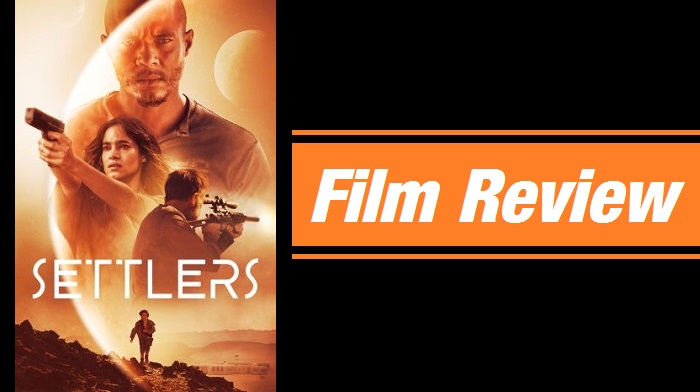
REVIEW: “Settlers” (2021)

Fans of minimalist yet immersive science-fiction need to keep their eyes out for “Settlers”, a beguiling British thriller written and directed by Wyatt Rockefeller. The movie tinkers with some of the genre’s most recognizable tropes, using them to create a somber and melancholic examination of human nature. And while it’s true that this type of moody contemplative sci-fi doesn’t draw the same crowds as the showier action-packed epics, it’s still a warm reminder of how rich and diverse the genre remains.

Set (mostly) in the confines of a single location, “Settlers” does a great job of utilizing its setting. But it’s the story’s strong human focus that stands out most. A first time feature film director, Rockefeller shows a keen understanding of the kind of movie he wants to make. And he has the discipline to stick with his vision rather than go down some easier and more conventional paths that would have made this a different and much less-effective movie.

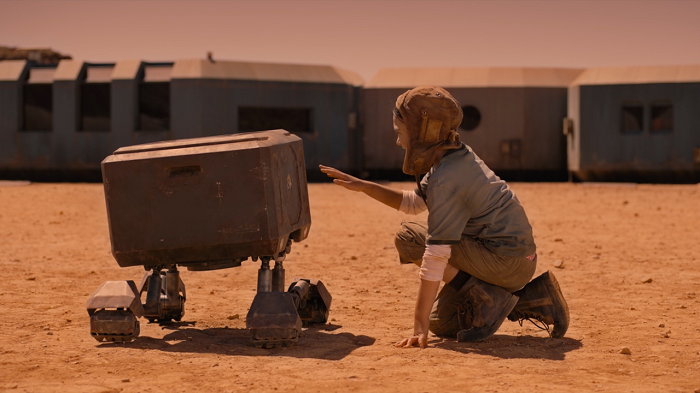
The story uses a three-chapter structure which at first seems like a needless device but ends up making sense considering the film’s use of perspective. Everything unfolds through the eyes of a young girl named Remmy (played in the first two chapters by a sublime Brooklynn Prince). She lives with her parents Ilsa (Sofia Boutella) and Reza (Jonny Lee Miller) on a remote run-down settlement on Mars, nestled in a valley surrounded by stark craggy ridges. Her parents insist they’re alone, but there’s an unshakable sense that they known more than they’re letting on.

Image Courtesy of IFC Midnight

Remmy only knows life with her parents. She’s never seen another human and earth is nothing more to her than a glowing speck in the star-filled sky. Her father Reza fills in the blanks with hazy answers to her questions: “Earth isn’t what it once was,” and “We left because we wanted something more.” But other than that it’s mostly left to her imagination. Reza tries to encourage Remmy with unconvincing promises that things will one day be “just like earth.” But Remmy is suspect and so are we.

The “we are alone” ruse is shattered when the family wakes up to find the word “LEAVE” smeared across their window. Soon after, in a tense and skillfully framed encounter, three armed intruders in dusty tactical gear enter the settlement. Both Reza and Ilsa fend them off, but in a flash the facade of domesticity and security is shattered. Even worse, Remmy is faced with the painful realization that much of what her parents have been telling her is a lie. There lives are upended even further when Reza leaves to secure the perimeter and doesn’t return. Instead a mysterious stranger named Jerry (Ismael Cruz Córdova) arrives.

From there the film evolves into a slow-simmering chamber piece with Jerry moving in and staking a claim to the settlement and Ilsa protecting Remmy with a mother bear ferocity. Jerry and his intentions are shrouded in mystery and Córdova’s steely restraint ensures that we never get a firm read on him. Meanwhile Boutella is a revelation, portraying Ilsa as quiet but tenacious and full of grit. Her maternal instinct mixed with her will to survive makes her a fascinating yet formidable presence.

Image Courtesy of IFC Midnight

But from the very start the story revolves around Remmy. Prince’s sparkling breakthrough performance in 2017’s “The Florida Project” was overflowing with youthful energy. It’s amazing to see her dial it back to such a degree. Through her we watch a young girl’s dreamy optimism slowly dissolve as she gets a better grasp of her bitter reality. Prince gives us our emotional center and does a terrific job setting up a final chapter that jumps ahead several years. Nell Tiger Free plays the older Remmy and does a good job adding new layers to the character.

As mentioned, “Settlers” is deliberately paced which is just the right speed for this type of intimate and contemplative outer space drama. But the story does take a significant leap in the last act that could have used more buildup. It’s a dramatic and weighty turn yet it feels as if we missed something important that gets us to that point. The actual ‘thing’ that happens is incredible effective, but this is easily a case where less isn’t more.

As “Settlers” eases from a simmer to a boil the story’s bleakness becomes more evident. It feeds into the film’s idea that no matter where we go, we can never escape the ugly side of human nature. Yet there are moments of sympathy and compassion, such as younger Remmy befriending a robot she names Steve. It’s considered nothing more than “a tool” by the others, but she treats it with kindness and empathy which proves helpful later on. These are the interests that lie at the heart of “Settlers”. And as we work our way through them you can’t help but be pulled in by Rockefeller’s savvy direction and his evocative setting. The curious side of me wishes his approach wasn’t so subdued and that he hadn’t left so many blanks unfilled. But it’s hard to be frustrated when the end results are this good. “Settlers” releases July 23rd.

VERDICT – 4 STARS

REVIEW: “Space Jam: A New Legacy” (2021)

In can be difficult giving a nostalgia-driven movie a fair shake when you have no emotional connection whatsoever to what it’s reflecting on. It’s why I almost didn’t review “Space Jam: “A New Legacy”. I wasn’t a fan of the original “Space Jam” back in 1996 so understandably I hold no attachment to it today. Perhaps that lack of connection or attachment is one reason I sat with a cold blank stare through most of this stand-alone sequel. Perhaps that explains why I not only entered it with utter indifference but left caring even less. Or maybe it’s just a bad movie. That’s what I’m going with.

“Space Jam: A New Legacy” is one big airball for Warner Bros. and the film’s star LeBron James. It’s not so much a movie as it is one massive marketing exercise with WB using it to highlight their many IPs and James using it to boost his brand. Some have called it “a shameless cash grab” and I’m sure there’s some of that. But for the most part the entire production plays like one big, long, excessive advertisement that ends up being one of the most grating movie experiences I’ve had in 2021.

Image Courtesy of Warner Bros.

The film comes from director Malcolm D. Lee working from a script written by a team of SIX screenwriters. That’s often a pretty good sign of where things are heading. The story is your basic father-son reconciliation bit. Playing himself, Lebron is an overbearing dad who can’t understand why his youngest son Dom (Cedric Joe) would rather design video games than play basketball. Lebron’s wife Kamiyah (Sonequa Martin-Green in a thankless role) chides her husband, telling him that Dom needs a father, not a coach. Wise words but of little value in a movie like this.

Later, LeBron and his family are invited to the Warner Bros. lot for a pitch meeting with some empty-headed studio execs. They want to make LeBron their next big movie star (hilarious considering the god-awful performance he gives in this movie). The studio’s cutting-edge algorithm named….ahem…Al-G Rhythm (poor Don Cheadle) has developed a way to scan LeBron’s likeness and inject it into their other properties like “Justice League” and “Game of Thrones”. LeBron hates the idea and turns down the offer which infuriates the fame-craving algorithm.

Al-G Rhythm lures LeBron and Dom into the Warner Bros. server room where he somehow sucks them into a digital world that he calls the “Serververse”. In order to get out with his son, LeBron will have to assemble a team and defeat the algorithm’s Goon Squad in a no-rules basketball game. As dumb as it sounds there is a method to the algorithm’s madness. It’s just so glaringly inconsequential that you won’t care. The main thing is LeBron puts together a team of classic Looney Tunes characters including Bugs Bunny, Daffy Duck, Wile E. Coyote, Tweety, and so on.

In truth, none of the family stuff carries much weight and none of Al-G Rhythm’s mischief really matters. It’s all there just to get us to the big basketball game which is nothing more than a deluge of chaotic slapstick and cringe-worthy gags that seems to goes on for eternity. And while there are no rules to the game, there doesn’t seem to be any rules for the filmmaking either. Lee and company apparently threw everything that came to mind at the screen resulting in a hollow 40-minute assault on the senses. And for anyone looking to torture me, making me sit through that excruciating Porky Pig rap sequence again would be unbearable.

Image Courtesy of Warner Bros.

Back to James, no one is going into “Space Jam: A New Legacy” expecting him to be a revelation. And most people would probably be content with him being forgettably average. But his performance here ranges from remarkably bland to so bad it’s distracting. And while I don’t mean to pile on him, we laughed more his stiff and unnatural line delivery in any of the film’s countless gags. Michael Jordan was never in any danger of getting an Oscar nomination for his performance in the original film. LeBron should be the instant front-runner for a Razzie.

Some may argue that this is just a kids movie and such scrutiny is unfair. But Pennywise, The Matrix, Game of Thrones, A Clockwork Orange, Casablanca, The Godfather – these are references we get that certainly aren’t aimed at children. And those are just a few of the movie’s innumerable cameos and callbacks. It ends up being hard to choose what’s most annoying, the relentless lionizing of LeBron or WB’s brazen self-promotion. Either way, it’s pretty clear that story, characters, good humor, and heart took a back seat to the misguided corporate priorities. Even the classic Tunes, the only real reason to watch this thing, feel like props there to fill space rather than have any fun and meaningful impact. “Space Jam: A New Legacy” is now showing in theaters and streaming on HBO Max.

VERDICT – 1 STAR

REVIEW: “Spring Blossom” (2021)

The provocative French drama “Spring Blossom” looks at an ill-advised romance between a teenage girl and an older man from the perspective of a 20-year-old first time filmmaker. Suzanne Lindon writes, directs, and stars in this evocative coming-of-age story that she penned when she was fifteen and directed five years later. Her debut has a very French sensibility and introduces the audience to a young filmmaker with a really bright future.

Lindon (the daughter of French actor Vincent Lindon and actress/singer Sandrine Kiberlain) approaches her story from an interesting angle. She makes no judgments throughout the film’s lean 73-minute runtime, only observations. And she doesn’t make this about predatory seduction or angry teen rebellion. It’s more specifically a film about adolescence and a 16-year-old girl caught in that hard-to-navigate space between childhood and adulthood.

Image Courtesy of Kimstim

Cozily set in Paris’ picturesque Montmartre, Lindon plays the lead character also named Suzanne who has a life many kids would envy – good grades, plenty of friends, a stable home with loving parents. Yet despite comforts and privilege, she finds her self disillusioned with people her own age. It’s not that she’s an outcast. All of her classmates seem to genuinely like her. But she’s bored with them and feels as if she doesn’t belong. It’s perfectly encapsulated when Suzanne is asked to rate the boys at party on a scale of 1 to 10. “If I really had to do it, I’d give everyone a 5“.

Lindon shoots the scenes with Suzanne and her friends in a way that really highlights this disconnect. Suzanne looks like a puzzle piece that doesn’t quite fit. Even her deep black hair stands out in the seas of blonde and reddish tints. Lindon also uses several clever touches that illustrate Suzanne’s position between childlike innocence and burgeoning maturity. My favorite may be two posters on her bedroom wall. One is of Disney’s animated children’s classic “Bambi”. The other is of the much more adult Maurice Pialat film “À nos amours” (which once had the working title “Suzanne”).

During her walks to and from school, Suzanne begins noticing and soon becomes infatuated with a frustrated theater actor named Raphaël (Arnaud Valois). In a harmless stalker-like fashion she begins observing him, watching as he sits at a cafe, takes a smoke break outside the theater, or works on his broken-down scooter. Inevitably he starts to notice her too and after a few awkward encounters the two begin a lightly breaded romance.

Image Courtesy of Kimstim

You would almost call it sweet and innocent if not for the discomfort of the one big detail. He’s 35 and she’s 16. The film’s mostly chaste treatment of the relationship still doesn’t hide its ickiness. And having Suzanne not only instigate the romance but also control its direction doesn’t make it easier to digest. Interestingly it takes a while for her preoccupied parents (Frédéric Pierrot and Florence Viala) to notice something’s up. For a while they greet Suzanne’s wave of unusual questions or her sudden interest in wearing makeup with puzzled looks and a shrug of the shoulders. Yet the daughter/parents relationship that Lindon gives us is built on a very organic picture of love, trust, and maybe a dash of naïveté.

Yet there’s a lot to say for the film’s honesty especially coming almost exclusively from the younger girl’s perspective. And Lindon’s point-of-view is an intriguing mix of style and empathy. Take the handful of impromptu interpretive dances that are used to express true emotional connection between Suzanne and Raphaël. Some of these scenes don’t fully feel in sync with the rest of the movie but they are bold and audacious. And it’s a far cry from conventional storytelling which is pretty impressive coming from a filmmaker just beginning what could be a wonderful career in cinema. “Spring Blossom” releases in select theaters May 21st.

VERDICT – 3.5 STARS

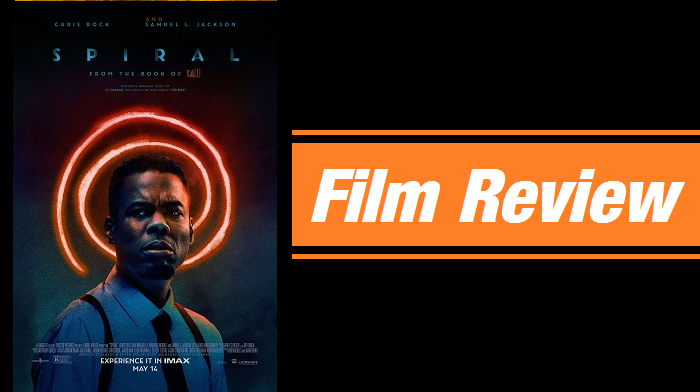
REVIEW: “Spiral: From the Book of Saw” (2021)

Before getting into the new film “Spiral: From the Book of Saw” I have a confession: I’ve never really connected with the “Saw” series. I haven’t seen all of the movies. I don’t fully understand the allure. The franchise’s success is a puzzle I just can’t solve. I say all of that to stress that I’m not well versed in the Saw-verse (is that a term?) and that I don’t come to this ninth installment (yes…nine!) with any sense of attachment. Does that help or hurt my thoughts on “Spiral”? Considering the sometimes hard to read pulse of fandom, I’ll let you determine for yourself.

I will say the trailers for “Spiral” caught my attention in a way “Saw” movies never have before. They teased a new direction for the franchise – going the route of a gritty and grisly crime thriller in the vein of Fincher’s “Se7en”. Despite hesitations over casting Chris Rock as the film’s lead, I was still interested to see if “Spiral” could pull the series away from its tortuous central conceit and onto something fresh and inspired. To the film’s credit it does try something (kinda) new, but suffice it to say “Spiral” is certainly no “Se7en”.

Image Courtesy of Lionsgate

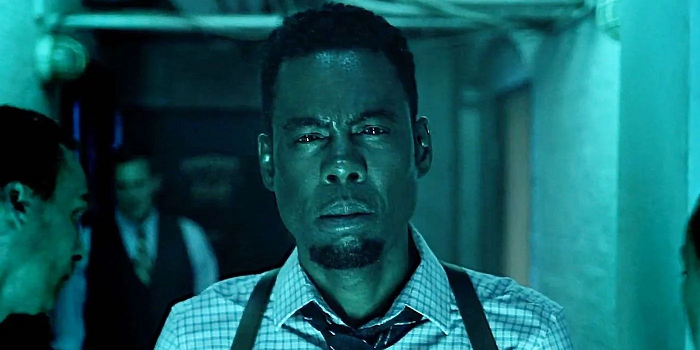
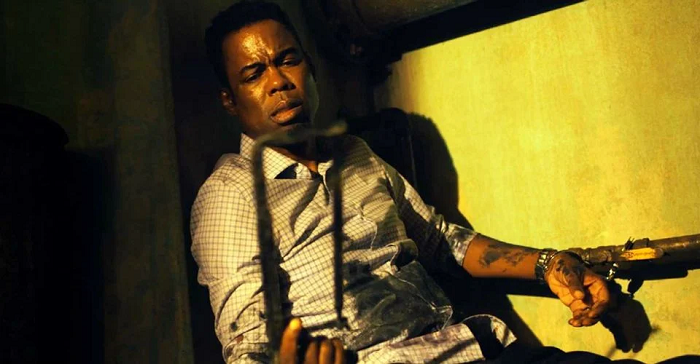
In case die-hard franchise fans were worried, the movie kicks off with a gruesome Saw-like opening, assuring the audience that there would be no shortage of blood and viscera. From there it shifts to Rock’s character, Ezekiel “Zeke” Banks. He’s a homicide detective living in the shadow of his father and former police chief Marcus Banks (Samuel L. Jackson). Zeke is generally hated by the other officers in his precinct who have labeled him a rat for turning in a dirty cop. Unable to trust the other detectives, he often goes at it alone much to the chagrin of his shouty and perpetually angry Captain (Marisol Nichols).

As punishment for failing to report his undercover work, Zeke is assigned a rookie partner Detective William Schenk (Max Minghella). You’ve seen it before – the sour and cynical veteran paired with the young enthusiastic family man who carries around a picture of his wife and newborn baby and can’t wait to get out on the streets. He doesn’t have to wait long. Soon the two are neck-deep in a murder case that has all the markings of a Jigsaw copycat. But this is a psychopath with a social conscious and on a not-so-subtle crusade for police reform.

“Saw” alum Darren Lynn Bousman directs from a script written by Josh Stolberg and Peter Goldfinger. In one sense their movie does precisely what it intends to do – it manages to differentiate itself from its predecessors by offering a new spin on the series. But on the other hand, “Spiral” does little to distinguish itself from countless other better made police thrillers. The film is overflowing with hard-boiled cop movie tropes and head-scratching details and oversights that you can’t help but laugh at. It does maintain a grim and nasty tone, so much so that its few vain attempts at humor land with a thud. But tone alone can’t immerse you into a world. You can see “Spiral” working hard to pull in its audience much like Fincher did with “Se7en”. Sadly it never happens.

Image Courtesy of Lionsgate

And then you have Chris Rock . The 56-year-old comedian goes for it and gives it his all, yet I was never convinced I was seeing his character. Instead I was always seeing Chris Rock playing Zeke. From his confused squinty expressions to his constant yelling, comedic traits he’s always been known for end up seeping into his performance. And he’s not helped by the relentless f-bomb saturated dialogue which calls back to so many of his earlier stand-up routines. In his defense, there are a handful of welcomed moments where he dials down the volume and we see flashes of the dramatic turn he’s going for. But the character and the story need considerably more than he can ultimately give.

At times “Spiral” can be gnarly, brutal, and borderline sadistic which is exactly what the “Saw” movies have always promised. Yet it barely feels like a “Saw” film. If not for the three or four signature torture contraptions scattered throughout you could easily dismiss this as just another bland and uninspired police procedural. It makes an effort to add some weight, but the ham-fisted social commentary and the not-so-big twist does little to help. So we’re left with something that feels kinda new for the long-running franchise, but deep down is nothing we haven’t seen before. “Spiral” opens in theaters tomorrow (May 14th).

VERDICT – 2 STARS