
REVIEW: “Star Wars: Skeleton Crew”

It has been nearly six years since a new Star Wars movie has been released on the big screen. During its absence, the Galaxy Far, Far Away has made a temporary shift to streaming television – a move that has resulted in several highs and a few unfortunate lows. Arguably its biggest misfire was last year’s “The Acolyte”, a mess of a series surrounded by outside noise but with significant flaws that stood out despite the ongoing drama.

For reasons that are completely unfair, following right behind “The Acolyte” was an unenviable spot for any new series. Such was the scenario for “Skeleton Crew”, a new Star Wars installment from the creative minds of Jon Watts and Christopher Ford. Sadly it seems “Skeleton Crew” felt the effects of its streaming predecessor, falling below the viewership numbers of every previous Star Wars series. That’s unfortunate because there’s a lot to like about this charming and spirited adventure.

“Skeleton Crew” is every bit a coming-of-age tale that takes its inspiration from such classic kid-driven 80s movies as “The Goonies”, “E.T.”, and “Explorers”. It’s also very much a Star Wars adventure, albeit one that is very comfortable existing as a self-contained story. That’s not to say there aren’t things introduced that will explored in future Star Wars projects. “Skeleton Crew” features many things familiar to franchise fans and it expands established lore in some interesting ways. But it can also stand on its own with no trouble whatsoever.
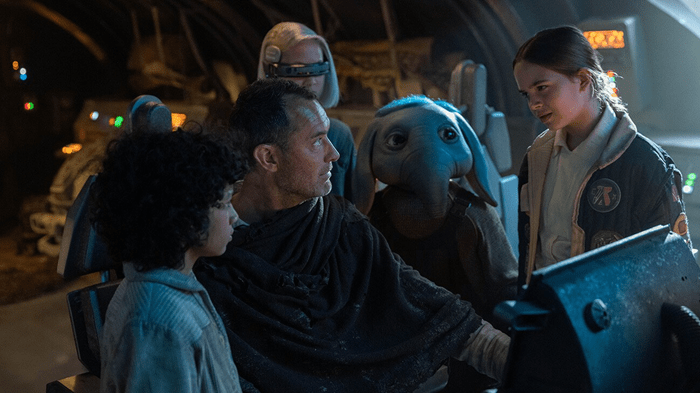
Set roughly five years after the fall of the Galactic Empire, “Skeleton Crew” shares a point on the Star Wars timeline with other streaming series, most notably “The Mandalorian”. The story begins on the intentionally hidden planet of At Attin. Considered to be a myth by most in the galaxy, At Attin is shrouded by a huge gaseous cloud that gives it the appearance of a toxic and uninhabitable world.

But underneath is a peaceful and domesticated society with all the markings of a highly developed utopia. Its people live in comfortable, well-manicured subdivisions. The adults all contribute to something they call “The Great Work” while their children attend school until graduation after which they join their parents in their planetary duties. In reality, the people of At Attin have lived under a technocracy for generations. They are essentially a brain-washed workforce who believe their perceived safety and security is worth being cut off from the galaxy.

But it’s all disrupted by four curious kids, Wim (Ravi Cabot-Conyers), Fern (Ryan Kiera Armstrong), KB (Kyriana Kratter), and Neel (Robert Timothy Smith). They discover a buried hatch which Wim is convinced leads to a Jedi temple like the ones in his storybooks. But after opening the hatch the foursome quickly learn they’re in an old starship. And after some very kid-like antics, they accidentally trigger the auto-launch which rips the ship from the ground, sends it soaring through the defensive orbit, and racing through hyperspace.

From there the show turns into the kids trying to find their way back home. In the process, Watts and Ford whisks them (and us) away to under-explored reaches of the vast Star Wars galaxy. And in vintage Star Wars fashion, we’re introduced to a number of characters, none more compelling than a mysterious force-sensitive pirate named Jod Na Nawood (Jude Law). He takes the kids under his wing, agreeing to help them get home. But does his real interest lie in helping the kids or in discovering the secrets of At Attin?

The eight episodes are helmed by an interesting collection of directors. The strongest installments come from Star Wars regular Bryce Dallas Howard and Watts. The weakest come from the Oscar-winning duo the Daniels and also Watts. Filling out the group is David Lowery, Lee Isaac Chung, and Jake Schreier. Even with the slow-moving setup of the opener and a lone filler episode later on, the series builds a strong story arc and surrounds it with some solid worldbuilding.

Even better is the evolution of the characters. The four kids fit into some pretty familiar archetypes. There’s the starry-eyed dreamer, the assertive tough-talker, the all-business tech guru, and the timid but loyal best fried. But the performances are delightful and each character is a very different person by the story’s end. It also helps to have Jude Law – a stabilizing anchor who immediately feels right at home in the Galaxy Far, Far Away. “Skeleton Crew” is now streaming on Disney+.

VERDICT – 3.5 STARS

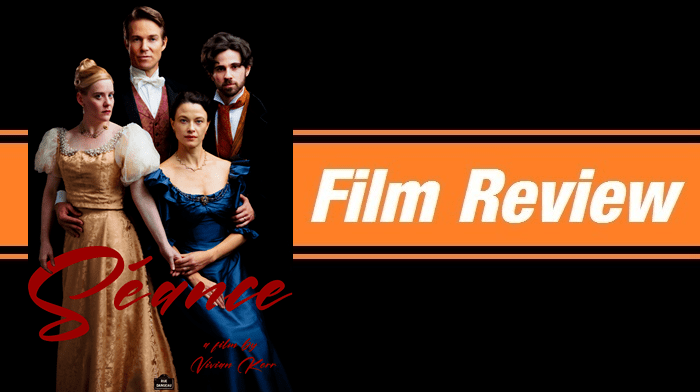
REVIEW: “Séance” (2024)

Finding something original in the densely populated horror genre isn’t easy. But writer, director, and co-star Vivian Kerr manages it in her compelling and character-rich horror drama “Séance”. Kerr mixes the supernatural with the psychological in framing her eerie Victorian era chamber piece. But at its core, “Séance” is a strikingly human relationship drama that lures us in with its chilling atmosphere before enthralling us in an unfolding story that would rather us think than jump out of our skin.

Kerr is no stranger to thoughtful character explorations as evident by her terrific 2022 film “Scrap”. With “Séance” she shows similar interests although with a deeper and more involving focus. Her latest centers around four complex people, each hiding their own emotional baggage behind fragile facades of happiness and contentment. But it’s not long before those thinly constructed walls start to crumble.

An extraordinary Scottie Thompson leads the film’s small but superb cast. She plays Emma Strand, a published novelist who is six months into her second marriage. She and her husband Albert (Connor Paolo) reside in Texas but have traveled to California for some vacation time on the beach. While there, the couple run into Emma’s first husband George Ford (Jilon VanOver) and his wife Lillian (played by Kerr). The rather awkward meeting leads to a dinner invitation which the Strands uncomfortably accept.

The rest of the film plays out in the Fords’ dimly lit, shadow-draped mansion which Lillian inherited from her late parents. Throughout its lean and efficient 85 minutes much is revealed about the characters, both as couples and individuals. Emma is exhausted by Albert’s constant doting and frustrated by his lack of intimacy. Albert has allowed his insecurities to impact his marriage, so much that he’s been keeping things from his wife.

As for the Fords, both are still reeling from the loss of their young daughter Hazel who tragically drowned eight months earlier. George has suppressed much of his grief, concentrating more on providing for his wife than dealing with his own sorrow. Lillian has had a much tougher time. She was with Hazel when the child died and the guilt has left her an emotional wreck. Now she’s convinced her daughter’s spirit is still present in their house and is trying to communicate with her.

Everything eventually comes to light after Emma and Albert agree to stay the night rather venture out into a torrential storm. More troubling truths are revealed and new tensions are exposed. To top it all off, Lillian convinces everyone to participate in a spooky séance complete with creaking floors, flickering lights, a shaky chandelier, and a levitating table. Though well executed, the séance seems a little out of the blue. But its importance becomes clear later on, even if everything about it isn’t fully explained.

But all in “Séance” comes back to its four flawed central characters. Kerr shrewdly unwraps them so that each manages to earn our sympathies and our reproach. But most importantly, she maintains their human pulse which enables us to understand their feelings and motivations, at least until final 15 minutes or so. Surround them with Kerr’s assured direction and you have a thematically rich, elegantly shot, and exquisitely acted dark mystery/relationship drama that’s focused more on the spirits within its characters than any haunting specter without.

VERDICT – 4 STARS

REVIEW: “Stream” (2024)

Blood on the ground means points on the board.” That is both a tagline and motto for the highly imaginative and gleefully gory “Stream” – a horror feature built by slasher enthusiasts for slasher enthusiasts. Without question, “Stream” is a true labor of love from many of the folks behind the Terrifier series. They were able to get their movie made thanks to a lot of dedication, a helpful crowdfunding campaign, and the gnarly vision of director, editor, co-writer, and co-producer Michael Leavy.

“Stream” is built upon a gonzo concept which (in vintage slasher form) seeks to maneuver us from one spectacularly gory kill to the next. It’s a hearty feast for genre lovers, serving up helpings of creative carnage impressively brought to screen through the practical makeup and effects wizardry of Terrifier’s Damien Leone. But its concept is wildly entertaining outside of the kills with its terrific setting, wacky premise, self-aware humor, and handful of killer cameos (which I won’t dare spoil).

Written for the screen by the tandem of Michael Leavy, Jason Leavy, Robert Privitera, and Steven Della Salla, the bulk of the story takes place in a newly renovated rural Pennsylvania hotel called The Pines. Roy Keenan (Charles Edwin Powell) and his wife Elaine (Danielle Harris) feel their family is in desperate need of a getaway. So along with their rebellious 17-year-old daughter Taylor (Sydney Malakeh) and tech-obsessed 11-year-old son Kevin (Wesley Holloway), they book themselves a fun weekend at The Pines.

But upon arrival it’s pretty obvious (at least to us) that something is off. There is no internet, no cell service, and no phones in the rooms. There’s also no Mrs. Spring (Dee Wallace), the hotel’s kindly owner who the Keenan family know from past stays. Instead they’re greeted by the antsy Mr. Lockwood (Jeffrey Combs). Among the colorful array of other guests are two hunky French twenty-somethings, a crusty retired cop, an obnoxious drunk and his frustrated wife, three partying frat kids, and a handsy newlywed couple.

Unfortunately for our hapless guests, their reservations aren’t for a relaxing stay at a nice country inn. Instead they’re fodder in a brutal game hosted by Mr. Lockwood. In this game, the guests find themselves locked inside the hotel as four masked psychopaths stalk and savagely slay them for points. The more stylish and creative the kill, the more points they score. As they do, Mr. Lockwood broadcasts the competition on the dark web for a worldwide audience who bet big money on their favorite killers. It’s warped, depraved, and slyly indicting.

Mr. Lockwood’s four maniacal “all-stars” are the methodical #1 (Jason Leavy), the sadistic siblings #2 and #3 (David Howard Thornton and Liana Pirraglia), and the brutish #4 (Mark Haynes). While none of them utter a word, Leavy finds a way to give each of them their own sickly twisted personalities. And those personalities inevitably leak over into their kills which run the gamut of grisly and deranged.

As you might expect, it can be comical how characters and their actions don’t always make sense. And it’s best not to think too hard at certain junctures in the story. Yet as any fan knows, slasher movies have a style and spirit all their own. And that’s a big reason so many of us enjoy them. But “Stream” doesn’t just settle for following formula. Leavy and company let their imaginations soar, taking some big original swings and having a blast doing it. Even better, slasher fans will have a blast as well.

VERDICT – 3.5 STARS
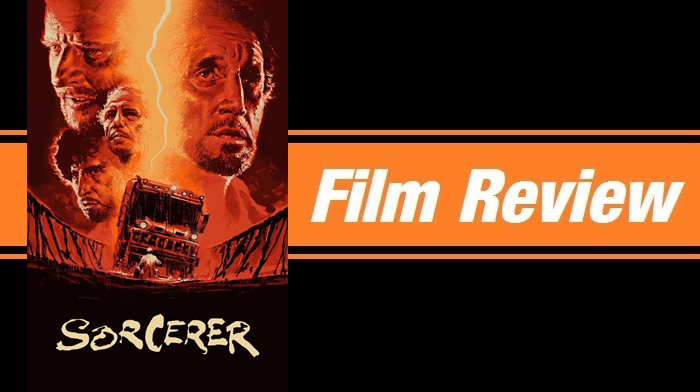
RETRO REVIEW: “Sorcerer” (1977)

What started as a modest side project evolved into one of director William Friedkin’s very best films and one of the unheralded masterpieces of the 1970s. Released in 1977, “Sorcerer” was Friedkin’s feature film follow-up to his enormously popular “The Exorcist” and it couldn’t be a more different movie. Given the massive success of “The Exorcist”, Friedkin was pretty much given carte blanche for whatever he chose to do next.

But as his vision grew, notoriously so did his budget. Friedkin’s insistence on filming on location deep in the jungle and his intense dedication to a documentary-style authenticity led to expensive shoots and costly delays. To make matters worse, the movie was not well received by critics. And its troubles were only compounded when it released in the same window as George Lucas’s groundbreaking “Star Wars”. As a result, “Sorcerer” earned back less than half of its production budget.

Here’s the thing, while Friedkin’s ambition pushed production to (and sometimes past) its limit, that very ambition is the fundamental reason “Sorcerer” is a truly great movie. His determination to shoot on location and his commitment to realism cements the very foundation of the film and impacts everything including the austere visuals and nontraditional storytelling. As for the critical response, there has been a significant reassessment in recent years with the movie finally getting the positive appraisal it deserves.

Image Courtesy of Universal Pictures

Written for the screen by Walon Green (his first script since penning 1969’s “The Wild Bunch”), “Sorcerer” is based on Georges Arnaud’s 1950 novel “Le Salaire de la peur”. Of course “Sorcerer” isn’t the first adaptation of Arnaud’s book. That honor belongs to director Henri-Georges Clouzot’s acclaimed 1953 thriller “The Wages of Fear”. Many have referred to “Sorcerer” as a remake of Clouzot’s film. But Friedkin rejected that notion, stating his focus was always on Arnaud’s original source material.

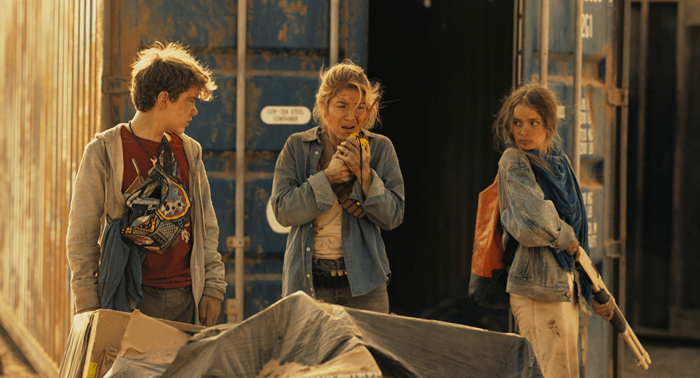
The film opens with a prologue that plays out through four vignettes. Each is dedicated to an unsavory criminal and the crime that put them on the run. In Mexico, an assassin named Nilo (Francisco Rabal) neatly executes an unsuspecting target. In Jerusalem, a terrorist named Kassem (Amidou) is the only member of his group to escape after detonating a bomb in the city. In Paris, a crooked businessman named Victor (Bruno Cremer) is about to be charged for fraud. And in New Jersey, an Irish gangster named Jackie (Roy Scheider) gets in hot water after his crew steals money that belongs to the Italian Mafia.

Among its several themes, “Sorcerer” is a cynical treatise on the inescapable hand of fate. That comes fully into focus once all four men end up in the same small impoverished South American village of Porvenir. Friedkin and his cinematographer John M. Stephens (who took over for Dick Bush) render the village with jaw-dropping authenticity. Every frame is teeming with detail and there is a tangibility to everything – the sweat, the rust, the grime, the despair.

Porvenir is essentially a forsaken spot marred by poverty, corruption, and unrest – a place where hope is as foreign as prosperity. There our four criminals take on aliases and go about their individual lives, laying low and working menial labor for low pay. But fate reemerges following a massive explosion at a nearby oilfield that’s ran by an American oilman named Corlette (Ramon Bieri).

To extinguish the raging fire Corlette needs to cap the oil well. But he needs dynamite to do it. And the only available dynamite is miles away in an old shed deep in the jungle. To make matters worse, the dynamite has sat in crates for nearly a year and is seeping nitroglycerin making it dangerously unstable. But Corlette is desperate. So he heads back to Porvenir in search of four experienced truck drivers, offering a big payday for anyone willing to transport the dynamite to the oilfield.

Image Courtesy of Paramount Pictures

The offer brings together Jacki, Victor, Kassem, and Nilo, each needing the money if they’re ever to get out of Porvenir. And that sets up the tension-drenched second half which follows the four men as they attempt to navigate two trucks, carrying three cases of dynamite each, across 218 miles of mountainous jungle terrain. Along the way they face muddy roads, treacherous bridges, and torrential rainstorms, all while transporting cargo that the tiniest vibration could cause to explode.

This is where Friedkin’s filmmaking reaches its pinnacle as he creates scene after scene of white-knuckle suspense. None are more harrowing than them crossing a dilapidated suspension bridge as their trucks are battered by violent winds and sheets of rain. Meanwhile the character work remains strong as the four strangers bound by fate are forced to work together if they’re to have any hope of surviving. Nothing close to friendships ever form, making their relationships feel more grounded. And we find ourselves thoroughly invested in seeing these ‘bad guys’ through to the end.

With “Sorcerer”, William Friedkin pushed aside all traditional methods of big screen storytelling to make something uniquely timeless. Its world is cruel and forbidding; its characters are flawed and unglamorous; its story is dark and downbeat. But those are hardly faults. “Sorcerer” remains top-tier cinema and a true 70’s hallmark that’s highlighted by immersive storytelling, strong performances, and extraordinary craftsmanship. And as the film’s more recent reassessments have shown, those are the kind of things that never age out.

VERDICT – 5 STARS

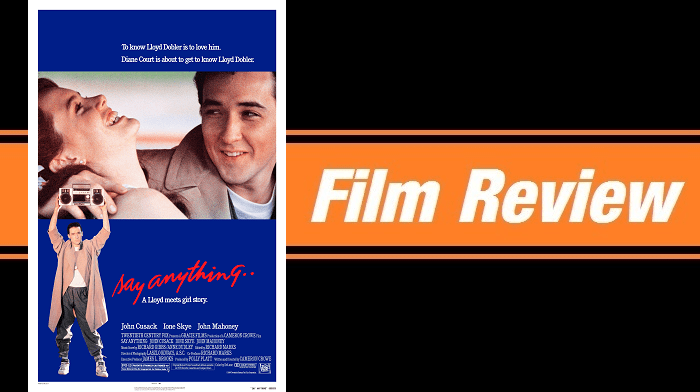
Retro Review: “Say Anything…” (1989)

Mere weeks before I was set to graduate from high school in 1989 Cameron Crowe made his directorial debut with the teen dramedy “Say Anything…”. At the time teen flicks were a dime-a-dozen and they often fell into many of the same categories. You had the genuinely funny comedies, the schmaltzy fluff, the all-out raunchy ones, etc. Many of them relied on the same tropes, the same character types, the same jokes, and the same basic storylines.

But “Say Anything…” felt different. A big reason is because Crowe gave us authentic and relatable characters rather than annoyingly shallow caricatures. He clearly cared for them which carried over to his audience. Also, he didn’t rely solely on the popular teen movie or rom-com formulas of the time. There are a few familiar beats, but Crowe’s interests lie beyond them. It wasn’t enough to earn huge numbers at the box office, but the movie has stood the test of time.

Image Courtesy of 20th Century Studios

Crowe’s script is laced with good humor which is well delivered and almost always comes at just the right time. Yes, there’s a sweet romance and plenty of teen-oriented drama at the story’s center. But it’s the well developed and emotionally layered characters that keep us invested. Crowe makes them easy to connect with and even easier to root for.

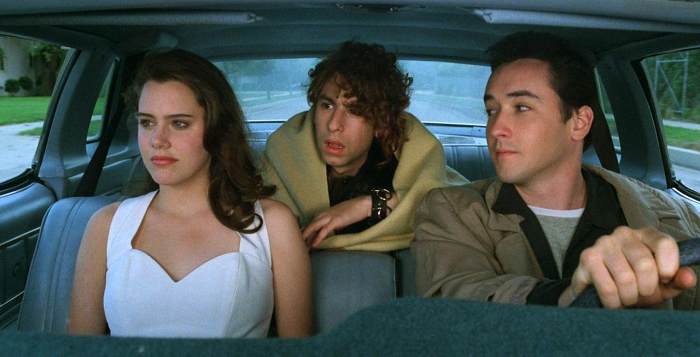
The story begins on graduation day at a small Seattle, Washington high school. John Cusack plays Lloyd Dobler, an average everyday student with no clear vision for what he wants to do with his life. He’s a straightforward guy who has a thing for Diane Court (Ione Skye), the class valedictorian. On paper they’re far from a perfect match, which Lloyd’s best friend Corey (Lili Taylor) is happy to point out.

Both Lloyd and Diane have their own struggles which Crowe takes time to explore. Aside from his uncertainty about his future, Lloyd’s parents are overseas, leaving him to live with his sister and nephew. Their absence creates a void for the rudderless Lloyd. Meanwhile Diana is the smartest girl in school which has distanced her from her entire class. She doesn’t have any close friends and her lone confidant is her caring father Jim (John Mahoney).

As you can guess, Lloyd and Diane eventually connect. Their feelings towards each other are genuine yet their personal problems complicate things in a variety of ways. Interestingly, the story features a lot of talk about honesty. Lloyd is honest and sincere which plays a big part in his connection with Diane. Meanwhile her relationship with her father is built entirely on honesty and trust. And just like in real life, when trust is broken it can often carry heavy consequences.

Image Courtesy of 20th Century Studios

Cusack shines as Lloyd, relaying ample amounts of teen enthusiasm and nervous energy while bringing an innocence and vulnerability to his character. Skye gives an overall good performance despite going a little too big at times which can make her stand out for the wrong reasons. Mahoney is especially good as Diane’s father, dodging many of the conventional ‘movie dad’ traps and playing a bigger role in the film’s second half.

“Say Anything…” is now 36-years-old but it still maintains a freshness within a genre that has often felt tired and stale. It’s a film that examines teens through a fair-minded lens, seeing them as regular people with real-world feelings and their own complexities. Cameron Crowe’s screenplay still hits its marks and his direction is sharp. And while it still feels very much like a 1980’s movie, it has a grounded human quality that never ages out.

VERDICT – 4 STARS

REVIEW: “Survive” (2025)

The title says it all in “Survive”, a fun and fittingly propulsive French feature that mixes disaster and survival thriller elements into one entertaining cocktail. Directed by Frédéric Jardin and written by Matt Alexander, “Survive” follows a stranded family of four fighting for their lives following a cataclysmic global disaster. It’s nothing you would consider strikingly original, but it remains enjoyable throughout.

“Survive” opens with some table-setting script that reads “Since its formation, the Earth has experienced five mass extinctions. The sixth is just beginning.” And just like that we get a good idea of the experience we’re in for. Jardin and Alexander don’t waste time digging into the hows and whys of the catastrophe that’s set to unfold. Instead they take a straightforward genre approach – setting the stakes, building tension, and ratcheting up the peril for a taut and fast-paced 85 minutes.

Image Courtesy of Samuel Goldwyn Films

Somewhere off the coast of Puerto Rico, Cassie (Lisa Delamar), her husband Tom (Andreas Pietschmann), and their two kids Julia (Émilie Dequenne) and Ben (Lucas Ebel) are spending a few days on their mini yacht in the Caribbean Sea. After a fun evening celebrating Ben’s 13th birthday, their trip takes a terrible turn when the Earth’s poles suddenly reverse. Burning satellites begin falling from the sky and the changing currents below sends the ocean waters rushing inland.

As the winds and waves violently ravage their boat, the family is knocked out. They wake up to find what’s left of their boat grounded on a ridge of what was once the ocean floor but is now a vast desert wasteland. Obvious questions immediately come to mind that the movie never attempts to answer. Just know that the ocean now covers the mainlands presumably wiping out huge numbers of the planet’s population.

Stunned and stranded, the family now must figure out how to survive. The first thing Tom does is get the radio working. He makes contact with a fellow oceanographer named Nao (Olivier Ho Hio Hen) who was deep sea diving when the waters retreated. Nao informs them that his instruments indicate the water will come rushing back within a week’s time. Left with no other options, the family sets out on the long and arduous trek to Nao’s submersible vessel that sits miles away.

Image Courtesy of Samuel Goldwyn Films

If racing against the clock wasn’t enough, their journey grows even more perilous with the sudden appearance of a creepy stranger (Arben Bajraktaraj). And then there are the thousands upon thousands of flesh-eating crabs from the deep, starving and driven mad by the oxygen. They make for an admittedly goofy yet wildly entertaining addition that speaks to the movie’s genre affections.

Jardin deserves a lot of credit for what he accomplishes with a reportedly meager budget. Shot on location in Morocco, Jardin creates vast and desolate landscapes that provide a fittingly forbidding setting which he uses to great effect. And the digital effects we get are used strategically and help ramp up the excitement. Sure, it’s all pretty silly and the character choices don’t always make sense. But the family dynamic adds some emotional stakes while the crisp pacing never lets our eyes wander from the screen.

VERDICT – 3.5 STARS