REVIEW: “Star Wars: Tales of the Empire” (2024)

Dave Filoni wears many hats within the wonderful world of Star Wars. He’s a director, screenwriter, producer, and showrunner. He’s also an Executive Vice President at Lucasfilm and just last year was promoted to Chief Creative Officer. A former understudy of sorts of the legendary George Lucas, Filoni has his hand in nearly every Star Wars project from the many television series to his own upcoming feature film.

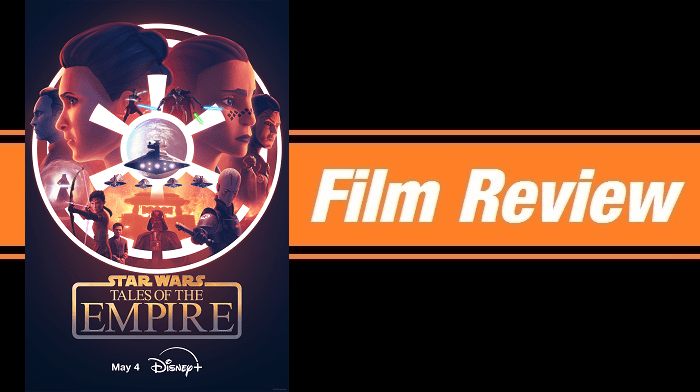
Filoni made a name for himself at LucasFilm in animation, overseeing the terrific shows “Star Wars: The Clone Wars” and “Star Wars: Rebels”. Even with his promotions, Filoni hasn’t left that first-love as evident by “Star Wars: The Bad Batch” which is currently wrapping up its final season. But there’s also his “Star Wars: Tales” – an anthology series consisting of six animated short films focused on different characters in the Star Wars universe. The terrific “Tales of the Jedi” released in 2022. Now we get “Tales of the Empire”, an equally satisfying experience custom-made for the Star Wars faithful.

Image Courtesy of LucasFilm

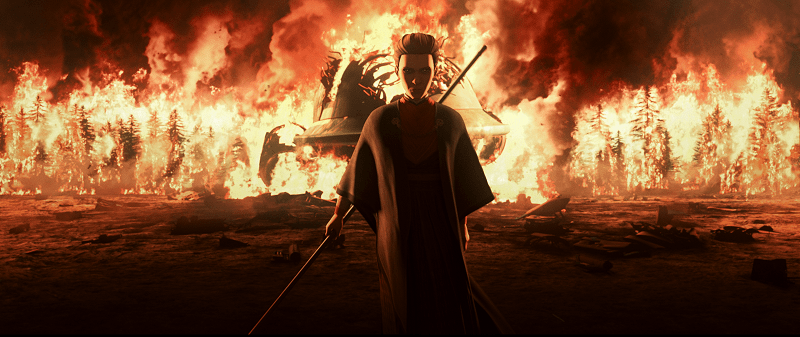
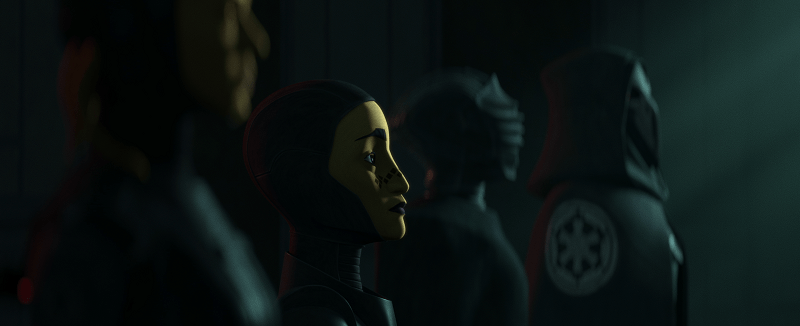
“Tales of the Empire” hones in on two specific characters, Morgan Elsbeth and Barriss Offee. As we’ve come to expect from Filoni and LucasFilm, the animation is outstanding and the voice work is impeccable. Fans will recognize countless connections to various people, places, and events across the Star Wars timeline yet the shorts are more than simple fan service. Filoni always looks for the humanity in his characters and it’s no different here.

The first three shorts focus on Morgan Elsbeth who first appeared in the second season of “The Mandalorian” and had a significant role the Ahsoka series. Morgan was a Force-sensitive Nightsister from the planet Dathomir. She become a devoted follower of Grand Admiral Thrawn and would serve as an oppressive Imperial Magistrate on the planet Corvus. “Tales” makes three life-altering early stops on her timeline, adding some captivating depth to this fascinating character. The great Diana Lee Inosanto is back to voice Elsbeth.

The final three shorts do the same with Barriss Offee who is voiced by the returning Meredith Salenger. Barriss was a Jedi Knight during the Clone Wars and developed a close friendship with Ahsoka Tano. But Barriss grew disillusioned with the Jedi and turned to the dark side of the Force, going as far as bombing the Jedi Temple and letting Ahsoka take the fall. “Tales” adds some interesting complexity to her story, tapping into some of the conflict that drove her to follow the various paths she did.

Unlike the other Star Wars animated projects, the “Tales of the Empire” seasons are very much anthologies. The shorts may be connected by their focus on certain characters, but there’s nothing resembling a flowing episodic narrative. That may sound obvious since it’s baked into the very definition of an anthology. But I remember reading those very criticisms about its predecessor. So knowing what the show is obviously helps.

Image Courtesy of LucasFilm

Also, it’s worth stressing again that “Tales of the Empire” is for fans first and foremost. That’s not necessarily a bad thing. But newcomers should know that this isn’t where you want to begin your Star Wars journey. All six shorts demand some knowledge about the characters and their story arcs. Without it you can still admire the exquisite animation which employs the same art style as “The Clone Wars” and “The Bad Batch”. But the series is made with the intent of adding to what we already know about these characters, filling in and expanding upon what we’ve already seen. As a Star Wars diehard, I loved it. Those not well versed may struggle.

Each short runs approximately 15 minutes long and are written exceptionally well. The lone exception is the final episode which doesn’t wrap things up as strongly as possible. Still, for Star Wars fans there are so many nuggets to chew on and savor. Filoni knows how to handle his characters and his team of directors and animators vividly bring these short stories to the screen. I’m not sure where the “Tales” series goes next, but the quality of what we’ve been given so far makes me hungry for more. “Star Wars: Tales of the Empire” premieres May 4th exclusively on Disney+.

VERDICT – 4 STARS

REVIEW: “Sleeping Dogs” (2024)

Based on Romanian author E.O. Chirovici’s 2017 crime novel “The Book of Mirrors”, the new film “Sleeping Dogs” hands Oscar winner Russell Crowe a meaty and surprisingly heartfelt role. He plays a retired homicide detective who is drawn back into a long unsolved murder case after undergoing a radical experimental procedure for Alzheimer’s disease. How does a cold case and an experimental treatment connect? Well, in a kinda silly yet surprisingly poignant way.

“Sleeping Dogs” marks the feature length directorial debut for Adam Cooper who works from a screenplay he co-wrote with Bill Collage. Their story takes on several different appearances. At times it resembles a somewhat gritty crime thriller. Other times it plays as a moving character drama. But at it’s core lies all the elements of a classic whodunit. Maybe not the most well-oiled whodunit you’ll watch. But a compelling one made all the better thanks to its veteran lead actor.

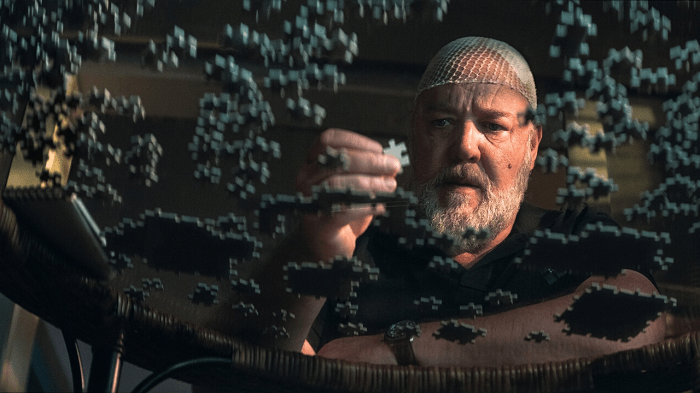
While perhaps no longer in the heyday of what has been a marvelous 35-year career, Russell Crowe is still finding an array of form-fitting roles. Such is the case with “Sleeping Dogs” where he plays Roy Freeman, a former detective suffering from severe dementia. Roy’s condition has progressed to the point where he can no longer remember anything about his career or family. His house is lined with strips of tape inked with information that covers everything from his name to how to heat up a TV dinner.

Image Courtesy of The Avenue

Roy recently underwent an experimental procedure focused on synaptic regeneration. The hope is that over time it will reverse his condition and reclaim his memories. As part of his mental exercises his doctor instructs him to stimulate his brain. And what better way than through books, jigsaw puzzles, and maybe even a real-life murder mystery.

One day Roy is visited by an advocate for Isaac Samuel (Pacharo Mzembe), a prison inmate who’s on death row for the brutal murder of a college professor named Joseph Wieder (Marton Csokas). With his execution date fast approaching, Isaac requests to speak to Roy who was one of the interrogating officers on the night of his arrest. We learn that Isaac was pressured into signing a confession but has since vehemently professed his innocence. He sees Roy as his last chance to prove it. The problem is Roy remembers nothing about the case.

From there Cooper takes an unexpected diversion. After a person of interest named Richard Finn (Harry Greenwood) winds up dead, we get a lengthy flashback revealing his connection to Professor Wieder. Through it we’re also introduced to Finn’s love interest and Wieder’s research partner, Laura Baines (Karen Gillan) as well as the professor’s ever observant handyman, Wayne Devereaux (Thomas M. Wright). Like every good whodunnit, all fit nicely onto the list of suspects, each with their own possible motives.

Image Courtesy of The Avenue

Meanwhile Roy begins digging deeper into the case which leads him to reconnect with his old partner Jimmy (Tommy Flanagan in a “Gladiator” reunion with Crowe). Jimmy clearly wants Roy to let sleeping dogs lie which immediately adds him to our growing pool of suspects. From there the mystery intensifies as Roy’s treatment shows signs of working and certain memories start rushing back.

The story takes Roy on quite the journey – one marked by uncertainty, sadness, and inevitably violence. The revelations that come throw us several curveballs, some of which are a little far-fetched and others that hit their mark. Perhaps most effective is the ending which you begin to suspect yet that still makes for a solid payoff. And driving it all is Crowe whose well-modulated performance brims with authenticity and nuance.

While it could be tempting to be skeptical after reading its synopsis, “Sleeping Dogs” has a surprisingly smart and layered story with enough of its own identity to get through its handful of flaws. Not everything clicks firmly into place. But it’s hard to push back too much when a filmmaker has you as invested as I was. “Sleeping Dogs” is out now in select theaters.

VERDICT – 3.5 STARS

RETRO REVIEW: “The Sting” (1973)

There are a plethora of things that fascinate me about the movies. Among them is the way our impressions of a particular movie can change so dramatically over a fairly long period of time. Such is the case with “The Sting”, a beloved Tinsel Town caper which last year turned 50 years-old.

Rarely has my opinion of a film changed after a rewatch quite like it has with “The Sting”. For clarity, it’s not that I ever openly disliked the movie. It just never left much of an impression. In fact my apathy towards it was such that I had no real urge to revisit it in the thirty or so years since my first viewing. Boy what a difference a few decades can make.

Recently I sat down to rewatch and reevaluate “The Sting” and to my surprise it felt like a different experience altogether. For reasons I still can’t quite put my finger on, the movie clicked with me in ways I wasn’t expecting. The stylish Saturday Evening Post inspired title cards by artist Jaroslav “Jerry” Gebr. Its use of Scott Joplin’s iconic ragtime piano tune “The Entertainer”. George Roy Hill’s steller direction and David Ward’s snappy screenplay. The award winning production design and costumes. And of course the cool and charismatic duo of Paul Newman and Robert Redford. This time they all came together like it didn’t before.

Image Courtesy of Universal Pictures

Releasing on Christmas Day in 1973, “The Sting” was a smash-hit at the box office earning $160 million against a $5.5 million budget (quite the contrast from today’s model). It was also a hit with critics and at the 46th Academy Awards. The film earned a total of ten Oscar nominations, winning seven including Best Picture, Best Director, and Best Original Screenplay. It even spawned a sequel (of sorts) some ten years later that starred Jackie Gleason, Mac Davis, and Teri Garr. Most people (wisely) choose not to talk about it.

Coming into “The Sting”, George Roy Hill was just a couple of years removed from directing Newman and Redford in the highly acclaimed “Butch Cassidy and the Sundance Kid”. The three reunite in another period film, this one taking place in 1936. It was a time when big cities were full of gangsters and hustlers; dirty cops and dirtier politicians; speakeasies and underground gambling halls. It’s an era Hill has a ton of fun exploring.

Redford plays Johnny Hooker, a good-looking but reckless grifter from Joliet, Illinois who gets himself in a bind after he and his hustling partner Luther (Robert Earl Jones) swindle $11,000 in cash from a poor sap. The problem is, that ‘poor sap’ is actually a numbers runner for a powerful mob boss named Doyle Lonnegan (a fantastic Robert Shaw).

Hooker is approached by William Snyder (Charles Durning), a crooked police detective on Lonnegan’s payroll, who demands he pay back what he stole. Hooker pays him off in counterfeit bills which understandably provokes the ire of Lonnegan even more. His goons kill Luther which sends Hooker fleeing to Chicago.

Image Courtesy of Universal Pictures

After arriving in Chicago Hooker seeks out Henry Gondorff (Newman). Gondorff was an old friend of Luther’s and a big-time conman. But lately he’s been laying low, trying to avoid the pesky FBI. Hooker tells Gondorff about Luther’s murder and persuades him to help pull “the big con” on Lonnegan.

Gondorff puts together a crack team of hustlers played by a terrific collection of actors including Ray Walston, Harold Gould, and James Sloyan. But pulling one over on a tough guy like Lonnegan proves to have its challenges and consequences.

“The Sting” plays a lot differently than many of the gangster pictures of its time and ours. There’s a playful allure that permeates much of the film and it has a cool retro style that calls back to the classic mob movies of Raoul Walsh and Lloyd Bacon. But it also has a touch of 1970s grit which helps sets it apart.

Things do get a bit far-fetched in the third act, but it’s hard not to be hooked by the quirky mix of old-fashioned playfulness and gritty violence. That’s a big part of what gives the movie its unusual charm. And to George Hill’s credit, it might be a bigger sleight-of-hand than anything we actually see on screen.

VERDICT – 4 STARS

REVIEW: “Self Reliance” (2024)

In the new comedy thriller “Self Reliance”, Jake Johnson plays a lonely man named Tommy who is stuck in a mundane existence. Ever since splitting up with his long-time girlfriend nearly two years ago, Tommy has seen his life become one long boring routine. Every day it’s the same thing. No zest, no excitement, and no social life outside of his mother (Nancy Lenehan) and two sisters, Amy (Mary Holland) and Mary (Emily Hampshire).

But one day everything changes as he’s walking to work. A black limousine pulls up next to him and inside is Andy Sandberg (playing himself). He asks the starstruck Tommy to get in which he promptly does. It turns out that Sandberg is the paid spokesman for a dark web reality TV game show. In it the contestant must stay alive for 30 days while hunters try to track him down and kill him. If he survives he will win one million dollars. Weird, right?

Image Courtesy of Hulu

But there’s an interesting rule (or loophole as Tommy interprets it). He can only be targeted if he is alone. Any moment he’s not within close proximity of someone he can be killed. He first goes to his family thinking he’ll stick close to them for the 30 days. But they think he’s after attention and refuse to play along. He then approaches a homeless man named James (a hilarious Biff Wiff) and hires him to stay by his side 24 hours a day. But James isn’t the most reliable. Terrified and paranoid, Tommy finds what may be his means of survival in the slightly neurotic fellow contestant named Maddy (Anna Kendrick).

In addition to starring in “Self Reliance”, Jake Johnson also produces, writes, and makes his directorial debut with mostly satisfying results. At times the movie feels like the work of a first-time feature filmmaker, lacking assurance and focus. But Johnson has a great feel for comic timing and delivery, working in the same aura as Jay and Mark Duplass. Yet he has a distinct oddball flavor all his own, melding deadpan with the absurd, resulting in some genuinely laugh-out-loud funny scenes.

While the story centers around a wild and wacky premise, the movie itself is pretty tame, playing is safe rather than really going for it. Instead Johnson sticks with his strengths which is a key reason why the movie works in the end. Not all of the humor lands yet it hits a lot more than it misses. And it’s helped by an all-in cast who were consistently cracking me up (Hampshire is a hoot). It’s a promising debut in a genre that can always use new comedic voices. “Self Reliance” is now streaming on Hulu.

VERDICT – 3 STARS

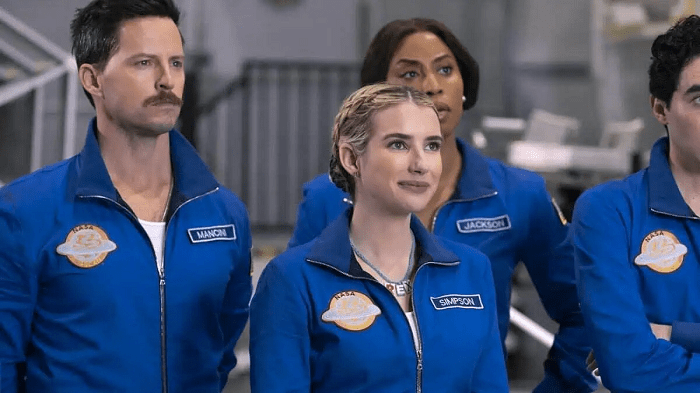
REVIEW: “Spaceman” (2024)

A cerebral space drama and Adam Sandler – not exactly a ‘peanut butter and jelly’ kind of combination at first glance. Now throw in a giant extraterrestrial spider voiced by Paul Dano and you have “Spaceman”, a movie that on paper defies description. It’s directed by Johan Renck, best known for his work on the award-winning mini-series “Chernobyl”. His involvement adds another curious piece to the enigma that is “Spaceman” while also adding to the film’s allure.

It should be said, “Spaceman” is not a Happy Madison production and that’s a good sign. Written for the screen by Colby Day, the film is based on the 2017 novel “Spaceman of Bohemia” by Jaroslav Kalfař. Sandler fans who haven’t tapped into his more thoughtful work might be surprised by his ability to pull off such a somber and restrained meditation. But “Spaceman” is a welcomed reminder of how good he can be whenever he ventures outside of his exhausting comfort zone.

Emotionally layered, necessarily slow, yet ever absorbing – “Spaceman” is the kind of movie that is sure to provoke a fascinating array of responses. For me, I have a real soft spot for these kinds of movies. When they’re done well it’s easy for me to get lost in them. Such is the case with this rich exploration of the human condition set against the backdrop of the daunting vastness of space. It’s something that’s been done before and Renck’s inspirations are impossible to miss. But that doesn’t take away from what he accomplishes.

Image Courtesy of Netflix

Sandler plays Jakub Procházka, an astronaut on a Czech space mission to study an ominous yet beautiful purple-hued particle cloud in deep space that’s large enough to be seen in the Earth’s sky. 500 million kilometers from home and on the outskirts of Jupiter, Jakub is entering his 189th day in space – the halfway mark of his journey (I’m not sure the math adds up but oh well…).

Back on Earth, Jakub’s mission is tightly guarded by the head of Mission Control, Commissioner Tuma (Isabella Rossellini). She keeps a firm and calculated grip on information. In doing so she has captured the public’s interest by commercializing Jakub and turning his mission reports into must-see television. At the same time, she closely monitors and screens information given to Jakub, withholding anything that she and her team feels may jeopardize his fitness to complete his mission.

But what Mission Control doesn’t realize is that by keeping certain information from him they’re actually contributing to his downward mental spiral. In addition to being lonely and overcome by feelings of isolation, Jakub desperately misses his wife, Lenka (played by the always terrific Carey Mulligan, an actress who can make reading a cereal box compelling). But this yearning of his is driven mostly by deep feelings of guilt and regret, even if he’s not ready to admit it.

Jakub tries to keep his worsening mental state hidden from his Mission Control handler Peter (Kunal Nayyar). There’s even a sense of denial as Jakub struggles to convince himself that he’s fine. But he’s forced to come face to face with his distress after he discovers an uninvited visitor aboard his ship. Elegantly voiced by Dano and in the form of a giant brown spider, the extraterrestrial reveals itself to be an explorer who has been studying human behavior.

Image Courtesy of Netflix

Through their interactions we begin to see deeper into the reluctant Jakub’s psyche. The more the alien arachnid probes the more we see what has driven him to such a fragile place. Most of what we see centers around his marriage to Lenka. Mulligan is an aching hypnotic presence seen mostly as a silhouette pulled by the alien from Jakub’s memories. We see the two fall in love and soon after learn that Lenka’s pregnant. But Jakub’s obsession with his mission drives a wedge between them. And his eagerness to leave her alone to have their baby feeds a growing frustration that leads Lenka to question their entire relationship.

It’s never said for sure when the movie takes place, but there are features that seem firmly grounded in the past and others that feel near-future. Similar ambiguity is found in the characters as well, more specifically in the choice to have the cast use their natural accents. It’s a decision that fits nicely within the film’s enigmatic framework. Equally effective is the claustrophobic yet immersive cinematography from Jakob Ihre and Jan Houllevigue’s rigorously detailed production design.

“Spaceman” can best be described as a psychoanalytical character study set as much in the depths of one man’s soul as it is the vastness of space. Director Johan Renck pulls from a variety of films such as Tarkovsky’s “Solaris” and Kubrick’s “2001: A Space Odyssey”. He even throws in a dash of Malick and a smidgen of Spielberg. But even with its deeper musings, there is a simplicity at the film’s core that considers a number of potent themes including the meaning of love, neglect, and the need for human connection. Altogether it makes for an unexpectedly moving experience that some will have a hard time connecting with. Me…what can I say, I was captivated. “Spaceman” premieres March 1st on Netflix.

VERDICT – 4 STARS

EDFF REVIEW: “Shudderbugs”

Johanna Putnam’s elegantly made and emotionally layered psychological drama “Shudderbugs” embodies much of what is both special and essential about independent cinema. It’s the kind of movie that comes from a filmmaker who only has to answer to herself. No pressure from producers, no big studio meddling, no demand to make something more digestible for mainstream audiences. Putnam and her small but cohesive team of collaborators had the freedom to make the movie they wanted. And the results are pretty special.

“Shudderbugs” recently had its Arkansas premiere at the El Dorado Film Festival where it took home the Pam Callaway Spirit of the Festival Award. Filmed in 2020 at her parents’ farm in upstate New York during the COVID-19 lockdown, “Shudderbugs” tells a deeply resonating story about coming to grips with loss and trying to move forward. It’s a story that’s rich with feeling, full of evocative imagery, and driven by an aching and soulful lead performance from Putnam herself.

Putnam plays Samantha Cole who returns to her family’s rural farm house following the unexpected death of her mother Elizabeth. Sam’s father, a beloved local historian, drowned two years ago in their small pond. So that leaves Sam, an only child, to handle her mother’s affairs. Over the course of her stay, Putnam patiently yet methodically lets us in on the family’s history, mostly through Sam’s memories and discoveries. Dreams, flashbacks, phone calls, etc. – these devices and more help the audience fill in the lines.

But Putnam also keeps us feeling a bit off balance. “Everything seems off,” Sam says at one point and we sense the same thing. There are a handful of mysteries that spring up and Putnam throws us a few curveballs that make us question what we see and think we know. For example, what was Sam’s mother’s cause of death? And what’s with the creepy neighbor named Noah (Brennan Brooks, also the film’s DP) who lives in the basement of a dilapidated yet character-rich old house down the road?

Adding to the subtle sense of unease is the sublime sound design. At times it seems as if everything we hear is amplified – the squeak of a screen door, the wind chimes on the porch, the creaking stairs, the buzz of mosquitoes. It can be eerie, haunting, and even hypnotic. Yet as with everything it’s very controlled and never overpowering. That’s a testament to Putnam’s keen direction and particularly her terrific management of tone. You see her confidence in her determination to stick with her vision, and maintaining the right tone is essential to that vision.

Putnam makes so many good choices both as the film’s director, writer, and star. It’s hard not to be swept away by her mesmerizing drama, from its compelling setup straight through to its fittingly poignant final frame. You could say the film is a tad longer than it needs to be and that’s one thing that will likely trip up the aforementioned mainstream crowds. But I’ll happily accept that if it means getting something as genuine, as original, and as alluring as “Shudderbugs”.

VERDICT – 4 STARS