REVIEW: “The Thursday Murder Club” (2025)

Television producer and presenter Richard Osman struck gold as a novelist with his 2020 best seller, “The Thursday Murder Club”. Not only was the book greeted with strong reviews, The Guardian called it “the fastest selling adult crime debut since records began“. His light yet intelligent work of crime fiction spawned three sequels that were released over the following three years. Now fans eagerly await the fifth installment that is due out later this month.

As we wait, director Chris Columbus and Netflix have delivered a feature film adaptation of “The Thursday Murder Club” and it is nothing short of a delight. It’s an adaptation full of spirit and with a level of charm that makes it irresistible. It also features a crackling cast that includes Pierce Brosnan, Helen Mirren, Ben Kingsley, and Celia Imrie – all so wonderfully in tune with the material and each other. And while it hardly reinvents the murder mystery wheel, nearly everything from its characters to its setting to its all-around vibe clicks cozily into place.

Image Courtesy of Netflix

Built within a beautiful old abbey and its surrounded property, Cooper’s Chase is a luxurious retirement village for elderly folks with good pensions. Among the residence are three good friends who make up the Thursday Murder Club. They are a retired international spy, Elizabeth (Mirren), a retired high-profile trade unionist, Ron (Brosnan), and a retired psychiatrist, Ibrahim (Kingsley). Together the group of murder mystery enthusiasts pick out a current police cold case and attempt to solve it.

Their current case involves the murder of a young woman. Needing some medical expertise for their ‘investigation’, the group recruits a new resident, a retired nurse named Joyce (Imrie). But before they can dig into their case, they’re sidetracked by the news that a ruthless and corrupt land owner, Ian Ventham (David Tennant) wants to shut down Cooper’s Chase and turn it into a luxury resort. The co-owner and operator, Tony (Geoff Bell) vows to fight for their home. But when he turns up dead, the club realize they have a more pressing murder case on their hands.

While the super sleuthing is a lot of fun, it’s what happens around it that gives the movie some weight. The four club members each have their own family side stories which the film cleverly uses to speak about aging. When not combing over evidence, Elizebeth is taking care of her beloved husband Stephen (Jonathan Pryce) who’s struggling with dementia. Ron is so enamored with his celebrity son Jason’s (Tom Ellis) fame that he can’t see the young man’s struggles. Joyce and her daughter Joanna (Ingrid Oliver) haven’t communicated well since the death of her husband. Meanwhile Ibrahim keeps quiet about his family past until just the right moment.

Other supporting players give good performances to help round out the story. Naomi Ackie is a fine addition playing Donna, a frustrated constable who has grown tired of making coffee and handing out parking tickets. Daniel Mays is a lot of fun playing the lead detective investigating Tony’s murder. And even Richard E. Grant shows up in a small but chilling role as a major crime kingpin who may or may not have connections to the murder.

Image Courtesy of Netflix

Among the many reasons for the film’s success are screenwriters Katy Bland and Suzanne Heathcote. While their script happily embraces a number of stock whodunnit tropes, they avoid the commonly overused elderly archetypes, even poking fun at them on occasions. Their treatment of Elizabeth, Ron, Ibrahim, and Joyce is a breath of fresh air. These aren’t overly sweet grannies or amusingly grumpy grandpas. Bland and Heathcote imbue their characters with grit, personality, intellect, and emotional sincerity. The veteran actors take it from there, wonderfully breathing life into this endearing foursome.

Perhaps its story is a bit overstuffed. Maybe the ending is too tidy and the final moments a tad too saccharine. Yet “The Thursday Murder Club” never pretends to be something it’s not. Despite the presence of murder, the film is self-aware enough not to take things too seriously. Its tone is breezy and easygoing with no shortage of good-natured humor. But what sets it apart is its treatment of its leads. They’re presented as real people with real personalities. And they’re vibrantly portrayed by a top-notch ensemble who drive this smart and satisfying crowdpleaser. “The Thursday Murder Club” is streaming now on Netflix.

VERDICT – 4 STARS

REVIEW: “The Toxic Avenger” (2025)

The history of “The Toxic Avenger” is nearly as wild as anything its creators have put on screen. Lloyd Kaufman’s 1984 film was a bonkers superhero, black comedy, and splatter film mashup that gained a boisterous cult following through its VHS and Betamax releases. It eventually paved the way for three feature-length sequels, an animated spin-off series, and a video game based on the spin-off series.

Now here we are in 2025 with a remake that has its own wild history. There were talks of a family-friendly reboot as far back is 2010 but it fell through. Six years later, another reboot was discussed with Guillermo del Toro attached. In 2018, Legendary Pictures won the rights to the remake, and a year later Macon Blair had been hired to write and direct. The finished film hit a few festivals in 2023 but struggled to secure a distributor due to its over-the-top gore. No one would touch it until Cineverse stepped in earlier this year.

Image Courtesy of Cineverse

Now “The Toxic Avenger” is back and with a fresh coat of 2025 paint. Blair’s script has a little bit of everything. It starts as an underdog story, evolves into a vigilante story, and ends as something similar to a superhero story. But possibly more than anything, “The Toxic Avenger” is a pitch-black comedy. The laughs come in rapid succession and often from the most unexpected places. And then there’s the gore, thrown liberally at the screen through an array of digital and practical wizardry.

Peter Dinklage stars as Winston Gooze, a widowed single parent doing his best to raise his stepson Wade (Jacob Tremblay). Life has dealt Winston a tough hand, and it only gets worse after he’s diagnosed with a terminal brain disease and given one year to live. Winston learns of an insanely expensive potential cure. But he’s devastated to learn that it’s not covered by the insurance plan he has with his employer, BTH, who has loyally worked for as a janitor.

BTH is ran by an its pampered and corrupt CEO, Robert Garbinger (played by a wacky Kevin Bacon who eats up every wacky scene he’s in). The company creates and distributes proprietary bio-boosters. But it’s also a criminal polluter, dumping cancer-causing chemicals and toxic waste into a river that runs by the small town of St. Roma’s Village. As a result, a determined whistleblower named J.J. Doherty (Taylour Paige) is ready to go public with damning evidence exposing BTH’s complicity.

After the company refuses to help him, a frustrated, hurt, and desperate Winston breaks into the BTH factory to steal enough money to pay for his treatment. But he’s caught by Garbinger’s goons who shoot him in the head and dump his lifeless body in a tank full of toxic sludge. Unexpectedly, the chemicals bring Winston back to life yet leaves him horribly disfigured and deformed. Even more, the mutated Winston emerges with superhuman strength and healing factor which he uses to become the working-class, mop-wielding avenger his city needs.

Image Courtesy of Cineverse

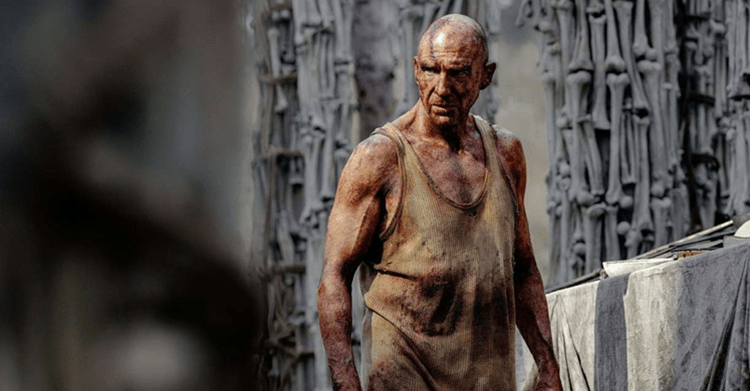
Dinklage brings energy and heart to the ill-fated Winston, both before and after his grotesque transformation (Luisa Guerreiro handles the body suit performance with Dinklage provides the voice-over). Meanwhile he’s surrounded by a supporting cast who are all-in with what the movie is going for. In addition to the hilariously gonzo Bacon and Paige as the movie’s straight woman, we also get Elijah Wood channeling Danny DeVito’s Penguin, Jonny Coyne playing a perpetually angry mob boss, and Julia Davis as Garbinger’s ditzy wife.

“The Toxic Avenger” is a zany yet self-aware reimagining that pretty much accomplishes everything it sets out to do. In fact, you could tag it as pure shock schlock and the filmmakers wouldn’t be a bit offended. It’s extremely gory to the point of delighting some and turning off others. It’s also absurdly silly which could lead to the very same reactions. I get that it may be excessive to the point of being exhausting. But it’s hard to not be entertained by this raucous mix of shock value and humor. “The Toxic Avenger” releases in theaters Friday, August 29th.

VERDICT – 3.5 STARS

REVIEW: “Together” (2025)

Cryptic teasers and creepy trailers paved the way for “Together”, A24’s latest twisted foray into the world of body horror. “Together” is the directorial debut for writer-director Michael Shanks and has grabbed a lot of attention since premiering at this year’s Sundance Film Festival. It stars real-life husband and wife Dave Franco and Alison Brie and tells a tale built upon a fairly obvious allegory. At the same time it lacks the psychological edge that could have made it considerably better.

Franco and Brie play codependent couple Tim and Millie. He’s a struggling musician and she is an elementary teacher who was just hired by a small rural school. As a result, the longtime partners buy a house in the country. But before leaving the city, Millie shocks Tim with a marriage proposal while at a going-away party with friends. His hesitation not only embarrasses her, but it’s the first of several hints that reveal the complications in their relationship.

Image Courtesy of NEON

Once settled in their new home and in desperate need of some quality time together, Tim and Millie take a hike in a nearby forest. Both end up falling into a deep hole where they discover the ruins of an old church – broken pews, broken stain glass windows, and an ominous bell embedded in the rock. But more mysterious is the pool of water than Tim decides to get a drink from. The pair eventually escape, but over time Tim begins to change. The formerly aloof Tim suddenly can’t stay away from Millie. And Millie can’t resist the attention. That’s when their story takes a gnarly Brothers Grimm-esque turn.

Shanks hasn’t been secretive about his film’s big twist. The couple’s connection takes a new form. Their new desires to be ‘together’ are more compulsory as if from a force outside of themselves. Again, the metaphor is pretty clear and the dangers of it are visualized through grotesque sequences of their bodies painfully fusing together whenever they make physical contact. Shanks doubles down on these scenes, leaning into the twisted body horror but finding room for some pitch-black humor as well.

To the film’s credit, it smartly presents us with a fairly likeable couple and a central relationship that is rooted enough in truth to earn our empathy. It does a good job exploring their genuine affections but also the buried resentment that has grown over time. Brie and Franco’s real-life chemistry pays dividends as the two are key in developing an organic on-screen partnership that is easy to believe in.

At the same time, you can’t help feeling that “Together” could have taken everything a little bit further – their attraction, their contentions, their anxieties, their grisly consequences, etc. Even more, the movie never comes across as either a fully realized horror feature or relationship drama. Still, Shanks does a good job conveying the weight of codependency even as his blaring metaphor gets more obvious through each gory mutation. “Together” is in theaters now.

VERDICT – 2.5 STARS

REVIEW: “28 Years Later” (2025)

Danny Boyle put his own unique spin on the zombie genre with his acclaimed 2002 horror gem “28 Days Later”. He stepped aside for the 2007 sequel, “28 Weeks Later” – a movie that wasn’t as well received as its predecessor but that I personally enjoyed just as much. Now after 18 years, Boyle has returned with “28 Years Later”. And joining him again is the first film’s screenwriter, Alex Garland. The two make for a captivating creative pairing.

Much of “28 Years Later” delivers the bleak and visceral experience teased in its trailers. Boyle creates a dark, gruesome, and forbidding hellscape where any notion of hope hangs by a thread. It’s also helped by four rock-solid performances from Ralph Fiennes, Jodie Comer, Aaron Taylor-Johnson, and young Alfie Williams. But despite its ability to fully immerse us, the storytelling is hampered by plot holes, glaring questions, and a bonkers cliffhanger ending that feels yanked from an entirely different movie.

Image Courtesy of Sony Pictures Releasing

After a horrifying opening set in the Scottish Highlands, we’re introduced to the world 28 years after the second outbreak of the Rage Virus. It turns out the virus, which instantly turns anyone infected into a ravenous zombie, has been contained throughout much of Europe. Yet a ravaged England remains under a strict quarantine. Just off the coast, a group of people have built a community on a small island that’s only connection to the mainland is a heavily fortified causeway that can only be accessed during low tide.

Taylor-Johnson plays Jamie, a father who is preparing his 12-year-old son Spike for the community’s rite of passage ritual. It’s where a father accompanies his kid to the mainland for the first time – acquainting them with its dangers and guiding them to their first “kill”. For Spike (who is two years younger than the normal age), the ritual is especially trying, not just because of the perils he will face, but because he hates to leave the side of his ailing mother, Isla (Comer).

Once on the mainland, Jamie leads Spike deeper inland, showing him how to use his training to navigate the treacherous landscapes. Spike eventually gets his first kill, but soon after the pair is forced to flee after a violent zombie horde appears. They seek refuge in the attic of a dilapidated house where they find safety from the zombies. But it causes them to miss their window to return home by crossing the causeway.

As they spend the night in the attic, Spike notices the glow of a large fire in the far distance. Jamie tells him it’s probably Dr. Ian Kelson (Fiennes), a reclusive survivor dismissed by the community as a savage crazy man. After a few harrowing encounters – one with a hulking mutated zombie called an Alpha – Jamie and Spike make it back to the community. As the town celebrates his return, a frustrated and disillusioned Spike is more interested in his mother. Defying his father, Spike sneaks Isla out of the community and across the causeway in hope of finding Kelson and potentially a cure for her sickness.

Image Courtesy of Sony Pictures Releasing

From there “28 Years Later” turns into a perplexing mix of harrowing survival horror and coming-of-age drama. Some scenes are raw and genuinely unsettling and will leave you rattled. Other scenes are surprisingly tender, specifically between Spike and Isla. Boyle and Garland manage to create a number of truly captivating sequences. The problem lies with the connecting narrative tissue (or lack thereof). Things don’t always sense and there are holes in the story that are too big to simply look over.

“28 Years Later” is the first of a two-part story which becomes aggressively obvious in the film’s final scene. Without spoiling anything, let’s just saying the movie ends on a rather preposterous note that doesn’t really help cover its other shortcomings. Still, Boyle delivers several scenes fueled by in-the-moment tension to make the movie worth seeing. The world he creates is a fittingly grim representation of a society collapsed, and the pure horror of the zombie attacks is undeniable. If only there was more connecting its big moments. “28 Years Later” is in theaters now.

VERDICT – 3 STARS

RETRO REVIEW: “The Town That Dreaded Sundown” (1976)

Loosely based on the real-life Texarkana Moonlight Murders, “The Town That Dreaded Sundown” is a Southern horror thriller helmed by director Charles B. Pierce (“The Legend of Boggy Creek”). It takes its inspiration from a series of unsolved murders and attempted murders over a ten-week period in 1946. The killings garnered nationwide attention and made headlines across the country.

“The Town That Dreaded Sundown” was written for the screen by Earl E. Smith and briefly narrated by Vern Stierman. Set in and around the city of Texarkana, which straddles the Texas and Arkansas border, the story takes place eight months after the end of World War II. Most of the war-weary soldiers have returned to the town of 40,000 and are trying to get back into something resembling an everyday routine.

But the town is shaken to its core on the evening of March 3, 1946. While parking on a rural lovers lane, a young couple is attacked by a brawny man in a white hood with eye holes cut out. Both manage to survive but not before they’re savagely beaten within an inch of their lives. The investigation is led by Deputy Norman Ramsey (Andrew Prine playing a character inspired by Bowie County Sheriff Bill Presley). But the cops end up with no clues, no suspects, and no arrests.

Despite that, things eventually get back to normal in Texarkana. But on a rainy Saturday night, a mere 21 days after the first attack, the police make a gruesome discovery. A young man is found dead in the ditch near a rural road. His murdered girlfriend is found a short distance away, her body tied to a tree. Immediately a wave of fear sweeps across the town. Terrified citizens start buying guns and adding new locks to their doors.

As the killings become national news, the desperate police call in Captain J.D. Morales (Ben Johnson) of the Texas Rangers, a character based on real-life lead investigator M.T. “Lone Wolf” Gonzaullas. He immediately takes charge of the investigation, calling in twelve of his own men and setting rules for the local cops and area press. Meanwhile the killer, now dubbed “The Phantom”, continues his murder spree which puts more pressure on Morales to bring an end to the terror.

While the movie sounds like a prototypical slasher, it doesn’t always play like one and that’s a strength. At times it operates with a near documentary style. Other times, as the killings get more horrific, the movie more closely resembles a gritty crime thriller. Where it stumbles is in the strangely out of tune attempts at comedy. They’re all found in patrolman A.C. “Spark Plug” Benson (played by Pierce) who is assigned to be the designated driver for Morales. His absurd scenes clash mightily with the story and belong from an entirely different movie.

Despite those tonal jolts and the occasional moments of shaky acting, “The Town That Dreaded Sundown” is effective in creating the very dread found in its title. It’s spin on the true events keep us engaged and the finish has an unsettling edge that leaves us wondering. The film certainly shows its age, but it’s also atmospheric and at times genuinely chilling. And that’s enough to overcome a handful of poor comedic choices that should have been left on the cutting room floor.

VERDICT – 3.5 STARS

RETRO REVIEW: “The Thomas Crowne Affair” (1968)

Only one year removed from directing the Best Picture winner at the 40th Academy Awards (“In the Heat of the Night”), Norman Jewison followed up with a very different but equally lasting film, “The Thomas Crown Affair”. By ‘lasting’ I don’t mean the two film’s have the same weight or the same impact. But both movies still resonate nearly 60 years after their original releases albeit for much different reasons.

Aside from its alluring title, “The Thomas Crown Affair” had the draw of bona fide star power with Steve McQueen and Faye Dunaway. McQueen was at the front end of a run that would forever define his career. But he already had several big movies on his résumé as well as an Oscar nomination. Dunaway was still a young star, but she had just garnered major attention for her role in the smash-hit “Bonnie and Clyde”.

Richard Burton and Sean Connery were first in mind to play Thomas Crown but both turned it down. The role eventually went to McQueen who goes against type playing the eponymous lead. Thomas Crown is a successful Boston financier who has made millions of dollars through his own thriving company. In addition to being a prominent tycoon, Thomas is also thrill-seeker who satisfies his lust for adventure through high-stakes golf matches, flying gliders, playing polo, and riding dune buggies on the beach.

Image Courtesy of United Artists

But his biggest kick comes from organizing bank heists – not for the money but for the sheer rush. He’s the man behind the plan, orchestrating every detail right down to the cemetery drop-off location. Then he watches his players pull it off. He keeps his identity a secret, hiring five complete strangers yet never meeting them face-to-face. His only in-person involvement is picking up the money at the designated location.

The movie opens with an explosion of style as Jewison and cinematographer Haskell Wexler shoot Thomas’ latest heist through a series of fascinating compositions. The bank robbery goes off without a hitch to the tune of $2.6 million. After paying off his men, Thomas moves the rest of the money into a Swiss bank account and then sits back to enjoy his spoils.

With no leads and no suspects, the police eventually give up. But the bank’s insurance company has too much at stake, so they call in Inspector Vicki Anderson (Fay Dunaway) to help investigate the case. We learn quick that she’s ruthless and is not bound by any laws. She’s in it for the money – driven by the 10% she gets of whatever she’s able to recover. And as her tactics show, she’ll do anything to get her earnings.

Image Courtesy of United Artists

Through connections that are threadbare at best, Vicki hones in on Thomas as her chief suspect. She wastes no time introducing herself to him and doesn’t attempt to hide her identity or her intentions. Confident yet curious, Thomas plays along in what becomes a sultry game of cat-and-mouse. The two begin dating and even fall in love. But establishing trust is a different story. Soon Thomas finds himself playing the ultimate thrill game against a seductive opponent who’s up for the challenge.

McQueen was an interesting choice to play Thomas Crowne and his performance ranges from spot-on to strangely out of place. Through much of the film he’s ruggedly dashing and convincingly assured. But there are instances where his working class screen image clashes with the rich and dapper magnate he plays. He ultimately pulls it off. And McQueen creates some sizzling chemistry with Dunaway whose playful exterior masks a more devious side.

“The Thomas Crown Affair” was a success at the box office despite being greeted with lukewarm reviews from critics. It would go on to win the Best Original Song Academy Award for Michel Legrand’s “The Windmills of Your Mind” and over time has received more favorable reevaluations. It even led to a successful 1999 remake starring Pierce Bronson and Rene Russo. As for the 1968 film, it doesn’t sit among Norman Jewison’s best films. But “The Thomas Crown Affair” has maintained a lasting appeal that (for the most part) still holds up today.

VERDICT – 3.5 STARS