REVIEW: “Together” (2025)

Cryptic teasers and creepy trailers paved the way for “Together”, A24’s latest twisted foray into the world of body horror. “Together” is the directorial debut for writer-director Michael Shanks and has grabbed a lot of attention since premiering at this year’s Sundance Film Festival. It stars real-life husband and wife Dave Franco and Alison Brie and tells a tale built upon a fairly obvious allegory. At the same time it lacks the psychological edge that could have made it considerably better.

Franco and Brie play codependent couple Tim and Millie. He’s a struggling musician and she is an elementary teacher who was just hired by a small rural school. As a result, the longtime partners buy a house in the country. But before leaving the city, Millie shocks Tim with a marriage proposal while at a going-away party with friends. His hesitation not only embarrasses her, but it’s the first of several hints that reveal the complications in their relationship.

Image Courtesy of NEON

Once settled in their new home and in desperate need of some quality time together, Tim and Millie take a hike in a nearby forest. Both end up falling into a deep hole where they discover the ruins of an old church – broken pews, broken stain glass windows, and an ominous bell embedded in the rock. But more mysterious is the pool of water than Tim decides to get a drink from. The pair eventually escape, but over time Tim begins to change. The formerly aloof Tim suddenly can’t stay away from Millie. And Millie can’t resist the attention. That’s when their story takes a gnarly Brothers Grimm-esque turn.

Shanks hasn’t been secretive about his film’s big twist. The couple’s connection takes a new form. Their new desires to be ‘together’ are more compulsory as if from a force outside of themselves. Again, the metaphor is pretty clear and the dangers of it are visualized through grotesque sequences of their bodies painfully fusing together whenever they make physical contact. Shanks doubles down on these scenes, leaning into the twisted body horror but finding room for some pitch-black humor as well.

To the film’s credit, it smartly presents us with a fairly likeable couple and a central relationship that is rooted enough in truth to earn our empathy. It does a good job exploring their genuine affections but also the buried resentment that has grown over time. Brie and Franco’s real-life chemistry pays dividends as the two are key in developing an organic on-screen partnership that is easy to believe in.

At the same time, you can’t help feeling that “Together” could have taken everything a little bit further – their attraction, their contentions, their anxieties, their grisly consequences, etc. Even more, the movie never comes across as either a fully realized horror feature or relationship drama. Still, Shanks does a good job conveying the weight of codependency even as his blaring metaphor gets more obvious through each gory mutation. “Together” is in theaters now.

VERDICT – 2.5 STARS

REVIEW: “28 Years Later” (2025)

Danny Boyle put his own unique spin on the zombie genre with his acclaimed 2002 horror gem “28 Days Later”. He stepped aside for the 2007 sequel, “28 Weeks Later” – a movie that wasn’t as well received as its predecessor but that I personally enjoyed just as much. Now after 18 years, Boyle has returned with “28 Years Later”. And joining him again is the first film’s screenwriter, Alex Garland. The two make for a captivating creative pairing.

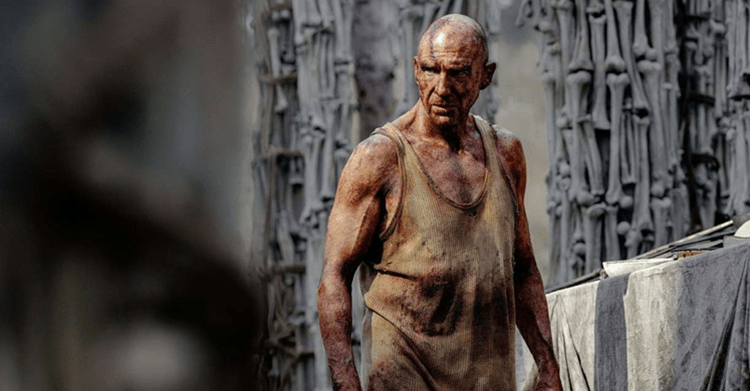
Much of “28 Years Later” delivers the bleak and visceral experience teased in its trailers. Boyle creates a dark, gruesome, and forbidding hellscape where any notion of hope hangs by a thread. It’s also helped by four rock-solid performances from Ralph Fiennes, Jodie Comer, Aaron Taylor-Johnson, and young Alfie Williams. But despite its ability to fully immerse us, the storytelling is hampered by plot holes, glaring questions, and a bonkers cliffhanger ending that feels yanked from an entirely different movie.

Image Courtesy of Sony Pictures Releasing

After a horrifying opening set in the Scottish Highlands, we’re introduced to the world 28 years after the second outbreak of the Rage Virus. It turns out the virus, which instantly turns anyone infected into a ravenous zombie, has been contained throughout much of Europe. Yet a ravaged England remains under a strict quarantine. Just off the coast, a group of people have built a community on a small island that’s only connection to the mainland is a heavily fortified causeway that can only be accessed during low tide.

Taylor-Johnson plays Jamie, a father who is preparing his 12-year-old son Spike for the community’s rite of passage ritual. It’s where a father accompanies his kid to the mainland for the first time – acquainting them with its dangers and guiding them to their first “kill”. For Spike (who is two years younger than the normal age), the ritual is especially trying, not just because of the perils he will face, but because he hates to leave the side of his ailing mother, Isla (Comer).

Once on the mainland, Jamie leads Spike deeper inland, showing him how to use his training to navigate the treacherous landscapes. Spike eventually gets his first kill, but soon after the pair is forced to flee after a violent zombie horde appears. They seek refuge in the attic of a dilapidated house where they find safety from the zombies. But it causes them to miss their window to return home by crossing the causeway.

As they spend the night in the attic, Spike notices the glow of a large fire in the far distance. Jamie tells him it’s probably Dr. Ian Kelson (Fiennes), a reclusive survivor dismissed by the community as a savage crazy man. After a few harrowing encounters – one with a hulking mutated zombie called an Alpha – Jamie and Spike make it back to the community. As the town celebrates his return, a frustrated and disillusioned Spike is more interested in his mother. Defying his father, Spike sneaks Isla out of the community and across the causeway in hope of finding Kelson and potentially a cure for her sickness.

Image Courtesy of Sony Pictures Releasing

From there “28 Years Later” turns into a perplexing mix of harrowing survival horror and coming-of-age drama. Some scenes are raw and genuinely unsettling and will leave you rattled. Other scenes are surprisingly tender, specifically between Spike and Isla. Boyle and Garland manage to create a number of truly captivating sequences. The problem lies with the connecting narrative tissue (or lack thereof). Things don’t always sense and there are holes in the story that are too big to simply look over.

“28 Years Later” is the first of a two-part story which becomes aggressively obvious in the film’s final scene. Without spoiling anything, let’s just saying the movie ends on a rather preposterous note that doesn’t really help cover its other shortcomings. Still, Boyle delivers several scenes fueled by in-the-moment tension to make the movie worth seeing. The world he creates is a fittingly grim representation of a society collapsed, and the pure horror of the zombie attacks is undeniable. If only there was more connecting its big moments. “28 Years Later” is in theaters now.

VERDICT – 3.5 STARS

RETRO REVIEW: “The Town That Dreaded Sundown” (1976)

Loosely based on the real-life Texarkana Moonlight Murders, “The Town That Dreaded Sundown” is a Southern horror thriller helmed by director Charles B. Pierce (“The Legend of Boggy Creek”). It takes its inspiration from a series of unsolved murders and attempted murders over a ten-week period in 1946. The killings garnered nationwide attention and made headlines across the country.

“The Town That Dreaded Sundown” was written for the screen by Earl E. Smith and briefly narrated by Vern Stierman. Set in and around the city of Texarkana, which straddles the Texas and Arkansas border, the story takes place eight months after the end of World War II. Most of the war-weary soldiers have returned to the town of 40,000 and are trying to get back into something resembling an everyday routine.

But the town is shaken to its core on the evening of March 3, 1946. While parking on a rural lovers lane, a young couple is attacked by a brawny man in a white hood with eye holes cut out. Both manage to survive but not before they’re savagely beaten within an inch of their lives. The investigation is led by Deputy Norman Ramsey (Andrew Prine playing a character inspired by Bowie County Sheriff Bill Presley). But the cops end up with no clues, no suspects, and no arrests.

Despite that, things eventually get back to normal in Texarkana. But on a rainy Saturday night, a mere 21 days after the first attack, the police make a gruesome discovery. A young man is found dead in the ditch near a rural road. His murdered girlfriend is found a short distance away, her body tied to a tree. Immediately a wave of fear sweeps across the town. Terrified citizens start buying guns and adding new locks to their doors.

As the killings become national news, the desperate police call in Captain J.D. Morales (Ben Johnson) of the Texas Rangers, a character based on real-life lead investigator M.T. “Lone Wolf” Gonzaullas. He immediately takes charge of the investigation, calling in twelve of his own men and setting rules for the local cops and area press. Meanwhile the killer, now dubbed “The Phantom”, continues his murder spree which puts more pressure on Morales to bring an end to the terror.

While the movie sounds like a prototypical slasher, it doesn’t always play like one and that’s a strength. At times it operates with a near documentary style. Other times, as the killings get more horrific, the movie more closely resembles a gritty crime thriller. Where it stumbles is in the strangely out of tune attempts at comedy. They’re all found in patrolman A.C. “Spark Plug” Benson (played by Pierce) who is assigned to be the designated driver for Morales. His absurd scenes clash mightily with the story and belong from an entirely different movie.

Despite those tonal jolts and the occasional moments of shaky acting, “The Town That Dreaded Sundown” is effective in creating the very dread found in its title. It’s spin on the true events keep us engaged and the finish has an unsettling edge that leaves us wondering. The film certainly shows its age, but it’s also atmospheric and at times genuinely chilling. And that’s enough to overcome a handful of poor comedic choices that should have been left on the cutting room floor.

VERDICT – 3.5 STARS

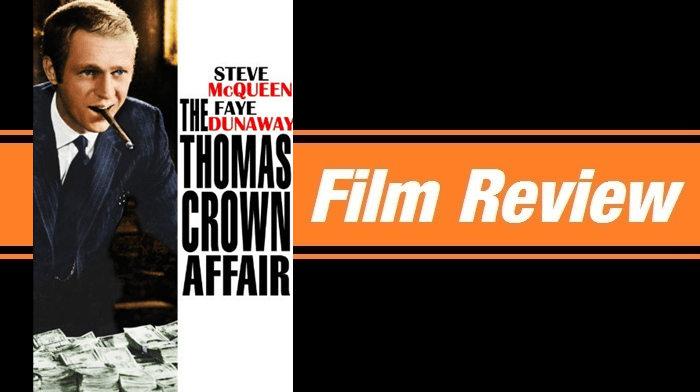
RETRO REVIEW: “The Thomas Crowne Affair” (1968)

Only one year removed from directing the Best Picture winner at the 40th Academy Awards (“In the Heat of the Night”), Norman Jewison followed up with a very different but equally lasting film, “The Thomas Crown Affair”. By ‘lasting’ I don’t mean the two film’s have the same weight or the same impact. But both movies still resonate nearly 60 years after their original releases albeit for much different reasons.

Aside from its alluring title, “The Thomas Crown Affair” had the draw of bona fide star power with Steve McQueen and Faye Dunaway. McQueen was at the front end of a run that would forever define his career. But he already had several big movies on his résumé as well as an Oscar nomination. Dunaway was still a young star, but she had just garnered major attention for her role in the smash-hit “Bonnie and Clyde”.

Richard Burton and Sean Connery were first in mind to play Thomas Crown but both turned it down. The role eventually went to McQueen who goes against type playing the eponymous lead. Thomas Crown is a successful Boston financier who has made millions of dollars through his own thriving company. In addition to being a prominent tycoon, Thomas is also thrill-seeker who satisfies his lust for adventure through high-stakes golf matches, flying gliders, playing polo, and riding dune buggies on the beach.

Image Courtesy of United Artists

But his biggest kick comes from organizing bank heists – not for the money but for the sheer rush. He’s the man behind the plan, orchestrating every detail right down to the cemetery drop-off location. Then he watches his players pull it off. He keeps his identity a secret, hiring five complete strangers yet never meeting them face-to-face. His only in-person involvement is picking up the money at the designated location.

The movie opens with an explosion of style as Jewison and cinematographer Haskell Wexler shoot Thomas’ latest heist through a series of fascinating compositions. The bank robbery goes off without a hitch to the tune of $2.6 million. After paying off his men, Thomas moves the rest of the money into a Swiss bank account and then sits back to enjoy his spoils.

With no leads and no suspects, the police eventually give up. But the bank’s insurance company has too much at stake, so they call in Inspector Vicki Anderson (Fay Dunaway) to help investigate the case. We learn quick that she’s ruthless and is not bound by any laws. She’s in it for the money – driven by the 10% she gets of whatever she’s able to recover. And as her tactics show, she’ll do anything to get her earnings.

Image Courtesy of United Artists

Through connections that are threadbare at best, Vicki hones in on Thomas as her chief suspect. She wastes no time introducing herself to him and doesn’t attempt to hide her identity or her intentions. Confident yet curious, Thomas plays along in what becomes a sultry game of cat-and-mouse. The two begin dating and even fall in love. But establishing trust is a different story. Soon Thomas finds himself playing the ultimate thrill game against a seductive opponent who’s up for the challenge.

McQueen was an interesting choice to play Thomas Crowne and his performance ranges from spot-on to strangely out of place. Through much of the film he’s ruggedly dashing and convincingly assured. But there are instances where his working class screen image clashes with the rich and dapper magnate he plays. He ultimately pulls it off. And McQueen creates some sizzling chemistry with Dunaway whose playful exterior masks a more devious side.

“The Thomas Crown Affair” was a success at the box office despite being greeted with lukewarm reviews from critics. It would go on to win the Best Original Song Academy Award for Michel Legrand’s “The Windmills of Your Mind” and over time has received more favorable reevaluations. It even led to a successful 1999 remake starring Pierce Bronson and Rene Russo. As for the 1968 film, it doesn’t sit among Norman Jewison’s best films. But “The Thomas Crown Affair” has maintained a lasting appeal that (for the most part) still holds up today.

VERDICT – 3.5 STARS

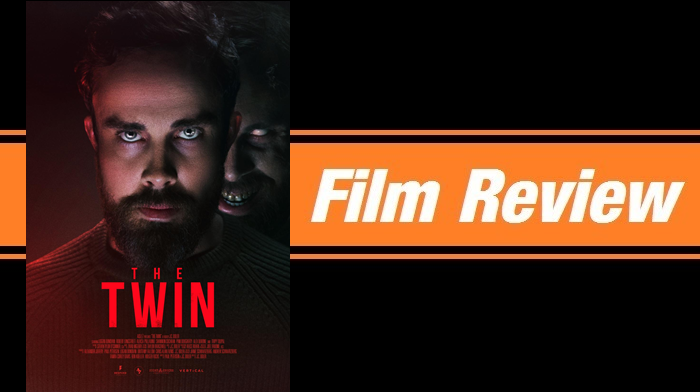
REVIEW: “The Twin” (2024)

A husband and father squares off against his inner demons following a devastating tragedy in the tense and bracing “The Twin”. Directed by J.C. Doler, this psychological horror thriller is as clever as it is unsettling, using well established tenets from the horror genre in its smart, incisive, and terrifying examination of mental health, childhood trauma, grief, and forgiveness. And that only scratches the surface of the film’s thematic richness.

Getting “The Twin” made had its share of hurdles. Its genesis can be traced back to a short film Doler made with his wife, Taylor Bracewell. After being approached about turning it into a feature film, Doler spent the next several years hammering out the script through nearly thirty drafts. He finally found the root of his story in an old Irish legend. But then came the challenges of funding, and after that the COVID-19 pandemic. But his diligence paid off and the film finally came together.

Following a heart-wrenching prelude, the story (co-written by Doler and Paul Peterson) follows Nicholas Schultz (Logan Donovan) whose life crumbles after he and his wife Charlie (Aleska Palladino) lose their young son Jacob (Tripp Toupal) in a tragic accident. While both struggle to cope, Nicholas takes it especially hard, going as far as attempting suicide. Charlie is able to save his life and eventually has him placed in a state institution.

A month passes and Nicholas returns to their home – an old farmhouse that has been in his family for years. Returning to the scene of the accident is difficult enough, but Nicholas’ problems only seem to compound after Charlie declares she’s leaving him. It’s a jarring revelation and we’re tempted to judge her actions as insensitive and self-serving. But we learn Charlie has been crumbling under her own suppressed grief and she desperately needs time away for her own mental wellbeing.

That leaves Nicholas alone with his guilt, sorrow, and trauma in a house where painful memories linger in every corner. But to help, and as a condition of his release, he’s required to receive routine home visits from a psychiatrist, Dr. Andrew Beaumont (Robert Longstreet) whose services include therapy, making sure Nicholas takes his meds, and “light” hypnosis. The two don’t instantly hit it off. But Andrew is both patient and sympathetic, having gone through some trauma of his own.

But the unease sets in as we witness Nicholas being haunted by disturbing nightmares. Then he begins hearing malicious voices that later evolve into terrifying visions. It eventually leads to him coming face to face with his fetch which is defined in the opening script as “a supernatural double or apparition of a living person.” His fetch (or twin) is a chilling and gruesome manifestation of his inner dark side which blurs the lines between his crippling mental anguish and reality.

Doler’s direction impresses in a number of ways. Take how he employs a variety of well-used devices from the horror genre and imbues them with a sharp psychological edge. Not only does it play with Nicholas’ ability to discern what’s real from what’s in his head, but for a time it challenges our perception as well. Through it we’re treated to some grisly imagery that includes gnarled bodies, milky eyes, and necrotic fingers – all fun reminders that we’re watching a horror movie. Yet it’s one with a piercing allegorical bite.

Perhaps more than with any other genre, good horror movies come in numerous forms. Some of the best are able to unsettle us while finding compelling ways to speak to the human condition. “The Twin” certainly does that through its smart script, sharp direction, and gripping performances from Donovan and Palladino. The film may not fully develop all of its ideas, but it tackles weighty subject matter while still entertaining us like good old-fashioned chiller.

VERDICT – 4 STARS

REVIEW: “Thelma” (2024)

How am I so late getting to one of the biggest treats of the movie year? Much like its titular lead character, “Thelma” is an absolute delight. Writer, director, and editor Josh Margolin took inspiration from his very own grandmother, Thelma Post, who turned 104 earlier this year. Margolin based his lead character on her, and the early setup to his story is taken from a real situation his grandmother experienced.

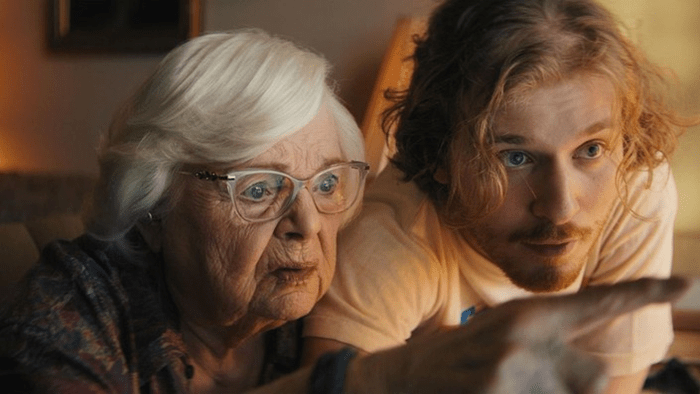
Who better than the effervescent 95-year-old June Squibb to play Thelma Post, an infectiously charming elderly woman who spends her days cross-stitching, watching YouTube videos, and trying to figure out the Facebook app on her cellphone. She has a tight-knit relationship with her sweet and caring grandson Danny (a very good Fred Hechinger) who happily comes over to help her around the house and take her wherever she needs to go.

Image Courtesy of Magnolia Pictures

Thelma’s adventure begins when she gets a strange phone call from a man claiming Danny has ended up in jail. The man needs $10,000 cash mailed to a certain address in order to get him out. In a panic, Thelma pulls money from her hidden stash and drops it in the mail. But when she finally gets in touch with Danny she realizes she has been scammed. She goes through all the proper channels but can’t get her money back.

Instead of sitting idle and accepting her losses, an inspired Thelma sets out to reclaim what is hers. But she’ll need to do it without her disapproving family knowing. And since she can’t drive, she will need a little help. So she seeks out her old friend Ben (the late, great Richard Roundtree) who lives in a nearby retirement center and happens to own a shiny red two-seat mobility scooter. After some reckless convincing, Thelma and Ben are putting across Los Angeles to Van Nuys to confront the scammers face-to-face.

Image Courtesy of Magnolia Pictures

Squibb and Roundtree are such an enjoyable pairing, bringing ample amounts of personality, warmth, and humor to both of their characters. Adding to the fun is Parker Posey as Thelma’s fussy daughter Gail and Clark Gregg as Gail’s tightly wound husband Alan (Clark Gregg). Together they are reasonably concerned yet slyly amusing helicopter parents to Danny and take a similar approach to shepherding Thelma. It leads to several funny back-and-forths.

But at the end of the day this is a June Squibb joint and she brings all the energy, charm, and playfulness necessary for an entertaining crowdpleaser. The movie provides her with everything she needs to keep us rooting for Thelma and laughing most of the way (wait till you see the hilarious Tom Cruise / “Mission: Impossible” bit). And Margolin’s love for his real grandmother comes through in the clear affection he shows for the Thelma he puts on screen. That love proves to be the secret sauce that makes “Thelma” such a joy.

VERDICT – 4 STARS