REVIEW: “To the Wonder”

TO WONDER POSTER

Terrence Malick is a filmmaker that marches to the beat of his own drum. To be honest, that’s one of the things I like the most about him. We say this often but here it unquestionably applies – you know a Terrence Malick movie when you see one. Malick has a distinct style of lyrical and visual storytelling and you either respond to it or you don’t. Personally I love it. Now sometimes his style is more impressive than his finished products, but for the most part Malick is one of my favorite filmmakers. In fact, his last film “The Tree of Life” was my clear favorite film of 2011.

Malick is a director who takes his time and only makes a film when he’s ready. This is evident by the fact that he has only six movies on his directing resume. His latest, surprisingly only two years after “The Tree of Life”, is another exercise in lyrical and contemplative style. It’s one of my most anticipated films of 2013. It’s called “To the Wonder” and for me it’s another soul-stirring gem that throws the textbook on conventional moviemaking out the window. Instead Malick is making another deeply personal film, possibly his most personal movie to date. It’s also his most romantic, most spiritual, and most tragic film all at the same time.

The movie follows a young couple as they navigate the unquenchable joys and the devastating heartbreaks associated with love. We first meet Neil (Ben Affleck) and Marina (Olga Kurylenko) in Paris, France. The two are madly in love and Malick expresses it through a rhythmic series of romantic and absorbing scenes in such beautiful Parisian settings such as the Luxembourg Gardens and the banks of the Seine River. There’s also a majestic sequence with the two outside of town at the gorgeous Mont Saint-Michel. Neil and Marina can’t seem to be able to control their affection for the other. There’s a strong focus on touch in these scenes whether it’s holding hands or running a hand across the shoulder blades. The romance between Neil and Marina is sublime and beautiful and I never doubted its authenticity.

TO WONDER 1

Marina, a Paris native and single mother, decides to move with her daughter to the States in order to be close to Neil. They land in midwestern Oklahoma where Neil works as an environmental safety inspector. The contrast between the energetic and vibrant Paris and their sparse and sometimes empty Oklahoma community almost serves as a metaphor for their relationship. The two who were as passionate as the French city they consumed now battle creeping bouts of emptiness and an emotional wedge that we watch grow and grow. It becomes painfully obvious that their relationship is hurting but neither seems to know what to do.

Then there’s the story of Quintana (Javier Bardem), the local priest in Neil and Marina’s area. Quintana is a troubled man. He has a deep love for the Lord but he feels disconnected. He’s dying to have the intimacy with God that he once had. He visits the sick, the poor, and the needy. He shepherds his flock. Yet there’s still a void in his soul that he desperately wants to fill. But he’s also a lonely man bound by the shackles of the priesthood an its strict rules. Watching Bardem’s solemn face and lonely, tired eyes really drew me to this character. It did surprise me how little he had to do with what seemed like the main focus of the film but Malick shows some moving similarities between his struggles and those of Neil and Marina.

Their stories do begin to connect and we watch as everything plays out. But don’t expect a tight narrative with a fully disclosed ending. Malick is more interested in having us observe and experience than being baby fed an entire story. He wants us to feel, to sympathize, to grow angry, and to meditate. Our time is spent observing and Malick lays his canvas before us. On it he explores inner conflicts, poor and costly decisions, and revived hope. It’s presented through an artistic machine that utilizes everything including the stunning score, the beauty of nature, a graceful camera, and the natural ambiance of the world surrounding his characters.

Affleck and Kurylenko are transcendent. The film features little to no dialogue with the exception of voice-over narrations therefore the two lead actors basically perform off of each other or in scenes alone. Neither ever seem aware of the camera and both get lost in their performances. Affleck was a great surprise. He’s quiet, sincere, and a stout and strong contrast to Kurylenko’s subtle elegance and grace. And speaking of Kurylenko, I think she gives an awards worthy performance. But while the performances are key, a Terrence Malick film is usually made in the editing room. Don’t believe me? Just ask Rachel Weisz and Jessica Chastain. Both shot scenes for the film but all of them ended up on the cutting room floor. Regardless the editing is sensational and the film moves like a page of good music with the exceptions of a few patches of repetition in the second half of the film.

TO THE WONDER 2

As with his other movies, Malick uses his visuals to draw us in and also tell the bulk of his story. His sensational command of his camera and his artist’s eye for capturing beautiful shots are essential to his success. His camera is constantly moving and it always seems perfectly positioned. I was absorbed in what I was seeing and his fluid and poetic transitions from shot to shot kept me that way. Even for those who don’t respond to the film as a whole, they’ll be hard pressed to not be fascinated with Malick’s visual artistry.

There will be plenty of people who can’t latch onto “To the Wonder”. It will be perceived as slow, confounding, and lifeless. I couldn’t disagree more. I loved the film and while it’s certainly not as challenging as “The Tree of Life”, it’s still a captivating piece of cinema. It doesn’t answer every question. It doesn’t adhere to a conventional storytelling formula. It asks the audience to think and to feel. If you’re not open to that you’re probably not going to respond well to this film.

In his final review before his unfortunate passing, the late Roger Ebert said this about “To the Wonder” : “(Many will) be dissatisfied by a film that would rather evoke than supply.” I think he’s right and some early reviews have shown that to be true. But I believe Malick has given us another standout picture that takes a real (sometimes uncomfortably so) look at relationships, faith, and the quest for love in both. Yet it’s all told through an artist’s lens with entrancing metaphoric imagery and a steady grace that could only come from a Terrence Malick film. I know many are going to struggle with this movie but for me it’s the first great film of 2013.

VERDICT – 4.5 STARS

REVIEW: “Titanic” (1953)

Classic Movie Spotlight

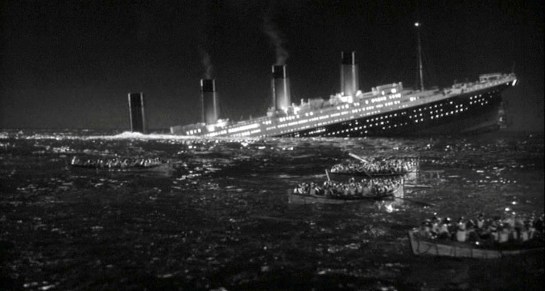
TITANICWhen mentioning “Titanic” and the movies most people today instantly think of James Cameron’s 1997 blockbuster epic. But there have actually been several movies centered around that ill-fated voyage in 1912. One of the best of these films came out in 1953 and like Cameron’s movie, this film was simply titled “Titanic”. It featured a fine cast and special effects that were considered pretty cutting edge for that time. Of course being a 1953 picture it didn’t depend on its special effects as heavily as Cameron’s. Instead the true strength of this version lies in the characters and their stories which unfold before us on the ship prior to the collision which would eventually sink the vessel.
In the film Julia Sturges (Barbara Stanwyck) boards the Titanic with her 18-year old daughter Annette (Audrey Dalton) and 10-year old son Norman (Harper Carter). She’s secretly leaving her husband Richard (Clifton Webb) and taking her children to America, leaving behind the lavish high society living that Richard is consumed with. But he gets wind of her plan and is able to buy his way onboard before the ship sets sail. Webb is perfectly cast as the snobbish and conceited aristocrat. He surprises Julia and their children in the dinner hall later that evening and let’s just say the exchange between husband and wife is pretty heated.

For much of the remainder of the film the two battle it out with their children caught in the middle. One of their biggest disagreements centers around their conflicting views of class. Julia is tired of the pampered upper class living and misses the more humble life of her American roots. Richard’s arrogance is such that he believes their worth is tied to their prosperity and social status. This personal conflict between them mirrors the class differences on the ship. The movie doesn’t spend a lot of time on it but we do get several looks at the swanky elegance of the first class passengers contrasted with the poorer people in the noisy and crowded decks below. Of coarse Richard and Julia also argue about the future of their children which leads to some brutal verbal exchanges and the unveiling of secrets that have been hidden for years. The scenes shared by Stanwyck and Webb are brilliantly written and performed and I found myself completely absorbed in every word.

Titanic1

There are several other interesting characters on the ship as well. I loved the wonderful Thelma Ritter as a straight-shooting wealthy woman who’s still grounded in her working class roots. I also enjoyed 22-year old Robert Wagner as a peppy Purdue University tennis player who tries to win over Annette. Richard Basehart has some fine scenes as an ex-Catholic priest struggling with alcoholism. Unfortunately his character is terribly underdeveloped. But I also have to mention Brian Aherne as the ship’s Captain. He gives a subtle but focused performance that paints the perfect picture of what I would imagine the Captain to be like. There are several other characters that work for me as well and while I do wish some had been given more screen time, they each have their moments where they capture my interest.

But regardless of how well these personal stories play out, this is still a story of the disastrous maiden voyage of the Titanic. The film only spends about 30 minutes on the collision with the iceberg and the subsequent sinking of the ship and that works out just fine especially considering the film’s compact overall running time of 98 minutes. As I mentioned earlier the special effects are quite good. Considering today’s heavy CGI approach to visuals, it’s interesting to see how these older movies approached their special effects. I think what makes these so effective is that director Jean Negulesco never keeps his camera focused on them. He shows us some incredible long shots of the ship in various stages of descent but in each scene he cuts his camera or puts something else in the shot to keep us from seeing his visual trickery. The results help create a perfect sense of peril that I really responded to.

titanic2

Charles Brackett, Richard Breen, and Walter Reisch won Oscars for their work on “Titanic’s” screenplay and while there is a level of sentimentality and melodrama, I don’t think that’s a bad thing. And I wouldn’t say that their story is striving to be the most accurate account of the disaster. As with the most recent movie, there are several things that Titanic history buffs could pick away at. But in terms of dramatic storytelling the trio collaborate to create a highly entertaining character-driven drama. The dialogue is smart and efficient and its easy to be enthralled when it’s handled by such a wonderful and capable cast.

1953’s “Titanic” will never match James Cameron’s film in visuals, size, or scope but for me it doesn’t have to. This is a movie that certainly stands on its own. Its character based storytelling approach draws you into the story, and by the time the ship begins to sink you’re thoroughly invested. In many ways its structure resembles that of Cameron’s epic minus the newer film’s bloated first half. This is a much tighter story and there’s never a wasted or throwaway scene. I do wish we could have spent more time getting to know some of the smaller underdeveloped characters but I wouldn’t trade that for a single scene that Stanwyck and Webb share together. So if the only “Titanic” picture you’ve seen was the 1997 box office smash, take time to give this one a watch. It certainly deserves a new audience today.

VERDICT – 4 STARS

THE END

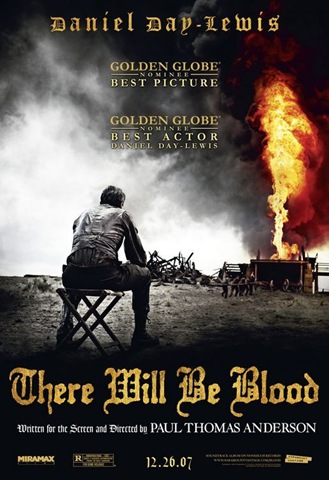
REVIEW: “There Will Be Blood”

Writer and director Paul Thomas Anderson has certainly established himself within the art of filmmaking. He has shown a unique talent when it comes to cinematic storytelling that can’t be questioned. Critics and moviegoers alike have flocked to his work singing their praises. That being said, I have to admit that I am a little lukewarm when it comes to Paul Thomas Anderson’s films. But I also have to admit that his 2007 masterpiece “There Will Be Blood” is sheer motion picture brilliance both in terms of writing and presentation. Loosely based on a 1927 Upton Sinclair novel, “There Will Be Blood” is a mesmerizing period drama and character study that I’ve never been able to let go of.

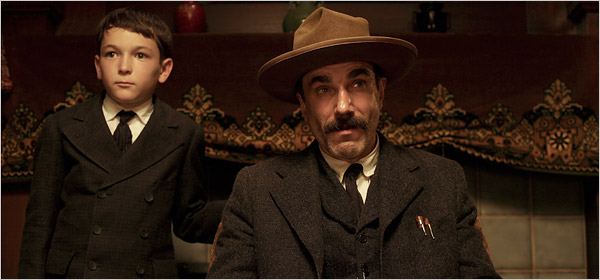
Now let me go ahead and get something out of the way. The biggest reason this movie is so profound is because of Daniel Day-Lewis’ towering performance. Now there’s no denying Anderson’s wonderful script and his brilliant use of the camera, but it’s Day-Lewis who dominates every scene with a performance that I believe is one of the best of all time. He plays Daniel Plainview, a shamelessly amoral oilman Seeking wealth during the California oil boom. He’s tipped off about a possible motherload of oil resting beneath the small and poor community of Little Boston, California. He heads there along with his adopted son H.W. (Dillon Freasier) to get drilling rights through any ruthless tactic necessary.

While in the Little Boston, Plainview runs into Eli (Paul Dano), an equally manipulative man who is the leader of the small charismatic congregation. I am no fan of Paul Dano, but he does a serviceable job playing this sniveling, disgusting huckster. There are several see where his performance really stands out. But he also has the unenviable job of sharing scenes with Day-Lewis and he’s often times not up to the task. The two characters but heads on numerous occasions as each seek their own ambitions regardless of who they must mislead to do it. It’s truly fascinating to watch and Anderson weaves several of his familiar themes throughout the unfolding of these characters.

But it’s the Plainview character that I keep coming back to. He’s certainly a vile and contemptible man. But there are other moments where he is so convincing that even the audience almost buys into what he saying. There are also scenes such as where he threatens an abusive father that adds to the overall complexity of this character. Day-Lewis channels all of this through a rugged and worn exterior mixed with a convincing John Huston-like voice that fits the character perfectly. Watching this great actor open up and dissect this character Is like watching a master hone his craft. He loses himself in the character and and we the audience are treated to a delightful experience.

I do want to take a little time to talk about the visuals. Anderson does a great job portraying a dirty and almost desolate environment. The Texas landscape works perfectly with the film’s tone and the camera captures it well. There are scenes that feature an almost poetic fluidity with the camera as well as some beautiful tracking shots. I also love the peculiar yet menacing soundtrack from Radiohead’s Jonny Greenwood. The music lingers behind the scenes in an almost subtle way. But there are also specific moments where the music almost overtakes the scene yet it feels strikingly perfect. All of this works in unison to create a lively vibe yet disturbing undercurrent.

I truly love “There Will The Blood”. And while I won’t be mistaken for Paul Thomas Anderson’s biggest fan, this movie unequivocally proves to me that he is a genius filmmaker. It works on almost every level and I even found it’s scrutinized ending to be great fun. But more than anything it is another example of the brilliance of Daniel Day-Lewis. He won the Academy award for his performance and rightfully so. He drives this movie and you can’t take your eyes off of him. Combine that with Anderson’s creative prowess and you have a movie that will stay with me forever – a true classic.

VERDICT – 5 STARS

5 STARSs

5STAR K&M

REVIEW: “28 Weeks Later”

As the title obviously suggests, “28 Weeks Later” is the sequel to Danny Boyle’s widely successful zombie flick “28 Days Later”. Juan Carlos Fresnadillo takes over the directing reins and goes to great lengths to capture the same frantic style and pacing that helped make the first movie so unique. Mission accomplished! “28 Weeks Later” does something few sequels are able to do. It gives us a better film than its predecessor. Make no mistake, I really liked “28 Days Later”. But for me it lost its way in the third act which ultimately hurt the film a bit. The sequel steers clear of that and the result is a terrifying action horror movie that is relentlessly brutal but thoroughly entertaining.

I’m sure you remember the premise of the first film. A radical animal rights group storms a laboratory in England and inadvertently unleash a highly contagious Rage virus. 28 days later London and the surrounding areas are abandoned with the exception of Rage-infected people running the streets. That brings us to the sequel where many things have happened in the 28 days since the outbreak. The infected are believed to have died of starvation. A U.S. led NATO force has come in, quarantined an area, and created a safe zone for resettlement. It’s here that Don (Robert Carlyle) is reunited with his daughter Tammy (Imogen Poots) and young son Andy (Mackintosh Muggleton).

“28 Weeks Later” is smart with its storytelling. The movie opens up with a brief but brilliantly horrific scene that shows Don narrowly escaping a raging group of infected. But in order to escape Don makes a highly questionable decision and I found myself quick to judge him for it. But in a very subtle way the movie asks the audience what they would do in that situation. And of course the question grows more complicated when we learn there are children involved. The film forces several of its characters to make important yet difficult choices. Jeremy Renner plays Sgt. Doyle, an Army Sniper forced to choose between his superior’s orders and his moral convictions. Idris Elba plays General Stone that has to make a choice that will either save or end hundreds of innocent lives. Harold Perrineau plays a helicopter pilot called on to make some critical decisions by his best friend Doyle. It’s a movie of tough choices.

But c’mon, this is a zombie horror movie so you know things go bad at some point. I don’t want to give anything away but the Rage virus gets loose in the safe zone in a very surprising way. Just as in the first film, the infected are brutally vicious and ravenous. They’re genuinely frightening as they relentlessly pursue their potential meals. They run at breakneck speeds, burst through windows and doors, and spew gallons of infectious blood. They are pretty grisly sights and Fresnadillo doesn’t shy away from the gore. The infected transformation scenes are gruesome and the various zombie head shots, decapitations, and torchings aren’t for the faint of heart. Yet the graphic effects feel right at home here.

“28 Weeks Later” doesn’t stop to smell the roses. The story moves at a frantic pace with tension and intensity playing bigger roles than genuine horror movie scares. But the entire concept is laid out so well that there are moments that are utterly frightening. This is helped by some deeply committed performances. Renner is really good and convincing as is Elba. I was also impressed by the performances of Muggleton and Poots as the two kids who play a major role in the story. I also have to mention Rose Byrne’s solid work as a military doctor who makes saving the kids her top priority.

I expected “28 Weeks Later” to basically be exactly like the first film and that’s not a bad thing. But I certainly didn’t expect it to be a better movie that grabbed me early and kept me on the edge of my seat all the way to it’s fantastic final shot. Fresnadillo perfectly matches the style and tone of Danny Boyle’s first film while also making this movie his own. It’s much more straightforward but equally intelligent. “28 Weeks Later” is a wild ride and as far as horror movies go this one was right up my alley.

VERDICT – 4 STARS

REVIEW: “The Third Man”

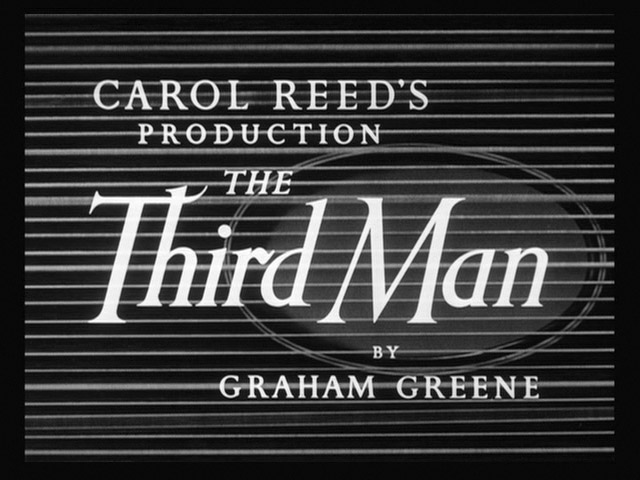
“The Third Man” is a stunning British film noir from 1949 directed by Carol Reed and starring Joseph Cotten. It’s a film featuring a tight Hitchcockian story and some extremely clever uses of cameras and lighting. Novelist Graham Greene wrote the screenplay that takes place in a battered post-World War 2 Vienna. The city has been broken up into sectors, each owned by different countries. This plays a big part in Greene’s story. Throughout the film we see shells of buildings, burnt out cars and piles a debris left from the war and it creates one of the most believable atmospheres. This is in large part due to the incredible cinematography from Richard Krasker but more on that later.

This is the Vienna that novelist Holly Martins (Joseph Cotten) enters into. He arrives there at the request of his friend Harry Lime who has offered him a job. But he finds out that Harry had just been killed after being struck by a car. Curious about the circumstances surrounding his death, Martins begins to suspect that Harry was murdered. Along the way he runs into several characters including a cryptic British military policeman (Trevor Howard), Harry’s girlfriend (Anna Schmidt), a couple of Harry’s suspicious “friends” (Ernst Deutsch & Siegfried Breuer), Harry’s doctor (Erich Ponto), and an eyewitness to Harry’s death (Paul Horbiger). Martins sets out to piece together the tidbits of information he gets from each of these people and soon finds out that the truth may be a hard thing to handle.

The story moves at a perfect pace while nicely delivering all the elements you would expect from a high quality mystery and film noir. Cotten is fabulous as always and the supporting cast does a marvelous job of creating the shady and hard-to-read characters that give a movie like this such energy. It’s also necessary to mention that Orson Welles has a small but pivotal part in the movie and, just as you would expect, he is superb. The story never hits a lull nor does it ever overplay it’s hand. It’s intelligent and well constructed and I was consumed by both the narrative and the environment in took place in.

Getting back to Krasker’s cinematography, it’s impossible to watch this picture and not be struck by it. His work was ahead of its time and serves as an object lesson on creative camera angles and the use of lighting. The film was shot almost entirely in Vienna. Krasker goes to great lengths to capture the historical beauty of the city although it’s often shrouded in the darkness of night. But his impeccable use of lighting and shadows draws out the attraction of the statues, architecture, and cobblestone streets as well as the devastation left by the war. Also, you can’t talk about the presentation without mentioning the lovely score by Anton Karas. It features some great tunes none better that the beloved “Third Man Theme”.

I love “The Third Man”. Everything from its production value to the performances to the mesmerizing story works for me. This is great example of classic film noir and it had me hooked from the opening moments until that perfect final shot. This is a film that may have slid under some people’s classic movie radar. But this film excels in both visual presentation and intelligent storytelling. “The Third Man” is a real gem and it’s a movie that simply must be seen.

VERDICT – 5 STARS

5 STARSs

5STAR K&M

“Taken 2” – 2 STARS

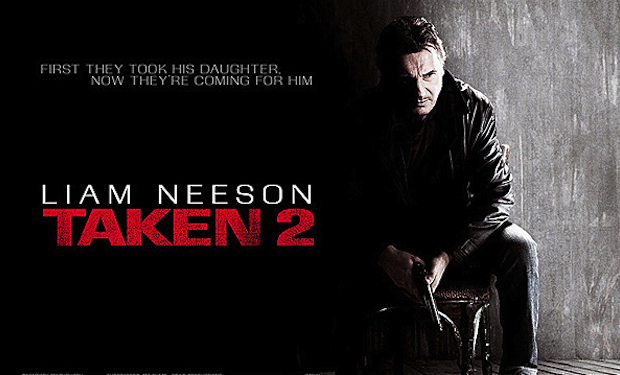
It’s still a little hard to believe that the man who played Oscar Schindler has evolved into a bonafide action movie star. Such is the case with 60-year old Liam Neeson. Neeson’s 2008 action thriller “Taken” was a surprise hit that moved his career in a new direction. And while I enjoyed “Taken” and it was a huge success, it wasn’t a movie that I expected to have a sequel. Yet writer Luc Besson returns with a new story (well, kinda) and with Neeson, Famke Janssen, and Maggie Grace back onboard. Now when watching “Taken 2” you’ll undoubtedly question why it was made (other than the obvious cash in) and it will strike you as very similar to the first movie. But while critics have shelled it, overall I didn’t have the sharp negative reaction to the film that many have had. Still “Taken 2” is a movie that doesn’t do a lot to stand out and ultimately it’s a standard “watch it once and you’re done” kind of film.

This movie is pretty much a direct sequel to the first film. It’s been a year since Neeson’s Bryan Mills killed those evil Albanian mobsters who kidnapped his daughter. Now the head of the mob and father of one of those killed is out for revenge. He puts together a plan to kidnap Bryan, his ex-wife Lenore (Janssen), and daughter Kim (Grace) who are spending time together in Istanbul. After Lenore is taken and with Kim running for her life, it’s up Bryan to kill a bunch more evil Albanians in order to save his family. Luckily he still has that “particular set of skills”, right?

There’s nothing unwatchable about “Taken 2” and it does try to make itself an extension of the first film instead of a rehash. It begins by showing the lives of Bryan and his family since the events of “Taken”. These scenes are fine and I didn’t mind being reacquainted with these characters. But quite honestly they are irrelevant and do nothing to drive the narrative forward. Things do pick up when Bryan goes to Istanbul on some unspecified business. Both his family and the Albanian mob pay him surprise visits which sends the movie careening from action sequence to action sequence. That wouldn’t be a bad thing if “Taken 2” could shake the burdens of predictability and familiarity. It also embraces some pretty conventional action movie techniques that I couldn’t help but shake my head at. But there’s still a degree of fun to the movie and even though it’s not one that will stick with you, it always kept my attention.

But let me say a little bit more about the action. These are some of the most poorly edited action sequences I have ever seen. The fight scenes are made up of rapid-fire quick cuts that make it impossible to know what’s going on. The movie keeps the action toned down enough to get a PG-13 rating but in several instances it hurts the film. There’s almost no edge to the action and even some of the bigger payback scenes at the end are unsatisfying because of this. One more thing, “Taken 2’s” bad guys are some of the dopiest in movie history. Tell me if this sounds like a good idea: You capture your prime target and one of the most deadliest men in the world and you leave him tied up and unattended in a room while you go down the hall to eat and watch soccer on TV. Seriously?

No matter how much I wanted to love “Taken 2” I just can’t. It never had me checking my watch and at a compact 90 minutes it never overstays its welcome. But there are so many flaws with this movie. Sure I love a snarling Liam Neeson and I love watching him bust the heads of bad guys. Unfortunately this movie just gives us more of the same but at a much lower and lazier production level. Even Liam can’t fully overcome that.