2016 BlindSpot Series: “Who’s Afraid of Virginia Woolf?”

woolfposter

When Edward Albee’s play “Who’s Afraid of Virginia Woolf?” landed in 1962 it set Broadway ablaze. Its scorching, abrasive story of a middle-aged couple’s volatile marriage won Tony Awards but was stripped of its Pulitzer Prize for Drama due to its controversial content. It was perceived as a story that could be told on Broadway but could never be filmed due to the infamous Production Code.

But things were changing in Hollywood. Screenwriter Ernest Lehman was determined to keep the play’s coarse language and twisted sensuality in hopes of capturing the same initial shock of Broadway. He succeeded and “Who’s Afraid of Virginia Woolf?” is now known as one of the key movies of the 1960s that led to the abolishment of the Production Code. The movie became one of only two films to receive an Oscar nomination in every eligible category (the other being “Cimarron” from 1931).

woolf1

Real life husband and wife Richard Burton and Elizabeth Taylor were cast to play George and Martha, a venomous, hard-drinking couple in marriage turmoil. George is an apathetic associate history professor at a small college. Martha is the bitter malcontent daughter of the college’s Dean.

After a late night campus party, Martha invites a young couple to their home for a nightcap. The guests are Nick (George Segal), a hunky newly-hired biology professor, and his mousy, reserved wife Honey (Sandy Dennis). George and Martha begin a caustic back-and-forth verbal assault. At first Nick and Honey are terribly uncomfortable by what they witness, but their hosts seem impervious to their rudeness or damaging words. At one point George flippantly explains “Martha and I are merely exercising, that’s all.”

woolf2

As more alcohol is consumed the conversations grow more toxic and soon the young couple find themselves caught up in George and Martha’s games of emotional destruction. Through various stages of drunkenness the four scratch and claw at every sensitive scar revealing deep-rooted anger and boiling secrets from their pasts. Lehman’s script is deeply loyal to Elbee’s story. Within it no feelings are protected and no verbal assault is too vicious.

The film marked the directorial debut of Mike Nichols who was nominated for an Oscar but lost out to Fred Zinnemann (but no worries, Nichols would win the following year for “The Graduate”). Nichols wisely takes a more conservative approach to this material, trusting his four key players and allowing them to do most of the heavy lifting. But that doesn’t mean Nichols vanishes into the background. His hand is seen in several strategic camera techniques ranging from shot framing to camera movement. His direction never overshadows the dialogue, but there are instances where he accentuates it.

woolf3

But when people talk of “Virginia Woolf” the performances most always top the conversation. The film earned Elizabeth Taylor her second Best Actress Oscar. Taylor dove headfirst into her character, gaining 30 pounds for the role, wearing a wig, and doing anything to shed her image as a beautiful movie star. Burton is equally good and brings a bruising passive-aggressive apathy to his character. Albee originally wanted James Mason but later admitted Burton was fantastic. Both Segal and Dennis also received Oscar nominations (Dennis winning her category) and each add their own unique and specific component to this dysfunctional tale.

There is simply no denying the strengths of “Virginia Woolf”, but your overall enjoyment may depend on your tolerance levels. This is 135 minutes of relentless verbal and mental cruelty. It’s a mean, acidic, piercing drama featuring one combustible scene after another. But the longer you stick with it the more layers are stripped away from the characters – the more we learn about them. And eventually the film asks if we are so different. Perhaps George said it best when watching Honey scratch the sticker off a bottle of brandy – “We all peel labels.” How true it is.

VERDICT – 4 STARS
4 Stars

REVIEW: “The VVitch”

VVITCH

Much of the inspiration for the independent horror movie “The VVitch” was gleaned from folktales, journal entries, and court documents from 17th century New England. Writer and director Robert Eggers faithfully and extensively researched with the intent of presenting the most accurate portrayal of his time period and subject matter. As a result he has made one of the few truly unsettling modern horror movies.

It’s not that Eggers only took plot points from old records. He also sought a deeper understanding of the 17th century mindsets towards religion, family, and specifically for this story, the idea of witchcraft. Add to that an almost obsessive attention to detail regarding the visual representation. For Eggers the authenticity of the language and setting was vital.

WITCH1

The story begins with a family being banished from a Puritan settlement due to the father’s unwillingness to compromise his religious convictions. William (Ralph Ineson), his wife Katherine (Kate Dickie), daughter Thomasin (Anya Taylor-Joy), son Caleb (Harvey Scrimshaw), and two rambunctious twins eventually settle on a patch of land near a sprawling forest.

Over time the family builds a sufficient farm and William and Katherine have their fifth child, Samuel. Everything seems well until one day when Samuel seems to vanish while being closely watched by Thomasin. His disappearance begins a stream of unexplained and disturbing events that threaten the family and leaves them teetering close to madness.

I won’t say anymore, but Eggers plays with a handful of compelling themes. One of the biggest centers around the family’s puritanical faith. There is a genuine faithfulness to God  they all share. At the same time the rigidity of their adherence and their inability to live up to their own standards leaves each of them spiritually vulnerable to an evil force lurking in the forest. And it was that same rigidity that caused them to leave the protective walls of the settlement to begin with.

WITCH2

The story’s slow-burn generates a surprising amount of unease. There is an ominous cloud hanging over this family. They can’t see it but we do. With each step forward Eggers adds another layer of suspense and by the film’s end the horrors are so uncomfortably realized that you can’t help but be effected. And it manages this with very little blood and gore. It is the clever melding of setting and subject matter that leaves you squirming.

It seems like I’m often complaining about the scarcity of originality in the horror movie genre. “The VVitch” is definitely original. It features a gripping story sure to be interpreted a number of different ways. The performances are phenomenal. The cinematography is impeccable. The score is haunting. It’s impossible to leave “The VVitch” and not feel you’ve seen something unique.

VERDICT – 4.5 STARS

4.5 STARS

REVIEW: “The Wave” (“Bølgen”)

wave poster

I’m a professing disaster movie junkie. I admit it. I can’t help myself. For some inexplicable reason I always manage to find some degree of entertainment even from the flimsiest of the genre’s offering. And while many of these movies are admittedly bad, others can be top notch edge-of-your-seaters when they give us an interesting scenario and characters to actually care about.

Norwegian director Roar Uthaug gives us such a movie with “The Wave”. Called Norway’s first ever disaster movie, “The Wave” clearly pulls from western influences while at the same time bucking numerous parts of the tired Hollywood formula. Many things will strike a familiar chord – ignored warnings, a natural catastrophe, a family in peril. But it’s the film’s ability to competently and effectively craft something fresh and unique that leaves a much bigger impression.

Knowing that the film is not so much based on a specific past event but on a near certain future one adds a sobering perspective. It’s set in Geiranger, a tourist town threatened by the unstable Åkerneset mountain. Geologists believe the gigantic mountainside will one day crash into the fjord below spawning a massive tsunami. The people of Geiranger would have an estimated ten minutes to evacuate and get to safe heights. No one knows when it will happen, only that it will.

WAVE1

Uthaug has said that the frightening reality of the situation influenced how he told this story. He felt obligated to represent the potential catastrophe honestly and without exploiting the true-to-life dangers facing the people of Geiranger. Knowing the collapse will eventually happen is concerning. Wondering if the people will have enough warning to escape is terrifying.

Kristoffer Joner plays Kristian, a geologist whose team is tasked with monitoring Åkerneset and issuing the warning if a collapse ever happens. Recently Kristian took a job in the oil business and is preparing to leave Geiranger with his wife Idun (Ane Dahl Torp), frustrated teenaged son Sondre (Jonas Hoff Oftebro), and adorable young daughter Julia (Edith Haagenrud-Sande). But leaving the lure of the mountain proves to be a difficult task.

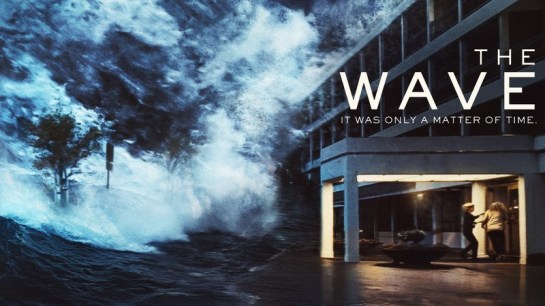
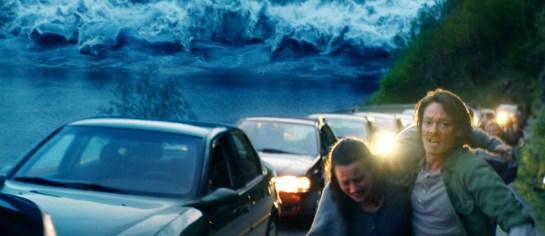
What happens next shouldn’t surprise you. The mountainside crumbles into the fjord sending an 80 foot wave barreling towards Geiranger. What is surprising is seeing a disaster film handle the entire thing with such smarts. First is how Uthaug handles the buildup. The setup to the mountain collapse is absolutely crucial. The film’s opening 45 minutes is deliberate and focused, steadily building the tension and raising extremely high stakes for the small community of Geiranger.

WAVE2

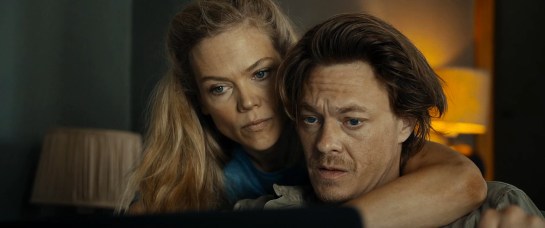
Another key is the film’s willingness to give us characters to care about. There are no caricatures here. There is a very humanistic approach to to how Kristian and his family are presented and developed. They are individually down to earth and are never exaggerated for the sake of drama. The performances, particularly from Joner and Torp, keep the characters authentic and grounded.

Even the catastrophic wave itself is dealt with on a human scale. The visual effects are incredible and represent the wave as ominous and deadly. But unlike most of these genre films, there isn’t a dependence on vividly showing off their digital creation. Instead the intensity boils its hottest in the moments where the wave isn’t shown, as people desperately try to get to safety. Even more importantly the camera doesn’t revel in the death and destruction. So many disaster flicks bombard us with their digital devastation – crumbling buildings, massive body counts, etc. This film knows it doesn’t need to do that in order to be effective.

What Roar Uthaug and company have given us is a film that manages to be unashamedly a disaster movie while at the same time distinguishing itself as something unique. The result is a fabulous, intense, nailbiter that more often than not stays within the realm of plausibility. Then add in the ominous warning that this event could legitimately happen in the future. That makes it all the more effective.

VERDICT – 4.5 STARS

4.5 STARS

REVIEW: “While We’re Young”

YOUNG POSTER

Noah Baumbach has made a career out of making movies about unlikable or generally unhappy characters. Many of his walking human complexities exist in various stages of lethargy, denial, or dissatisfaction. But at the same time the characters he creates drip with humanity and they are fascinating to watch. Yet with all of that being said, I don’t always fully go for his movies.

“While We’re Young” is another of Baumbach’s mixed bags. It is a sincere and genuinely human comedy that connects due to its observational honesty and its willingness to address real emotional struggles. But like a few other Baumbach projects, it doesn’t fully see its promise through and the final act of the film wanders away from what makes the story initially so compelling.

YOUNG1

Ben Stiller and Naomi Watts play Josh and Cornelia Schrebnick, a middle-aged couple living in New York City. Their past difficulties in having a baby are highlighted with the birth of their best friends’ daughter. Josh and Cornelia attempt to brush aside their feelings of disappointment and unfulfillment by focusing on the freedoms they have as a family of two. But even that is effected by the plain ol’ fact that they are just getting old.

Josh is a movie documentarian who has been stuck in the rut of an eight year film project that shows no signs of nearing completion. After teaching a continuing education class at a local college he is approached by young twenty something couple Jamie and Darby Massey (Adam Driver and Amanda Seyfried). The Massey’s invite Josh and Cornelia to dinner where we learn Jamie is an aspiring documentarian and a huge fan of Josh’s first film.

Josh and Cornelia grow infatuated with their new young hipster friends and their exaggerated retro styles. They feel young and energetic whenever they are around Jamie and Darby and they begin feeling a disconnect with their old friends. But is this simply a refuge from their insecurities about getting older, or is the old adage correct – you’re only as old as you feel?

For most of the film Baumbach explores that question through a number of smart and witty conversations and situations. We see the Schrebnick’s, particularly Josh, open up and embrace new things. He puts aside some of his closed-minded, exclusionist perspectives and sees creativity and life in general through a new lens. But at the same time Baumbach is shrewdly pointing a finger, not at Josh but at the Masseys; asking compelling questions about the younger generation.

YOUNG2

Baumbach’s film works on so many levels but it also has its flaws. Stiller and Watts each convincingly play their individual parts. Yet there are moments where I couldn’t quite buy into them as a couple. There are also a few moments where the normal sharp wit gives way to the juvenile. For example, an Ayahuasca scene leads to a running vomit gag that never seems to end. I mean who doesn’t laugh at vomit, right? And the biggest problem is in the last act when the story loses its focus a bit and ventures off in a direction that simply wasn’t that interesting.

Baumbach is a unique filmmaker who tells unique stories. His tales rarely venture outside of his confined view of life, love, and relationships but that’s what provides his films with their own flavor. “While We’re Young” gives its audience things to ponder and to chew on while also being deftly funny and unflinchingly human. It just can’t quite see its strengths through till the end. It’s still a good film. Not “Frances Ha” good but hey…

VERDICT – 3.5 STARS

3.5 stars

REVIEW: “The Water Diviner”

WATER poster

Russell Crowe has long been one of film’s most reliable actors. His work has earned him the reputation for giving strong and steady performances. This has allowed him to dabble in a number of different movie types and genres. But the 51-year old Oscar-winning Australian has watched his career truly flourish in period pieces covering everything from the Roman Empire to 1950s Los Angeles. Regardless of the time period or setting, Crowe always seems perfectly cast.

“The Water Diviner” places Crowe in 1919 following the end of World War I. He plays Joshua Connor, a farmer and water diviner living on the rugged Australian Outback. I knew practically nothing about the practice of water ‘divining’ but the film takes care of that in a fine opening sequence. From there we learn that recently Joshua’s life has been as hard as the ground he works. His three sons were presumed killed during the Battle of Gallipoli and his emotionally fractured wife Eliza (Jacqueline McKenzie) found it impossible to cope with the loss.

The grieving yet determined Joshua sets out to keep a promise to his wife – to find his sons and bring their bodies back home for burial. Along the way he is tortured by painful flashbacks, but his search is also assisted by guiding visions. He also encounters several key people along the way. He meets Ayshe (Olga Kurylenko), a war widow raising her son and running a hotel in Constantinople. Jai Courtney shows up playing an Australian officer tasked with finding lost Australian soldiers left on the battlefields. But the greatest help comes from an unexpected source, Major Hasan (Yılmaz Erdoğan), a Turkish officer deeply sympathetic to Joshua’s plight.

WATER1

Crowe not only stars in the film but makes his directorial debut. His direction may not instantly mirror that of an auteur, but it’s clear he is no novice and he understands the craft. In many ways Crowe’s approach hearkens back to a classic form of directing. We see it in much of his structural and camera decisions but also in the simplicity of the direction. I also think Crowe should be commended for giving the film a grand, near epic look and feel despite having a less than epic budget. The budget restrictions show themselves in the handful of action sequences but overall it feels like a sweeping, expansive story.

“The Water Diviner” is an entertaining and emotionally satisfying drama but it has sparked some intense controversy. Many people were offended by the film’s failure to address the Armenian genocide. Some pretty heavy allegations were hurled at Crowe and boycotts were called for. But were those feelings justified? Is this the type of film that demands the genocide be addressed? While offering the utmost respect for those effected by the slaughter, I would argue the answer to both questions is no.

“The Water Diviner” doesn’t aim to be a historically thorough film. The story takes place after the war and the central focus is on a father’s loss of his three sons. In many ways the film highlights the futility of war and the devastating personal costs that follow. Crowe shows the post-war through several different perspectives while never taking a side or forming any conclusion. But all of that serves as a backdrop. It’s truly a story of loss and a father coping the best way he can while also struggling with his complicity in his son’s fate. That is the emotional current that drives the film which is why I think the controversy is unwarranted.

Crowe’s direction is solid but even more could be said about his performance. I feel Crowe is sometimes overlooked because we know he is always going to give a strong performance. In this film he is the linchpin and the emotion center. I always enjoy Kurylenko and she is good here. Unfortunately her character is restricted to a fairly obvious side story. Not so for Yılmaz Erdoğan. The Turkish actor and filmmaker gives us an incredibly compelling character and he tells so much through his tired, war-weary eyes.

Some may consider “The Water Diviner” to be a bit too melodramatic and some may struggle with the film’s shifts in tone. Others may get caught up in the well-publicized controversy. Instead I found myself caught up in the story that lies at the heart of the film and I was completely invested in the central character. Russell Crowe has given us a fine movie that once again spotlights his talents as an actor while also introducing us to his talents as a director. It definitely impressed me and he has certainly earned more opportunities behind the camera.

VERDICT – 4.5 STARS

TEST star

REVIEW: “What We Do in the Shadows”

SHADOWS poster

These days good comedies are a rarity which makes finding one all the more special. The genre’s landscape is overloaded with obnoxious raunchy comedies and shallow Sandler-esque toilet humor. If you aren’t a fan of those two brands finding an enjoyable modern comedy may be a chore. But “What We Do in the Shadows” is one of the rare exceptions – a highly original comedy that is also smart in its open embrace of absurdity.

Calling the film “smart” may be stretch for some, but I think the filmmakers are devilishly perceptive. Co-writers, co-directors, and co-stars Taika Waititi and Jemaine Clement are very well aware of the type of humor they are employing. The Wellington, New Zealand duo create a concept so ridiculous on the surface yet pulsing with focused energy and a satiric edge. It shows smarts in its concept, smarts in its execution, smarts in its structure, and perhaps most importantly smarts in its ability to maintain a genuinely funny premise from start to finish.

SHADOW1

While pondering a way to describe the film I kept coming back to ‘a vampire mockumemtary meets “The Real World”. It presents itself as a found-footage reality show and/or documentary. The first thing we see is a cheap, grainy production graphic from “The New Zealand Documentary Board”. From there we are immediately injected into the world of four vampires living together in a Wellington flat. Our perspective is through the lens of a documentarian’s camera.

First we are introduced to the four vampires. The 379 year-old Viago (Waititi) is a good-hearted 16th century neat-freak. Vladislov (Clement) is an 862 year-old medieval fashionista. Deacon (Jonathan Brugh) is the youngster of the bunch – 183 years-old and a bit of a rebel. And then there is 8,000 year-old Petyr (Ben Fransham) who hisses more than speaks and has an uncanny resemblance to Count Orlok from “Nosferatu”. All four are uniquely funny which makes their quirky camaraderie a real treat.

It doesn’t take long to recognize the vibe Waititi and Clement are shooting for. The dry, deadpan humor. The constant awareness and conversations with the camera. The straight-faced approaches by the actors regardless of a scene’s nuttiness. All of it contributes to a movie which genuinely feels like a reality show or a documentary. It just happens to be spotlighting vampire roommates from different eras with very limited connections to the modern world outside their doors.

SHADOW2

Occasionally they go out to enjoy a socially awkward night on the town. Other times we see them having a “flat meeting” to discuss house duties. There are an assortment of camera confessionals talking about everything from lost loves to frustrations with roommates to favorite torture practices. And there are several funny bits after the boys are introduced to the wonders of YouTube, eBay, and Skype. Most of these scenes are given to us in pinches which are the perfect portions. They also toss in a very small handful of side characters who serve the story nicely.

“What We Do in the Shadows” is such a breath of fresh air. It’s a comedy that consistently delivers laughs without clinging to unfunny cliches or the hot current genre trends. Rarely does the movie miss a beat and its cleverness shows itself in a host of ways. It is subtly subversive, subtly satirical, and openly absurd. Waititi and Clement craft one very funny movie that clearly isn’t a film for the movie masses. I can see some people rolling their eyes and some people dismissing it altogether. I found it to be a hysterical reminder that there are comedies willing to do their own thing and do it very well.

VERDICT – 4.5 STARS

TEST star