

Jean-Pierre and Luc Dardenne remain among my favorite contemporary filmmakers and every new movie immediately finds itself high on my must-see list. The brothers are known for telling stories through an intensely realistic lens, often honing in on the disenfranchised working class and their everyday circumstances. The Dardennes have a restrained and observant style, reminiscent of the great French auteur Robert Bresson, but with slightly busier compositions and a considerably more fluid camera.
The Dardennes again bring their subdued, clear-eyed approach to their latest film “Young Ahmed”. A Cannes Film Festival winner for Best Director, “Young Ahmed” shares many of the same traits of their previous films, but they’ve never tackled subject matter quite like this. Their story centers on a 13-year-old Belgian boy named Ahmed (Idir Ben Addi), a young Muslim who has been radicalized by a local imam (Othmane Moumen). Right out of the gate you realize this a tricky and sensitive material. But it’s also a case where the Dardennes’ distinctly grounded style makes them more capable to tackle it than many of their filmmaking contemporaries.

Image Courtesy of Kino Lorber
By the time we meet Ahmed he has already committed himself to the imam’s teaching and is deeply devout when it comes to prayer and study. His strict interpretations can be seen in nearly every part of his daily life. From his refusal to shake the hand of his teacher Inès (Myriem Akheddiou) down to the precise way in which he washes his hands. It doesn’t take long to notice other concerning things about Ahmed, most notably that he’s a somber and serious boy who never cracks smile. He’s obviously impressionable and a dramatically different person than he once was. We also notice the wedge his religious zeal has put between him and his family, particularly his heartbroken single mother (Claire Bodson).
It all culminates in an ill-advised and utterly botched violent act that sees Ahmed arrested and sent to a youth detention and rehabilitation center. It’s here that the film takes an unexpected turn and begins to examine Ahmed from a different perspective. While in the facility his caseworker and staff engage in a strategically subtle form of intervention, allowing Ahmed to pray but involving him in activities that may help him reconnect with the kid he once was.

Image Courtesy of Kino Lorber
Storywise it sounds rudimentary, but throughout the film’s second half the Dardennes keep us wondering how far Ahmed has fallen down the rabbit hole. How deeply rooted are his convictions? Are the activities at the rehab center having any effect? We don’t know because Ahmed is such a hard book to read – never emotional and rarely interested in anything other than his prayer time. But we see cracks, especially when he meets a flirtatious young girl named Louise (Victoria Bluck). Still the Dardennes and their lead actor never tip their hand. It’s an especially impressive feat for Idir Ben Addi considering he’s in practically every scene.
“Young Ahmed” is yet another Dardenne brothers film that highlights their unique harmony of story and style. It’s a quietly affecting drama stripped of artifice and that fully embraces their naturalistic point-of-view. Interestingly it doesn’t always have the same intimacy as some of the brothers’ best films, but it still examines humanity through their uniquely personal lens. That makes “Young Ahmed” another great addition to their already fascinating catalog of movies.
VERDICT – 4 STARS













 Akira Kurosawa’s 1961 classic Yojimbo is a Japanese samurai film that’s not only beautifully hypnotic entertainment but is a master’s class on camera work and film making. Kurosawa creates a gritty and audacious period picture that manages to mix action with small bits of dark comedy while constantly showing off his technical savvy.
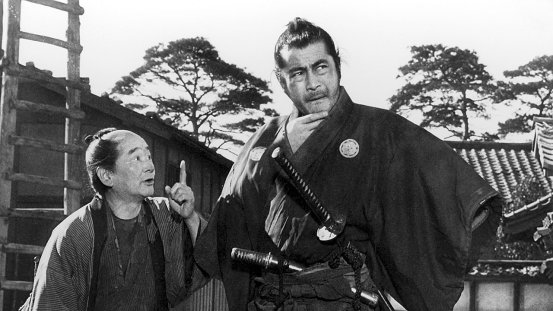 Yojimbo looks and sounds amazing. Masaru Sato’s magnetic score starts with the opening credits and resonates throughout the picture. The cinematography is fascinating with some cleverly staged camera angles, near perfect camera movement, and beautiful wide-framed shots. The story is pretty basic but very efficient with the exception of a few too many conversations over sake at the restaurant. Yet it’s never boring and more often times mesmerizing.

 Keith & the Movies