“IN DARKNESS” – 3 1/2 STARS

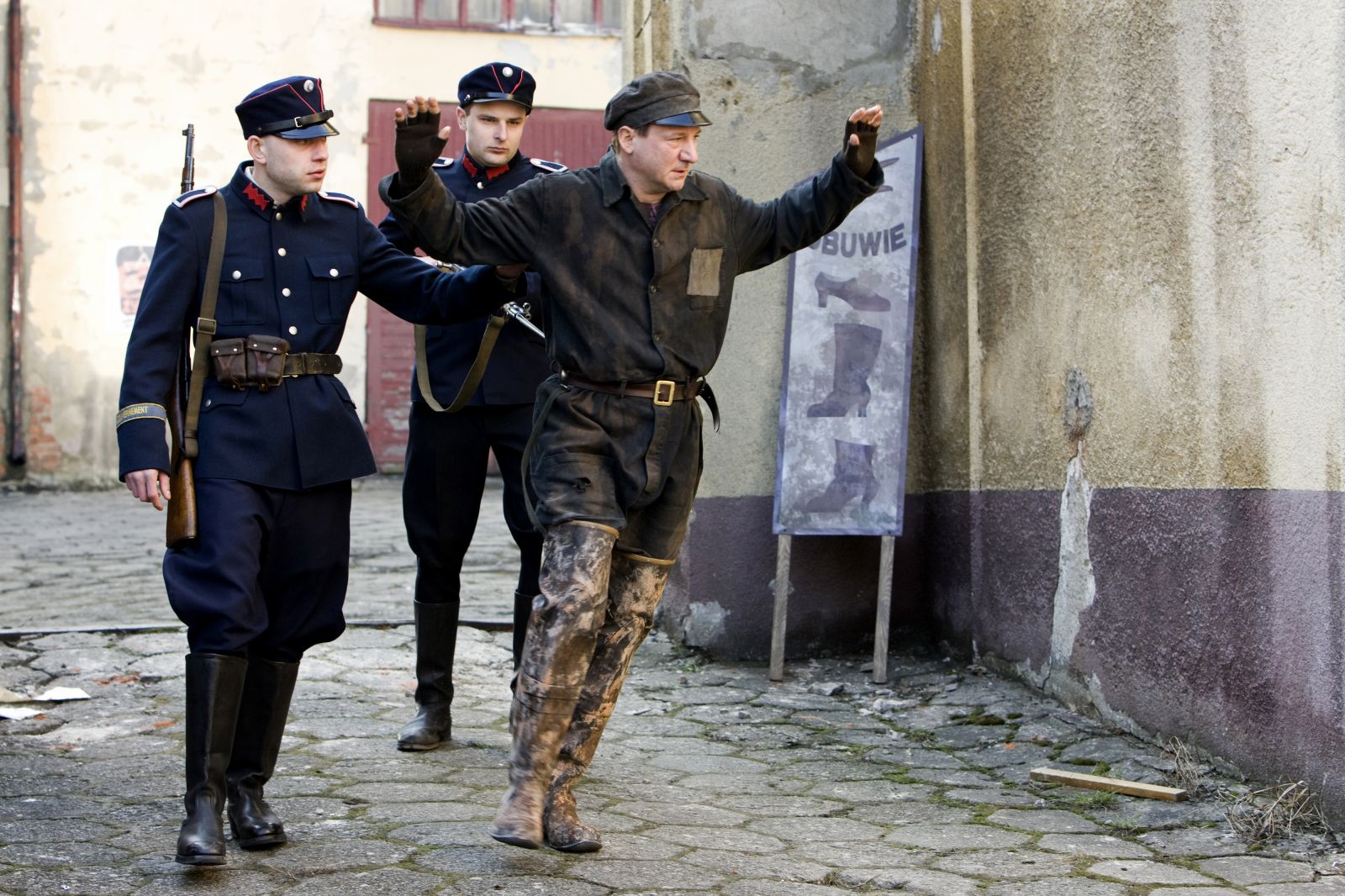
“In Darkness” is a Polish historical drama from director Agnieszka Holland and one of last year’s Oscar nominees for Best Foreign Language Film. It’s based on the novel  “In the Sewers of Lvov” by Robert Marshall which tells the true story of Leopold Socha and his efforts to shelter Jews from the Nazis and Nazi sympathizers in occupied Poland. It’s a foreign film that looks at the war from a unique perspective and at times truly conveys the horrors of the Nazi occupation. It’s can be tense and heart-wrenching and you can’t help but be effected by what you’re seeing. But it’s also a movie that spins its wheels in a some places and features a few crude and jarring scenes that seem disconnected and pointless.

Robert Wieckiewicz plays Leopold Socha, a sewer worker in the city of Lvov. We first see Leopold as a gruff and self-serving individual who will even resort to stealing to make money. He’s a husband and father and we see early that he has no use for the Jews, even though he understands the horrors being inflicted by the Nazi occupiers. While in the sewers one day, Socha comes across three Jews who have dug a hole through the floor of their home to provide an escape route should they need it. A short time later the Nazi’s sweep through the Jewish ghetto killing and capturing the entire Jewish community. A small group escapes through the floor and into the sewers where Socha agrees to hide them for a fee.
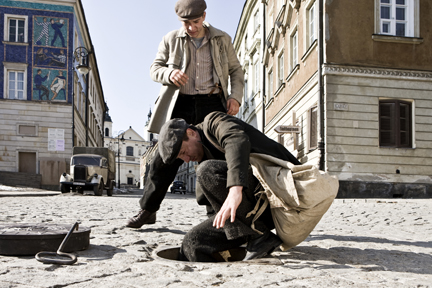
Initially Socha’s service is all about money. The Jews pay him each day and even a local market owner notices his sudden increase in income. But Socha begins to see the Jews in a different light and his gradual transformation becomes the centerpiece of the story. The Jews don’t exactly trust him either and watching the relationship between them evolve in the midst of such a harsh and dangerous set of circumstances is enthralling. Add the pull of this being based on a true story and it makes it all the more effective. Socha can’t help but sympathize with the Jew’s especially after witnessing acts of Nazi brutality and helping them through several near-miss encounters in the sewers.

Holland also does a fine job creating a visual representation of a war-torn Polland. From the ravaged neighborhoods and amazing wardrobe design to the savage and often times disturbing depictions of Nazi violence. But most of the film takes place in the dark and dirty sewers. These scenes are filled with shadows and almost no light other than from candles and quick-moving beams from flashlights. It’s effective in creating a grimy and claustrophobic environment but at times it makes it hard to decipher what is going on. The movie contrasts the darkness with some bright daytime scenes outside the sewers that sometimes show a world darker that what’s under the streets.

 “In Darkness” should be commended for it’s incredible acting. Wieckiewicz’s performance is grounded and believable and his ability to portray a conflicted man who watches his perspective change is easy to buy into. The film also does a pretty good job of developing an assortment of interesting people among the Jews in hiding. Each performance is well executed and even though several of the characters seem underwritten, the performances are nonetheless good.
David Shamoon’s script moves along pretty well but there were some bumps in the road. There are a handful of rather crude scenes that really felt completely out-of-the-blue. I couldn’t understand their purposes other than adding a different level of adult content to the film. They didn’t add anything to the bigger story and in fact pulled me out of the movie on each occasion.  The scenes were pointless and that time could have been much better spent elsewhere.

While “In Darkness” does trip over itself in a couple of places and the lighting in the sewer scenes sometimes makes things hard to see, it still captures the notion that human goodness can persevere. It’s real-life groundwork grants the movie a genuine emotional pull that I was caught up in. “In Darkness” isn’t the best World War 2 period movie or the best movie dealing with the holocaust. But it does offer many tense scenes filled with suspense. It also celebrates the will to live even in the face of the worst adversities and reminds us that even a simple sewer worker can have a monumental effect on the lives of others.
“LOCKOUT” – 3 STARS

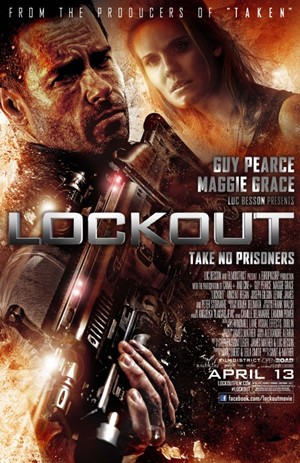
I grew up watching those 1980’s and early 90’s tough guy action movies. During that time, the action genre was immensely popular. For years those movies made one-man-armies and cheesy one-liners commonplace. But that doesn’t mean they weren’t fun and I wouldn’t hesitate calling some of them personal favorites. “Lockout” takes a lot of its inspiration from those 80’s action flicks and it unashamedly tries to recreate the tone and feel of those films. Because of that, the movie could be an immediate turn-off for those who didn’t care for the genre or a disappointment for those who don’t get what the film is aiming for. I found it to be a fun piece of popcorn entertainment despite its few noticable shortcomings.

“Lockout” doesn’t pretend to be earth-shattering or ground-breaking by any means. It’s very straightforward in its presentation and even the trailer seemed patterned after those from the 80’s. Several elements of the story are fairly familiar but with a futuristic, sci-fi angle. Guy Pearce bulks up to play a government operative named Snow. He’s an irreverent, wise-cracking loose cannon who finds himself framed for a crime he didn’t commit (stop me if you’ve heard this before). Meanwhile Emilie Warnock (Maggie Grace), the U.S. President’s daughter, is visiting an orbital space prison known as MS ONE on a humanitarian fact-finding mission. But while there, the prisoners revolt and take charge of the space station. Snow is asked to go in and rescue the President’s daughter in exchange for his freedom. Of course he agrees but with his own ulterior motives.

The story moves at a pretty fluid pace and at 95 minutes it’s pretty compact and doesn’t drag things out. In many ways Snow is your prototypical tough-guy. He’s tough as nails, has a bad attitude, and fires off more one-liners than bullets. Clearly he’s written to take wise-cracking to the extreme but it’s a little overdone. In fact, it’s almost as if Snow is completely incapable of carrying on a normal conversation. One the flip side, this isn’t a movie centered around stimulating conversation and several of Snow’s quips are quite funny. But it also makes him an incredibly one-dimensional character.

The movie is chock full of CGI and special effects. Some of the effects are well done and they do a lot to create a believable sci-fi environment. But there are also several examples where they look more like a video game than a movie. Before the movie started, the trailer for Ridley Scott’s “Prometheus” was shown and the difference in the special effects between the two is staggering. But to be fair, “Prometheus” has about five times the budget and “Lockout” just tried to make due with what it had. The action scenes are pretty well done even though so much of it happens off-screen. This was clearly done in order to obtain a PG-13 rating. But in a way it subverts the tough and gritty look of the film and takes away an edge that would have made the movie better in my opinion.

I’m a big fan of Guy Pearce. When it comes to movie roles he has a pretty diverse resume, but I haven’t seen him play a character quite like this. It doesn’t take long to figure out his approach to Snow. Pearce is clearly having fun with the role and his performance is quite good. I never felt Pearce let’s Snow become just a caricature and in several instances he elevates the material. Maggie Grace does a decent job although she’s not quite on Pearce’s level. The movie is helped by some really good smaller supporting performances. It’s funny to say about this type of movie, but the acting really rises above the story in many places.

“Lockout” is getting hammered by critics and I find that to be no surprise. This is another example of some critics not measuring the film by what its trying to be. Now I’m not saying “Lockout” is incredible filmmaking or a new classic. It clearly has it’s issues that do drag it down a bit. The special effects aren’t the best and the action is sometimes pruned to the point of being ineffective. But I still found it to be an entertaining sci-fi B movie led by a really, really fun performance from Pearce. “Lockout” won’t win any awards but for the most part it accomplishes what it intends to.

REVIEW: “The Adjustment Bureau” (2011)

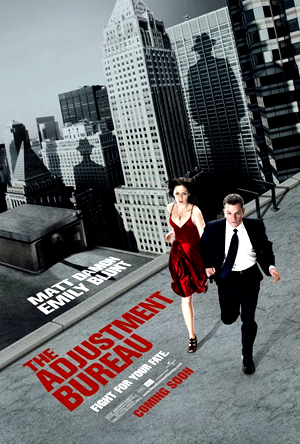
I think it would be fair to say that “The Adjustment Bureau” was a fairly big disappointment for me. The trailers and TV spots for the movie really sold it as something it’s not so I found myself expecting a little more than I actually got. I also felt the movie was going for an almost Hitchcockian feel. I mean look at the above movie poster that was released for it. Even it looks fresh out of Alfred Hitchcock’s creative mind. Unfortunately nothing in the film feels as creative as the poster and ultimately it’s a letdown.

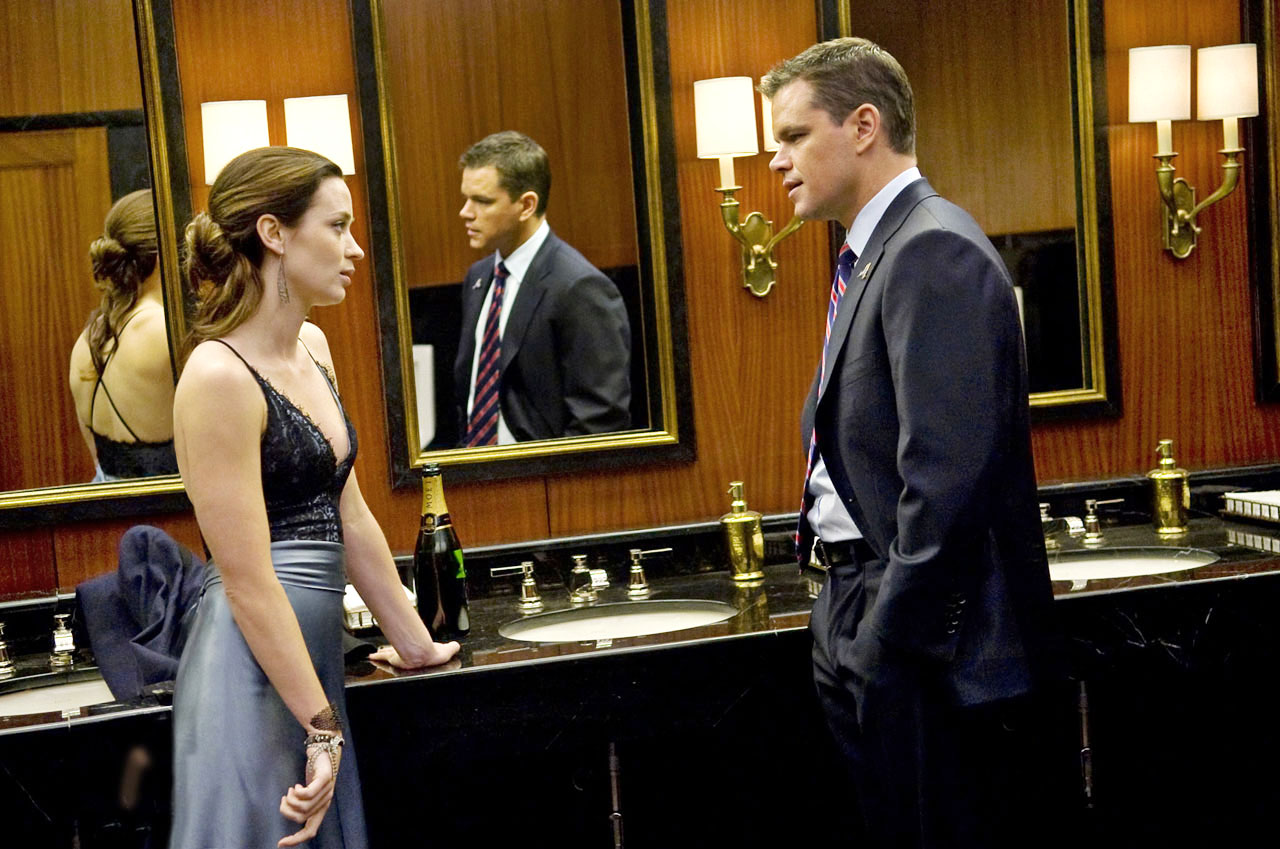
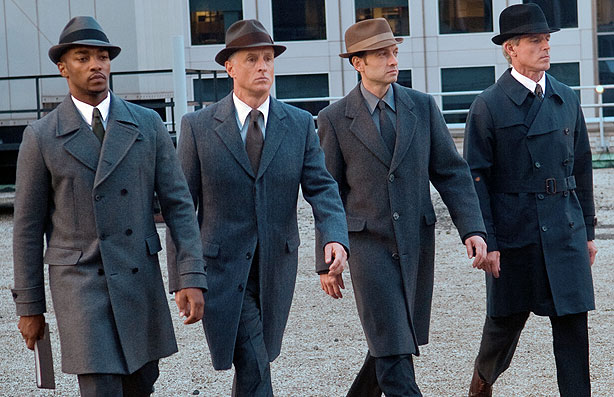
In “The Adjustment Bureau” Matt Damon plays David Norris, a young hotshot Democratic candidate for the U.S. Senate, who loses his bid for office due to his questionable maturity and impulsive behavior. While rehearsing his concession speech he bumps into and immediately is attracted to the mysterious but beautiful Elise (Emily Blunt). The problem is they aren’t meant to be together, at least according to “the plan”. Enter The Adjustment Bureau, a group of stiff, ominous men in hats who intervene to make sure this sprouting relationship never takes place and that “The Chairman’s” plan stays on course.

“The Adjustment Bureau” could be called a romantic sci-fi thriller. Sadly the film’s romance has no believable foundation. While Damon and Blunt have good on-screen chemistry, it was hard for me to believe in their romance. Director George Nolfi never allows the relationship to grow, instead choosing to springboard their undying love out of a few short hours together. I also felt the sci-fi element was pretty underwhelming.  There’s nothing that stands out about it. Instead we get doors that transport you from one part of the city to another (which is cool the first 10 times they are used) and magical hats that serve as keys (yes, I just actually said magical hats that serve as keys). The film also lacks any real sense of urgency that’s found in better thrillers. I never felt any intensity nor did I ever feel that there was a steady or consistent buildup.

Most of these problems are the results of a slow, lumbering script. The film spends too much time in the first act examining David’s political ambitions instead of developing the romance which is the supposed centerpiece of the entire picture. Then we get numerous scenes of tedious dialogue between David and Bureau members, meant to inform the audience but instead ends up deflating any momentum the film may gain. As more is revealed the sillier things get and by the time we get to the rather flat and uneventful ending, I wasn’t that interested.

As I mentioned, Damon and Blunt have good chemistry and both give earnest performances and could have pulled this film off with better material. I enjoyed seeing Anthony Mackie in a bigger role but he seems out-of-place in this picture. “Mad Men’s” John Slattery and  the great Terence Stamp also appear but neither are given the chance to do much that’s memorable, again a result of the sub-par material.

If you watched the trailer for “The Adjustment Bureau” you would be expecting an action-packed, intellectual thriller. Instead you get nothing close to that. This is supposed to be a film that promotes thoughts of free will versus fate but honestly, I was never engaged enough to be moved intellectually. The film is well made, uses some great Brooklyn locations, and has some nice performances especially from it’s two leads. But the inconsistent script, lackluster ending, and flat-out silliness brings down what could have been a fun movie.

VERDICT – 2 STARS

“TINKER, TAILOR, SOLDIER, SPY” (2011) – 4 STARS

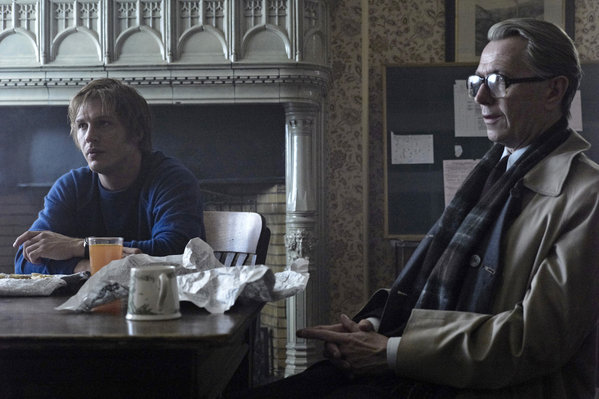
Bringing “Tinker, Tailor, Soldier, Spy” to the big screen was a pretty tough challenge. The movie is adapted from John le Carre’s complex 1974 spy novel of the same name. In 1979 it was adapted for television in the form of a seven part mini-series. So trying to condense the story down to two hours while maintaining its tense spy thriller feel was quite an undertaking. But hats off to director Tomas Alfredson and screenwriters Bridget O’Connor and Peter Straughan for not only pulling it off but for delivering a deep and enthralling picture.

I was first attracted to “Tinker, Tailor, Soldier, Spy” thanks to its stellar cast. The film features a veritable who’s who of british actors. Any movie that features the incredible talents of Gary Oldman, Colin Firth, Tom Hardy, Mark Strong, John Hurt, Toby Jones, and Ciaran hinds (who is actually Irish) is automatically off to a good start. Some of my favorite actors are in this bunch and here they really shine. Each perfectly relay the antsy Cold War paranoia that this type of movie calls for. Not one performance is disingenuous or fake. In many ways you can call this an acting clinic.

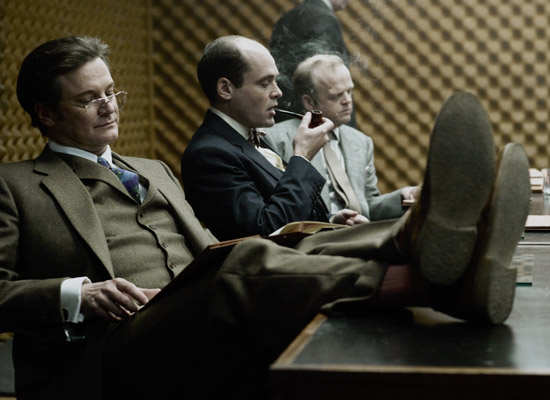
The film takes place in the early 1970’s. George Smiley (Oldman) is called back to British Intelligence, also known as “The Circus”, to root out a high level “mole” who is believed to be leaking highly classified intelligence to the Russians. One year earlier Smiley along with his boss Control (Hurt) had been forced out after a botched assignment caused the capture of an agent (Strong) in Hungary. Since Control has been removed, the Circus is being run by Percy Alleline (Jones). Working alongside Alleline is Bill Haydon (Firth), Roy Bland (Hinds), and Toby Esterhase (David Dencik). Smiley puts together a team to help find the mole. An important piece of the puzzle is an agent named Ricki Tarr (Hardy). Tarr is the one who made the allegation of a mole and may have even more information that could bring everything to light. Smiley must sift through the misdirections and false leads to find the identity of the mole and the four Circus higher-ups are prime suspects.

“Tinker, Tailor, Soldier, Spy” rewards patience. It’s a story that unfolds through a slow leak of clues and cleverly timed flashbacks. It’s a complex and layered story that requires a lot of attention and that could be what attracts many people to it (myself included). On the flip side I can see where some may be dissuaded after seeing the story as a muddled, convoluted, and almost laborious exercise. I’m not going to lie and say I completely grasped everything I was seeing. It did take a few rewinds and a little research to really put everything together. In some ways that did take away from the experience but on the other hand everything was presented. While it’s deliberate and sometimes dry, O’Connor and Straughan’s script is tight, structured, and clearly intends to make the audience work right alongside of Smiley.

Another thing you will instantly notice is the careful attention to the look and presentation of the movie. Alfredson’s direction is quite good and the mood and tone is just right. The movie is saturated with blues and greys that creates a cold, sullen atmosphere. The steel-faced agents are in a constant state of seriousness to the point that any smile automatically evokes suspicion from the audience. Oldman’s understated performance is pitch-perfect. Smiley is tired and worn but committed and resolved. His weathered poker-face hides his thoughts and intentions from the other characters and from us. Even Tom Hardy’s strange-looking blonde wig seems perfectly in tune with the picture.

This isn’t a spy movie in the same vein as James Bond or Jason Bourne. I’m certainly no expect of being a secret agent but this feels as real and grounded as any spy movie I have seen. It’s slow-moving and sometimes difficult to navigate but it’s also smart and completely engaging. It’s top-tier cast makes things even better and the movie would be worth seeing just for the wealth of acting talent involved. “Tinker, Tailor, Soldier, Spy” isn’t a film for everyone. But I found myself completely invested even if it did take a little work to get the full thrust of the story.

REVIEW: “Easy Rider” (1969)

EASYI fully understand that the 1969 motorcycle road film “Easy Rider” is considered a motion picture classic. I also understand that the movie introduced a new style of filmmaking that had a great impact on the industry. But while so many film critics and movie fans hold “Easy Rider” in high regard, I found it to be a flat, muddled, and occasionally annoying picture that hasn’t aged well at all. At the time of its release it was a relevent film examining such things as the hippie movement, the drug culture, and the late 60’s political environment. On the surface it may sound like an intelligent and thought-provoking experience. But it’s banal presentation, clunky storytelling, and overly cynical portrait of America did nothing to draw me in or keep my interest.

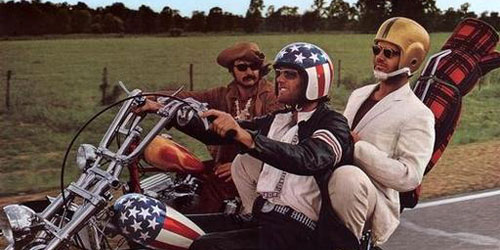
“Easy Rider” is a buddy movie about two motorcycle riding potheads named Wyatt (Peter Fonda) and Billy (Dennis Hopper). It sounds like the ingredients for a stoner comedy but they are actually treated seriously. They’re free-spirited counterculturalists who are out to capture their idea of live-by-your-own-rules Americanism. After smuggling some cocaine across the border, the two sell it in Los Angeles for a large amount of money. They then use that money for a road trip across the southwest and eventually to Louisiana where they hope to make it in time for Mardi Gras. They travel from location to location with just their bikes,  a gas tank full of hidden money, and apparently a bushel of marijuana.

Just like any other road movie, “Easy Rider” is more about the journey than the destination. As they travel, Wyatt and Billy see some beautiful sites and encounter a wide assortment of people. They are helped by a rancher who is struggling to make ends meet. They pickup a hitchhiker (Luke Askew) who leads them to a hippie commune filled with people who resemble space aliens more than human beings. They befriend an alcoholic civil liberties lawyer named George played by Jack Nicholson. They are arrested by small town police officers and harassed by intolerant locals. Yet the one constant seems to be their love for pot. It seems like during every stop they take time for a smoke especially at night as they sit around their camp fire rambling while under the influence. The story ultimately becomes about Wyatt and Billy’s search for freedom, freedom that turns out to be much more elusive than they thought.

EASY

“Easy Rider” is basically the hippie movement’s self-portrait and it looks at everything through their eyes. But it comes across as a sanctimonious and often times self-indulgent lecture that doesn’t have near the substance it wants to have. One prominent movie critic who is older than me praised the film saying “Seeing the movie years later is like opening a time capsule.” I guess I can see where the movie would have a stronger impact on you if you were a part of those years or if you’re sympathetic to the hippie culture. But as someone seeing it for the first time it feels incredibly dated and it definitely comes across as a drug-induced hallucination at times. It does dabble in a few interesting themes and the cinematography is impressive especially considering the tiny budget. But I never connected with “Easy Rider” or its characters.

This is a movie that is considered by many to be great. In fact, it’s #84 on AFI’s Top 100 Movies of all time. I don’t see it. Maybe it’s the overwrought counterculture message or maybe it’s just my personal disconnect with this element of that time period (I was born is 1971), but “Easy Rider” became an uninteresting and sometimes tedious undertaking. There are several scenes including a terribly annoying drug high in a cemetery and numerous campfire ramblings that had me desperately wanting to hit the fast-forward button. What little screenplay there is does nothing to help the film and the final few scenes of the movie feel cheaply pasted together. We do get some pretty camera work and a breakout performance from Jack Nicholson. But that’s not enough make me want to watch “Easy Rider” again. No thanks, I’ll pass.

VERDICT – 1.5 STARS

“SALMON FISHING IN THE YEMEN” – 4 STARS

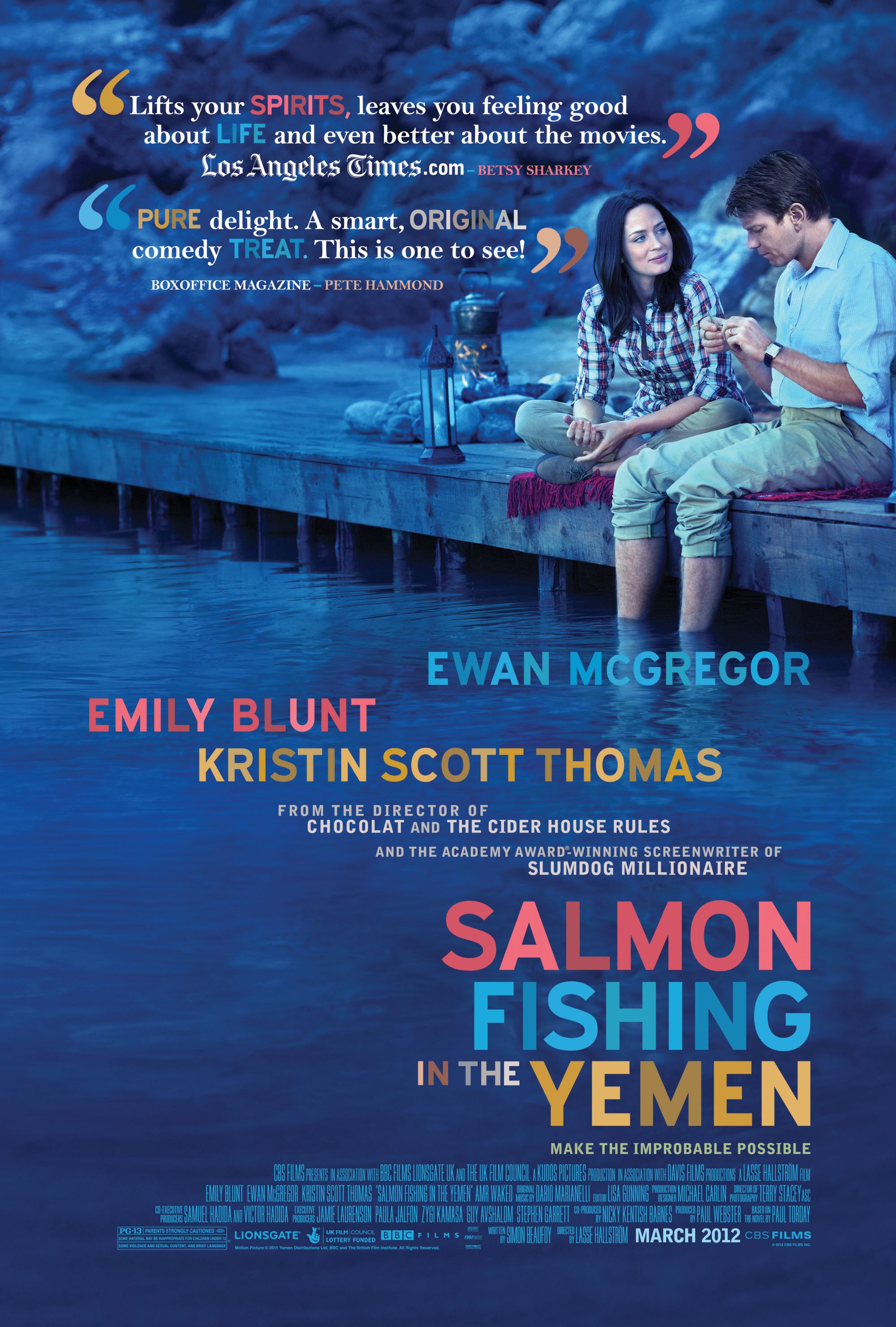
It may have the strangest title of any movie you will see in theaters this year. “Salmon Fishing in the Yemen” is a British romantic comedy that doesn’t shy away from the absurdity of its title. It’s a story about faith and believing you can accomplish something regardless of how preposterous it may sound. But this isn’t another run-of-the-mill, paper-thin rom-com that we seem to get bombarded with each year. Instead, “Salmon Fishing in the Yemen” has charm, a lot of heart, and some really good laughs.

“Salmon” is based on a novel by British author Paul Torday. It centers around the idea of a wealthy Sheikh Muhammed (Amr Waked) to bring salmon fishing to his homeland of Yemen. He’s a visionary who sees the project as something that would bring his people happiness while a small opposition group of hardliners see it as an attempt to westernize their country. Nonetheless he sends his representative Harriet (Emily Blunt) to meet with Britain’s foremost expert on fisheries, Fred Jones (Ewen McGregor) to test the feasibility of the project. From the start, Fred writes it off as a ludicrous idea noting everything from Yemen’s lack of water to its temperature as reasons why it won’t work. Harriet, on the other hand, is armed with answers and provides several reasons why it could work.

Still Fred wants nothing to do with the project but is soon forced to by Bridget Maxwell (Kristin Scott Thomas), the British Prime Minister’s cold-hearted press secretary. She’s taking some heat over how the country is being perceived by middle eastern countries particularly due to their military presence in Afghanistan. She sees helping the salmon fishing in Yemen project as a way to manipulate headlines and make the country look good. Maxwell is a mean and abrasive character but she also provides several of the film’s bigger laughs. While she is funny, there were times where the script overplays her baseness. Fred goes to Yemen to oversee the project and is soon won over by the Sheik’s vision and passion. He also discovers a growing attracted to Harriet which complicates both of their lives even further.

For me a romantic comedy will never work without good characters. “Salmon” has good characters. Fred is basically a fishing nerd. He’s a by-the-books fellow who feels uncomfortable if he’s even close to being outside his comfort zone. His marriage to Mary (Rachael Stirling) is on it’s last leg and he has no sense of direction for his life. He’s also not your typical rom-com male lead. He’s not suave, powerful, or your standard movie beau hunk. He’s just a guy and he’s easy to sympathize with and maybe even relate to in some ways. McGregor is perfectly cast and he has no problem capturing the qualities of Fred. Even Harriet isn’t your typical character. While she is beautiful, she’s also intelligent and witty yet equally unsure of her future. She recently became involved with a soldier but their relationship is put on hold when he is deployed to Afghanistan. Both main characters feel real. They’re not over-the-top or unrelatable nor are they cardboard cutouts. I liked them both.

“Salmon” does a lot of things right. The performances are really strong throughout and the chemistry between McGregor and Blunt doesn’t have to be manipulated. The movie also doesn’t force the relationship on the main characters. I don’t want to ruin anything but lets just say you’ll know what I mean after you’ve seen the film. I also really liked the sequences that take place in Yemen. They were actually filmed in Morocco and offer their own unique beauty. Also, I found the story of faith to be very effective. The sheik is a man of faith but Fred is not. As the story progresses we see that start to change. The salmon project becomes a time of reflection and self-discovery for Fred and in some ways also for Harriet. There’s one particular scene where Fred is walking with a heavy crowd of people. The overhead shot shows him stopping, turning around, then going back against the steady flow of pedestrians. It perfectly represents the change of direction in his life, the going against the grain if you will. As a whole, the story is well done and as mentioned it features some truly funny moments. Perhaps the only issue with the story is that I did feel some of the plot directions seemed too clean-cut. A few things happen along the way that just felt a little too convenient. But that’s not a big gripe.

I love a good romantic comedy or drama but they seem so rare these days. The genre has been watered down with films that follow the same broken formulas. But “Salmon” is unique in that it actually has funny moments, it is intelligent, and it’s two main characters are easy to care about and believe in. Again, some things in the story are a little too on the nose, but they’re easy to overlook when you have so much else to like. The film looks good and the performances are superb, especially from Blunt. It’s just a solid romantic comedy and so many of the other films in this genre should take notes.