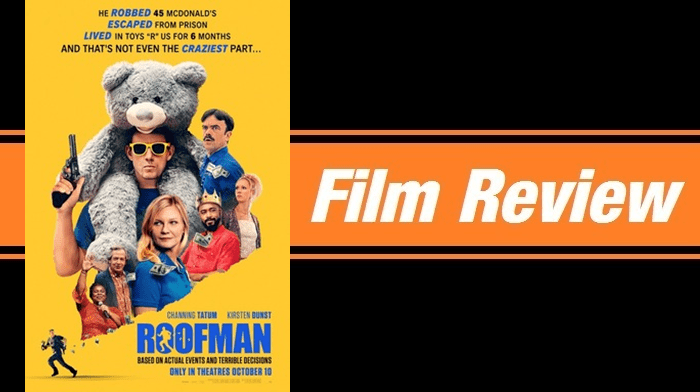
REVIEW: “Roofman” (2025)

“Roofman” is based on the real-life story of Jeffrey Manchester, a former U.S. Army Reserve officer turned small-time robber. Manchester committed as many as 60 robberies, mostly McDonald’s restaurants. He was finally caught in North Carolina and sentenced to 45 years in prison. But he would eventually escape, making his way to Charlotte where he secretly lived inside of a Toys “R” Us store. He hid there for months, unknown by the employees, living on baby food and candy.

Manchester’s story seems too ridiculous to be true making it prime material for a big screen adaptation. “Roofman” is directed by Derek Cianfrance who works from a script he co-wrote with Kirt Gunn. Channing Tatum plays Jeffrey Lancaster who we first meet as he’s successfully robbing a local McDonald’s. While in the service, Jeffrey was a unique soldier known for catching details, recognizing systems, and memorizing routines. Those particular set of skills have made him a successful robber but they haven’t helped him at home.

Image Courtesy of Paramount Pictures

Jeffrey is crazy about his young daughter Becky (Alissa Marie Pearson). But his ex-wife Talana (Melonie Diaz) has grown tired of his flaky antics. And that only gets worse after he’s finally apprehended and sent to prison. Missing his daughter, Jeffrey uses the very same skills that made him a good thief to escape. While on the run, he finds the most peculiar hiding spot – inside of a Toys “R” Us store where he stays hid during the day and rummages during the night.

But the story’s wackiest turn comes when Jeffrey falls for Leigh Wainscott (Kirsten Dunst), a single mother who works at the store. Despite being all over the television, Jeffrey tracks Leigh to her church’s toy drive where he pretends to be new in town, brought there by his top-secret government job. He begins attending services, and even goes to a singles social where he charms the church ladies and eventually Leigh. Before long the two are going on walks in the park and hanging out with her teen daughters, the proudly geeky Dee (Kennedy Moyer) and the angsty older Lindsay (Lily Collias).

Some of the film’s silly additions make the already crazy real-life account even crazier, and not necessarily in a good way. Whether it’s lazier stuff like Tatum running around Toys “R” Us naked or the dumbing down of characters to make Jeffrey’s ruse work. Also, this is one of those predictable stories where you know everything is going to blow up in Jeffrey’s face. There’s simply no scenario where he can settle down with his old life or his potentially new one.
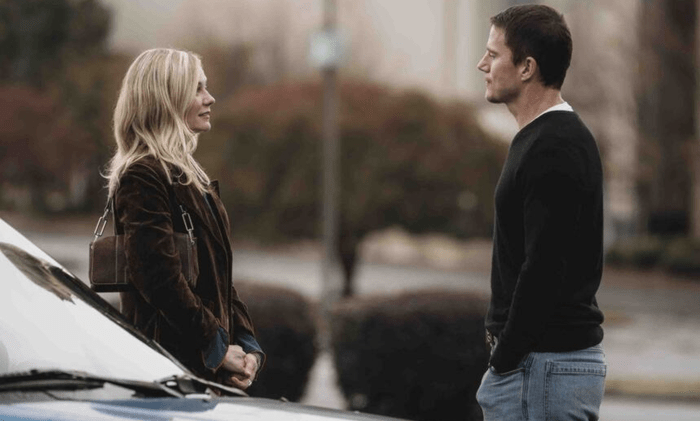
Image Courtesy of Paramount Pictures

Still “Roofman” remains watchable thanks to a cast who all seem to be having a lot of fun. This isn’t the first time Tatum has played an endearing dunderhead so he knows what he’s doing. Peter Dinklage gets some moments playing the bully Toys “R” Us manager, Mitch. Notorious screen villain Ben Mendelsohn has a blast going against type as Leigh’s pastor. LaKeith Stanfield gets a handful of good lines as Jeffrey’s cranky friend and former squad mate. And best of the bunch is Kirsten Dunst, an actress who is infinitely better than the material she’s working with.

“Roofman” certainly has its moments of fun, and Cianfrance mines some pretty good emotion and the occasional big laugh out of a wonky story. But the movie often feels tonally confused. And the writers seem more interested in telling a sanitary good guy tale than considering Lancaster’s crimes and what drove him to continue committing them. It leaves you with the feeling that there is a much better version of this gonzo true story still waiting to be told.

VERDICT – 2.5 STARS

REVIEW: “Three Billboards Outside Ebbing, Missouri”

BLLposter

Playwright turned screenwriter Martin McDonagh is three movies into his feature film career – “In Bruges”, “Seven Psychopaths” and his latest “Three Billboards Outside Ebbing, Missouri”. While each film has their differences they also also have their similarities. All three are black comedy crime pictures and each prominently feature McDonagh’s brash writing style. You can decide whether that last part is a good thing or not.

McDonagh’s inspiration for “Three Billboards” came as he was driving in southeastern United States and noticed some billboards speaking to an unsolved crime. He began filling in his own elements to the story and “Three Billboards” was born. As he began penning the script, two characters were written with specific performers in mind. The lead character of Mildred for Frances McDormand and the key supporting character Dixon for the always entertaining Sam Rockwell.

BILL1

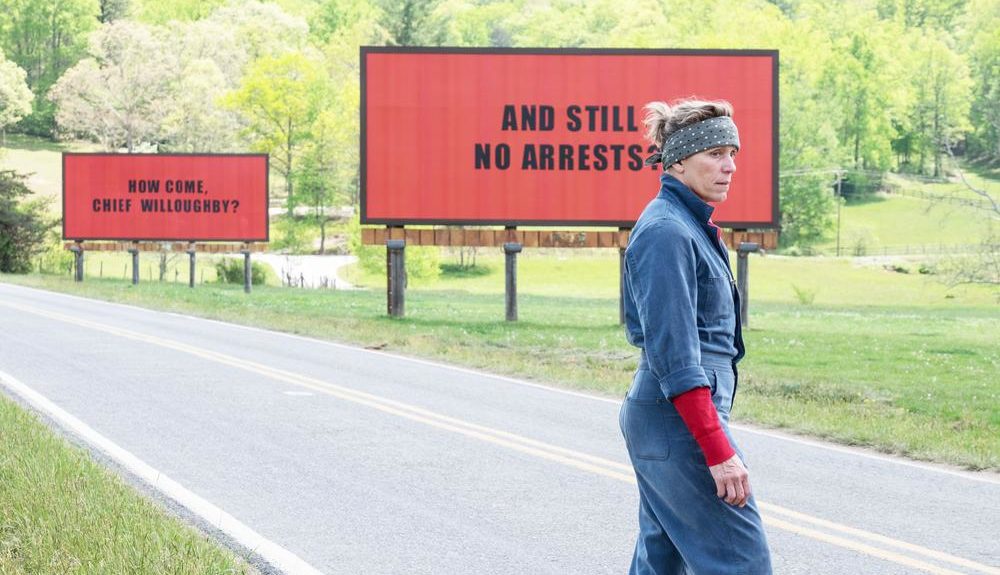
The story begins seven years after the brutal rape and murder of a teenaged girl around Ebbing, Missouri. The girl’s mother Mildred (McDormand), angered by the sheriff department’s lack of progress on the case, rents three abandoned billboards just outside of town and plasters messages calling out the local authorities. The billboards read “Raped while dying”, “And still no arrests?” and “How come, Chief Willoughby?”

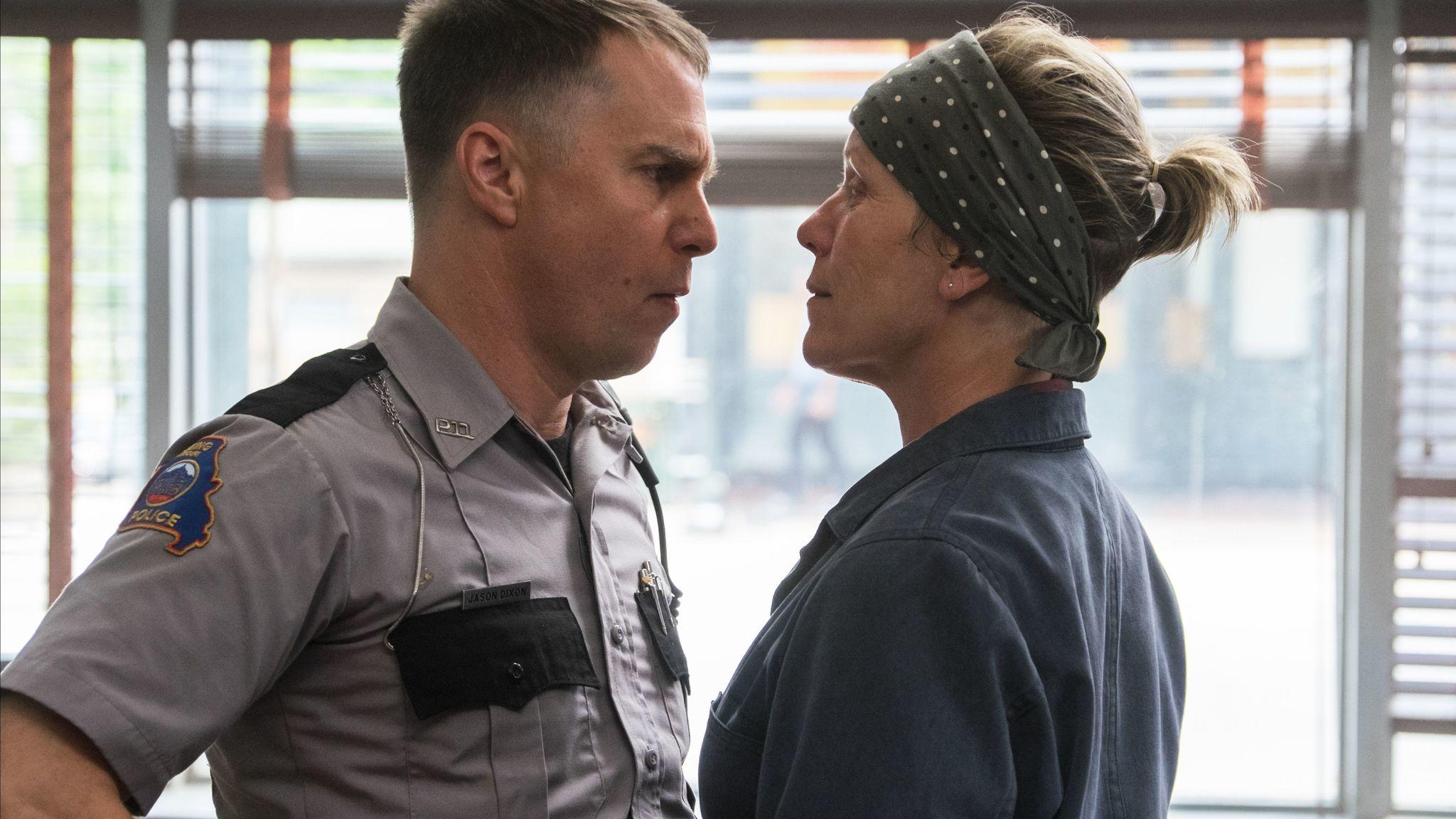
Mildred’s billboards spark the ire of the townsfolk including Sheriff Willoughby (Woody Harrelson), his dense and racist deputy Dixon (Rockwell), and even her depressed son Robbie (Lucas Hedges). But Mildred (a fitting reflection of McDonagh’s abrasive writing style) pushes forward which leads to a series of conflicts that make up a bulk of McDonagh’s problematic story.

BILL3

“Three Billboards” is such a mixed bag. McDonagh wildly swings from absurdly goofy to deeply emotional with no real gauge for tone. A scene of oddball humor can shift to a scene of startling violence on a whim. Often the characters are the biggest victims. One minute a man is brutally beating another man and punching a woman in the face. Only a few scenes later we are asked to buy into his moral transformation. Even Mildred suffers from McDonagh’s erratic treatment. She’s an inspirational crusader and a sympathetic mother. She’s also a verbally abusive, dysfunctional parent and can sometimes be needlessly hateful and vile. McDormand goes all in and her performance is solid, but her character (like most in the film) is all over the map.

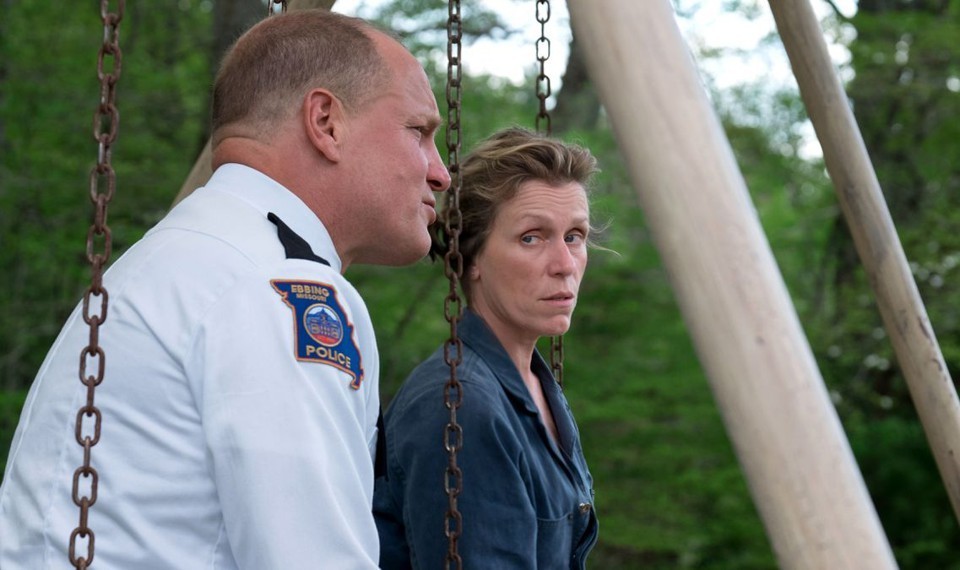
Funny enough the movie is most effective when it turns down the volume and focuses on the quieter dramatic moments. Many of these involve Woody Harrelson, an actor often known for being big, silly, and showy. His Sheriff Willoughby is probably the film’s most tempered character, but even he’s not immune to McDonagh’s occasional jarring dialogue. And it seems we are meant to be at least a little sympathetic towards him. But the movie ignores some gaping moral holes and expects us to do the same. Sorry, I can’t.

BILL2

Several other things keep “Three Billboards” from reaching the potential it teases. There’s McDonagh’s weird vision of small town America. He nails how the effects of a horrible tragedy can ripple through a rural tight-knit community. And visually the North Carolina location is a nice stand-in for the fictional town of Ebbing. But his wonky cast consists of racists, sexists, bigots, abusers, child molesters, and several other offensive classes of miscreants. Is this his rural perception? Give me a Coen brother’s version any day.

And then you have McDonagh’s insistence on being blatantly and often pointlessly vulgar and crass. I get that it’s his thing, but forcing it into the bulk of the dialogue becomes obvious and distracting. I have no problem with a writer bringing their own style and sensibility. But it’s never a good thing when a writer’s self-reverence overshadows his material. Mix that with the seismic tonal shifts and uneven and often incomprehensible characters, and you have a frustrating movie built on a good idea but undermined by problems too big to dismiss. Ultimately it’s a film that acts like it has something to say, but you quickly learn it’s little more than an empty hull.

VERDICT – 1.5 STARS

1-5-stars