
Yearly Archives: 2014
REVIEW: “Sarah’s Key”
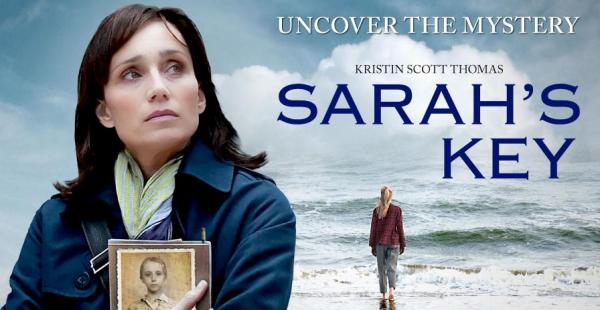
Movies depicting the Holocaust and the plight of the Jewish people during the Nazi reign can be some of the most potent and emotional movies to watch. There have been several films that have taken a broader look at the subject while others choose to tell more personal stories. Either way, I remain fascinated at how skilled filmmakers can still remind us of this deep and devastating scar on our world’s history through truly powerful cinema. “Sarah’s Key” is another example of that. This film may not carry the weight of bigger Holocaust pictures, but it tells a stirring and sobering story that I really responded to.
The movie jumps back and forth in time and tells two interconnected stories. The first takes place during the Vel’ d’Hiv Roundup in Paris on July 16th 1942. It was the early morning mass arrest of over 13,000 Jews by French Police in a broader effort to placate the Nazis. The arrested Jews, of which nearly 10,000 were women and children, were taken to internment camps and eventually to Auschwitz for “extermination”. What made this even more despicable was the complicity of the French government and police, something France had failed to publicly own up to until 1995. It’s in this environment that we’re introduced to young Sarah Starzynski.

I found Sarah’s story to be the most interesting and certainly the most powerful. While playing under the covers of her bed, Sarah (Mélusine Mayance) and her little brother Michel are startled by a loud knocking on the front door. It’s a French policeman there to take them into custody as the roundup begins. Before Michel can be noticed Sarah hides him in a closet and makes him promise not to leave. She locks the door, hides the key in her pocket, and is soon taken away with her parents.
The other story starts in Paris in 2009 when an American journalist named Julia (Kristin Scott-Thomas) and her French husband Bertrand (Frédéric Pierrot) inherit an apartment from his grandparents. It turns out the apartment came into the family over 65 years earlier, around the same time as the Vel’ d’Hiv Roundup. Julia had recently wrote a piece on this sad part of French history so naturally she wants to know more about the house’s history.
We are told both of these stories in chunks. Co-writer and director Gilles Paquet-Brenner does a pretty good job of moving back and forth between stories although there are some fairly awkward transitions. And I mentioned that Sarah’s story is easily the more riveting and interesting of the two but that’s not to say Julia’s story is bad. In fact I liked it. But her story is hampered by a few plot points that just don’t work within the context of this film. These are mainly found in the relationship between her and her husband. Julia finds out that she’s pregnant and we learn that she’s had some difficult and failed pregnancies in the past. Bertrand doesn’t want the baby and is perfectly content with their life the way it is. This entire dynamic ends up playing a significant role in Julia’s life and it leads to a nice moment later in the film, but overall it feels underdeveloped and quite honestly insignificant compared to the horror that Sarah and her family are facing.

But when it comes down to it, I like the way both stories come together. It’s not as surprising or profound as it could have been but I found it to be satisfying. Julia has several good moments as she digs deeper to connect her husband’s family to the Starzynskis. But it’s the strength of Sarah’s story that makes the joining of these two narratives work. I was consumed with watching Sarah’s difficult and heartbreaking life unfold. It’s brilliantly told both visually and through the script and it never shoves too much in your face. It’s respectful and reserved yet it maintains an authentic emotional punch.
A big hunk of the movie’s success is due to some standout performances. Kristen Scott-Thomas is a fine actress and her flawless American accent and fluent French gives Julia a natural believability. She also never overplays her scenes. But even better was Mélusine Mayance as young Sarah. I know we could get into the whole ‘How much of a child performance is acting or directing’ debate, but I thought she was magnificent. Niels Arestrup is another familiar face in the film who’s always good. There’s also two relatively unknowns who are wonderful here. Natasha Mashkevich really caught my attention as Sarah’s mother and Charlotte Poutrel is great in a much smaller role as an older Sarah. In her few scenes we see a beautiful but scarred young woman and it’s clear the events of her past have left a terrible mark.
“Sarah’s Key” is a movie that completely slipped under my radar. During my recent examination of French cinema I stumbled across this picture and I am glad I did. It’s a smart and respectful story whose only fault is that it tries to do too much. With a little more culling this could have been a tighter and more concise picture. But even considering that, this is a very good movie that’s both responsible and deeply moving. It may not be listed among the best overall movies about the Holocaust, but there are parts of this film that I would put up against any other.
VERDICT – 4 STARS
Know Your Movies – One Image, Three Hints

It can’t only be reviews, Phenomenal 5 lists, and commentaries, right? Know Your Movies is all about having fun. Here’s how it works: I’ll share a single shot from a movie. It can be extremely serious or completely absurd. After that I’ll provide you with three hints. The rest is up to you. Hop in the comments section and share your guess as well as any thoughts or memories you have on the movie, actor/actress, or the scene itself. It should be a blast.
Today’s image is from a film that is one of my favorites of all time. So here is the shot. Three hints will follow.

Hint 1: Released in 1949
Hint 2: Was shot primarily in Vienna, Austria
Hint 3: Harry Lime
Now head to the comments and share your guess. It’s a classic shot that should make it obvious for some. I would also love to hear your thoughts on the film, the scene, or anything else related to it. Now feel free to guess and discuss this fabulous movie classic.
REVIEW: “Elysium”

Neill Blomkamp surprised a lot of people with his 2009 science fiction thriller “District 9”. While I wasn’t drawn to it, the majority of critics gave it high marks. It would go on to earn four Academy Award nominations including one for Best Picture. His eagerly anticipated follow up comes in the form of “Elysium”, another sci-fi foray soaked in social commentary. It’s a bleak, gritty, and violent film with high ambition and a much bigger budget.
Blomkamp once again writes and directs the movie which starts with a pretty heavy-handed setup. Blatantly obvious political statements on immigration, healthcare, and class warfare are thrown at the audience without an ounce of tact or subtlety. In fact it’s so painfully obvious that I started rolling my eyes and began to dread what was ahead. But to my surprise the film steers away from that and instead of shoving its positions in our face it allows them to simmer underneath the surface which definitely better serves the movie.

The story basically goes like this – in the distant future Earth is an impoverished and overpopulated planet. People struggle against starvation, disease, and a brutish robot police force. But while the poor make up the Earth’s population, the rich upper-class live on a luxurious space station community known as Elysium. This orbital paradise features mansions, lush gardens, and machines able to cure any health problem instantly. But here’s the catch – only the wealthy and powerful are allowed on Elysium and there are strict government and military bodies that enforce that rule. As I said, not an ounce of subtlety.
Enter Max De Costa (Matt Damon), a struggling assembly line worker on Earth who has an accident which exposes him to lethal amounts of radiation. He learns he has only five days to live, but he’s not ready to kick the bucket just yet. He has to get to Elysium for treatment so he makes a deal with an underground smuggler. In exchange for a trip he must steal some important information from a corrupt military contractor. Seeing Max’s failing health, the smuggler has his doctors implant him with a super-strength robotic exoskeleton and cerebral implant to help with the mission. But Elysium’s Defense Secretary Jessica Delacourt (Jodie Foster) also wants that information for her own nefarious reasons and she will do anything to get it.
Oddly enough “Elysium” drastically changes course as the film goes along. It moves from an obvious heavy-handed social critique to a fairly conventional sci-fi action flick. It uses several all too familiar approaches and it’s fairly easy to gain a sense of how things are going to end. That said, Blomkamp’s pacing is spot on. He keeps things moving which keeps the audience attached. He also has wonderful visual senses. The movie looks great whether it’s the big sweeping location shots or the intense and sometimes brutal action (and there is quite a bit of it). I loved the contrasting aesthetics between the dirty, rundown vision of Los Angeles (which was actually filmed in the Mexico City area) and the spotless Eden-like Elysium. Blomkamp has an unquestionable knack for visual filmmaking.

Matt Damon is a solid choice to portray a ‘regular guy’. There’s not a lot of flash or bravado to his performance. He’s not a bold or larger-than-life character. In fact I would call him a very atypical hero and that works well within the story. But then there is Jodie Foster. I have no idea what she’s doing in this movie. Her erratic performance is all over the map and her accent morphs from French to British to something I’ve never heard before. I also thought Sharlto Copley was pretty bad as a ruthless sleeper agent who works for Delacourt. He certainly looks the part but that’s it. I don’t know if it’s his voice or his line delivery but nearly all of his dialogue feels terribly off. But thankfully this is Damon’s movie and he carries most of the load.
There’s no doubt that Neill Blomkamp is a gifted visual storyteller. I loved the overall look of “Elysium” from the futuristic technologies to the locations. I also thought the action scenes popped with intensity and grit. Unfortunately his writing prompts the question mark. Early on he uses a mighty broad brush to paint his social/political landscape and later the movie turns into a fairly conventional action film – two issues that I think keeps “Elysium” from being the really good movie that we get glimpses of. Still it has its moments. and as conventional as it may be, the action and pure visual spectacle keep it from being a total loss.
VERDICT – 2.5 STARS
Cinema Snapshot
“Cinema Snapshot”

Rick’s Café Américain – “Casablanca”
“Casablanca” (1942)
Rick’s Café Américain is the most memorable location in the classic “Casablanca”. American expatriate Rick Blaine (Humphrey Bogart) keeps his club successful by catering to a wide-ranging clientele. Whether its German Nazis and the sympathetic Vichy French or an assortment of smugglers and gamblers, Rick stays in business by embracing neutrality and adhering to his one policy – “I stick my neck out for nobody”.
Rick’s Place is a bustling den of music, socializing, and backroom gambling. He doesn’t allow the politics or divisions of war in his front door but as tensions rise in the area he finds himself in a precarious position. Things are complicated even more by the surprise appearance of old flame Ilsa (Ingrid Bergman) and her resistance leader husband Victor Laszlo (Paul Henreid) who is on the run from his Nazi pursuers. All of this makes things around Rick’s Café Américain very interesting.
REVIEW: “Draft Day”

Kevin Costner’s 2014 movie trifecta continues with “Draft Day”, a football film about the back room wranglings leading up to and during the NFL draft. This certainly isn’t the first sports movie focused on the front office instead of on the field. Think “Moneyball” with helmets and shoulder pads. The two films actually have a lot in common. Both feature two strong central lead performances and both give cool cinematic insights into a little known side of their sports.
Interestingly its similarities to “Moneyball” could be perceived as a bigger weakness. Both movies revolve around an audacious and headstrong team leader who bucks the system and conventional sports wisdom to build “his team”. They face constant resistance from ownership, scouts, and everyone in between yet stake their job on their faith in their system. It’s impossible not to see the resemblance.

But despite the similarities “Draft Day” still manages to feel like its own movie. In reality football has become America’s #1 sport so much so that even the NFL Draft has become must watch television for fans. That hectic and intense timeframe is the setting for director Ivan Reitman’s movie. Costner plays Sonny Weaver, Jr., the general manager for a Cleveland Browns team mired in an extensive losing stretch. With only hours remaining until the start of the draft Sonny is facing immense pressure from the owner (Frank Langella) to make a big splash. He’s also butting heads with a newly hired coach (Denis Leary) and a fan-base desperate to win.
Sonny’s personal life is equally stressful. His secretive romantic relationship with a front office coworker named Ali (Jennifer Garner) has taken an unforeseen turn. He wrestles with the shadow of his recently deceased father – a well-respected former coach for the Browns. He also struggles under the weight of everyone’s expectations in light of his own inadequacies. The movie never dives deep into any of these personal issues, but we get just enough of them to flesh out Sonny and make him more than a stereotypical sports character.
The meat and potatoes of the movie is football but you don’t have to be well versed in the sport to understand what’s going on. That said, understanding the landscape and the relationship between college football and the NFL gave me a deeper appreciation for the story. I loved the manipulative and sometimes vulturous back-and-forths between GMs, each hungry to get the best deal. Then there is the turbulent draft preparation which is itself fascinating even without this stories added drama. All of this clicks and even when you know the movie is stretching it is still a ton of fun.

But the biggest strength of the film is Kevin Costner. Talk about a strong performance. Costner reminds us why he became such a huge star. It’s a completely seamless and effortless performance that reveals so many of the characteristics and contradictions of this character. I also really love Jennifer Garner here. In the past she has been an actress I have never given much attention. Here she is razor sharp and she is a welcomed strong and confident female character. Even Denis Leary, an actor I normally dislike, is really good and I never get tired of watching Frank Langella. And then of course there is the assortment of mandatory football related cameos sprinkled throughout the film. Some are really cool while others are really obvious.
“Draft Day” could be accused of being too safe and by-the-book. It also follows several familiar sports movie tropes that you will immediately recognize. But the movie never chokes itself on them and it remains compelling throughout. The story is crisp and exciting even in its unique setting and overall it is loads of fun. But Costner is the shining light and watching him work here makes me so happy that he is back on the big screen. Simply put it’s one of my favorite performances of the year so far and it made “Draft Day” all the more interesting.
 Keith & the Movies