

In the revisionist Western “The Settlers”, director Felipe Gálvez sits us down in 1901 Tierra del Fuego, Chile during the Selk’nam genocide. That’s when land-hungry sheep ranchers backed by large livestock companies and protected by the Chilean and Argentine governments carried out the systematic extermination of native tribes that populated the area. It was yet another dark and vile stain on human history.
Gálvez begins by introducing us to a young Chilean mestizo named Segundo who is our eyes and ears for much of the harsh and uneasy 90 minutes that follow. Segundo (played with such quiet yet pained intensity by Camilo Arancibia) works in the fields under the cold-hearted Alexander MacLennan (Mark Stanley), a former British lieutenant who is now a foreman for a wealthy rancher named José Menéndez (Alfredo Castro).

The haughty Menéndez claims that the local indigenous tribe, the Onas, are killing and stealing his sheep. So he sends MacLennan on a lengthy expedition across his land. It’s under the guise of scouting a path for him to safely move his sheep to the Atlantic Ocean. In reality there is something far more sinister behind it – a secret agenda at the heart of the mission.
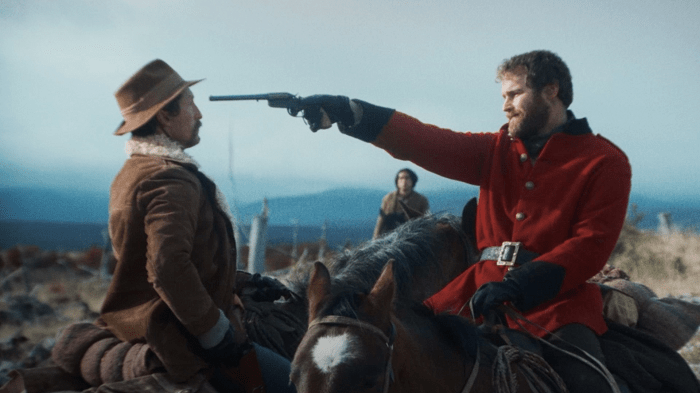
MacLennan orders Segundo to come along without letting him in on the details of their expedition. They’re joined by Bill (Benjamin Westfall), a ruthless, racist, and borderline cartoonish American mercenary who is Menéndez’s right-hand man. The three head out on horseback across the vast open territory eventually arriving at the base of the snowcappeed Andes Mountains.
Along the journey, Gálvez and his co-screenwriter Antonia Girardi give us a clear sense of who these three men are. This is especially true when the trio happen upon a small camp of Ona. The sheer barbarism at the hands of MacLennan and Bill along with their cold and calloused indifference is hard to stomach. Meanwhile the mostly silent Segundo is horrified by what he witnesses but is too frightened to try and stop it. His feelings of complicity torture him through the rest of the film.
The story is broken down into chapters tagged with ever so slightly pretentious headings like “The King of the White Gold”, “The Half-Blood”, and “The Ends of the Earth”. Yet it gives us a harrowing and unflinching dive into Chile’s colonial past, offering a piercing and fittingly uncomfortable critique. And all to the backdrop of DP Simone D’Arcangelo’s stunning John Ford-esque canvas.
Gálvez makes a bold choice for the final 30 minutes – a turn that’s both mesmerizing and frustrating. It sees the story suddenly bolt forward seven years. In these scenes an envoy of the Chilean president named Vicuña (Marcelo Alonso) confronts Menéndez about the massacres across his land in an effort to make amends with what remains of the indigenous people. It’s utterly engrossing and ends the movie with a morally repugnant gut-punch. But that jump in time leaves a big gap full of questions that never get satisfying answers.
Even with that conflicting miscalculation, Gálvez has his points to make and he does so by handling his material in a manner that you wouldn’t expect from a first-time filmmaker. He shows a willingness to take risks and makes choices that may not completely work as intended, but that show confidence and vision. And for a movie like this one, that’s the kind of approach that proves to be invaluable.
VERDICT – 4 STARS

 Keith & the Movies
Sounds similar to Flowers in the moon or whatever that me is called. So many bad people wiping out other people.
This one is tough to watch yet uncomfortably compelling. Definitely a part of world history I know too little about.
I have heard about this film. I think it’s coming to MUBI soon which I’m glad to be a subscriber for.
Awesome! It’s a tough watch.
I’m glad to see more “expose'” films coming out that tell the hidden dark stories of colonialism at its most evil. Will definitely be seeing this one.
I gets really touch to watch. But to be honest it should be. This is tough subject matter.