

“Stella. A Life.” is a Holocaust drama that tells a true story unlike most others. It’s a fictional film that is based on historical facts that were researched from the 1946 trial records of the Soviet Military Court. At the center of the trial and this story is Stella Goldschlag, a young Jewish woman living in Berlin during the rise of Naziism. Like many Jews, Stella felt the devastating horror of Hitler’s unspeakable despotism. But unlike other Jews, the actions she took were every bit as unspeakable.
The film stars the captivating Paula Beer who was so good in her three collaborations with director Christian Petzold, “Transit”, “Undine”, and “Afire”. Here she takes on an especially challenging lead role that sees her character significantly and tragically transform over the film’s compelling two hours. To no surprise Beer is up to the task, keenly handling the emotionally heavy workload to such great effect that we find ourselves beguiled by Stella’s vivacity and charm. At least until the allure turns to repulsion.

The film opens in 1940 where we’re introduced to Stella Goldschlag (Beer), a spirited young woman living in Berlin with big dreams of becoming a jazz singer. Early on it seems as if she has everything going for her. Not only is she and her band getting gigs in fancy nightclubs, but they’ve even earned an invitation to one day travel to America and play on Broadway. But just as her dreams look to be within reach, Stella is faced with the crushing reality of being a Jew in Nazi Germany.
From there director Kilian Riedhof makes a sobering time jump to 1943 where we see Stella working in a factory making pistol clips for a German military. Gone are the elegant gowns, jazzy music, and spirited nights out with friends. And it only gets worse when Stella, her mother Toni (Katja Riemann), and her father Gerhard (Lukas Miko) are forced into hiding after the Nazi roundups begin.
Yet while everything is collapsing around her, Stella refuses to accept the reality of the world. She sneaks out at night, assimilating in with the non-Jewish crowds. “They don’t recognize me,” she naively tells her father, “I don’t look like a Jew.” And despite having married her longtime friend Fred (Damian Hardung), Stella spends many of those evenings cruelly cavorting with low-level German officers before eventually hooking up with an unruly forger named Rolf (Jannis Niewöhner).
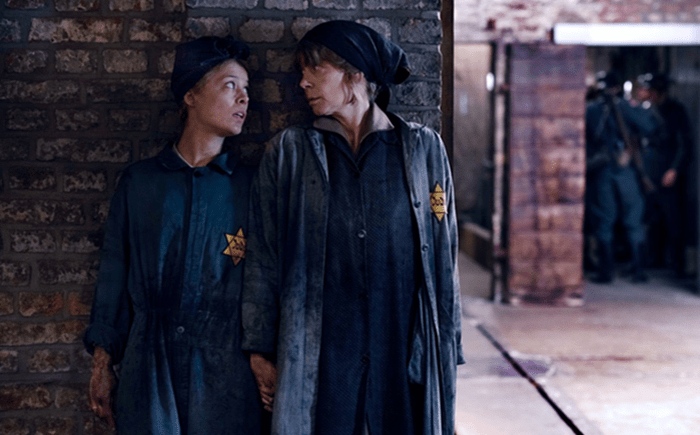
Stella’s luck eventually runs out when she and her family are captured. Beaten and terrified of being sent to Auschwitz, Stella barters with the Gestapo and agrees to become a “catcher”, exposing the location of hidden Jews to the Nazis for modest wages and protection from deportation. She later recruits Rolf, and what begins as a desperate attempt to save her family turns into a shamefully willing betrayal marked by callousness and revelry.
Riedhof deftly handles Goldschlag’s complex story, showing both the root and consequences of her actions. He also superbly recreates the timeline through period-accurate costume and production design as well as performances that run the emotional gambit. And it all begins with Beer who takes on the challenge of finding humanity in a monster. True accounts state that hundreds to thousands of Jews were captured due to Stella Goldschlag’s betrayal. Yet Beer succeeds in gaining our empathy and turning our stomachs via a richly defined performance that’s not to be missed.
VERDICT – 4 STARS



Not a chance I’d watch such a traitor…
It’s a really good movie and it doesn’t sugarcoat her actions or make her into some kind of hero. It’s a story I wasn’t familiar with.
That sounds hardcore.
It was not what I expected. It’s a very well done movie and very clear-eyed about its subject matter.
This is already in my watchlist as I do hope to see this eventually.
Oh nice. I think you’ll appreciate it.
Very good, in–depth book out there by PETER WYDEN who knew the real STELLA in high school. Has photos.