
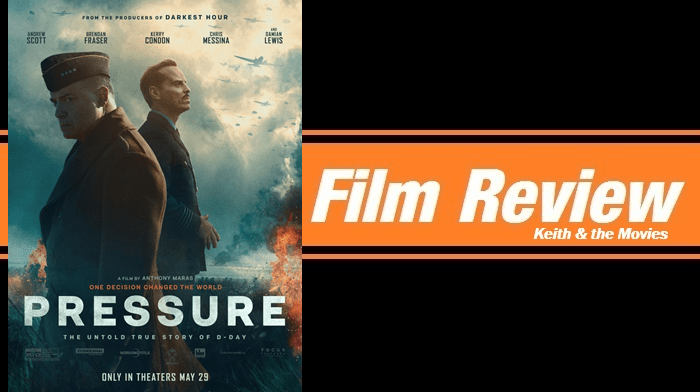
In the early part of June 1944, the Allied forces were in the preparation stage for what would be the largest and most consequential seaborne invasion in military history. D-Day saw nearly 160,000 soldiers cross the English Channel and land on the beaches of Nazi-occupied Normandy. The costly yet successful assault was a crucial moment in liberating Western Europe and turning the tide of the war. And much of the operation’s success hinged on the weather.
In the new film “Pressure”, director Anthony Maras concentrates on the roughly 72 hours before the D-Day assault. Based on the 2014 stage production of the same name by playwright David Haig, the film adaptation unfolds like a high-stakes thriller where the action takes place behind closed doors rather than on the battlefield. And where the tension simmers between meteorologists and military leaders rather than infantrymen and pilots.
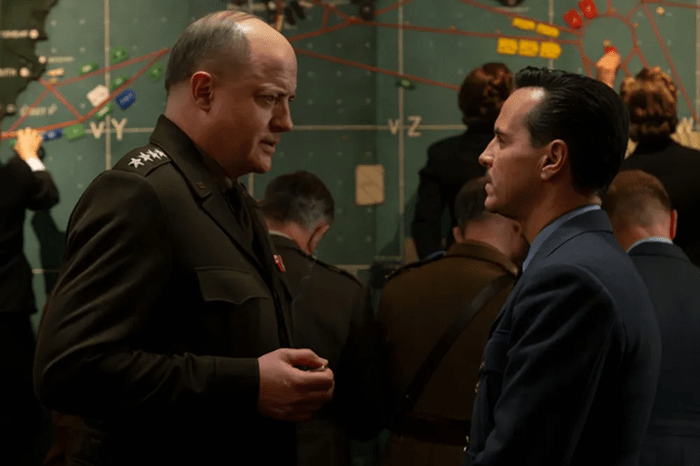
Co-written by Haig and Maras, “Pressure” tells the true story of James Stagg (Andrew Scott), an esteemed Scottish meteorologist summoned by Allied Commander Dwight D. Eisenhower (Brendan Fraser) at the recommendation of Winston Churchill. Stagg is assigned the position of Chief Meteorological Officer whose responsibility is supplying Eisenhower and his team of Allied leaders a definitive forecast for the planned D-Day invasion.
Stagg reluctantly leaves his pregnant wife and reports for duty at the remote and heavily fortified Allied headquarters. There he learns he must present a preferably favorable forecast for the assault which is set to take place in 72 hours. But the serious-minded and businesslike Stagg quickly finds himself at odds with a number of people including Colonel Krick (Chris Messina), Eisenhower’s own longtime weather forecaster. Krick predicts a clear and sunny invasion day. But Stagg warns of severe storms, much to the chagrin of the military men.
As time becomes more of a factor, the character-centered story sees the tension move from a simmer to a boil. Key players factor in a variety of ways starting with Stagg. Scott’s captivating performance combines remarkable restraint with uncompromising conviction, portraying Stagg as a man of inspiring fortitude amid heart-wrenching personal incertitude. And while he becomes unpopular among the British and American contingents, he finds an ally in Lt. Kay Summersby (a wonderful Kerry Condon), Eisenhower’s personal secretary and advisor.
Fraser’s portrait of Eisenhower is equally compelling. He reveals Ike to be a deeply committed yet burdened commander who is still haunted by the costly failure of Operation Tiger – an attempted rehearsal for D-Day that went terribly wrong. The decision to launch rests solely with him, and the weight of that choice is taking its toll. If he delays, he runs the risk of tipping off the Germans and losing the element of surprise. If he goes ahead with the invasion and Stagg’s forecast is right, the results for the Allies could be catastrophic.
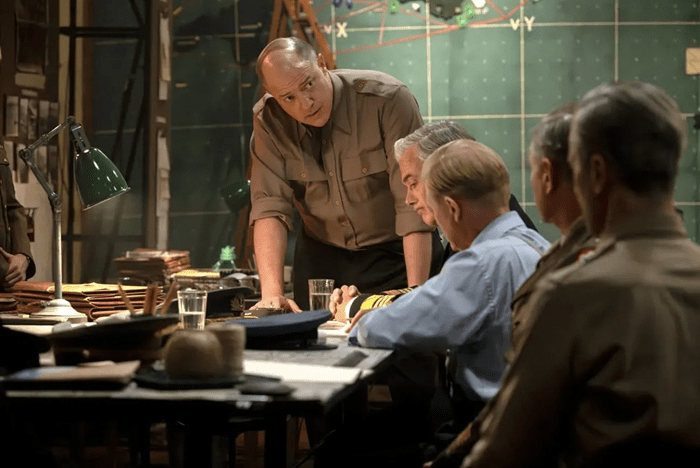
True to its name, this riveting chamber piece is built around a pressure cooker scenario, with history itself reminding us that the stakes couldn’t be higher. Maras draws us in and keeps us engaged through a host of interesting personalities and dynamics. And whether they are sparring over conflicting data or realizing the staggering consequences if they get this wrong, the story is pulsing with authenticity and urgency.
“Pressure” isn’t your prototypical World War II movie. It sits behind the grander scenes, telling the true story of an unsung hero who dared to stick by his convictions and a noted leader willing to make the tough choice with everything on the line. And while the bulk of the film’s combat doesn’t take place on the battlefield, it is every bit as gripping thanks to stellar performances, an intelligent script, and focused direction. It’s one of the nicest surprises of the 2026 movie year so far.
VERDICT – 4 STARS



Looks good and I have seen a couple movies recently with Brendan (Rental Family) and Andrew Scott and think highly of each.
Both are so good in “Pressure”. HIGHLY recommended.
I loved Scott in “Ripley” a few years back and in the more recent, “All of Us Strangers.”
Scott was also excellent in “Blue Moon” !
That’s one I’ve been meaning to see. Thanks for reminding me, Keith.
Yep of course!
You’ll really like it.
I was very curious to hear your thoughts on this movie. I mostly liked it. I actually have a rare copy of Stagg’s memoir in my home library. This movie made me want to give it a good, thorough read!
I bet that’s a really good read. It did seem that there was a lot that the movie might have left out.