
REVIEW: “The Last House” (2026)

“Everyone remembers where they were when the rains came.” Those early words introduce us to the high-concept premise of Netflix’s new apocalyptic science fiction thriller “The Last House”. Director Louis Leterrier, working from a script by screenwriter Matthew Robinson, takes a suspenseful setup, infuses it with survival elements, and even dabbles in classic creature feature territory. But it surprises most as a domestic drama, where family dynamics are challenged as the situations intensify.

Robinson wrote a big chunk of “The Last House” during the COVID-19 pandemic, and much of his story mirrors the emotional and psychological impact the lockdowns had on people across the globe. The same feelings of fear, isolation, and uncertainty that paralyzed many parts of society is baked into Robinson’s story. And it fits nicely within the dystopian sci-fi world he and Leterrier creates.
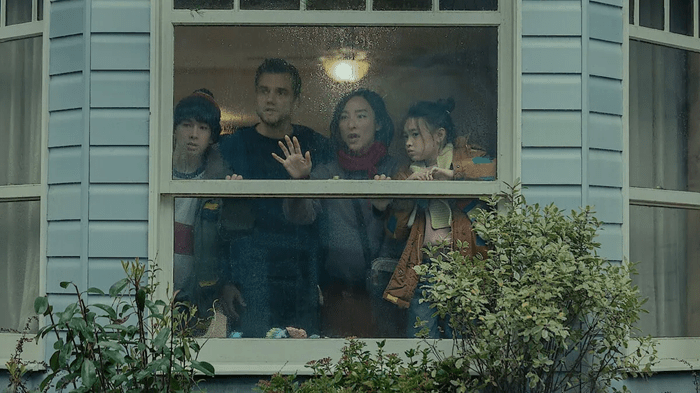
Image Courtesy of Netflix

Wagner Moura plays Jason Delgado, an unemployed engineer and part-time fisherman who lives in Seattle with his wife Ann (Greta Lee) and their two children, 12-year-old Graham (Noah Alexander Sosnowski) and 8-Year-Old Ruth (Riley Chung). After a sudden and unexpected rainstorm drives them inside, the Delgado family makes an alarming discovery. They and everyone in their neighborhood find themselves sealed inside their homes by the mysteriously anomalous rainwater.

Jason tries everything – breaking windows, hammering through walls, even escaping through the attic. But every attempt is thwarted by the seemingly sentient rainwater which forms impenetrable barriers that he can’t break through. While they have electricity, water, and gas, they immediately lose phone and internet service. It’s the same with all their neighbors who the Delgados are able to communicate with via signs. Yet with plenty of food and water, Jason and Ann have the supplies needed for what they hope is a short confinement.

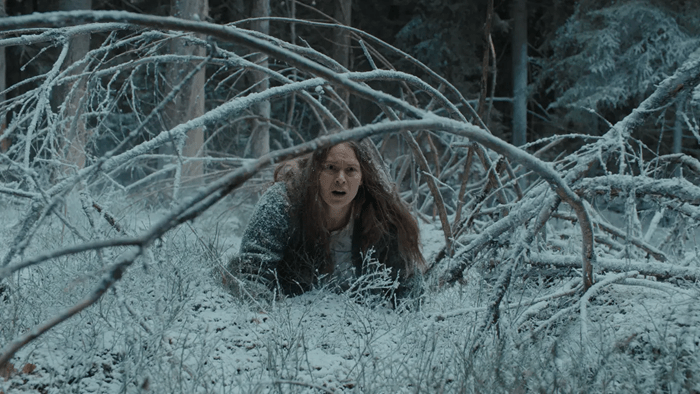
But that’s not the case. Quickly days turn into weeks, and soon months turn into years. Rather than giving up, the family adapts, turning their home into its own micro-ecosystem. As Ann finds a way to grow vegetables inside, Jason rigs several contraptions to catch animals outside. But things take a chilling turn when the family discovers terrifying creatures that only come out when it rains. Suddenly surviving gets a little tougher as they now must avoid drawing the attention of the monsters.

The family dynamic is a good one with Jason relishing his role as family protector. He keeps everyone alive, but as time goes by and reality sets in, his ‘survival is living’ mentality crumbles. On the flip side, despite being gripped by fear early on, Ann later grows better in tune with their circumstances and becomes the reality check Jason needs. Meanwhile the kids watch and absorb it all, losing key years from their childhood which takes a psychological toll.

Image Courtesy of Netflix

Again, it’s hard to miss seeing the movie as a COVID allegory. Perhaps it’s a little on the nose, but Leterrier manages to capture the intense feelings of isolation and dread in a number of visceral ways. He also has a lot of fun with the sci-fi and survival components which take center stage in the film’s second half. And he really goes for broke once the final act arrives and the movie goes full creature feature. Some will inevitably push back on the choice. But as a genre fan, I loved the ambition.

To be honest, things do get a little corny in the final twenty minutes as the Delgado family goes full MacGyver. We’re also left with a ton of questions that never get answers. And the ending is a little too tidy considering everything that came before it. Still “The Last House” remains solid entertainment, especially for anyone with the right expectations and a hearty appetite for end-of-days thrillers and old-fashioned monster movies. It had me onboard from the start and kept me involved till the very end.

VERDICT – 3.5 STARS

REVIEW: “The Last Picture Shows” (2026)

I still have memories of the first movie screen I ever saw. They’re faint but definite, and very precious to me. Once upon a time my small South Arkansas hometown had a drive-in movie theater. And while I don’t remember the specific movies playing while I was there, I do remember sitting in the backseat of my family’s 1974 Chevelle Malibu Classic and being in awe of the images bouncing off the massive outdoor screen. That theater has been gone for decades now. But those memories remain, and I’m grateful for them.

That childhood memory, along with other experiences that would follow, are big reasons I responded so strongly to the new documentary “The Last Picture Shows”. Writer, director, and producer Rustin Thompson set out across the American West in search of small-town movie houses either still in operation or long gone. The film is Thompson documenting his findings. Along the way he injects some compelling history while voicing valid concerns about the future of cinema, and not just for the struggling movie houses that have steadily been fading from existence.

Image Courtesy of Foghorn Features

Thompson’s journey across the American West spanned ten states and covered 10,825 miles. As he made stops in such communities as Burns, Oregon, Goldfield, Nevada, Susanville, California, Cortez, Colorado, and Springer, New Mexico (just to name a few), he came upon the remains of countless movie houses that once buzzed with life. As his movie’s opening scroll succinctly puts it, “they’ve been abandoned, destroyed, replaced, or forgotten.”

But Thompson also discovered a handful of locally owned theaters still open for business. He has several insightful conversations with the owners who candidly share their struggles. They talk about the difficulty in turning profit, the costly transition from 35mm projection to digital, the crippling impact of the COVID mandates, the restrictive demands of the studios, the influx of streaming, and the challenge of competing with big multiplexes. They’re fascinating testimonies from people who have poured their hearts and souls into keeping these cultural landmarks alive.

Image Courtesy of Foghorn Features

Thompson’s film is more than a nostalgic stroll down memory lane. He does take time to chronicle the history of moviegoing, from the genesis of movie theaters, to the boom of the 1940s, the decline in the late 60s and early 70s, and the blockbuster resurgence. But it all builds towards a timely warning about where things are heading. He notes how we’re nurturing a collective disregard for the movie theater experience. As a result, there is a younger generation who hasn’t developed a love for moviegoing meaning they’ll have nothing to pass on to the next generation.

It’s said that in 1929 there were 22,000 theaters in the United States. Today there are fewer than 3,000. Those are sobering stats for those of us who deeply cherish the history and the experience of watching movies in a theater. Thompson impressively transports us back in time while also connecting us to the reality of today. And it’s all evocatively filmed in ways that will bring both a nostalgic smile to your face and a melancholic tear to your eye as you lament a bygone era and feel the growing uncertainty for the future.

VERDICT – 4.5 STARS

REVIEW: “One Night Only” (2026)

The new romantic comedy “One Night Only” is what you get when you combine two immensely talented young stars with an utterly ridiculous premise. You’re drawn in by the appeal of seeing two charming and charismatic performances. But once in you’re constantly being pushed away by the sheer absurdity of the story being told. That insurmountable clash is what makes “One Night Only” far more frustrating than romantic or funny.

Director Will Gluck of “Easy A” fame teams with screenwriter Travis Braun to tell a story set in a hokey pseudo-fascist America where a congressional mandate has made it illegal to have sex outside of marriage. For reasons that never make much sense, the government has designated one night of the year where singles are legally allowed to hook up. It’s when seemingly normal people turn into rabid horn-dogs for twelve hours just because this ridiculous premise needs them to.

Image Courtesy of Universal Pictures

The story kicks off as ‘singles night’ is about to begin. Callum Turner plays Owen, the owner of a Manhattan pizza shop who has big plans for the evening. He’s all set to propose to his girlfriend, Malika (Maya Hawke). But before he can, she randomly informs him that she’s going to sleep with someone else that night. She offers no meaningful explanation other than it being an “abnormal circumstance”. That leaves Owen on his own to find someone he can share the night with.

Elsewhere, Allie (Monica Barbaro) is an aspiring vocalist who has settled on singing jingles for medication advertisements. Her plans for the evening are shattered after her flaky best friend Jacinta (King Princess) ditches her at a bar for the first guy she meets. Suddenly Allie too is on her own which sets up the first of several meet-cutes with Owen. Things don’t go well at first, as the two deny their obvious mutual attraction and look to hook up elsewhere. But after each failed attempt, Allie and Owen bump into each other again. And as you can probably guess, each time they meet the romantic spark gets a little hotter.

Image Courtesy of Universal Pictures

The goofy premise alone immediately puts “One Night Only” behind the 8 ball. But the issues don’t stop there. The movie doesn’t seem to know what it wants to be. Much of it plays like a dime-a-dozen romcom that’s made watchable by two likable leads. But then you have the lazy attempts at being a raunchy sex comedy which is where the movie spectacularly falls on its face. Whether it’s the forced vulgarity-for-laughs from a 12-year-old kid or an embarrassingly bad scene for Molly Ringwald and LeVar Burton – these off-putting and glaringly unfunny choices knock the movie completely off the rails.

It also doesn’t help that the “One Night Only” has nothing of value to say about anything. It’s only at the very end that we get something resembling a point. But by then I had already spent all of my goodwill and was ready for the credits to roll. It’s a shame because Barbaro and Turner give it their all and have some pretty decent chemistry. But they’re in desperate need of better material. And no matter how hard they try, there’s just too much for them to overcome.

VERDICT – 2 STARS

REVIEW: “Nightborn” (2026)

Hanna Bergholm follows up her delightfully demented directorial debut “Hatching” with the less wacky and considerably more obvious “Nightborn”. Her latest is a Shudder Original that dips its toes into both Finnish folk horror and gruesome body horror. At the same time, her movie is a glaring allegory for young motherhood, hampered by a lack of subtlety that can be hard to look past.

Saga (Seidi Haarla) and her husband Jon (Rupert Grint) make the decision to leave the comforts of London and move to the Finnish countryside, into an old home that once belonged to her late grandmother. They arrive to find the house in serious disrepair. But with a little work, it should be the perfect place for them to raise the three children they plan to have. But the seemingly sentient forest that surrounds them appears to have other ideas for this family-to-be.

Image Courtesy of Shudder

Soon Saga is pregnant with their first child, and following a hard labor, she gives birth to a baby boy they name Kuura. But the child has some noticeable abnormalities, starting with him being unusually hairy. Later it’s his sharp, fast-growing fingernails and sensitivity to sunlight. And perhaps most disturbing is his insatiable appetite for his mother’s blood rather than her breast milk. The borderline feral Kuura pushes Saga to her maternal limits, and feelings of dread, frustration, guilt, and isolation quickly set in.

Meanwhile Jon is written to be oblivious to the obvious signs. He insists Kuura is fine and believes Saga is the real concern. Jon isn’t portrayed as intentionally cruel. Instead he comes off as clueless, which may be a big part of Bergholm’s critique. Either way it takes Jon from being a supportive partner to unaware at best and doltish at worse. It’s hardly an unfair approach. But when taken with the film’s allegorical heavy-handedness, it somewhat undermines what Bergholm is going for.

Image Courtesy of Shudder

Things only get worse when Saga’s domineering mother (Pirkko Saisio) and her cryptic sister (Pamela Tola) pay a visit. Both have their own concerns with Saga’s parenting and they express them in dramatically different ways. They end up fueling Saga’s feelings of alienation and self-doubt. Meanwhile the forest becomes more of an ominous and overpowering force, which itself is a metaphor for the inner battle going on within Saga. Animosity gives way to hostility as the new mother’s idealistic world crumbles all around her.

Bergholm conveys Saga’s disintegrating psyche in some creatively twisted and grotesque ways. It may be through the beautiful yet creepy forest routinely making its presence known, or some squirm-worthy body horror that can sometimes come when you’re least expecting it. But the story’s themes are blaring from the start. And there is a lack of subtlety and nuance that keeps us from connecting with the message in the way that Bergholm intends. It doesn’t fully derail “Nightborn”, but it’s a nagging issue that never goes away.

VERDICT – 2.5 STARS

First Glance: “Primetime” Full Trailer & New Poster

“To Catch a Predator” was a series of reports that aired on the popular news magazine show Dateline NBC. The segments were hosted by investigative journalist Chris Hansen and focused on catching internet predators attempting to meet up with minors for sex. The series was a pivotal yet controversial means of bringing awareness to the growing epidemic of sexual predators on the web. Now director Lance Oppenheim is telling Chris Hansen’s story in his new film “Primetime”.

Set in 2006, “Primetime” tells the origin of “To Catch a Predator” by following Hansen (played by Robert Pattinson) as he aggressively confronts child predators through hidden camera sting operations. The riveting first trailer gives us a good sense of what to expect from this biographical/psychological crime thriller which is set to premiere in September at the Venice Film Festival. Merritt Wever, Skyler Gisondo, Phoebe Bridgers, Tony Revolori, and Matthew Maher also star.

“Primetime” opens in theaters on September 25th. Check out the trailer and the poster below and let me know if you’ll be seeing it or taking a pass.

REVIEW: “Ice Cream Man” (2026)

Creepy kids are the main dish in Eli Roth’s “Ice Cream Man”, the director’s intentionally goofy and gleefully gory spin on the age-old Pied Piper legend. The film is Roth’s first feature since the seismic box office disaster that was “Borderlands”. His latest sees him back in his splatter film wheelhouse with a movie that is a horror comedy in its fullest sense. And I can an assure you, “Ice Cream Man” is quite different than his previous horror offerings.

There are no grand illusions here. Roth knows the kind of movie he’s making and never pretends otherwise. “Ice Cream Man” is a gorefest that pushes the blood and guts to absurd levels. But it’s also openly self-aware which ends up fueling much of the film’s warped and twisted humor. And considering how much “Ice Cream Man” relies on children, the humor is crucial in making the blood-drenched movie digestible. More on that in a second.

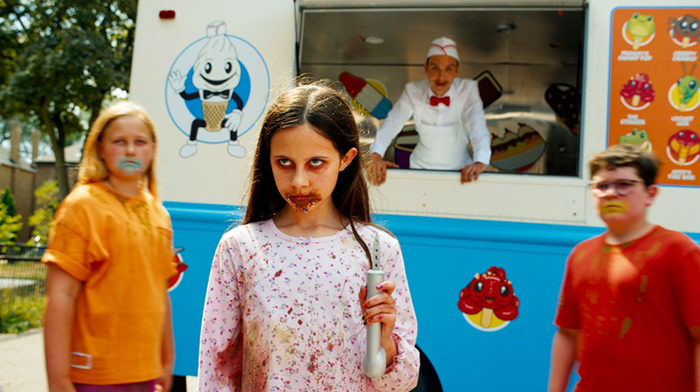
The story kicks off as an old-fashioned ice cream truck rolls into Bayleen Bay. It’s a regular day in this cozy coastal town, which basks in the idyllic glow of the warm summer sun while the enthusiastic sounds of children plays like background music. And their enthusiasm only grows once they hear the high-pitched jingle of the ice cream truck. As kids surround his frozen ecstasy on wheels, the eerily silent ice cream man (slyly yet devilishly played by Ari Millen) hands out free ice cream to every child there.

The day ends as normal, outside of a few brain freezes, sugar rushes, and upset tummies. It isn’t until later that the movie’s sinister twist is revealed. In the middle of the night, the Ice Cream Man begins driving his truck through every neighborhood with his jingle ringing out in the darkness. It triggers something within the children, who suddenly begin rising out of their bed in a catatonic haze, their faces stained with dried ice cream and sprinkles. Much worse, the kids begin gruesomely murdering their parents with a gleeful indifference.

The next morning, Jared (Charlie Zeltzer), who fortunately is lactose intolerant, wakes up and heads to school where he encounters a campus full of zombified classmates. Suddenly the Ice Cream Man pulls up, which sends the students into a murderous frenzy. They begin hacking, impaling, and dismembering their teachers, and those are the tamer kills! Meanwhile Jared is joined by fellow ice cream abstainers Mia (Kiori Mirza Waldman) and Tommy (Shiloh O’Reilly) in a desperate effort to escape.

The rest of the movie follows these three kids from vastly different social groups as they navigate the copious carnage and comical chaos that Roth throws their way. And he throws A LOT their way. Enough that we can’t help but feel a little queasy, not at the extreme gore itself, but at the child actors and actresses tasked with capturing it for the camera. From all indications, it was made a playful shoot for the young cast. Still it’s a quagmire that the film never fully escapes from.

That said, there is a lot for splatter film fans to appreciate in “Ice Cream Man”. The creativity and artistry from the makeup and effects teams is routinely on display as they mostly practically capture every bonkers idea Roth tosses at them. And they visually manage to walk the line between grisly and goofy. Together with Roth and DP Simon Shohet, they also help to pull off some mind-boggling extended sequences that require as much intense coordination as corn syrup.

“Ice Cream Man” succeeds in being the gratuitously gory and absurdly funny horror-comedy concoction that Eli Roth envisioned. It has all the ingredients to entertain those who know what they’re getting into and repulse those who don’t. On one hand, it’s unhinged go-for-the jugular fun that is just as interested in making you laugh as squirm. On the other hand, it’s a movie that uses children in ways that can easily be considered suspect. It ultimately poses a question that reaches beyond this one movie. But the answer to that question may be enough to shape how you feel about it.

VERDICT – 3 STARS