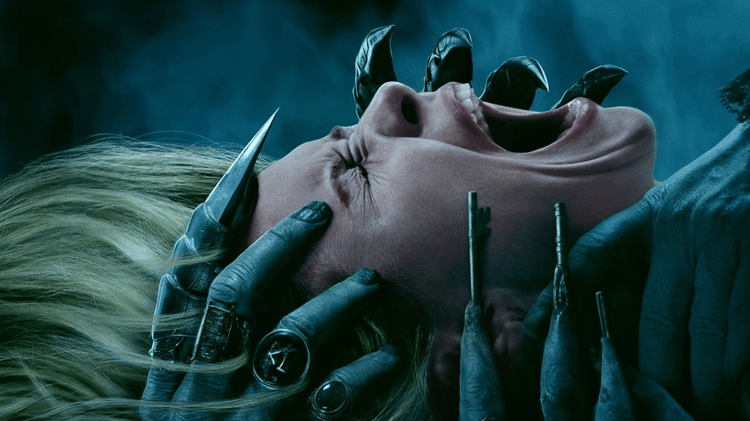
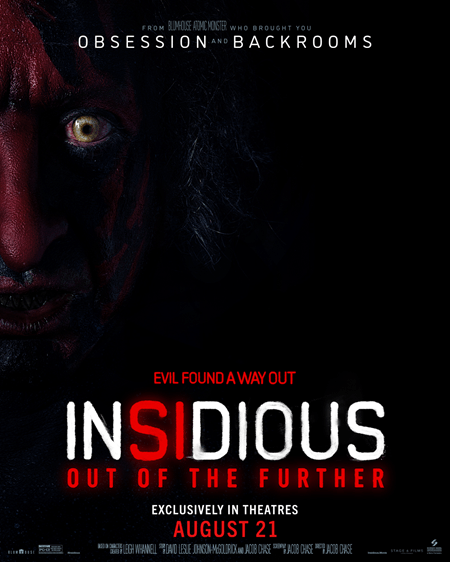
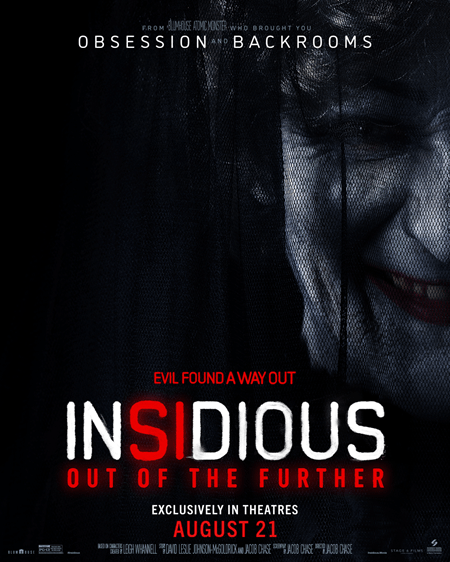
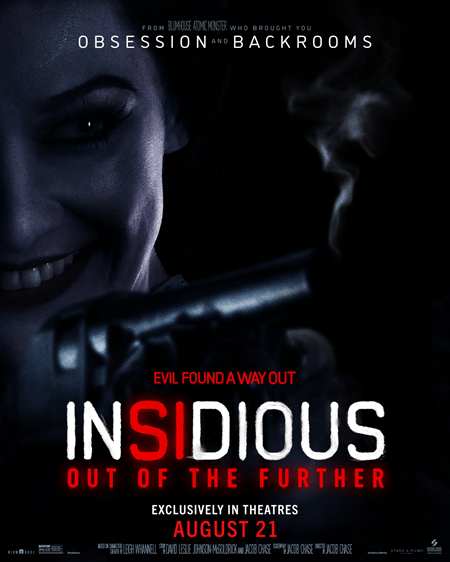
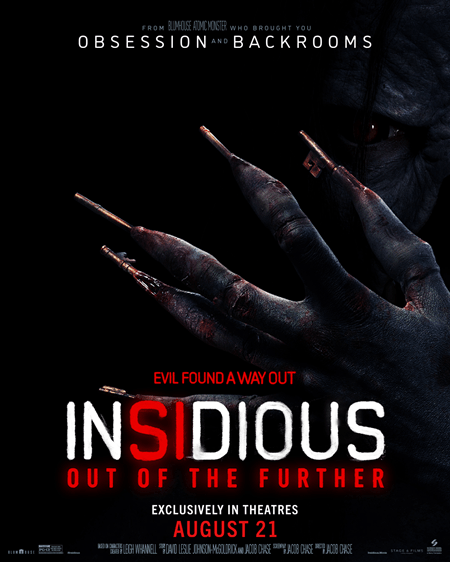
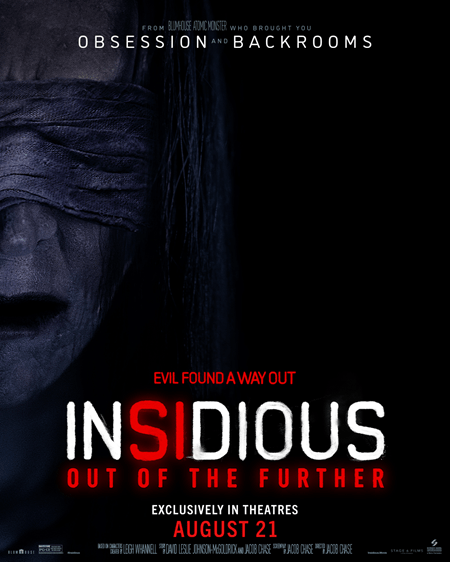
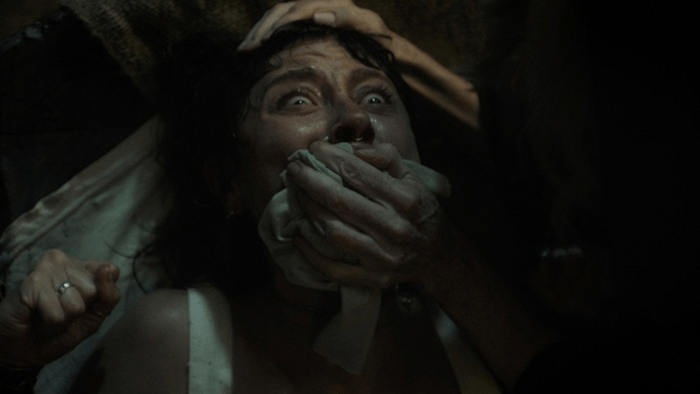
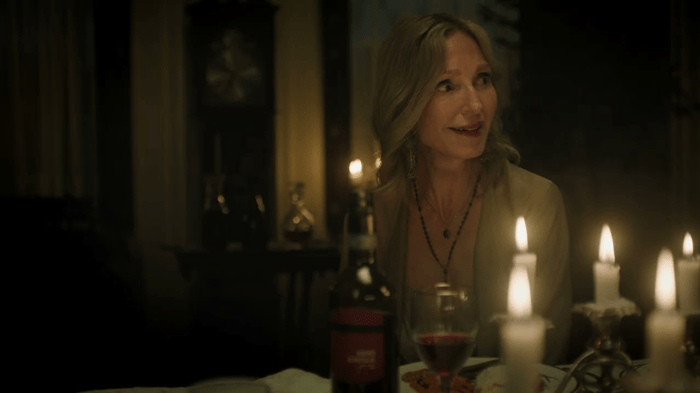
This month the Insidious franchise returns to the big screen with its sixth installment, “Insidious: Out of the Further”. The film (written and directed by Jacob Chase) seeks to build on the franchise’s box office success, with it having already earned over $740 million to date. “Out of the Further” focuses on a new family while introducing a terror that redefines what the purgatorial realm of lost souls known as The Further is capable of.
With the film set to release in a few weeks, Sony Pictures Releasing has dropped five new character posters focusing on the demonic entities terrorizing a single mother and her young daughter. Amelia Eve, Brandon Perea, Maisie Richardson-Sellers, and Lin Shaye star while horror stalwarts Jason Blum, James Wan, Oren Peli, and Leigh Whannell produce. “Insidious: Out of the Further” releases exclusively in theaters on August 21st.
Japanese auteur Kiyoshi Kurosawa has carved a cinematic path that couldn’t be more different than that of the other esteemed filmmaker who shares his last name (no relation). Kurosawa cut his teeth on J-horror but quickly expanded his catalog to include dramas, black comedies, science-fiction, crime thrillers, and even a period spy movie. But his latest film sees him venturing into the genre that made the legendary Akira Kurosawa a household name.
With “The Samurai and the Prisoner”, Kiyoshi Kurosawa makes his first foray into the classic jidaigeki genre. Yet from its opening moments, you would never guess this was his first samurai film. Through an elegant combination of technical precision and creative intuition, Kurasawa transports us back to feudal Japan in a way that fits right in with the samurai classics of the past. Yet his story almost plays like a deconstruction as Kurosawa takes a critical look at the samurai code entire dynasty’s were built upon.
“The Samurai and the Prisoner” is an aggressively faithful adaptation of Honobu Yonezawa’s 2021 novel of the same name. It’s a mostly confined period epic where the bulk of the drama happens within a besieged castle. And though unwieldy and plodding at times, Kurosawa’s script is an intricate and evocative melding of the old and the new, both in its storytelling and its craftsmanship. It’s a chamber drama murder mystery told in a classical style but through a shrewdly modern lens.
The story is set in 16th century Japan as warlord Nobunaga Oda advances west with the aim of ruling the entire country. One of his most trusted retainers, Murashige Araki (Masahiro Motoki) of Arioka Castle in Settsu, suddenly turns against Oda. His reasons are a mystery, but they slowly and clearly come to light through the film’s patient episodic structure. And as the battles with Oda’s forces intensify outside of Murashige’s impregnable fortress, a more cunning war is being waged within his walls that threatens to tear his castle apart from the inside out.
The screws begin to tighten with the arrival of Kanbei (Masaki Suda), a master strategist and Oda’s envoy. Kanbei warns Murashige of Oda’s gathering army and urges him to surrender. Instead of sending him back, Murashige has Kanbei locked in a dungeon, which is his first of several breaks from samurai tradition. A short time later, an unexplained murder inside the castle sparks rumors among the soldiers, prompting Murashige to seek help from an unlikely source – the imprisoned Kanbei.
Kurosawa unwraps much of his story through a number of dense dungeon discussions between the perplexed samurai lord and his crafty captive. What begins as Murashige’s firm establishment of power turns into gripping verbal chess matches between foes. But when Kanbei’s power of deduction leads Murashige towards solving the murder, the prisoner begins earning the trust of the castle’s embattled leader. And that trust grows as Murashige continues to consult Kanbei following a series of other mysteries that threaten his standing among his clans.
The whodunit mysteries themselves shrewdly feed the film’s central storyline. But it’s Murashige’s loyalty to his convictions that adds the most compelling layer. Take his refusal to have a young man crucified as punishment for his father’s shame. Or his choice to have a soldier exiled rather than executed for his betrayal. Murashige’s decisions routinely clash with the rigid and often merciless samurai code. And that challenges those under his command, who find themselves torn between faithfulness to their esteemed leader or to their long-held and deeply rooted customs. It’s a fascinating conflict with no easy resolution.
As the drama unfolds, Kurosawa remains far more intrigued with exploring the intellectual, psychological, existential, and philosophical facets of his story rather than indulge in sword duels and battlefield combat. It’s a focus that can sometimes leave the movie feeling staid, slow-moving, and emotionally distant. And while it’s a handsomely shot film, Kurosawa mostly shuns the idea of thrilling spectacle. Yet “The Samurai and the Prisoner” remains a captivating watch, despite its occasional sluggishness. Kurosawa earns our investment and grounds us in the drama, making this strikingly unique period epic hard to turn away from.
It seems as if each month brings along new additions to the ever-growing sharksploitation genre. These shark-infested concoctions have come in all shapes and sizes, from moderately budgeted shark thrillers to shamelessly campy B-movie romps. Of course you can always expect some stinkers when you have such a crowded pool. But most understand the kind of straightforward entertainment their audiences want, and they often deliver in ways that keep fans circling back for more.
The latest sharksploitation entry is “The Devil’s Mouth”, a Prime Video Original that sticks pretty close to the established survival thriller formula. You know the one – a group of college cohorts venture out to an exotic location for some frisky fun on the water only to become chum for the movie’s real star, a ferocious man-eating shark. That is this movie in a nutshell, although it does throw in a few ideas of its own that stand out, namely a cool location and some slightly interesting character dynamics.
Kathryn Newton plays Sara, the fifth-wheel from a group of five college “friends” on a summer trip to Thailand. She’s joined by her pampered and overly assertive best friend Max (Lana Condor), Max’s ‘whatever” boyfriend James (Nico Hiraga), their mutual friend Adrienne (Tommi Rose), and Adrienne’s douchy new beau, Greg (Gavin Casalegno). The two couples make sure to involve Sara in all of their frolicking, but she can’t help but feel like the odd person out.
But deep down there are relationship issues that Sara has yet to acknowledge. It’s mostly seen in Max’s controlling nature. Max feels compelled to control everything and she expects everyone to fall in line. It’s especially true of Sara, who Max has no problem guilting into doing whatever she wants. Even James sees it, but he’s too spineless to say anything about it. Layers peel from their complicated friendship once the film’s central conflict comes into play.
The group’s vacation turns to terror after they set out to tour a network of underwater caves. They meet up with their guide, Wat (Tayme Thapthimthong) who takes them by kayak to the entrance of “The Devil’s Mouth”. The six begin their underground adventure, making their way from chamber to chamber. But once deep inside the dark labyrinthine cave system, they discover they are not alone. Among them is an angry and ferociously territorial shark who was swept in by the tide. He’s hungry and our six explorers would make a tasty meal.
Director Jeff Wadlow ratchets down on the familiar survival elements as the characters find themselves in one harrowing situation after another. It’s hard to muster much sympathy for anyone outside of Wat, who had the ultimate misfortune of being stuck with the five obnoxious brats. But in fairness, we do see Sara evolve over time. Not a lot, but enough to say something about her character. Everyone else is stuck in one gear and we never really care if they make it out or not.
The character work may not be great, but Wadlow does make good use of his setting and environments. The sense of being trapped in small, dark, unknown spaces generates some legitimate tension, at least until it begins to feel repetitive. He also concocts some ridiculous but fun shark action. Wadlow comes up with an assortment of attacks from the man-eating menace, some that will make you jump and others that will make you laugh. Admittedly it’s pretty entertaining.
“The Devil’s Mouth” does nothing to redefine the sharksploitation model. Instead it embraces the simplest mechanics of the genre, adding a few strokes of its own along the way. It’s still plagued by annoying characters whose mind-boggling decision-making leads the story down the most predictable route imaginable. But the shark is mean, dangerous, and it eats people. So in that respect, genre fans can expect to get exactly what they’re looking for.
I know there are passionate superfans out there who will disagree with me, but the Marvel Cinematic Universe has been a shell of its former self since the blockbuster event that was 2019’s “Avengers: Endgame”. A total of 14 movies and 20 streaming series have released since “Endgame”. A couple were nice surprises and a few others were serviceable. But some were glaring disappointments. Even more, none have managed to build up anticipation quite like the MCU did in its heyday.
But one bankable exception has been Spider-Man. Collectively, the three standalone Spider-Man movies have made a whopping $3.94 billion at the global box office. Tom Holland has proven himself to be perfect for the role of Peter Parker, and his three solo films have mostly been solid. Yet none of them stand among the best of the MCU offerings. Well not only does the latest entry, “Spider-Man: Brand New Day”, offer a welcomed refresh for the beloved web-slinger, it’s also the very best Spidey movie of the Tom Holland era.
Destin Daniel Cretton takes the directing reins from Jon Watts and you can quickly tell the difference in his approach. “Brand New Day” has much of the same superhero energy and playfulness as its predecessors. But it stands out as the most emotionally grounded of the now four standalone Spidey films. Even more, its story offers a much needed evolution for the Peter Parker character, exploring themes of loneliness and isolation, while portraying the sacrifice that so often defines true heroism.
Image Courtesy of Sony Pictures
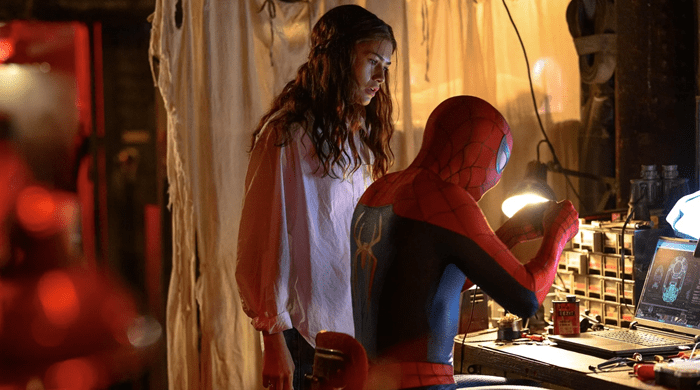
For those in need of a quick refresher, in 2021’s “No Way Home” Peter Parker (Holland) makes the choice to have himself erased from everyone’s memory in order to save the multiverse. He makes a pledge to his girlfriend MJ (Zendaya) and best friend Ned (Jacob Batalon) to find them and reintroduce himself when the time is right. And that leads to the events of “Brand New Day”.
As a means of dealing with his loneliness, Peter fully occupies himself with his crime-fighting duties as Spider-Man. About his only means of human connection is with New York City Police Detective Jean DeWolff (Liza Colón-Zayas). Otherwise he has spent what would have been his exciting college years at MIT watching MJ and Ned from afar. Both now live much different lives without any knowledge of Peter. Meanwhile he waits, heartbroken yet determined, for the right time to reveal himself and the truth of their pasts together.
Peter’s personal journey eventually converges with his role of Spider-Man after the appearance of a mysterious antagonist who is able to telepathically hop from person to person, possessing whoever they embody. The telepath targets The Department of Damage Control which prompts its director, Bill Metzger (Tramell Tillman) to reach out the Spider-Man for help. But the telepath isn’t so easily deterred and will stop at nothing to reach the secret which lies inside of the DODC’s vault.
I danced around a lot of information and for good reason. Co-writers Chris McKenna and Erik Sommers pack a ton into their story, much of which is better discovered for yourself. What impresses most is their ability to balance the more intimate personal stakes with the explosive superhero action. While there are plenty of moments for laughs, the film has a more serious tone which allows us to emotionally connect on a surprisingly deeper level, more so than with any of the previous Spidey films. But then there is the action, which features some of the best captured, cut, and choreographed set pieces from the MCU to date.
Image Courtesy of Sony Pictures
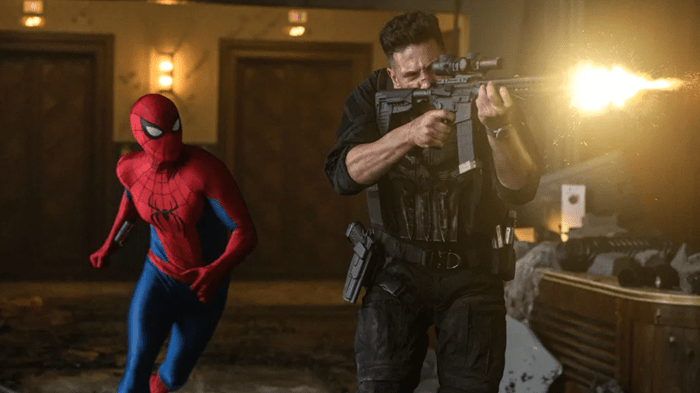
Smartly, Cretton ensures the characters remain his focal point. This is Holland’s best Peter Parker performance to date while Zendaya and Batalon offer their best supporting work of the series. Beyond them, we get a wild array of side characters and guest appearances highlighted by Jon Bernthal’s killer return as Frank Castle aka The Punisher. While slightly tamed to fit the film’s PG-13 rating, Bernthal still retains Castle’s fury and grit. Mark Ruffalo also returns as Bruce Banner in a role that doesn’t feel necessary, yet that finally gives us a glimpse at the real Hulk that so many of us have been longing for.
The vast majority of the movie comes together incredibly well but there are a few minor issues. There are a couple of appearances that feel thrown in for reasons beyond this story. There’s a storyline involving Peter’s sudden spider mutations that leads to several good scenes but no real conclusion. And there are several instances of things just not making sense. For example, how do some memories click for one character but not for another? It’s a case of the movie opening doors and not always knowing how to close them.
I went into “Brand New Day” interested in it more than excited for it. Then for the first time in years, I left the theater feeling genuine enthusiasm for an MCU movie. Destin Daniel Cretton has rediscovered what makes these movies click, by shedding most of the multiverse baggage and telling a contained story that nicely balances authentic humanity with pulse-pounding superhero thrills. “Brand New Day” may not be the best ever MCU offering, but it definitely sits in the upper tier. And when you’ve put out 38 movies, that’s a pretty impressive accomplishment.
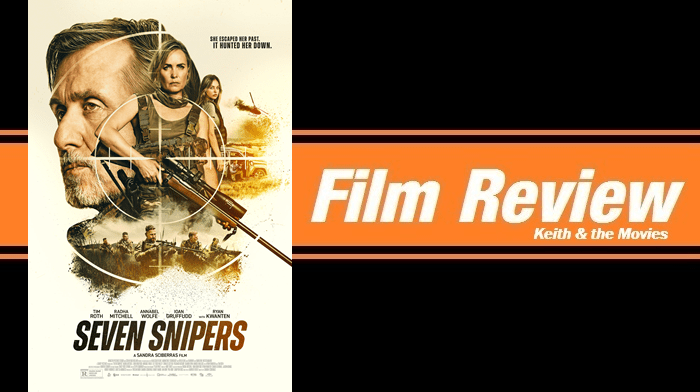
In the Australian action thriller “Seven Snipers”, Radha Mitchell plays a retired army medic named Kris Hendricks. At least that’s the story she has sold to everyone, including her angsty 16-year-old daughter Anja (Annabel Wolfe). In reality, Kris was a member of an elite sniper squad who went by the codename Voodoo Child. And rather than working in a field hospital, she was eliminating enemy targets to the tune of 116 verified kills. And as usual in movies like this, that violent past comes back to haunt her.
Directed by Sandra Sciberras, “Seven Snipers” is a no-nonsense feature that wastes no time plunging us into the action. And once it does, Sciberras moves her audience along with a tense and tactical pacing that locks us in for the entirety of the film’s lean and efficient 88-minute run time. It also helps us to overlook the minimal backstory and character development, both of which are alluded to more than fleshed out.
Image Courtesy of Well Go USA
Kris and Anja live in a remote farmhouse set upon the sprawling Queensland countryside. Things haven’t been easy for Kris. In addition to raising Anja on her own, she also struggles with compartmentalizing her combat trauma while shielding her daughter from the truth of her violent past. But her good intentions have frustrated Anja, who spends most of her time skipping school with her boyfriend Michael (Lee Tiger Halley).
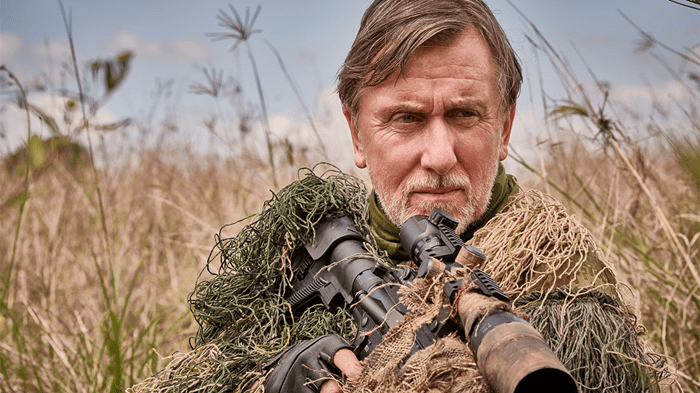
Their quiet life is interrupted by a terrifying person from her past – a lethal marksman and former warlord known only as “The Dragon” (Tim Roth). The ruthless Dragon sends an envoy (Ryan Kwantan) who Kris promptly sniffs out and eliminates. But before he dies, he leaves her with an ominous message, “He’s coming. Long live the Dragon.” At first the reasons for the Dragon’s sudden reemergence looks to be old-fashioned revenge. But we later learn of a far more precious purpose which adds some extra layers of tension.
Image Courtesy of Well Go USA
But the movie is called “SEVEN Snipers”. Enter Kris’ old squadmate Malcolm (Damien Ryan) who she calls on for help. He brings along four other snipers including his somewhat green son Junior (Charles Cottier), the cynical Nico (Pacharo Mzembe), the all-business Kaldayev (Bianca Wallace), and the silent and stoic Milk (Ioan Gruffudd). The stealthily sinister Dragon is the last person to the dance. And from the first crack of his rifle, we’re convinced that he is a formidable threat.
While it’s hard to miss the lack of depth and detail in both the characters and the overall conflict, there’s something refreshing about its simplicity and straightforwardness. “Seven Snipers” builds itself upon the slightest of stories. But once characters begin peering through their long-range scopes, the intensity builds and the stakes ratchet up a notch. From there it’s all about keeping us gripped, which the movie does through economical direction and an all-in cast who fully understand their assignments.
There is a genuinely fun concept waiting to be realized somewhere inside of the Canadian supernatural horror thriller “Son of Sara”. It’s a concept that would find the balance between being uncomfortably chilling and darkly funny. But the movie we get never fully settles on what it wants to be. At least not in a way that is coherently conveyed on the screen. It’s a shame because we see a handful of exciting glimpses of what this film could have been.
As a purely independent film, “Son of Sara” is an admirable accomplishment. It’s written, produced, directed, and edited by Houston Bone who does some interesting thing with an obviously modest budget. It’s a competently made feature that especially impresses in the practical effects department. But the movie is let down by the pieced-together story which toys with several familiar ideas without doing anything interesting with them.
Image Courtesy of Saban Films
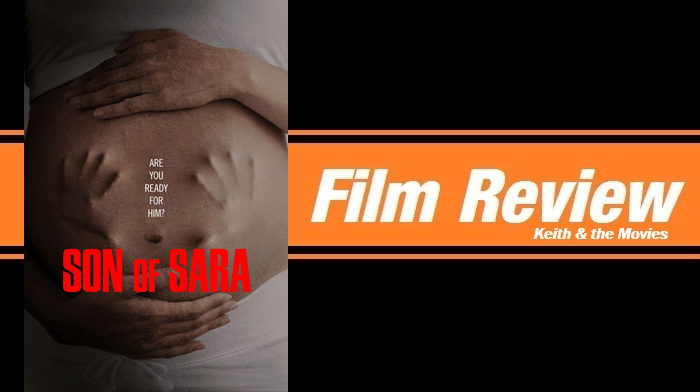
Chloe Van Landschoot plays Sara, a young woman who is very pregnant – the result of a tryst with the icky Troy (Garrett Hnatiuk), who took off after their fling and hasn’t returned her calls since. Now Sara lives with her doting girlfriend Carol (Tymika Tafari), sharing a surface-level relationship that feels more performative for the camera than authentic to the story. Sara is way past her due date, so getting around has become a chore. But far more concerning is her insatiable appetite for raw ground beef, upchucking long plugs of hair, and terrifying visions that repeatedly haunt her.
But the movie takes a goofy turn when Sara unexpectedly bumps into Troy who is surprised to learn she is pregnant. She invites the jerk to her apartment while Carol is away and the two somewhat reconcile in record time. Even wackier, Troy invites Sara to his family’s farmhouse “just outside of the city” to have dinner with his mother Agnes (Jane Moffat). Of course it’s clearly a terrible idea. But in one of several mind-boggling choices, she accepts his offer.
So not only does Sara immediately let this glaringly obvious slug back into her life, but she waltzes off with him to the middle of nowhere. And as I’m sure you also expect, things go terribly wrong for her. To the tune of occult rituals, a demonic entity, and a shocking claim about her baby that shakes her to her core. The lone question – is her baby a demon child from Hell or are Troy and Agnes cult crazies who will do anything to please their malevolent master?
Image Courtesy of Saban Films
Sadly that question never carries much weight. That’s because it’s hard to invest in things when the entire premise is undermined by such a head-scratching setup. So much is left untold, especially regarding Troy and Agnes. Instead time is wasted on baffling inclusions, such as a random second-half sequence of meaningless nudity that distracts more than informs. Even the story’s potential thematic treatment is ultimately stripped of its voice.
Not all is bad in “Son of Sara”. There are a few slashes of black comedy that made me laugh out loud. And the film features some startling body horror that is brought to life through impressively creative practical effects work. But these things aren’t nearly enough to keep us onboard. And that’s sad to say considering the movie leaves the impression that Bone wants to continue Sara’s story in another film. I wish there was enough here to bring me back for more.