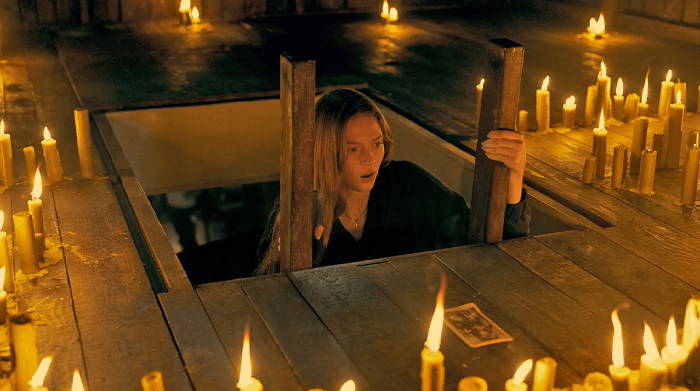
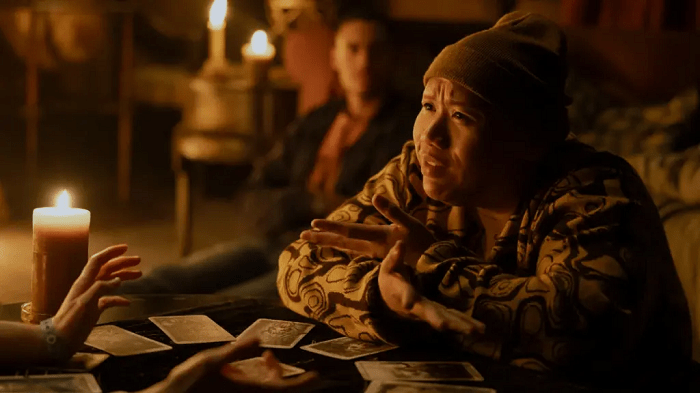
Sony Pictures Home Entertainment has released the supernatural horror film “Tarot” on home video. Released in theaters in early May, the film is now available to own on Blu-ray and includes a digital copy of the movie. “Tarot” is based on the 1992 novel “Horrorscope” by Nicholas Adams and follows a group of college kids who unleash a sinister force after using a mysterious Tarot deck. It’s written and directed by the duo of Spenser Cohen and Anna Halberg.
This Blu-ray and digital copy edition of “Tarot” is now available to purchase. See below for a full synopsis and release information including special features.
About the Film:
Year: 2024
Runtime: 92 Minutes
Director: Spenser Cohen and Anna Halberg
Screenwriter: Spenser Cohen and Anna Halberg
Cast: Harriet Slater, Adain Bradley, Avantika, Wolfgang Novogratz, Humberly González, Larsen Thompson, and Jacob Batalon
Rating: PG-13for horror violence, terror, bloody images, some strong language and drug content
When a group of friends recklessly violates the sacred rule of Tarot readings – never use someone else’s deck – they unknowingly unleash an unspeakable evil trapped within the cursed cards. One by one, they come face to face with fate and end up in a race against death to escape the future foretold in their readings.
A sparkling cast stand out in the first trailer for “Lee”, a British biographical drama and the feature film debut for director Ellen Kuras. Based on the 1985 biography “The Lives of Lee Miller” by Antony Penrose, the film stars Kate Winslet as war journalist Lee Miller. The stellar supporting cast includes Marion Cotillard, Andrea Riseborough, Alexander Skarsgård, Andy Samberg, Josh O’Connor, Noémie Merlant, and James Murray. After premiering at last year’s Toronto International Film Festival, “Lee” is now set for a theater release later this year.
The trailer gives us a pretty broad look at the movie’s scope as it chronicles Lee Miller’s journey from being a model to becoming a photographer for Vogue magazine where she covered the horrors of World War II, often from the frontlines. The period detail looks great from the costumes to the war sequences. And the ensemble looks to fit their roles well. I’m looking forward to giving this one a shot.
“Lee” releases in theaters on September 27th. Check out the trailer below and let me know if you’ll be seeing it or taking a pass.
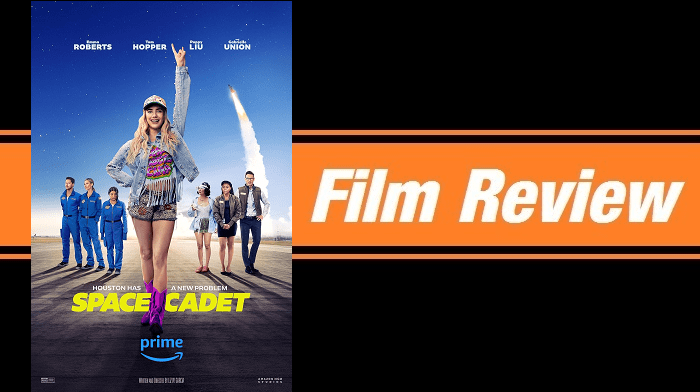
Emma Roberts dreams of blasting into space in her new film “Space Cadet”, a harmless yet ludicrous comedy written and directed by Liz W. Garcia. It’s a movie that (I think) wants to promote female empowerment and it has a hearty message about second chances when it comes to pursuing your dreams. But it’s hard to take those things seriously when the film makes suspending your disbelief this difficult.
“Space Cadet” feels like a movie that did the bare minimum when it came time to research our space program. Yes, it throws in some proper terminology and portions were shot at the U.S. Space and Rocket Center. But it’s all so silly and far-fetched, especially its depiction of NASA. I get that it’s just a movie and realism probably wasn’t a priority. But you can’t help but wonder what country would support such an inept space program? Suffice it to say NASA won’t be using “Space Cadet” in any of its recruitment drives.
Image Courtesy of Amazon MGM Studios
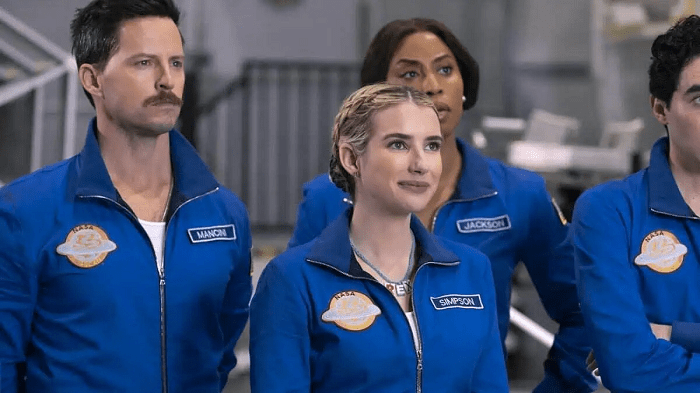
Among the film’s few bright spots is Roberts who does her very best with what she’s given. She plays Tiffany “Rex” Simpson, a flighty Florida party girl who once had big dreams of becoming an astronaut. These days she works as a beachside bartender and saves manatees in her spare time. She lives with her father Calvin (Sam Robards) who leads ghost hunting tours and still struggles with the loss of her mother who died ten years earlier. Oh, and she has an eccentric best friend Nadine (Poppy Liu) because these movies always have an eccentric best friend who exists solely for comic relief.
After a rather out-of-the-blue epiphany, Rex decides she wants to be an astronaut again. So she fills out an application to the NASA Training Program (as if that’s all it takes to be an astronaut). Nadine gets ahold of the application and secretly spruces it up a bit, wildly embellishing Rex’s achievements and qualifications. And wouldn’t you know it, this comically incompetent NASA chooses Rex to be a part of their exclusive program (so I guess that is all it takes to be an astronaut in this world).
Image Courtesy of Amazon MGM Studios
Rex travels to Johnson Space Center in Houston where she joins the supposedly elite group of trainees chosen to compete for jobs at NASA. The handful of finalists will take part in a mission to the International Space Station. Of course the bubbly and buoyant Rex sticks out like a sore thumb among all of the legit serious-minded geniuses. But she quickly begins to win everyone over including her superiors. Among them is the hunky but incredibly dense Logan O’Leary (Tom Hopper). He’s the Deputy Director of Operations and an astronaut, but he’s mainly there to serve as Rex’s eventual love interest.
It may surprise you, but all of that is the movie at its most realistic. Things only get more preposterous from there. So much so that it’s impossible to look past the absurdity no matter how hard you try. As a result, not only does the story suffer but the characters do as well. They’re all so thinly written and as unconvincing as the silly tale they’re handcuffed to. It’s unfortunate, especially when you see Roberts giving it her all. To her credit, she makes the movie endurable. But as with any actor, she can only do so much with bad material. “Space Cadets” is streaming now on Prime Video.
Love them or hate them, anyone who enjoyed movies during the 1980s knew of the Brat Pack. It was a nickname given to a specific group of young actors and actresses in their early twenties who would often appear together in popular coming-of-age movies throughout the decade. The name was play on Rat Pack which was an earlier Hollywood A-list group that had various iterations between the 1940s, 1950s, and 1960s.
The Brat Pack name was coined by David Blum in his 1985 cover story for New York magazine. The group (which most prominently consisted of Emilio Estevez, Rob Lowe, Demi More, Molly Ringwald, Anthony Michael Hall, Judd Nelson, Andrew McCarthy, and Ally Sheedy) hated the label and felt betrayed by Blum who they had briefly let into their inner circle. Even today, Blum has no regrets and views the people impacted by his story as little more than “collateral damage”.
“Brats” is a documentary directed by Brat Pack member Andrew McCarthy and it sets out to explore the careers and relationships of the young stars both before and after they were branded by Blum’s article. McCarthy approaches it with his own insider perspective but also reaches out to other former members including Estevez, Lowe, Sheedy, and Moore. Unfortunately Ringwald, Nelson, and Hall all declined to participate.
The film follows McCarthy as he seeks out the other Brat Pack members and those connected to the group in hopes of hearing their experiences and discovering what the name means to them some four decades later. Some he hasn’t spoken to in thirty or more years, as they went from making movies together to avoiding each other like a plague. Others have outside perspectives that offer some interesting insight. Many saw the Brat Pack label as insulting, reductive, and derogatory. But there were those who found benefits in the fame it brought.
As we watch it becomes clear that making the film was a therapeutic journey for McCarthy – an opportunity for him to finally reckon with this dark cloud that has followed him for so many years. It offers him the opportunity to wrestle with what the Brat Pack means to him today as opposed to in the 1980s. It’s an interesting element yet one that feels more personal to him than relatable for us.
Throughout the documentary’s brisk 92 minutes we’re treated to some insightful and revealing conversations. We also get lots of great archive footage of old interviews, movie clips, and behind the scenes video. It makes for an interesting and nostalgic retrospective for those of us who grew up in the Brat Pack era. And that’s who this film will ultimately resonate with. It’ll be a tougher sell for those without at least some attachment or familiarity. But for me, from my early crush on Demi Moore to my endless VHS rewatches of “The Breakfast Club” and “Sixteen Candles”, I’m very much the film’s target audience. “Brats” is now streaming on Hulu.
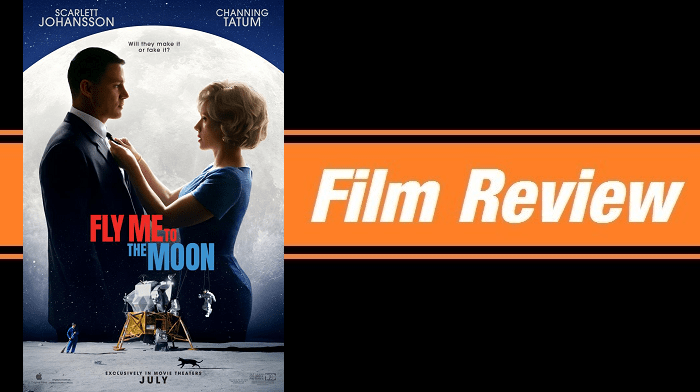
Likable lead characters and good old-fashioned star power can often carry a movie a long way. Such is the case with “Fly Me to the Moon”, a fun and undeniably charming new film starring Scarlett Johansson and Channing Tatum. It could best be described it as a romantic comedy and a historical reimagining mixed together into a breezy and accessible summer feature. Even better, it turns out to be one of the season’s bigger surprises.
Directed by Greg Berlanti and written for the screen by Rose Gilroy, “Fly Me to the Moon” turns back the clock to deliver the kind of well-made feel-good entertainment that we don’t get much of these days. It’s ready-made to be seen on the big screen and offers audiences a welcomed break from the usual summer blockbuster diet of sequels, prequels, reboots, and remakes.
The bulk of the story takes place in 1969 during the height of America’s space race with the Soviet Union. With the horrors of the Vietnam War dominating the headlines, the country’s interest in the space program was waning. So the government needed a new strategy if they were ever going to realize Kennedy’s ambition of reaching the moon. The bulk of the pressure fell on the underfunded and understaffed NASA who had endured a number of setbacks, some of them tragic.
Image Courtesy of Columbia Pictures
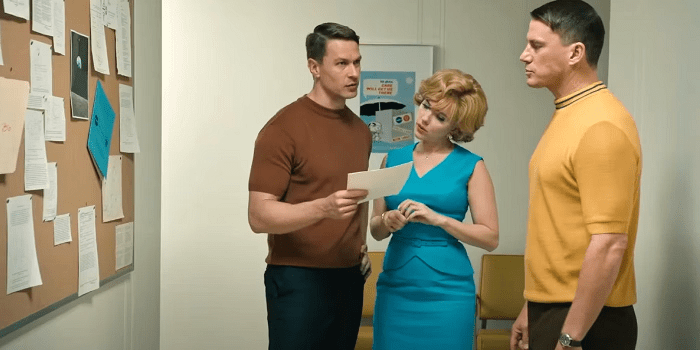
With only seven months left to prepare for the Apollo 11 mission to the moon, NASA’s image was in need of a makeover. Not only did they need to win back the public, but they needed to win over key Senators who were leaning towards cutting funding to their program. Enter Kelly Jones (a luminous Johansson), a tenacious marketing specialist from Manhattan with a rather eventful history.
One evening Kelly is approached by Moe Berkus (Woody Harrelson), a mysterious suit who works for the White House. He tells her that he wants to hire her, and if she agrees he can make certain troubling blemishes from her past disappear. The job is to sell the country on NASA’s space program and more specifically its upcoming moon mission. Without many options, Kelly agrees and immediately heads off to John F. Kennedy Space Center in Florida.
Once there, Kelly kicks into marketing mode much to the chagrin of the Apollo 11 Launch Director, Cole Davis (Tatum). He’s a ‘strictly business’ kind of guy who quickly grows annoyed by Kelly’s slick and savvy salesmanship despite his obvious attraction to her. Before long she has major advertisers lining up to partner with NASA including Tang, Fruit of the Loom, Peter Pan, and Omega watches. And no matter how hard Cole tries to push back, Kelly is always one step ahead of him (and having the support of the President doesn’t hurt).
Image Courtesy of Columbia Pictures
Despite being workplace adversaries, a romantic spark ignites between Kelly and Cole. And I emphasize “spark” because this isn’t what you would call a romantic movie. There is a hint of sexual tension between the characters and Johansson and Tatum have good chemistry. But it’s a small part of a bigger story. And that’s a big reason “Fly Me to the Moon” works as well as it does. Sure it’s light and frothy in spots, but it’s a movie that’s not easy to pigeonhole.
Berlanti and Gilroy try to add some emotional depth which for the most part works. For Kelly, it’s the weight of the missteps she’s made since losing her mother. For Cole, its the haunting memory of the Apollo 1 tragedy which happened under his watch. Gilroy’s script doesn’t really see these subplots through, but they do help open up and define these characters. As for Harrelson, he doesn’t have a big role but he livens up every scene he’s in which has become his MO in recent years. He’s a hoot.
If you’ve seen the trailer you know the movie also includes the filming of a fake moon landing. Interestingly this doesn’t unfold until the final act and it’s where the movie is at its most far-fetched. But surprisingly even it has more layers than you might think. It leads to a semi-satisfying ending to what is mostly a well-made, well-acted, and well-paced throwback movie – the kind I admittedly miss. Its blend of humor with romance and history with fiction makes for a lighthearted crowd-pleasing joyride that anyone can get onboard with. “Fly Me to the Moon” is in theaters now.
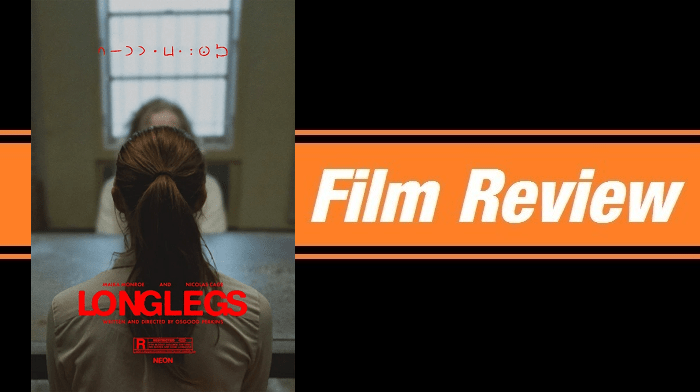
The promotional lead-up to the release of “Longlegs” has been pretty terrific. The creepy and cryptic first teasers, the equally mysterious full trailers, a series of unnerving movie posters, the slow and controlled hints at plot details – it has all worked together perfectly to build some real anticipation. Add in NEON’s stellar pedigree in the world of independent filmmaking and you have one of the most intriguing feature films of the year.
Now here’s the really good news – “Longlegs” absolutely delivers in nearly every way imaginable – as a horror movie, as a deep character study, and as a dark and disturbing crime procedural. It’s written and directed by Osgood Perkins, the son of the late actor and “Psycho” star Anthony Perkins. With “Longlegs” he has made a truly unnerving and visceral experience – one that sustains a chilling atmosphere and a steady sense of dread.
Image Courtesy of NEON
Perkins frames his story in three parts, each transporting us deeper into his bleak, nightmarish world. His approach is very measured and calculated. And while the subject matter is grim and some of the images are gruesome, there’s a level of restraint that leaves just enough to our imaginations. It’s an effective approach that sees Perkins burrowing into our subconsciouses and planting fears that linger for the film’s duration. He doesn’t feed the impulse to show us everything which may frustrate some mainstream audiences. But for those who don’t need to be spoon-fed every detail, “Longlegs” offers one of the most purely unsettling experiences to hit the screen in years.
Set in Oregon during the mid-1990s, a superb Maika Monroe plays Lee Harker, a rookie FBI agent who is assigned to an unsolved serial killer case involving a psychopath known as Longlegs (played by Nicolas Cage at his most demented and unhinged). Lee has an almost psychic intuition which prompted her boss, Agent Carter (Blair Underwood) to bring her onboard. Lee is meek and awkward but surprisingly capable and with good instincts. Think of her as Clarice Starling in demeanor and dress but minus the ambition.
As Lee begins digging deeper into the murders, she makes a number of discoveries involving information such as the dates of the killings and the birthdays of the victims. But they only scratch the surface of something far more insidious. Much like the messages Longlegs leaves at his crime scenes, the film itself plays like a code needing to be cracked. But just know, even when we finally do, not every question is given an answer which only adds to the movie’s sinister essence.
Image Courtesy of NEON
Nicolas Cage (who also serves as a producer) makes brilliant use of his limited screen time, manifesting the kind of terrifying madman that can turn your dreams into nightmares. At times you have to look close just to see Cage underneath the facial prosthetics, pasty white skin, and long stringy gray hair. But he’s there, and his maniacal transformation gets under your skin and makes you squirm. It may not go down as his best performance, but it’s as weird and gonzo as anything Cage has done to date.
As you watch “Longlegs” it’s easy to see the fingerprints of other movies that inspired it. “Zodiac”, “Se7en”, and “The Silence of the Lambs” are just some of the influences that stand out. Still, Perkins has made a movie that is distinctly his own – one that shows off the impeccable talents and confidence of its creator both as a storyteller and a visual artist. From his masterful use of framing, blocking, and aspect ratios to his keen instincts regarding tone, tension-building, and pacing, Perkins has crafted an eerie and riveting chiller that’s also one the best movies of the year. “Longlegs” is in theaters now.