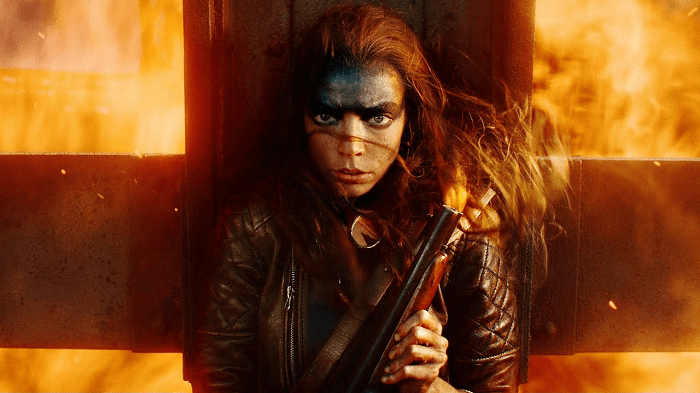
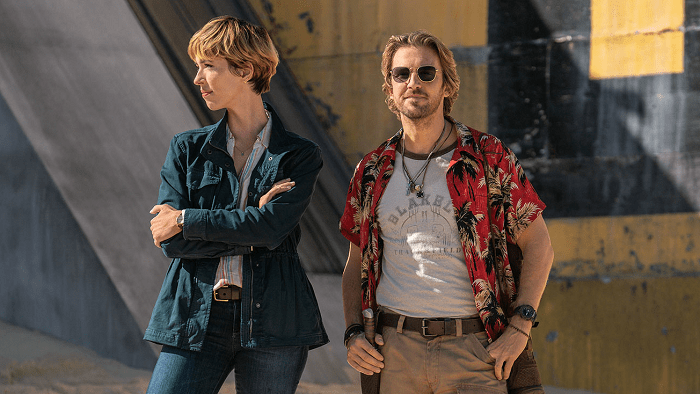
One of the most eagerly anticipated action movies of the year is only a few weeks away. George Miller returns to the post-apocalyptic wasteland with “Furiosa”, the fifth installment in his beloved Mad Max franchise. “Furiosa” serves both as a spin-off and prequel to Miller’s extraordinary “Mad Max: Fury Road” from 2015. The trailers have been brilliant and now Warner Brothers has dropped a killer new poster to entice us even more. Check it out and tell me what you think.
DIRECTOR – George Miller
WRITER – George Miller, Nico Lathouris
STARRING – Anya Taylor-Joy, Chris Hemsworth, Angus Sampson, Nathan Jones, Tom Burke, Lachy Hulme, John Howard, Charlee Fraser, Daniel Webber
Todd Phillips’ 2019 “Joker” turned out to be a blockbuster smash, making over $1 billion at the global box office and earning Joaquin Phoenix an Academy Award for Best Actor. Gritty, violent, and rooted in realism, “Joker” took the legendary DC Comics villain in some dark yet captivating directions. To no surprise a sequel was eventually announced. But rather than offer your run-of-the-mill follow-up, Phillips and Phoenix return with “Joker: Folie à Deux”, a movie that has been described as a super-villain movie musical.
Phoenix reprises his role as Arthur Fleck (aka Joker) who was last seen attempting to break out of Gotham’s Arkham Asylum. Where this second installment goes from there is anyone’s guess. What we do know is that Lady Gaga takes on the role of Harley Quinn. The first trailer shows the two meeting in Arkham and eventually breaking out together. But what really has me curious is the use of music. It’s been said the movie will include a total of 15 musical numbers which both piques my interest and causes concern. The trailer does hint at how the music will be used. It has the potential to be utterly spellbinding or a major miscalculation. Either way, I’ll be there on opening night.
“Joker: Folie à Deux” dances into theaters on October 4th. Check out the trailer below and let me know if you’ll be seeing it or taking a pass.
I don’t cover much television, but occasionally a must-see show comes down the pike that I can’t pass up. One of the latest is Prime Video’s upcoming “Fallout”, an eight episode series based on the extremely popular Fallout video game franchise from Bethesda Game Studios. Created by Jonathan Nolan and Lisa Joy (Nolan will also be directing several episodes), “Fallout” will premiere on Prime Video tomorrow, April 10th (a day earlier than its originally scheduled April 11th release).
For those unfamiliar, the Fallout series is set within a retrofuturistic wasteland. During the post-war 1950s, a nuclear war decimated our planet. Those who were able survived in massive bunkers across the United States known as vaults. The games follow dwellers around the country who leave their vaults for the first time only to encounter a dangerous, savage, and violent new world. The streaming series looks to follow the same formula as a young woman named Lucy (Ella Purnell) leaves her home in Vault 33 and ventures into the devastated and hostile remains of Los Angeles. Walton Goggins and Aaron Moten also star.
Prime Video’s promotion for the series has been off the charts. The trailers are filled to the brim with cool easter eggs and the production design seems plucked right of the games. They’ve also released a number of killer posters that feel right in tune with the franchise’s unique vibe. Check out the trailer and the posters below and tell me what you think. Are you excited for “Fallout”? Will you be checking it out? I know I will.
I for one have thoroughly enjoyed Legendary’s MonsterVerse movie franchise. “Godzilla x Kong: The New Empire” makes for the fifth film in the shared universe which dates all the way back to 2014 and Gareth Edwards’ terrific “Godzilla”. It’s considered the 38th film of the entire Godzilla franchise and the 13th King Kong feature. It sees the return of director Adam Wingard who helmed the previous installment, 2021’s “Godzilla vs. Kong”.
Initial reactions to this newest entry have been interesting. While early box office numbers have been impressive, the critics responses have been mixed. One reason is because some have unfortunately and unfairly pitted it against last year’s exceptional and more serious-minded “Godzilla: Minus One”. If anything the long-running Godzilla franchise has proven that you can do a lot of different things with the titular characters. Wingard understands that and sticks with his wild ‘Rock ‘Em Sock ‘Em Kaiju’ formula. I’m glad he did.
Image Courtesy of Legendary Pictures
After defeating Mechagodzilla in the last movie, Kong has descended back down to Hollow Earth – the vast world below our planet’s surface where he carries on his search for his ancestors. Meanwhile on the surface, Godzilla continues his fight against the Titans who frequently spring up and cause trouble. As the last film established, Godzilla and Kong don’t like each other. But as long as they stay out of each other’s territory there should be nothing to worry about…right?
Back at Monarch, the well-funded secret organization that specializes in the monitoring Titan activity, Dr. Ilene Andrews (Rebecca Hall) has been elevated to Head of Kong Research. She and her team keep an eye on Kong while others within the vast Monarch follow Godzilla around the globe trying to predict his next moves.
At home, Irene’s young adopted daughter Jia (Kaylee Hottle) remains the last surviving member of Skull Island’s Iwi tribe who has a special connection to Kong. She’s suddenly stricken with traumatic visions triggered by an unidentified signal emanating from Hollow Earth. Irene seeks the help of Titan enthusiast and podcaster Bernie Hayes (a returning Brian Tyree Henry) and Titan veterinarian Trapper (Dan Stevens) who accompany her to Hollow Earth where Kong has discovered an uncharted region full of secrets. Meanwhile the mysterious signal stirs up Godzilla who begins preparing for a potential new and terrifying threat.
Image Courtesy of Legendary Pictures
As you can probably guess, it’s all working toward a Titan-sized clash which Wingard and his digital effects team have a blast setting up and executing. The CGI-heavy visuals are pretty spectacular and often help to energize the movie. This proves to be important, especially as the heavy doses of mythology begin to wear a little thin. Admittedly, it’s impossible to deny the silliness of it all. At the same time, that very same silliness is a big part of what makes the movie fun. And Wingard’s snappy pacing makes sure you’re not dwelling on too much for too long.
Of course the bread and butter of “The New Empire” is the Titan throwdowns and we get some really good ones. Fans will relish the massive, destruction-driven battles, the film’s playful self-awareness, and the classic monster movie feel. Wingard and his trio of writers (Terry Rossio, Simon Barrett, and Jeremy Slater) make no bones about the movie they’re making. It’s pure popcorn entertainment and throwback escapism. If you didn’t like the previous MonsterVerse entry I’m not sure you’ll go for this one. Me? I’m already excited for the next installment. “Godzilla x Kong: The New Empire” is in theaters now.
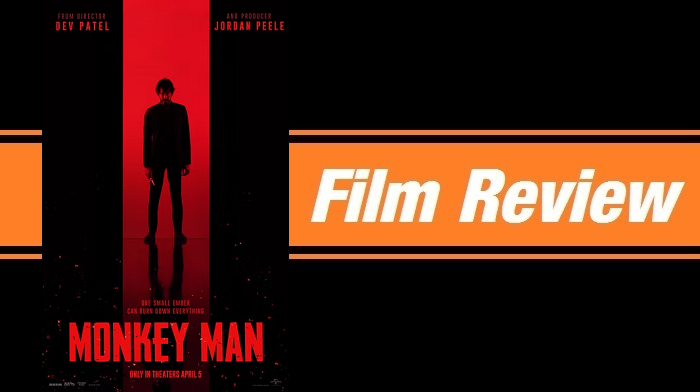
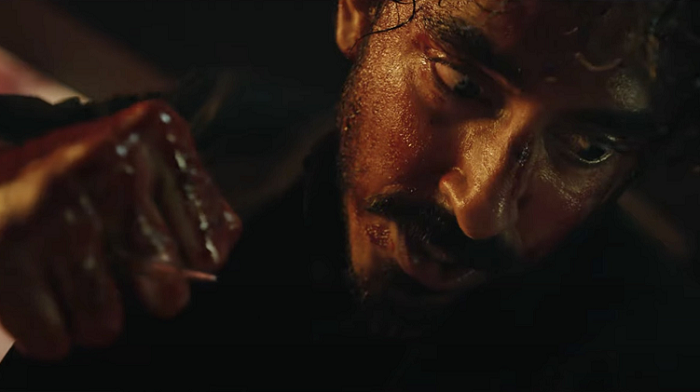
Dev Patel jumps head-first into the action arena with “Monkey Man”, an intriguing revenge thriller that marks the 33-year-old actor’s directorial debut. The ambitious “Monkey Man” is a brutal and bloody amalgamation that attempts to pull equally from Hollywood and Indian action cinema. Patel’s management of both styles, in front of and behind the camera, is a big reason his hard-hitting first feature works when it does. That said, it’s not without its flaws.
In addition to directing and starring, Patel also conceived the story, co-wrote the screenplay, and co-produces alongside Jordan Peele. His film was nearly cancelled after numerous delays during the COVID-19 pandemic. But Patel pushed through and his finished film was acquired by Netflix. Soon after, Peele saw the movie and was impressed. He purchased it from Netflix and inked a distribution deal with Universal Pictures. And just like that Patel’s passion project had its path to the big screen.
Image Courtesy of Universal Pictures
Some have compared “Monkey Man” to the John Wick films and from the trailers it’s easy to see why. But with the utmost respect, this is no John Wick. And the comparisons don’t do Patel’s film any favors. First off, this is not the fast-flowing, action-fueled movie you might expect. The bulk of the action in concentrated into two expanded sequences – one in the first half, the other in the final act. That’s pretty much it. And while Patel pours himself into it physically, the sequences are lacking in several ways. More on that in a second.
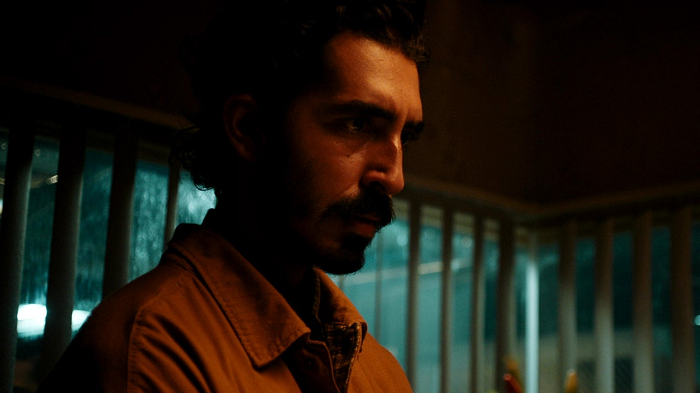
Patel plays a somber young man with no name who’s tormented by his troubled past. We learn that as a child he witnessed the savage murder of his mother (Adithi Kalkunte) at the hands of a cold-hearted Chief of Police, Rana Singh (Sikandar Kher). Donning a blood-stained gorilla mask, the young man now works in an underground fight club where he gets beaten to a pulp for cash. But in the back of his mind all he can think of is paying back every crooked police officer, corrupt politician, and spiritual guru involved in his mother’s death.
The young man’s quest for revenge starts when he gets a job at a swanky night club/restaurant ran by Queenie Kapoor (Ashwini Kalsekar), a child trafficker and close associate of Rana Singh. He carefully crafts a plan and patiently waits to make his move. Unfortunately things don’t go as planned and he misses his chance to kill Rana. He manages to escape but is badly wounded and severely beaten. His near lifeless body is nursed back to health by a vaguely defined transgender religious sect who use a few chants, some drum beats, and a burlap sack full of rice to turn him into a one-man killing machine. Yep.
Of course the young man gives vengeance another whirl, this time leaving behind a much higher body count. Much like the earlier action sequence, the finish has its moments and Patel’s intensity and physicality carry the load. Yet even with some beautifully violent flashes of brilliance, the action as a whole feels surprisingly inert. That’s because Patel’s big stylish swings can sometimes get in the way. But by far the biggest problem with the action is Patel’s frustrating over-reliance on shaky-cam and quick-cuts. It mucks up the scenes and can be borderline disorienting.
Image Courtesy of Universal Pictures
Meanwhile through it all Patel attempts to weave in commentary on Indian politics and religion although without much context. And he makes several broad statements on power, class, and marginalization. But they too are more surface level than explored. It’s obvious what Patel is going for. But “Monkey Man” ends up stuck in a rather unsatisfying middle ground. The lack of depth in its setups and treatments weakens its messaging. At the same time, its attempts at messaging takes away from the action which could have driven the film if given more attention.
All of that said, Patel still accomplishes quite a bit. First, he remains a terrific actor and he gives yet another astonishing performance in a role unlike anything he’s done in the past. He also shows some keen senses and an unbridled ambition behind the camera. His decisions don’t always come together, but he clearly has a bright future as a director. As for “Monkey Man”, it’s an admirable yet perplexing first effort in desperate need of some fine-tuning. It’s a movie with flashes of genius but hampered by a few head scratching choices and some miscalculations that unfortunately hold it back. “Monkey Man” is in theaters now.
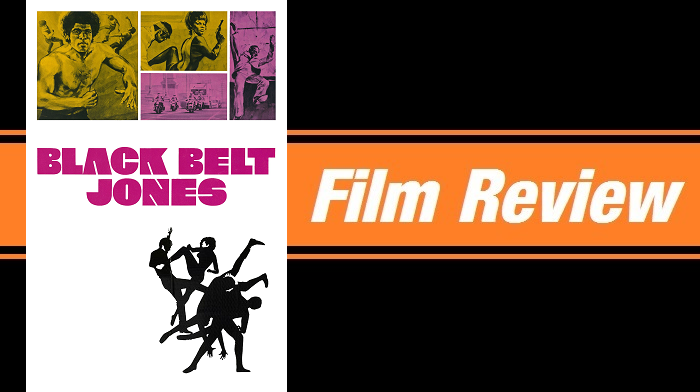
In 1974, Robert Clouse had just directed the highly revered Bruce Lee martial arts classic, “Enter the Dragon”. That film was an enormous box office success, earning a total of $400 million worldwide (which is over $2 BILLION today when adjusted for inflation). “Enter the Dragon” also starred a young Black martial artist named Jim Kelly. Clouse was so impressed with the charismatic Kelly that he cast him in his next movie, “Black Belt Jones”.
Checking off many blaxploitation boxes, “Black Belt Jones” offers up much of what you would expect from a wild genre mash-up of action, comedy, crime thriller, and of course kung-fu. It features much of what made blaxploitation films popular during their time. But it’s also hampered by their weaknesses which in this case are hard to look past despite the fun.
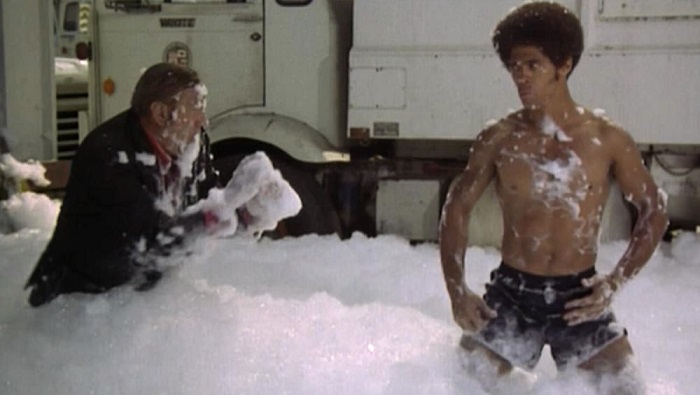
Kelly plays the titular Black Belt Jones, an expert martial artist thrust into a conflict between an old friend and the Mafia. Jones’ mentor, Wesley “Papa” Byrd (played by the great Scatman Crothers) runs Black Byrd Karate School. It’s located on a small patch of land in the middle of the city that the Mafia is desperate to get their hands on.
Image Courtesy of Warner Bros.
After local mob leader Don Steffano (Andre Philippe) gets wind that the city government is planning on building a huge civic center in the area, he begins gobbling up all the property in the neighborhood. He’s able to get everything but the karate school. So the Don sends a local drug dealer named Pinky (Malik Carter) to strong-arm Papa into selling his land. But when Pinky accidentally kills Papa, Black Belt Jones is forced to get involved.
Adding an extra wrinkle is Sydney Frazier (Gloria Hendry), Papa’s estranged daughter who comes into town determined to pay back those who killed her father. Hendry adds some spice to the story, portraying a young woman who is more than capable of taking care of herself. She and Kelly have some fun chemistry together. At least until Clouse overplays it by throwing together a hopelessly corny cat-and-mouse game on the beach. It’s meant to be romantic but instead is comically mawkish.
“Black Belt Jones” has some big laughs, often at unexpected moments. And while the screenplay doesn’t always help him, Jim Kelly is a fun and often charismatic lead. But the hokiness is hard to overlook, and even the most forgiving eye will have a hard time looking past the movie’s obvious limitations. Genre fans like myself will find something to enjoy. But there are plenty of better films for those wanting to dip their toes into the world of blaxploitation.