REVIEW: “The Boys in the Boat” (2023)

George Clooney returns to the director’s chair with “The Boys in the Boat”, a biographical sports drama based on the true story of working class University of Washington rowers who defied all odds to represent the United States in the 1936 Summer Olympics in Berlin, Germany. The film is written for the screen by Mark L. Smith (“The Revenant”) who is adapting Daniel James Brown’s 2013 nonfiction book of the same name. It’s really good material.

Whether he hits or misses his marks, I’ve mostly enjoyed Clooney’s classical directing style (a style that’s rarely as appreciated today as it once was). With “The Boys in the Boat” he has delivered one of the bigger surprises of the year – a film with the kind of old-fashioned crowdpleaser quality that still resonates for many of us. It tells yet another inspirational underdog sports story yet one rich with humanity. And it takes place within a period setting that’s captured with impeccable authenticity.

Standing out among the film’s many strengths is the tough yet affecting performance from Callum Turner. He brings grit and pathos to the character of Joe Rantz. Abandoned by his father shortly after his mother died, Joe has been raising himself since he was 14-years-old. Set in 1936, we meet Joe living in the hull of a rusted out car. Each day he walks from his homeless community in Seattle to the University of Washington where he’s working on a degree in engineering.

Image Courtesy of Amazon MGM Studios

But Joe gets some bad news. He still owes for his current semester and he’s given two weeks to pay his balance or he’ll be kicked out. Desperate and unable to find a part-time job, Joe decides to try out for the rowing team after being told he can earn some money. He joins dozens of other young men vying for the eight open spots on Washington’s junior rowing crew. Overseeing the grueling tryouts is former rower and seasoned university coach Al Ulbrickson (a terrific Joel Edgerton).

To no surprise Joe makes the team which gets him in a dorm and helps pay for his school. But he quickly learns that rowing is all about the boat and the team you put in it. And as a brotherhood forms between the eight young men, they begin to realize some unexpected potential. Soon the junior crew is outshining the varsity team leaving Coach Ulbrickson with a decision – does he endure the scorn of his boosters and do the unthinkable? Does he take his junior crew rather than his varsity guys to the Olympic qualifiers?

Without question many of the film’s themes are familiar ones. Topics such as defying the odds and overcoming adversity are inherent to stories like this. But that doesn’t make them any less impactful especially when they’re handled as well as they are here. But beyond these more traditional ideas, it’s the movie’s setting that steers it into more unexpected waters.

Image Courtesy of Amazon MGM Studios

On the precipice of a Second World War, the 1936 Summer Olympics were held in Nazi Germany. Adolph Hitler saw hosting the event as a means of promoting his party’s antisemitic platform. It’s a necessary part of the film’s true account and Clooney approaches it smartly. He doesn’t linger on the obvious and he doesn’t give in to the urge to spell everything out. Instead he allows us to take it in and absorb it. The scarlet red Nazi banners and black swastikas; the appearance of Hitler himself, and the chilling cheers from the mass of supporters. Clooney lets his images speak rather than spinning us off on an unnecessary side story.

The performances are great throughout. I’ve mentioned Turner who is a revelation and Edgerton who seems to be able to plug into any role and nail it. There’s also a great turn from Peter Guinness who plays a wise old boatmaker and the team’s mentor. Hadley Robinson is utterly charming as Joe’s sweet but forward love interest. And then you have the collection of young actors who bring character and personality to the rowing team. It’s a fine ensemble.

In some ways “The Boys in the Boat” shares a common framework with many other sports movies. But narrowing this one down to just a ‘sports movie’ would be dismissive. There’s so much more to this uplifting and sincerely human feature. The heart-pounding races are brilliantly shot and edited while the production design and costumes help transport us. But it’s Clooney’s ability to create and define the personal stakes as well as deliver satisfying emotional payoffs that make “The Boy in the Boat” more than your run-of-the-mill feel-good sports flick.

VERDICT – 4.5 STARS

“Oppenheimer” Takes Top Honor as the Southeastern Film Critics Association Award the Best From the 2023 Movie Year

Today the voting body of the Southeastern Film Critics Association (which I’m proudly a member of) has announced their choices for the best of the 2023 movie year. The big winner was Christopher Nolan’s “Oppenheimer” which was named Best Picture. In addition, the film took home honors for Best Director, Best Actor, Best Supporting Actor, Best Adapted Screenplay, Best Ensemble, Best Cinematography, Best Score.

Below is the official press release from the Southeastern Film Critics Association along with a full list of the winners.

Monday, December 18, 2023 – The Southeastern Film Critics Association (SEFCA) has named
Christopher Nolan’s Oppenheimer as the Best Picture of the Year. SEFCA’s eighty-nine members
located across nine Southeastern states also recognized Christopher Nolan for Best Director
and Best Adapted Screenplay. Additionally, the film earned Best Actor for Cillian Murphy, Best
Supporting Actor for Robert Downey, Jr. and Best Ensemble for its star-studded cast that
includes Emily Blunt, Matt Damon, Aldren Ehrenreich, Jason Clarke, Tom Conti, Josh Hartnett,
Kenneth Branagh and others. Behind the camera Oppenheimer took the top prizes for Best
Cinematography (Hoyte Van Hoytema) and Best Score (Ludwig Goransson).
“This fall featured three big films from three grandmasters of cinema,” said SEFCA President
Scott Phillips. “Martin Scorsese released Killers of the Flower Moon. Ridley Scott brought
Napoleon to the big screen and Michael Mann hits theaters next week with Ferrari. Despite this
bumper crop from heavy-hitting auteurs, Christopher Nolan’s film from six months ago is
walking away with eight SEFCA awards. Oppenheimer is a stunning cinematic achievement. Our members recognized that in July, and they are rewarding it in December.”
When asked about the film year that was 2023, SEFCA Vice President Jim Farmer said, “2023
will be remembered by many as the year that featured the commercial, critical and cultural
phenomenon known as Barbenheimer. But it was also a season that offered a stunning amount
of high-quality films, with master filmmakers near the top of their games, fresher faces making
strong impressions and performers showing new dimensions. It was a pleasure to take in all that
2023 had to offer.”
Those “fresher faces” include writer/director Celine Song whose debut feature, Past Lives, lands
at # 4 on SEFCA’s Top 10 of 2023, and writer/director Cord Jefferson whose debut feature,
American Fiction, placed seventh in the SEFCA Top 10. The diverse list also includes an
animated film (Spider-Man: Across the Spider-Verse) and two foreign films (Anatomy of a Fall,
The Zone of Interest).

Read SEFCA’s full list of winners below. Visit SEFCA on the web at SEFCA.net to learn more
about its members as well as past winners. You can also follow SEFCA on Twitter at
@SEFilmCritics.

Top 10 Films of 2023

  1. Oppenheimer
  2. Killers of the Flower Moon
  3. The Holdovers
  4. Past Lives
  5. Barbie
  6. Poor Things
  7. American Fiction
  8. Spider-Man: Across the Spider-Verse
  9. Anatomy of a Fall
  10. The Zone of Interest

Best Actor:
Cillian Murphy, Oppenheimer

Best Actress:
Lily Gladstone, Killers of the Flower Moon

Best Supporting Actor:
Robert Downey, Jr., Oppenheimer

Best Supporting Actress:
Da’Vine Joy Randolph, The Holdovers

Best Ensemble:
Oppenheimer

Best Director:
Christopher Nolan, Oppenheimer

Best Original Screenplay:
David Hemingson, The Holdovers

Best Adapted Screenplay:
Christopher Nolan, Oppenheimer

Best Documentary:
Still: A Michael J. Fox Movie

Best Animated Film:
Spider-Man: Across the Spider-Verse

Best Foreign-Language Film:
Anatomy of a Fall

Best Cinematography:
Hoyte Van Hoytema, Oppenheimer

Best Score:
Ludwig Goransson, Oppenheimer

REVIEW: “The Iron Claw” (2023)

Growing up as a kid in the South during the 1980s, professional wrestling had a huge impact. But it wasn’t just for knot-headed boys like me. Regional wrestling had fans of all shapes, sizes, and colors. Heck, it was my incredible grandmother who first introduced me to the wonderful world of pro wrestling. The two of us had a ritual. I would walk over to her house on Saturday mornings and together we would sit and watch Mid-South Wrestling. It was a special time.

During the territory days, the television shows, wrestling magazines, and arena cards were dominated by big names like Ric Flair, Harley Race, Junkyard Dog, Hacksaw Jim Duggan, and the Fabulous Freebirds (just to name a few). But few were bigger than the Von Erichs, a family of wrestlers originating out of Denton County, Texas. Brothers Kevin, David, Kerry, Mike, and Chris wrestled professionally under the leadership of their father Fritz. Sadly their many accomplishments inside the ring are often overshadowed by the personal tragedies that followed their famous family.

Sean Durkin writes and directs “The Iron Claw”, a wrenching biographical drama that sets out to share the story of the Von Erichs. Durkin highlights many of the family’s professional achievements and documents their rise in popularity. But his biggest focus is on their lives outside of the ring, namely the tight-knit brotherhood the boys shared and their well-meaning yet self-destructive drive to please their overbearing and demanding father.

Image Courtesy of A24

If you’re familiar with the true story of the Von Erichs you know “The Iron Claw” won’t be an easy watch. Durkin approaches it with honesty and empathy, palpably manifesting the pressurized father-sons dynamic and then hitting us with the inescapable heart-crushing results. It makes for a devastating family portrait. Yet it’s a story that doesn’t quite feel complete due to the odd omission of Chris Von Erich, the youngest brother who committed suicide in 1991. Durkin has stated Chris was left out because of running time concerns. But it could also have been an act of mercy – sparing us of even more anguish.

“The Iron Claw” is told mostly from the perspective of Kevin Von Erich (Zac Efron), the oldest son after the tragic death of his brother Jack Jr. at age 6. Through his eyes we see a family driven and ultimately decimated by a father’s personal war against a wrestling industry that never gave him the respect he felt he deserved. As a wrestler-turned-promoter, Fritz Von Erich (played with unnerving intensity by Holt McCallany) viewed everything through the prism of competition, pitting son against son and grooming them for his own selfish interests.

But Durkin keenly establishes the unbreakable fraternal bond between Kevin and his brothers David (Harris Dickinson), Kerry (Jeremy Allen White), and Mike (Stanley Simons). Their in-ring scenes are exquisitely choreographed and shot, often captured in rigorously detailed recreations of old television broadcasts and inside famed venues such as the Sportatorium south of downtown Dallas. When wrestling, the brothers have an electric presence that can energize a crowds (and us). These scenes are rich with nostalgia and loads of fun.

But it’s when they’re navigating the turbulence of their lives outside of the spotlight that their closeness really comes to light. Of course the brunt of that turbulence comes from their embittered father who shows little concern for the consequences of pushing his sons too hard. Fritz is especially tough on Mike who dares to have interests outside of wrestling. Their mother Dottie (Maura Tierney) isn’t much help. She refuses to get involved preferring to stay emotionally detached. So all the brothers really have are each other.

Image Courtesy of A24

The unfaltering love and devotion they share makes their eventual downward spiral all the more difficult to endure. “Ever since I was a child people said our family was cursed,” Kevin solemnly shares. It’s a thought firmly lodged in the back of his mind and that haunts him more with each devastating gut-punch to his family. There are moments of light, such as Kerry beating Ric Flair (Aaron Dean Eisenberg) for the NWA World Heavyweight Champion and Kevin meeting and falling for a straightforward sweetheart named Pam (Lily James). But in reality they’re doomed by a self-serving father’s iron claw-like grip on his family.

Thankfully Durkin does provide us with a needed emotional release – a cathartic final scene that’s wholeheartedly earned and that offers us a glimmer of hope. It’s a surprisingly tender stroke for Durkin and a fitting cap on his affecting screenplay – one of the year’s best. Equally great is the terrific ensemble cast led by Efron who has never been better. He physically bulks up for the part, almost to the point of being unrecognizable. But it’s his artlessness and heartfelt sincerity that imbues the performance with such authenticity and texture.

You don’t have to love professional wrestling to be enthralled with “The Iron Claw”. But that’s not to say old-school fans won’t love the numerous name drops and cool callbacks (Durkin has really done his homework). At the same time, you can’t put this film in a box with other sports dramas. The heart-rending true story it tells doesn’t allow it. And for that matter neither does Durkin. He has crafted a painfully absorbing feature through both his pen and camera. And even with the aforementioned omission, it’s clear he cares about this story. And the sincerity of his affection resonates in a really big way. “The Iron Claw” hits theaters December 22nd.

VERDICT – 4.5 STARS

REVIEW: “Maestro” (2023)

Bradley Cooper directs, co-writes, co-produces, and stars in “Maestro”, Netflix’s new biopic based on the life of American conductor and composer Leonard Bernstein. While the musical artistry of the incredibly talented Bernstein is on display, the movie’s central focus is on his complex and layered marriage to Costa Rican-Chilean actress Felicia Montealegre Bernstein, played with scene-stealing vitality by Carey Mulligan.

Along with Cooper, “Maestro” features a list of producers that includes Steven Spielberg and Martin Scorsese, both of who at different times were considered to direct. But after screening Cooper’s 2018 highly acclaimed box office hit “A Star is Born”, Spielberg handed the actor the reins. As a result, Cooper has made an arresting biography-esque movie that avoids many biopic traps. But in doing so it skimps on some helpful details.

First off “Maestro” works under the assumption that its audience already knows the professional/artistic merit of Leonard Bernstein. In one sense it’s a plus as we’re spared from getting yet another ‘cradle to the grave’ story. But for those lacking at least a working knowledge of Bernstein’s acclaim, it may be difficult latching onto “Maestro”. It’s a creative choice that’s both a strength and a liability depending on how much you know going in.

Image Courtesy of Netflix

But I don’t want to shortchange what Cooper has accomplished. He captivates, both through his acting and in the director’s chair, showing off an extraordinary command of the camera (along with DP Matthew Libatique) and delivering a performance that should garner all kinds of awards season attention. Cooper’s intense commitment propels the movie in a number of ways. But it’s Mulligan who is the film’s true heart and soul.

The movie’s full-color opening takes us to the Bernstein’s Connecticut home where Leonard (more affectionately called Lenny) is giving a television interview. He plays a few aching chords on his piano while lamenting how desperately he misses his late wife Felicia. After a quick shift to striking black-and-white, Cooper transports us back in time to November 14, 1943. On that faithful day a 25-year-old Leonard Bernstein, the assistant conductor of the New York Philharmonic, gets the call to fill in for the orchestra’s ailing lead conductor. The rest is music history.

“Maestro” glazes over Leonard Bernstein the artist, alluding to his renown more than exploring it. People from his professional life routinely pop up with practically no explanation of who they are or what they do. They become nothing more than poorly sketched familiar faces. But Cooper doesn’t completely shelf Bernstein’s gifted artistry. He gives us a handful of revealing scenes, none better than his show-stopping recreation of Bernstein’s conduction of Mahler’s “Resurrection” inside Ely Cathedral. It’s an electric scene with currents of creative energy emanating from Cooper’s every pore.

But those scenes are few. Instead Cooper sets out to show us the Leonard Bernstein beyond the spotlight. The Lenny we see is a man of endless contradictions. His concern for his legacy is only outdone by his intense fear of being alone. And his obvious genius is only matched by his equally evident hedonism. His behind the scenes life was marked by social posturing, affairs with both men and women, and a number of poorly veiled insecurities. Yet Lenny maintained an indomitable spirit and a domineering passion that often clashed with the times he lived in while feeding a nearly insatiable love of self.

Image Courtesy of Netflix

But a stabilizing force comes in the person of actress Felicia Montealegre played with such empathy and resolve by Mulligan. Felicia and Lenny meet in 1946 and there was an instant connection. Driven by their deep yet contradictory love, the two marry and eventually have three children. But over time the long-suffering Felicia finds herself lost in the shadow of her famous husband. Yet she remained devoted despite his overwhelming creative impulses and frequent dalliances with other men. And his dependence on her is such that she becomes the proverbial “woman behind the man”.

Cooper and Singer’s script moves “Maestro” from a love story to a domestic drama and eventually to a full-blown tearjerker. Along the way we’re treated to an assortment of directorial flourishes. Early on Cooper uses black and white and an academy ratio, shooting his scenes in a sumptuous Old Hollywood hue. Later scenes burst with a vibrant Technicolor glow. And it’s all surrounded by an appealing collection of Bernstein’s original music.

There’s so much to appreciate about Bradley Cooper’s “Maestro” yet there remains that one nagging issue. Cooper’s striking portrayal gives us a compelling sketch of Leonard Bernstein. But his artistic achievements are an afterthought. So much so that it feels like a huge chunk of the man is missing. And if you don’t understand his significance going into it, “Maestro” may leave you a little cold. Yet there is still plenty to love in Cooper’s direction, the performances, and the top-notch makeup and costumes. It may not be the most complete portrayal. But it’s a solid enough introduction to a man as layered as his musical compositions.

VERDICT – 3.5 STARS

First Glance: “Civil War”

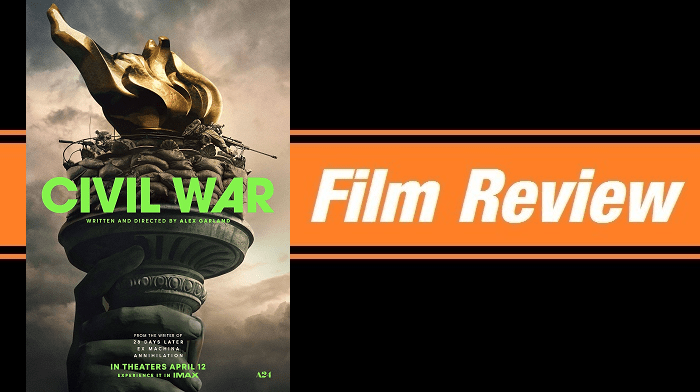
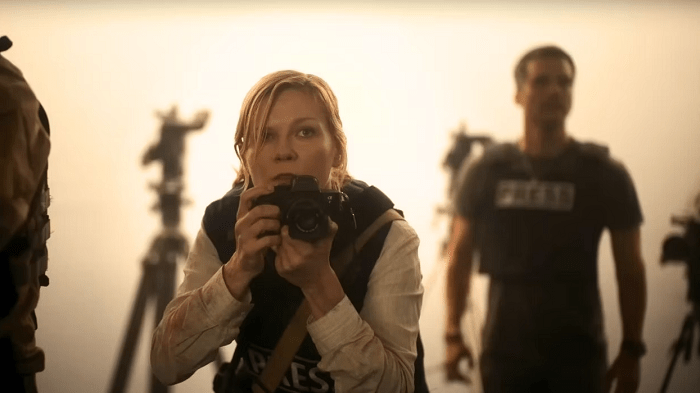
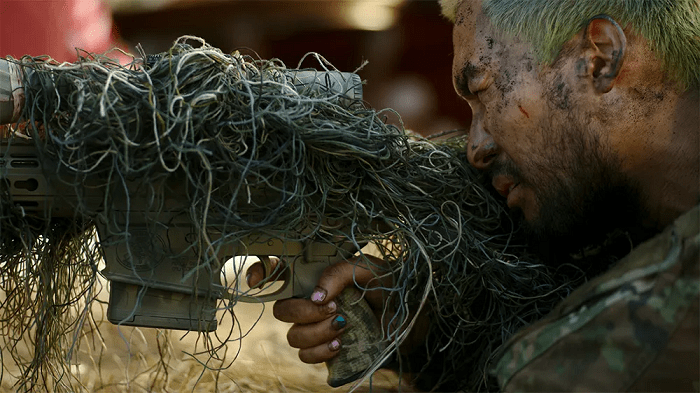
Alex Garland has always been a captivating filmmaking whether solely as a screenwriter (“28 Days Later”, “Never Let Me Go”) or as a writer-director (“Ex Machina, “Annihilation”). His last film, “Men” was a letdown. But despite being called a “companion piece” to that previous work, the new trailer for his latest, “Civil War” looks like a possible return to form. It will all depend on where he goes with this potentially fascinating story.

Set in a near-future America, “Civil War” takes place in the United States as it sits on the precipice of a second civil war. The trailer tosses out clues to the political turmoil that has seen states succeed, new militaries form, and countrymen taking arms against fellow countrymen. The movie has a chance to speak powerfully to the bitter division that has engulfed our nation. It could also go off the rails if it becomes a political bludgeoning tool. I’m interested to see where it goes.

“Civil War” releases on April 26th, 2024 via A24. Check out the trailer below and let me know if you’ll be seeing it or taking a pass.

REVIEW: “Anatomy of a Fall” (2023)

Justine Triet’s scintillating French feature “Anatomy of a Fall” was the big winner at this year’s Cannes Film Festival, taking home the coveted Palm d’Or along with the praise of most critics. Picked up by NEON for distribution, the film is on its way to a wider audience who will get to experience what is one of the most riveting courtroom dramas of recent years.

But narrowing Triet’s film down to the courtroom would be a gross disservice. There’s so much more packed into this lengthy but compelling feature. It’s also a well-crafted crime mystery. It’s an insightful analysis of a broken marriage. And it takes a look at a touching yet complex mother-son relationship. There is a lot to unpack along the way. And there’s enough ambiguity throughout to have you second guessing much of what you see. But that’s a testament to Triet’s craftiness and a big part of what makes the film work.

Image Courtesy of NEON

In what is one of the year’s best performances, Sandra Hüller plays Sandra Voyter, a translator living with her novelist husband Samuel (Samuel Theis) and their 11-year-old visually impaired son Daniel (Milo Machado-Graner). The family lives in a cozy mountain chalet at the base of the French Alps. This gorgeous scenic setting will soon become the site of tragic accident, the scene of a crime, or perhaps something else entirely. Trier and production designer Emmanuelle Duplay get us well acquainted with the location – a place under great scrutiny for the first half of the film.

One sunny day Daniel takes his guide dog out for a walk. Upon arriving back home he discovers his father laying in the snow, dead from an apparent fall from the house’s third-floor attic window. Sandra rushes outside after hearing her son’s cries and soon the police are on the scene to begin their investigation. A deep head wound immediately raises suspicions and Sandra finds herself as the chief suspect. Before long she’s officially indicted.

Sandra seeks the help of a savvy lawyer friend named Vincent (Swann Arlaud) who takes her case and begins building her defense. Sandra is adamant that her husband fell. “Yea but nobody’s going to believe that”, Vincent bluntly professes. “I don’t believe that.” The inconclusive autopsy results don’t help. From there new details arise and new evidence comes to light. Fresh revelations prompt an array of new questions about the family and their relationships.

Image Courtesy of NEON

Of the film’s many strengths, perhaps tops on the list is Triet’s extraordinary screenplay. It’s highlighted by her handling of characters, by the depth of her story, and by some of the most engrossing dialogue you’ll come across this year. This comes out most in the courtroom scenes where old baggage is spilled out and shallowly buried secrets are unearthed. Together with Hüller’s superbly calibrated performance, Triet shows small cracks in Sandra’s veneer as her entire life is laid bare by the prosecution. But she holds it together, leaving us with even more uncertainty.

“Anatomy of a Fall” can be a bit cold at times yet it’s not without an emotional current. And while it will never lose your attention, it probably didn’t need to be two-and-a-half hours long. But those are minor beefs especially when considering what Triet has achieved. She has put together a smart and sophisticated story, brought to life through her precise and confident direction. It’s pretty easy to see why it has received so much praise from Cannes and beyond.

VERDICT – 4 STARS