REVIEW: “Triangle of Sadness” (2022)

The rich and pampered have become a favorite punching bag of filmmakers and studios (it’s hard to miss the baked-in irony of that statement). It makes sense considering the snobbish upper crust elites routinely give us new things to scrutinize and satirize. So you could call them an easy but deserving target. The latest film to take a big swing at the wealthy and privileged is Swedish director Ruben Östlund’s “Triangle of Sadness”.

This satirical black comedy surprised a lot of people by winning the Palme d’Or at this year’s Cannes Film Festival. Early critics scores revealed a more mixed reaction, and understandably so. “Triangle of Sadness” is a peculiar movie – one whose blistering intentions are so clear from scene to scene that there’s no room whatsoever for subtlety or nuance. In fact, its heavy-handedness is so pronounced it drags the movie down on a few occasions. Yet there are other times when the Östlund’s bluntness feels like part of the joke.

Perhaps the most surprising (and perplexing) thing about “Triangle of Sadness” is in seeing how much more Östlund enjoys poking fun at the one-percenters and relishing in their suffering than saying anything new and insightful about them. Yes, there are some pointed cuts at the systems that provided and sustains their wealth, and we get some obvious commentary on class disparities and skewed power dynamics. But this is mostly a all-out basting and humiliation of the rich and powerful.

Image Courtesy of Amazon

But don’t get me wrong, part of the mad genius of Östlund’s batty concoction is in how he takes everything I said above and makes it into something so thoroughly entertaining. “Triangle of Sadness” is a blast, firing off a number of good laughs through both its overt directness and its unbridled absurdity. Östlund’s irreverent style is tailor-made for such a scourging. And though there’s nothing revelatory in his portrayal of the uber-wealthy, he exaggerates his perception in such a way that we’re always given something to chew on.

The closest we get to protagonists are Carl (Harris Dickinson) and Yaya (Charlbi Dean). They’re a young couple in the literal sense, but it’s hard to tell if their relationship is built on true affection or social clout. Carl is your prototypical male model and makes most of his money with his shirt off. Yaya is a social media influencer whose success is based more on followers than revenue. Both live off of their good looks, but it’s hardly a lucrative business. Yet they happily live above their means, in large part thanks to the freebies Yaya gets from companies hungry for free advertising.

One such freebie is a luxury cruise on a $250 million yacht. Carl and Yaya join an assemblage of obscenely rich high-society types that includes a Russian fertilizer magnate (Zlatko Burić) and his self-deluded wife (Sunnyi Melles), an elderly British couple (Oliver Ford Davies, Amanda Walker) who made their fortune on hand grenades, a disabled German woman (Iris Berben) who continually shouts “In Den Wolken” (which means “in the clouds”), and a forlorn mobile app creator (Henrik Dorsin) among others.

The very makeup of the ship could be a reflection of class structures around the world. The privileged out-of-touch cruisers soak up the amenities of the lavish upper deck where mostly white servers pamper them in anticipation of huge tips. Meanwhile the predominantly non-white service members stay in cramped cabins below. They’re considered part of the service crew, but not allowed to be seen topside. Like many things, it isn’t the slightest bit subtle, but nor is it trying to be.

Image Courtesy of Neon

While the first half focuses on the privilege the rich enjoy, the second half explores what happens when they have it taken away. But connecting those two halves is what’s sure to be considered the film’s signature scene – a posh Captain’s Dinner that goes horribly wrong. Let’s just say it involves spewing vomit, overflowing toilets, turbulent seas, and the ship’s stone-drunk captain (a hysterical Woody Harrelson). It sends the story careening into its third act as a select number from the boat find themselves stranded on a deserted island. Once there, class status is tossed, gender roles are reversed, weaknesses are exposed. But being good-looking still has its benefits.

Unfortunately Östlund doesn’t see his story through to the end. Instead he takes an easy out, giving us an ambiguous ending that doesn’t offer any real conclusion. It’s the old “you determine for yourself” finish which often works nicely. But in a movie like this, where everything is so straightforward and Östlund is basically shooting fish in a barrel, it really needs to end with a punch.

Still, Östlund gives us plenty to absorb as he runs his filthy rich subjects through the wringer. Some scenes are savagely funny while others are simply savage. More importantly, we’re always engaged. And his satire, though glaringly blunt and without an ounce of subtlety, has bite. “Triangle” is a wild and wildly original film, and it’s hard not to be drawn to it, flaws and all. And though Östlund may whiff on a few of his crazy swings, most of them connect with bludgeoning force. So much so that we may feel a little guilty about laughing at these people’s suffering. Not much, but maybe a little. “Triangle of Sadness” is now showing in select theaters.

VERDICT – 4 STARS

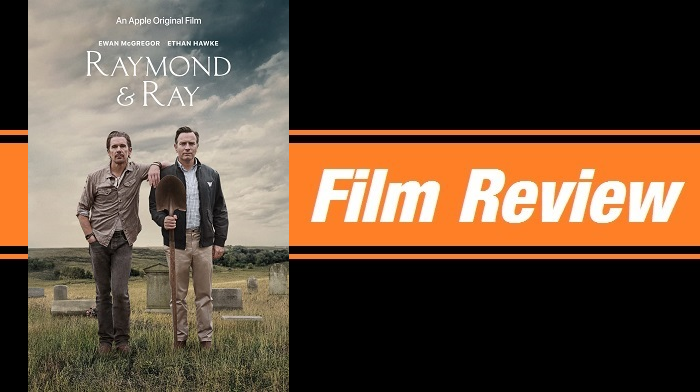
REVIEW: “Raymond & Ray” (2022)

Two of my favorite working actors teaming up in an off-beat family dramedy? That’s too much for me to pass up on. And wouldn’t you know it, “Raymond & Ray” turns out to be right up my alley. It’s the kind of slice-of-life movie I’m often drawn to. It doesn’t strive to be innovative, nor does it pretend to be something momentous. It’s a simple and grounded look at the human condition through the experiences of two well-rooted characters. It’s tight in scope and honest with its emotions, but it also finds time for levity which is welcomed considering death is a key component.

Written and directed by Rodrigo García, “Raymond and Ray” features a story that’s a bit warped and even a little zany. Yet it always has its feet planted in reality. It follows two half-brothers. Both are very different people who have lived very different lives. Yet they do have one thing in common – they both detest their father. And that shared hatred has only driven them apart. Not because of any disdain for each other (they were actually inseparable as kids). But because being together only brings back the memories of the neglect and abuse they experienced.

Image Courtesy of Apple TV+

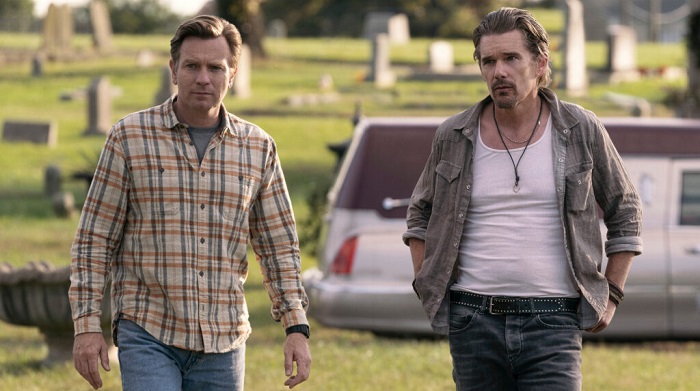
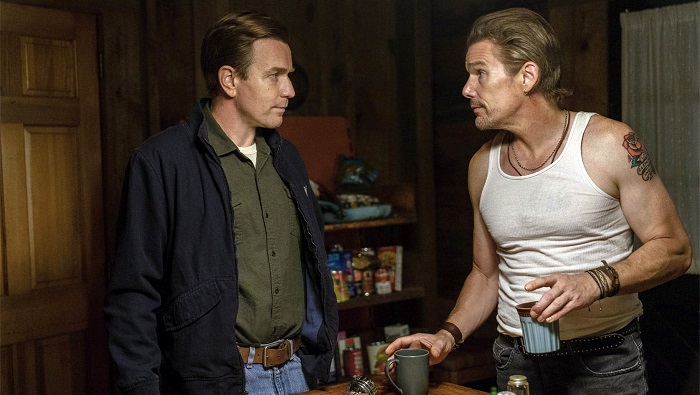
Ewan McGregor plays Raymond, an straight-laced stiff with two divorces behind him who’s now separated from his third wife. Ethan Hawke plays Ray, a recovering heroin addict who once aspired to be a trumpet player but gave it (and everything else) up after his wife died of cancer. Both are damaged people whose lives never panned out they way they hoped. And they sought answers in places that only led to more problems.

The movie opens with Raymond arriving at Ray’s house to inform him that their father has died. It’s the first time the two have seen each other in years and even longer since either had seen their estranged father. Ray isn’t especially moved by the news, but he is surprised to learn that their father’s dying wish was that his sons attend his funeral. Ray says to brush it off. After all, the old man’s dead; he won’t know. But Raymond wants them to go (plus he recently lost his drivers license after a DWI so he needs a ride). Ray reluctantly agrees, and the two load up and make a trip to Richmond.

After arriving, Raymond and Ray discover that their late father’s last wishes didn’t end at attending his funeral. He also left word that his boys were to dig his grave and cover it up (their father was able to get the cemetery’s consent through a bogus religious freedom request – a funny gag that pops up several times). While Raymond sees it as their duty, Ray quickly begins to lose patience. Was this really a heartfelt wish of their dead dad or was he heartlessly screwing with them from beyond the grave?

Image Courtesy of Apple TV+

From the very start, the story structure of “Raymond & Ray” is pretty obvious. There will be plenty of revelations along the way, both for the two half-brothers and the audience. These reveals come through their father’s various acquaintances who describe a much different man than Raymond and Ray experienced. Among them are their father’s attorney (Oscar Nunez), his former lover (Maribel Verdú), his pastor (Vondie Curtis-Hall), and his nurse (Sophie Okonedo). Raymond and Ray begin to discover who their father became in recent years. But it doesn’t erase who he was in the past, and those old wounds prove to be deep and painful.

While Garcia gives us plenty of great character moments and some genuinely good laughs, the story doesn’t fully stick its ending. Obviously I won’t spoil it, but let’s just say one lead character ends in a more believable place than the other. But for the most part, “Raymond & Ray” has all the heart and quirkiness it needs to work well as a dysfunctional family drama and a subtle black comedy. And it doesn’t hurt to have talent the caliber of McGregor and Hawke, two savvy seasoned actors who keep this oddball tale on a human level. “Raymond & Ray” premieres October 21st on Apple TV+.

VERDICT – 3.5 STARS

First Glance: “Creed III”

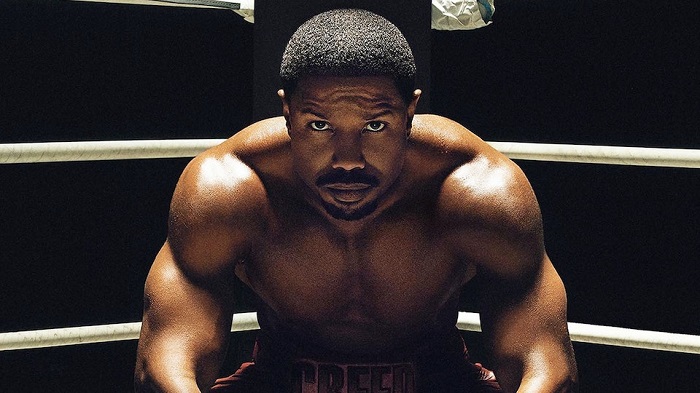
Few movies have surprised me more than “Creed” and “Creed II”. The very idea of jump-starting the “Rocky” franchise by focusing on the son of Apollo Creed seemed like a stretch. As it turned out, Ryan Coogler, Michael B. Jordan, and Sylvester Stallone had a great story to tell, and they followed it up with an exceptional sequel (Stallone was robbed of a Best Supporting Actor Oscar). Now the third chapter is on the way with Jordan not just starring, but making his feature directorial debut.

The first trailer has dropped giving us a good taste of what we can expect. This time around Adonis Creed (Jordan) finds himself on a collision course with Damian Anderson (Jonathan Majors), a close friend from his past who’s fresh out of prison following an 18 year sentence. While the two were once like brothers, Damien clearly has animosity towards his old friend and he intends to settle things in the ring. “I’m coming for everything”, Majors utters with a confident snarl. Gratuitous body-flexing aside, the trailer captures the same spirit as the previous two films. I’m all in.

REVIEW: “The Road Dance” (2022)

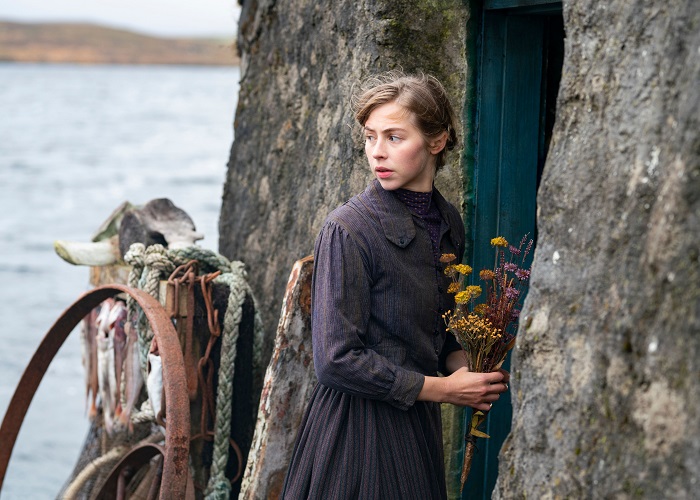
Sexual assault, trauma, war, small town oppression – just some of the weighty themes woven into the very fabric of “The Road Dance”, a handsomely shot old-fashioned melodrama from writer-director Richie Adams. Based on the 2004 novel of the same name by John MacKay, “The Road Dance” handles its sensitive issues with the right amount of empathy and thoughtfulness. And though a touch soapy in spots, even those scenes are elevated by an eye-opening lead performance from Hermione Corfield.

Based on actual true events, the story is set in a small, tight-knit community in the Scottish Outer Hebrides. Kirsty McLeod (Corfield) has long been a dreamer, ever since the days of sitting on the beach with her late father, listening to him talk about the world beyond their shores. And while her father may be gone, she still dreams of more than planting potatoes on the same land farmed by her parents. She wants bigger things. She wants to go to America. But it’s a dream that seems so far out of reach.

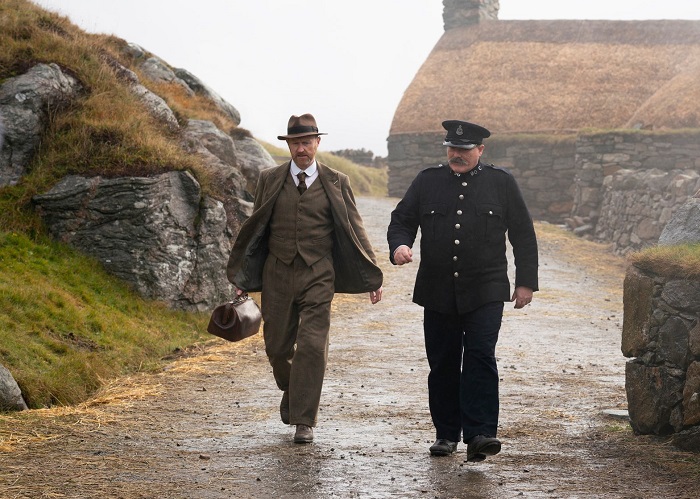
As the outside world braces for the First World War, Kirsty lives in a tiny remote village with her hard-working mother, Mairi (Morven Christie) and her younger sister, Annie (Ali Fumiko Whitney). It’s an exquisitely realized setting, from the stone houses with grass covered rooftops to the collection of folks who make up the community. You have their priest, their constable, their doctor, and even an odd hermit named Skipper. They all bring such authenticity and character to the film.

Also among the locals is the well-mannered, book-loving Murdo (Will Fletcher) who returns to the village after a tour with the British military. He immediately takes a liking to Kirsty, and the two soon fall in love. But before they can begin their future together, Murdo and three other young men from the village are called to England where they’re to be sent to the Western Front. On the night before the four boys are sent off to war, the village honors them with a ‘road dance’. But for Kirsty, the already sad occasion takes a darker turn after she’s the victim of a horrific crime.

From there the bulk of the film deals with the aftermath, in one part playing like a mystery to uncover Kirsty’s assailant. But the more potent aspect of the story follows a young woman forced to hide her trauma from a small town’s judgement. It’s here that Adams does an especially good job peeling back the many complicated layers, revealing the idyllic storybook setting to be anything but. And it’s in the film’s second half that the intensely committed and throughly engaging Corfield shines brightest. She does most of the film’s heavy lifting, earning our empathy through her honesty and vulnerability.

The movie does feel a little hammy at times (a fault of the screenplay, more so than the acting), and some of the early proclamations of love aren’t particularly convincing. I’m also not sure about the abruptness of the final scene. But there’s an overall sincerity to the storytelling that makes “The Road Dance” more than a standard-issue weepie. And as the drama unfolds to the ruggedly gorgeous backdrop, it’s hard not be swept away. But we’re always brought back to earth, in large part thanks to the revelatory lead work from Hermione Corfield – a star in the making.

VERDICT – 3.5 STARS

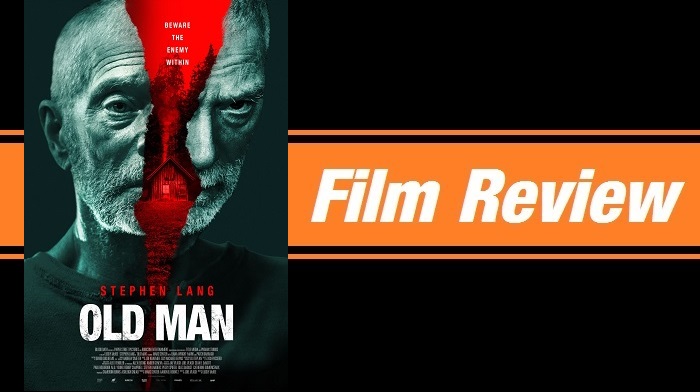
REVIEW: “Old Man” (2022)

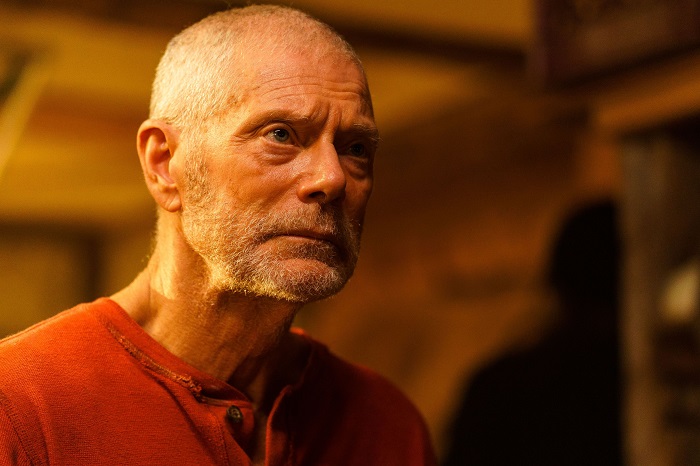
Stephen Lang plays a character simply credited as Old Man in the fittingly titled new psychological horror-ish thriller “Old Man”. Now for the sake of clarity, this isn’t the same old man he plays in the two “Don’t Breathe” movies although certain similarities are impossible to miss. Instead, here he plays an old man living in seclusion somewhere deep in the wilds of the Smokey Mountains.

“Old Man” is a wily two-hander led by Lang and Marc Senter. Directed by Lucky McKee from a script by Joel Veach, the movie does a nice job sucking you into its crude, one-location setting. At least for a while. Unfortunately it begins to lose its grip around the halfway mark, struggling to maintain the tension it builds so well early on. But Lang and Senter keep it afloat. They’re nice fits for Veach’s off-kilter story, and McKee smartly leans on his two actors and their weird yet fascinating chemistry.

Courtesy of RLJE films

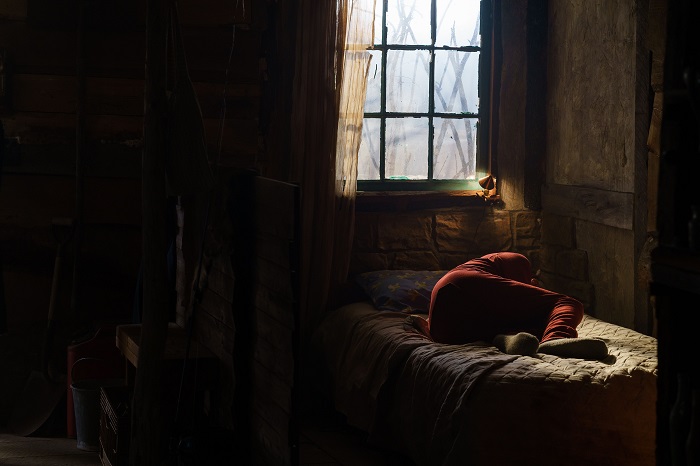
Its no-frills setup begins with the camera panning around and snaking through a rustic wood cabin, stopping on an old man (Lang) in red longjohns asleep on a bed. He suddenly snaps awake as if jolted from a nightmare. He gathers himself (sort of) and gets up, his bones creaking as much as the tired bed springs and planked flooring. He starts rambling incoherently, calling for his dog Rascal who has apparently run off. “Nobody leaves me”, he grumbles with a tinge of anger in his voice.

Suddenly there’s a knock on his door. Startled, the old man grabs his double-barrel shotgun and opens it to find a polite yet nervous young man named Joe (Senter). The old man pulls him inside, sticking his gun to the terrified young man’s throat. What’s this guy doing at his cabin in the middle of nowhere? “My wife, she didn’t send you out here, did she?”, asks the suspicious old-timer, hinting at a backstory which will come more into focus a bit later.

Courtesy of RLJE films

Joe explains he got lost in the woods. He saw the smoke from the old man’s chimney so he came to the cabin for help. Should the old man believe his uninvited guest’s story? Should Joe be scared of the old man with gun? Nearly the entire movie is spent sorting these questions out as the unhinged codger and his jittery visitor simply talk – tense and genuinely frightening at first; deeper and more personal later. Yet we know from the start that things aren’t as they seem. It comes down to patiently waiting for McKee to reveal his hand.

As for that reveal, it’s fine. Nothing as twisted and gnarly as I hoped for (the film would had benefited from a final act burst of gonzo nuttiness). Instead it goes in another direction, adding a twist that’s reasonably clever but that won’t blow anyone’s socks off. Still, “Old Man” squeezes a lot out of its meager budget and single setting. And there are stretches where you’re so absorbed in the dialogue and the two central performances that the film’s constraints all but vanish. And while it sputters in the second half, it keeps your attention throughout – a testament to the talent both in front of and behind the camera. “Old Man” is out now in select theaters.

VERDICT – 2.5 STARS

REVIEW: “Halloween Ends” (2022)

The end of Michael Myers and the “Halloween” franchise? Oh we’ve heard that before. Perhaps not as blatantly as the pointedly titled “Halloween Ends”, but it feels like we’ve been down this road before. I mean who actually believes that if this latest installment makes good money at the box office and has a high streaming rate on Peacock that we won’t eventually see the pale-masked slasher icon return to butcher a fresh new batch of Haddonfield fodder?

One thing that does seem to be coming to an end is Jamie Lee Curtis’ run with the franchise. This will be the seventh appearance in a “Halloween” film for the beloved scream queen, and going into it you get the sense that the 63-year-old Curtis is ready to step away. That alone makes “Halloween Ends” significant. It’s too bad she isn’t given a better movie to end with. Both she and her character, Laurie Strode deserve better.

Let’s not beat around the bush, “Halloween Ends” is a baffling misfire. It’s a movie plagued by bizarre choices and hampered by vain attempts at subverting our expectations. The movie should have been a slamdunk. Laurie Strode, Michael Myers, one final showdown. That’s an easy recipe for success. Perhaps not the most original idea, but it’s exactly what fans have been waiting and watching for. It’s what this trilogy has been building towards. But that seems like an afterthought for director David Gordon Greene and his trio of co-screenwriters.

Image Courtesy of Universal Studios

Rather than honing in on the two characters who were supposed to be the trilogy’s centerpiece, “Halloween Ends” goes an entirely different route, back-burnering Laurie and especially Michael in order to introduce a new (and uninteresting) angle revolving around a new (and uninteresting) character. Laurie is wedged in here and there, and other than a fleeting glance, we don’t see Michael at all for the first hour. It’s hard to imagine how this looked good on paper. It certainly didn’t turn out good on the screen.

The movie begins with a night of babysitting that goes terribly wrong. Corey Cunningham (Rohan Campbell) is a kind-hearted 21-year-old Haddonfield boy who agrees to babysit a young brat on Halloween night so the parents can go to a costume party. But when a terrible accident leads to the kid’s death, Corey is charged with aggravated manslaughter and becomes pariah to the locals.

Jump ahead a couple of years where Laurie Strode (Curtis) is working hard to assimilate into the Haddonfield community. “It has been four years since I last saw my monster,” she notes. In that time, she has bought a house in the middle of town where she lives with her granddaughter Allyson (Andi Matichak). She spends her time burning pies in the oven, flirting with Deputy Frank Hawkins (Will Patton) in the grocery store, and writing her memoir. Allyson works at the Haddonfield hospital and has taken a liking to Corey. He’s ridiculed by many of the townsfolk who call him “murderer” and “psycho”. But Allyson sees him as a kindred spirit – someone besides her who understands trauma and its effects.

Image Courtesy of Universal Pictures

I won’t pound out or spoil the details. But the movie misguidedly latches onto Corey and makes his story its centerpiece. He and Allyson grow closer, but the bullying and abuse from the citizens of Haddonfield, especially four entitled high school seniors, begin to take its toll. While all of that is playing out, Laurie gets lost in the background, pondering whether she likes Allyson dating Corey. Meanwhile a wearied and worn Michael Myers lives in a sewer drain waiting for the filmmakers to finally let him off his chain. Sadly they never really do. Michael ends up restricted to being a secondary character. Little about him makes sense in the film, and his lone big moment comes at the end, and feels tacked on rather than meaningful.

In once sense, it’s interesting to see David Gordon Green take some wild swings. And there are plenty of big ideas that might have been interesting if given room to develop. But at times it seems like Green forgets he’s making a “Halloween” movie, much less the final installment in a trilogy and a significant movie for the franchise. Making it worse, characters often act impulsively, and some of their motivations are woefully underdeveloped. And when the kills finally come, only a couple feel remotely memorable.

So what to do with “Halloween Ends”? Do we applaud it for going for something new or deride it for throwing out everything we expected (and was advertised)? Perhaps I could overlook some things if the new direction was compelling and didn’t feel pulled out of a hat. Perhaps I could get onboard if central characters still didn’t get pushed to the side. Perhaps it would be easier to digest if there weren’t so many nagging issues with the storytelling. As it is, “Halloween Ends” feels like a hodgepodge of ideas, some of them good (Haddonfield as a villain, society creating its monsters, the nature of evil, etc), but too many aren’t. Sometimes it’s best just to keep things simple. I wish this movie had. “Halloween Ends” is out now in theaters and streaming on Peacock.

VERDICT – 1.5 STARS