REVIEW: “Firestarter” (2022)

One of the first “grownup” novels I recall reading was Stephen King’s “Firestarter”. It first published in September 1980, but my exposure to it came a few years later. I’m guessing it was around the time of the 1984 movie adaptation starring Drew Barrymore. I was just a kid and remember finding a tattered paperback copy of King’s book based on the movie featuring “that girl from E.T.”. I immediately dove in, and while it took my younger self a while to finish, I was pretty proud when I turned that final page.

I wouldn’t see the movie adaptation for another couple of years or so, and I haven’t revisited it since. Pretty much all I remember is the wind blowing Barrymore’s hair whenever she would use her power and Heather Locklear (I was an 80s kid, what can I say). A better critic probably would have done his homework and rewatched “Firestarter” 1984 before reviewing the new Blumhouse produced reboot. But don’t worry, no knowledge of the original is needed for this pointless and lifeless update. It stands and stinks on its own.

“Firestarter” is directed by Keith Thomas whose last feature was the excellent supernatural horror film “The Vigil”. It’s written by Scott Teems who wrote and directed 2009’s terrific “That Evening Sun” and 2020’s underseen “The Quarry”. But he also penned last year’s “Halloween Kills”, a mediocre horror film that’s biggest issues lied with the script. There was enough filmmaking history between both for optimism. But when the studio announced they were holding press screeners until the day of the movie’s release, well that’s generally a bad sign.

Image Courtesy of Universal Pictures

As it turns out, “Firestarter” does little to justify a reboot. It’s a flat, unoriginal, and surprisingly fright-free film that doesn’t showcase the filmakers’ past successes in any way. It’s a shame because the premise from King’s book is loaded with potential as a horror movie, an action thriller, and even a family drama. But while it dabbles in all of those things, this 2022 reimagining doesn’t do any of them well. And we’re left with a story that flatlines early and is never able to recover.

The story revolves around 11-year-old Charlie (Ryan Kiera Armstrong) who has possessed pyrokinetic powers since birth. The “bad thing”, as her parents Andy (Zac Efron) and Vicky (Sydney Lemmon) call it, has mostly laid dormant. But lately it has been flaring back up, especially at school where Charlie is frequently bullied. Vicky wants to train their daughter to control her powers. Andy wants Charlie to keep it buried out of fear of what the film’s bad guys might do if they get a hold of her.

We learn that both Andy and Vicky have special powers of their own. Vicky has a form of telekinesis which she has kept suppressed for years. Andy is a $100-a-session cash-only life coach who uses his mind-powers to help people kick their cigarette habits. Both have built the closest thing to a normal life for Charlie while staying off the government’s radar. But after an incident at school reveals Charlie’s fiery powers, the film’s baddies set out to apprehend her.

That may sound interesting, but don’t expect much depth, especially when it comes to the movie’s villain(s), a secret government outfit called The Shop. They operate under the cover of some company called DSI and are ran by the recently promoted Captain Hollister (Gloria Reuben). She’s supposed to be devious and cold-hearted, but she’s a bland and toothless chief antagonist whose motives are paper-thin. Hollister claims she wants to capture Charlie in order to help her. In reality her intentions are far more sinister. Unfortunately the movie never feels the urge to let us in on those intentions. Basically she wants to use Charlie’s powers for the government and that’s supposed to be enough for us.

Image Courtesy of Universal Pictures

Lack of information turns out to be a reoccurring problem. The movie never tells us much of anything. In fact, we get more pertinent information in the opening credits than we do for the rest of the movie. There are a couple of exposition drops, one featuring Hollister visiting Dr. Joseph Wanless (Kurtwood Smith), one of the original scientists with The Shop and the inventor of a serum that imbued subjects with special powers. Hollister wants the good doctor to come back now that they’ve located Charlie. But he realizes Charlie’s power is in its infancy and that her capabilities will only intensify. He knows he made a mistake with the serum, but how he came to that realization, who knows.

The lone interesting character in the film is a mysterious mercenary named John Rainbird (a chilling Michael Greyeyes). He’s reluctantly reactivated by Hollister to hunt down Charlie for The Shop. The movie teases a compelling backstory for Rainbird, but (like so much else) it’s mostly left off screen. It’s an omission that really hurts the film’s ending which desperately tries to interest us in a sequel (something Thomas has expressed interest in).

Aside from Greyeyes, the only other noteworthy thing is the cool retro synth-heavy score from John Carpenter, Cody Carpenter, and Daniel Davies. Otherwise “Firestarter” stays dull and flavorless, dryly moving from one point to the next, checking off boxes in the story and offering nothing is terms of frights, surprises, or suspense. So we spend most of the time waiting for the movie to kick into gear, which unfortunately it never does. “Firestarter” is now showing in theaters and streaming on Peacock.

VERDICT – 1.5 STARS

REVIEW: “The Innocents” (2022)

CLICK HERE for my full review in the Arkansas Democrat-Gazette

Fresh off his Best Screenplay Oscar nomination for “The Worst Person in the World”, Norwegian filmmaker Eskil Vogt goes in a much different direction with his new movie “The Innocents”. This subtle yet relentlessly eerie supernatural thriller first premiered at Cannes in 2021. Now it’s set for its release this weekend and I promise you, this one will rattle you in ways you won’t be expecting.

Vogt uses a richly detailed but thoroughly unsettling vision to explore the notion of childhood innocence and burgeoning moral conscience. While he handles the subjects with a great deal of restraint, Vogt also manages to shake us to our core. Part of it is due to his ability to infuse a near unbearable level of dread into certain sequences. He’s also not afraid to shock his audience, using violence in a way reminiscent of Michael Haneke. Not simply for the sake of doing it, but with a precise intention in mind. It gives his movie a real bite.

Pretty much the entire story takes place in and around a large Norwegian apartment complex. Our avatar is nine-year-old Ida who’s played by the incredibly expressive Rakel Lenora Fløttum. Ida has just moved to the apartments with her parents (Ellen Dorrit Pedersen and Morten Svartveit) and her autistic older sister Anna (Alva Brynsmo Ramstad). Vogt builds a compelling family dynamic centered around Ida’s relationship with the mostly nonverbal Anna. Jealous of all the attention her sister requires from their parents, a resentful Ida will often pinch Anna when no one’s looking and sometimes does much worse.

Image Courtesy of IFC Midnight

While Ida’s cruelty is troubling, Vogt doesn’t cast her in a one-dimensional light. There’s more to her character and it really begins to come out once she makes two new friends, a troubled boy named Ben (Sam Ashraf) and the kindhearted Aisha (Mina Yasmin Bremseth Asheim). The two come from significantly different single-parent homes. Aisha’s mother (Kadra Yusuf) loves her dearly but struggles financially to make ends meet. Ben’s mom (Lisa Tønne) is abusive and neglectful, often leaving her young son to fend for himself.

The supernatural element is introduced after Ben reveals his telekinetic powers to Ida. It starts innocently enough with him snapping twigs and flinging pebbles with his mind. Neither seem shocked by his power. Both treat it with the same childlike amusement as they do Ida’s double-jointed elbow trick. They laugh it off the way kids often do with any cool little discovery. But some of their other antics go beyond simple kiddie mischief, and reveal a darker side to Ben that even Ida finds unsettling.

Aisha adds another variable to the story. Along with being sweet and compassionate, she also possesses psychic abilities that allow her to speak with people via their minds. It’s through Aisha that we learn Anna also has untapped supernatural powers of her own. I won’t spoil where things eventually go, but the interactions between the four children fester into something disturbing and deadly. And while the main story turns chilling and occasionally brutal, a powerful subtext examining class and minority status simmers under the film’s surface. It’s something that could’ve been explored deeper, but at the same time it’s there and relevant.

Image Courtesy of IFC Midnight

There are several interesting storytelling choices that are surprisingly effective. For example, we get no lengthy backstory explaining how these children acquired their powers or how widespread the phenomenon may be. It’s sounds like a significant omission, but by keeping us captive in their small confined world, such detail isn’t needed. Also, you may wonder about the adults. They’re present but they mostly exist on the periphery. They nicely serve the young characters, and their influences (both good and bad) can be felt in their children.

I also like how Vogt uses several clever methods to keep us always seeing things from the children’s perspective. One of my favorites is his visual approach. DP Sturla Brandth Grøvlen’s camera often puts an emphasis on the height of the children’s surroundings. Shots of the massive high-rise apartment building, the near bottomless stairwell in their complex, the towering trees in the nearby forest where they play – they all contribute to capturing the world the way these four young people see it. It may sound like a small detail, but it’s an artistic touch that proves impactful.

Led by four outstanding child performances and an unflinching vision from writer-director Eskil Vogt, “The Innocents” uses elements from the horror genre to challenge the traditional way we often depict childhood, both in the movies and in reality. It can be hard to watch (take heed cat lovers), and its patient and unvarnished style may let down those looking for a more conventional genre film. But that’s a key thing I loved about it. Vogt’s clear-eyed treatment allows him to focus on what matters most – his characters. And it’s their stories, as tragic and as uneasy as they may be, that makes this a hard movie to shake. “The Innocents” opens today in select theaters and on VOD.

VERDICT – 4 STARS

First Glance: “Avatar: The Way of Water” Teaser

It has been 13 years since James Cameron’s “Avatar” hit theaters, shattering box office records and ushering in a 3-D craze that (thankfully) has died off. The story of “Avatar” was essentially an overly preachy “Dances with Wolves” rip-off. But technically the movie was an eye-popping wonder and unlike anything moviegoers had ever seen. And it utilized 3-D in a way that no other movie after it could ever do.

Following numerous delays, many were wondering if the rumored “Avatar” sequel would ever see the light of day. Well, it most certainly is and we actually have the first teaser. There’s not much there in terms of story. We do know it’s set a decade after the first film and it revolves around Jake (Sam Worthington) and Neytiri (Zoe Saldana) protecting their family from a new evil on Pandora. But this teaser is all about the visuals and it looks stunning. You could say it looks more like a PC graphics card demo than an actual movie. But I’m sure we’ll see more soon.

“Avatar: The Way of Water” hits theaters December 16th. Check out the trailer below and let me know if you’ll be seeing it or taking a pass.

RETRO REVIEW: “Thelma & Louise”

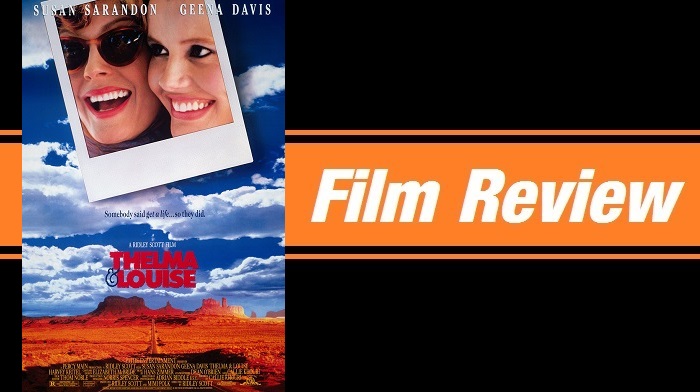
Ridley Scott’s acclaimed road-trip crime movie “Thelma & Louise” came out 31 years ago this month. And after watching it again for the first time in well over a decade, I was blown away by how well it still holds up. With its strong female-driven story, “Thelma & Louise” still resonates today. And while it’s characterization of men can still be over-the-top to the point of cartoonish, that’s kinda the point in a movie about women taking charge of their own fate in such a male-dominated society.

“Thelma & Louise” came out on March 24, 1991 and was a hit both critically and commercially. It would go on to earn six Academy Award nominations including two Best Actress nods for its stars, Susan Sarandon and Geena Davis. Ridley Scott was also nominated for directing. The movie’s lone Oscar win was for its screenplay written by Callie Khouri. It was Khouri’s first feature film script. What a way to make a splash.

“Thelma & Louise” was followed by some controversy at the time. It faced several accusations from those calling the movie “anti-male” for its depictions of men. But again, the movie is a parable with a very important point to make. And focusing on the movie’s sometimes exaggerated portrayal of men instead of the message being conveyed is doing it a disservice. And it’s not like every single male presence in the film is decidedly negative. I like what Khouri said in response to the controversy, “If you think it’s anti-male, you’re identifying with the wrong character.”

The story centers around two best friends from Arkansas stuck in their dreary mundane lives. Louise (Susan Sarandon) is a waitress who’s tired waiting for her on-again, off-again boyfriend Jimmy (Michael Madsen) to commit. Thelma (Geena Davis) is a housewife married to a slimeball car salesman named Darryl (a hilariously despicable Christopher McDonald). Louise has planned a weekend fishing trip just for the two friends, but Thelma is scared to bring it up to her self-obsessed husband. After yet another Darryl tantrum, Thelma decides she doesn’t need his permission. She leaves him a note next to his TV dinner and calls Louise.

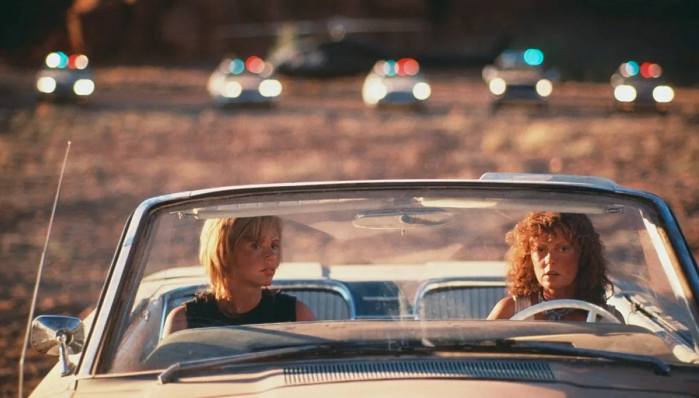
The two pack their bags and head out in Louise’s 1966 Thunderbird convertible for a road-trip that will change their lives. It begins when they stop to stretch their legs at a roadside honky-tonk where Thelma catches the eye of the overly flirty Harlan (Timothy Carhart). But what starts as a few drinks and some dancing ends up with Harlan beating and attempting to rape Thelma in the parking lot. Louise finds them and shoots Harlan dead with a pistol Thelma swiped from Darryl’s bedside drawer.

Thelma wants to go directly to the police, but the cynical Louise (for reasons that become clearer later in the movie) doesn’t think the cops will believe them, especially since the entire club saw Thelma and Harlan all over each other on the dance floor. So they go on the run, driving into Oklahoma and plotting a route to Mexico that doesn’t include Texas. Why not Texas you ask? That too becomes clearer as the story progresses.

A good on-the-lam movie needs a good pursuer and “Thelma & Louise” has one in Harvey Keitel. He plays Hal Slocumb, an Arkansas State Police detective with a heart. He’s genuinely concerned about Thelma and Louise and does his best to find them and bring them in before things get out of hand. Keitel has such a natural charisma and he’s such a nice fit here.

And of course there’s Brad Pitt in the supporting role that put him on the map. He plays a gentlemanly and good-looking young cowboy named J.D. who hitches a ride with Thelma and Louise as they’re crossing Oklahoma. It’s not a particularly great performance, but I don’t think it’s the performance that earned him the most attention (if you get what I mean).

Still, without question the stars are Sarandon and Davis. Flipping gender roles for a road-trip buddy movie was certainly significant. But this isn’t simply a case of two women simply mimicking what men have done in similar movies. Sarandon and Davis make for a spirited duo and they bring personality, grit, and humor their roles. And they really get to have fun once the second half kicks in. “We’re fugitives now. Let’s start behaving like that.”

While there is a real weight to the story itself, the two leads, Khouri’s straight-shooting script, and Ridley Scott’s stellar direction gives it room to be funny, warm, and even a little crazy. Some of the male caricatures are a little too goofy (see the chauvinistic truck driver who wears out his welcome after his second appearance). And the ending, though unquestionably iconic, has never fully felt right to me. I really like the choice and I even like the freeze-frame. But the quick fade to white ends things on such a hurried note. We’re seeing credits before the weight of what has happened can really set in. Still, it wraps things up in the most fitting way, and it gives the movie the kind of final punch that people are still talking about today.

VERDICT – 4 STARS

First Glance: “Hustle”

I hate to say it, but I’ve reached the point where whenever I hear “Adam Sandler” and “new movie” together I brace myself for the worst. It’s a reaction I think the always likable actor has earned. I can’t remember his last movie that I really liked (yes, that includes “Uncut Gems”). But his lucrative deals with Netflix has ensured that we still get a new Sandler movie nearly every year. This year it’s “Hustle”, a sports drama that sees Sandler shedding his signature goofiness for a more serious story.

Directed by Jeremiah Zagar, “Hustle” has Sandler playing a washed-up basketball scout attempting to revive his career by bringing a talented overseas player with a sketchy past to play in the NBA. The movie also features Queen Latifah, Ben Foster, and Robert Duvall. But then you have the shameless list of basketball cameos that have become a staple in movies like this. It’s a lazy recipe and hopefully one the movie doesn’t milk too much. Either way, it’s hard for me to get excited for a movie that looks too similar to countless other sports movies of its kind.

“Hustle” premieres June 10th on Netflix. Check out the trailer below and let me know if you’ll be seeing it or taking a pass.

REVIEW: “Operation Mincemeat” (2022)

The effects of the World War II reverberated across the globe and impacted people from all walks of life. As a result, there are countless movies sharing stories of heroism and horror, savagery and sacrifice, patriotism and oppression. True accounts stretching from the battlefront to the streets of occupied cities; from war rooms to concentration camps, are still waiting to be told.

In many ways, movies have been instrumental in informing generations on lesser known yet equally significant World War II stories. Some are bold and thrilling; others are somber and moving. And occasionally you get those that are so utterly implausible that you wouldn’t believe them if they weren’t true. Such is the case for the new Netflix Original “Operation Mincemeat”.

In 1943, with a quarter of a million dead in battle and no end of the war in sight, the Allies began preparations for a crucial invasion of Sicily. But Sicily was an obvious target, and Hitler was moving in troops to repel any possible advance. So in order to pull off a surprise attack, the Allies would need an elaborate deception – something to shift the Fuhrer’s attention away from the heavily reinforced Sicily.

Image Courtesy of Netflix

Directed by John Madden and written by Michelle Ashford, “Operation Mincemeat” chronicles one of the most remarkable (and improbable) military deceptions of World War II. A small group from British intelligence concocted and orchestrated an intricate ruse aimed at fooling Hitler into thinking Greece was the next Allied target. Ashford’s script tells the story through a crafty blend of fact and fiction. It plays best as a wartime drama and spy thriller. But there’s also a romantic angle thrown in that never quite simmers the way it should.

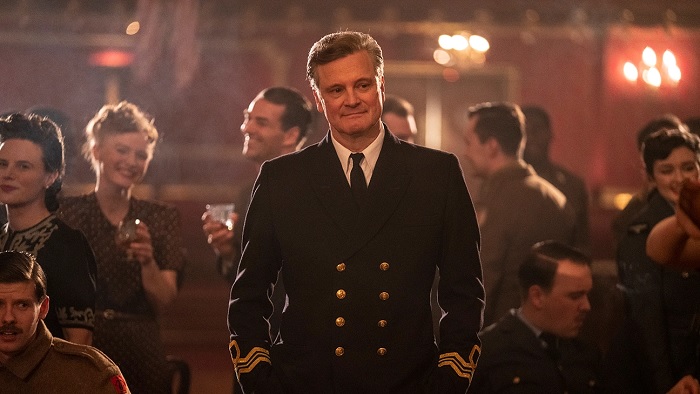
Colin Firth plays Lieutenant Commander Ewen Montagu, a seasoned serviceman with the British Navy intelligence who teams with RAF Officer Charles Cholmondeley (Matthew Macfadyen) to plan, coordinate and execute their extraordinary (and on the surface absurd) ruse. It went something like this: take a real corpse, dress it up like a real British officer, attach to it a briefcase of fake secret documents pointing to Greece as the Allies next target, and then dump the body into the Gulf of Cadiz off the coast of neutral Spain. What could go wrong?

To get their plan in motion, Montagu and Cholmondeley put together a small but crack team to help. Among them is Montagu’s devoted and straight-shooting secretary Hester (the always terrific Penelope Wilton) and a young war widow named Jean (Kelly Macdonald) who agrees to fill a pivotal role in exchange for a seat at the table. Eventually Jean is the center of the rather lukewarm romantic tension as both Montagu and Cholmondeley are soon smitten with her. It’s an angle made up of some pretty good scenes that unfortunately never really go anywhere.

For their plan to work the team needs a corpse. They find it in the unclaimed body of a homeless man who died from ingesting rat poisoning. From there it’s about hammering out the details of their outlandish deception. The best scenes may be their planning sessions at the Gargoyle Club in Soho. There the team piece together an entire biography for their fake officer. They tag him with the generic name Major William Martin to make him hard to single out once German intelligence start snooping. They even create a love story between their Major and a young woman named Pam – a faux romance with an overly syrupy connection to the growing feelings between Montagu and Jean.

Image Courtesy of Netflix

Playing the proverbial thorn in the side is Jason Isaacs as John Godfrey, a British Admiral who reports directly to the growling cantankerous Churchill (Simon Russell Beale). Godfrey doesn’t believe in Mincemeat but he is convinced Montagu and/or his brother is a Russian spy. He petitions to keep Mincemeat running in hopes of yielding intelligence on Montagu and his alleged connection to Moscow. Isaacs is no stranger to playing these types of characters and Godfrey is right on his wheelhouse.

Along the way, Madden and Ashford attempt to add depth to Montagu and Cholmondeley through a couple of personal side-stories – Montagu’s strained relationship with his wife Iris (Hattie Morahan) and Cholmondeley’s efforts to retrieve the body of his KIA younger brother. And while dramatic beats such as jealousy, deception and blackmail continue to play out, the second half mostly focuses on Mincemeat’s execution. It’s here that the tension really ratchets up.

Perhaps the filmmakers could have wrestled a bit more with the moral implications of the operation. And maybe the love triangle could have used some special sauce. But as a whole, “Operation Mincemeat” is a gripping stranger-the-fiction war drama brought to life by a craftier than expected script and an impressive ensemble. And when it comes to World War II history, I doubt you’ve heard many stories quite like this one. “Operation: Mincemeat” premieres tomorrow (May 11th) on Netflix.

VERDICT – 4 STARS