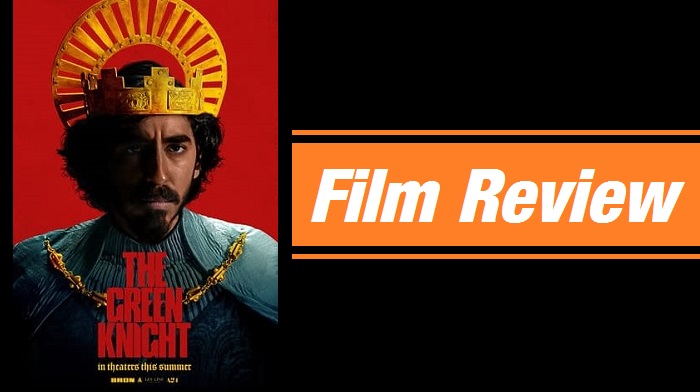
Few movies on the 2021 docket have captured the anticipation and curiosity of a segment of film fans quite like “The Green Knight”. This fresh retelling pulled from the rich and complex Arthurian mythology comes from writer-director David Lowery, an indie visionary who proves himself to be just the right person for the material. Surrounded by an almost deafening buzz from certain circles, “The Green Knight” is a savory feast sure to tantalize the taste buds of arthouse crowds while leaving some casual moviegoers frustrated and hungry.
“The Green Knight” is a dark and sometimes twisted medieval fantasy based on the 14th century poem “Sir Gawain and the Green Knight”. Or as the film itself states it, “the chivalric romance by anonymous”. Lowery puts his own unconventional spin on the material, focusing more on imagery, mood and atmosphere than dialogue, character building and traditional storytelling. It results in an eye-popping puzzle box of a movie with much to say about humanity, self-discovery, honor and what it means to be a legend. But gleaning its meaning through Lowery’s artful yet sometimes muddy lens can be a chore.
Who better to lead this beguiling dark fantasy twist than Dev Patel who has excelled at playing conflicted characters who often carry heavy burdens. The 31-year-old possesses a wide-eyed openness that makes him the perfect conduit between the audience and the material. Here he’s the key piece that keeps us connected both narratively and on a human level. Most of the other players we meet, though captivating, are shallow hulls who work more as representations than genuine characters. That may sound like a criticism and in a wishful way I suppose it is. But it’s an approach that fits well with the journey Lowery takes us on.
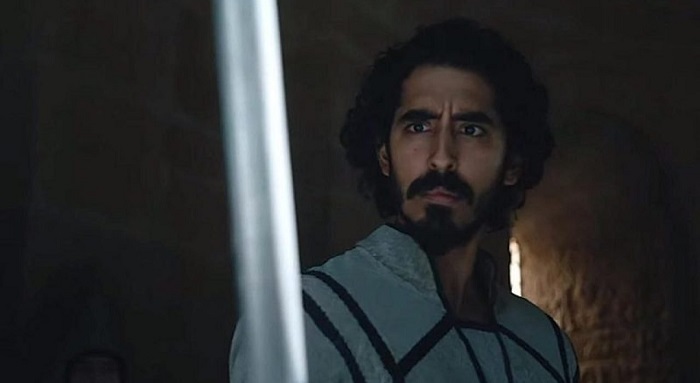
Patel plays the impetuous Gawain, nephew to the sickly King Arthur (Sean Harris) and his equally unwell looking queen Guinevere (Kate Dickie). Gawain is next in line for the crown but shirks his royal duties, choosing to hide his insecurities by drinking and cavorting with the waifish Esel (Alicia Vikander). But his life turns on Christmas morning when the king’s round table festivities are interrupted by an unexpected visitor. He’s a menacing yet entrancing creature surrounded by a dull forest green glow. He has the head of a Tolkien Ent sitting upon a giant’s body that creaks like thick bending tree limbs whenever he moves. His face is covered in tree bark, his eyes unexpectedly soulful, and his voice reverberating with the deep booming tones of Ralph Ineson.
With the full attention of the room, the creature issues a challenge. He offers anyone in the King’s court a free strike with their blade but it comes with one ominous condition – he’ll return the same blow exactly one year later at his chapel deep within a faraway forest. The impulsive Gawain jumps at the opportunity and with one swift slice of a sword decapitates the creature and begins his own legend. The still-living body of the hulking knight picks up his detached head and rides off, leaving a ‘see you in a year’ laugh echoing through the chamber.
The bulk of the film follows Gawain’s journey to keep his end of the agreement. Will Gawain remain a selfish entitled slacker or will he become a poem-worthy Arthurian legend? To answer that, Lowery takes his protagonist across a plethora of breathtaking landscapes, each using nature (a strength of Lowery’s) and the individual uniquenesses of the Irish locations to create this absorbing visual language. That may sound like nonsensical critic-speak, but it’s exactly what Lowery and his DP Andrew Droz Palermo do. Their camera (with a little help from Daniel Hart’s gnawing score – one of the year’s best) communicate a lingering feeling of dread that bleeds through every doom-soaked composition.
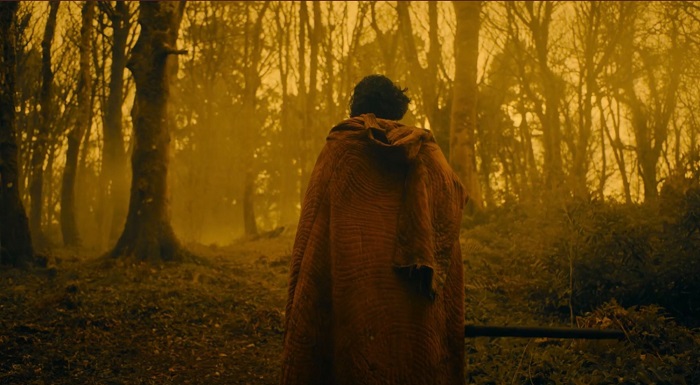
Equally effective are the countless visual touches scattered throughout Lowery’s moody epic. Tracking shots of Gawain riding across the dreary cloud-covered countryside. Holding certain shots slightly longer than we’re accustomed to. Exquisite camera pans including a particularly brilliant one (you’ll know it when you see it). The incredible use of darkness and shadows. There’s always something grabbing your eye and it says something that the film’s most indelible moments come through the camera.
As for Gawain himself, his path is marked by a string of encounters that challenge him in a variety of ways. On a dank and muddy battlefield littered with corpses he runs into a chatty scavenger played by Barry Keoghan. Later he crosses paths with a transfixing spirit (Erin Kellyman) in need of his help to retrieve something of immense value to her. One that doesn’t quite land as it should comes later when an exhausted Gawain happens upon the remote estate of a Lord (Joel Edgerton) and his lecherous wife (also Alicia Vikander). There’s a subtext of temptation versus a knight’s honor, but the sequence drags and gets caught up it’s own cryptic weirdness. But the movie quickly gets back on track and ends strong.
“The Green Knight” is a movie destined to be exalted by some and loathed by others. It’s utter indifference to mainstream acceptance will hurt it at the box office, but it’s part of what makes it special. David Lowery uses every ounce of his creative freedom to make something audacious, challenging, and unlike any Arthurian adaptation we’ve seen to date. It can be confounding and a touch too captivated by its own enigma. But you’ll be entranced from the very first frame, and once you fall under it’s hypnotic spell, it’s impossible to take your eyes off the screen.
VERDICT – 4 STARS