REVIEW: “The Little Things” (2021)

THINGSposterrr

On paper the new psychological crime thriller “The Little Things” has all the ingredients for something special. It has Denzel Washington playing a deputy sheriff who arrives in Los Angeles to help hunt down a cunning serial killer. A supporting cast topped with fellow Academy Award winners Rami Malek and Jared Leto. A dark and moody David Fincher “Manhunter” vibe. And music by fifteen-time Oscar nominated composer James Horner. But having the best ingredients doesn’t guarantee a tasty dish.

“The Little Things” reunites director John Lee Hancock with Newman, cinematographer John Schwartzman and editor Robert Frazen. The four previously worked together on 2019’s underrated period crime drama “The Highwayman”. The two movies are similar in that both are character-centered slow burns. But “The Little Things” proudly embraces its gritty neo-noir flavor while leaving the impression that the film could have been plucked right out of the early 1990’s, back when crime thrillers were all the rave.

LITTLE1

Image Courtesy of Warner Bros.

Speaking of the early 90’s, the story (written by Hancock) is set in 1990 and begins with an effective mood-setting prologue. A young woman drives down a rural highway late at night singing along with the B-52’s blaring on her radio. Suddenly another car quickly approaches, terrorizing her for the next four minutes and giving us a good sense of what to expect in terms of look and tone. Schwartzman’s use of darkness and light along with Newman’s slyly menacing score creates at atmosphere soaked in dread. It’s a good way to kick things off.

We’re then introduced to Washington’s Joe “Deke” Deacon. He’s a Kern County Deputy Sheriff who comes from a long line of tortured big screen law enforcement officers. His particular sins of the past still haunt him, lingering in his mind but out of our sight for most of film. They trace back to his days as a Los Angeles homicide detective and slowly comes into focus after he’s sent to LA by his Captain to retrieve evidence from his old department. There Deke is greeted with cold shoulders, some not-so-subtle jabs, and a general sense of ‘you’re not welcome here’. There’s clearly some history and hard feelings.

LITTLE2

Image Courtesy of Warner Bros.

Before returning home Deke meets Sergeant Jimmy Baxter (Malek), a young but capable detective heading the homicide department. Baxter is described by others as “a good cop” and a family man from The Valley. He’s also the lead investigator on a stalled serial killer case. With four bodies and no suspects he’s facing mounting pressure from both the press and the public. When Baxter is called to a new crime scene that could be linked to the serial killings he invites Deke to come along. “Maybe you can even give me a few pointers.”

Hancock wastes no time steering away from the territorial chest-pounding and ‘my way vs. your way‘ storyline. You know, the one where the outsider from another jurisdiction comes in and clashes with the officer in charge only to win his or her trust and friendship over time. It’s been done countless times before. Here there is some early distrust (and for good reason) but not a lot of wrangling. Instead we get two cops who can actually work together despite one’s stress and the other’s baggage. For Baxter the pressure is weighing on him as is the fear of losing the case to the Feds. For Deke, it doesn’t take a lot of sniffing around to see it’s much more personal for him. He knows the routine, understands the obsession, and is well acquainted with the pitfalls.

LITTLE3

Image Courtesy of Warner Bros.

All of this falls in line with one of Hancock’s biggest interests – exploring the minds of the cops more than getting into the mind of the killer. The film uses a lot of the genre’s dressing to explore how homicide investigation can consume an officer, grind them down, put them on edge, and even lead to a darker side of policing. It’s something Deke understands all too well. And it only intensifies when Leto shows up playing an eccentric loner and neighborhood repairman; a game-playing true-crime enthusiast who quickly becomes the prime suspect.

While some of the performances work better than others, they get the job done. From the subdued yet effortlessly convincing Washington to the stiff and mumbly Malek to the genuinely creepy and cryptic Leto. The patient slow rhythms of the storytelling may disappoint the action-starved, but they’re well-suited for this type of absorbing character study masked as a throwback crime flick from the 90’s. And instead of ending with the predictable iconic pop of something like “Se7en” or “Silence of the Lambs”, Hancock goes the subversive morally thorny route, looking at his character’s humanity through a lens of grace and critique. It’s a smart and satisfying choice. “The Little Things” opens January 29th in theaters and streaming on HBO Max.

VERDICT – 4 STARS

4-stars

REVIEW: “Dara of Jasenovac” (2021)

DARAposterr

When I previewed the upcoming film “Dara of Jasenovac” I noted that no faithful movie about the Holocaust is going to be an easy watch. But throughout the years these films have proven to be powerful reminders of humanity’s capacity for incomprehensible evil while also testifying to the indomitable resilience and courage of so many who suffered through the atrocities. And amazingly there are still powerful and moving true stories from the Holocaust yet to be told.

“Dara of Jasenovac” is a Serbian historical drama that tells a unique story from the Holocaust that’s not specifically about the Holocaust. Instead it’s concentrated on the genocide of Serbs in the Independent State of Croatia during the 1940s. Its main focus is on Jasenovac, a chain of the most notorious Croatian concentration camps which have been called by some historians “The Auschwitz of the Balkans”. They were the only concentration/extermination camps in all of Europe ran by non-Germans. Shockingly, their reputation for unspeakable brutally was such that even the Nazis were put off by their savagery.

DARA2

Image Courtesy of 101 Studios

Not to get too lost in the history, the Croatian death camps including Jasenovac were ran by emissaries of the ultra-fascist Ustase regime, allies to Nazi Germany in ideology but completely autonomous in how they ran their camps. They were not an offshoot of the Nazis doing the bidding of Adolf Hitler. They were conducting their own savage genocide and using the German death camps as their model. And while extinguishing ethnic Serbs was their main objective, the Ustase regime also contributed to the Nazi “Final Solution” by murdering an estimated 40,000 Jews in Jasenovac alone.

Until now there’s never been a feature film about this horrible blight on human history. “Dara of Jasenovac” comes from director Predrag Antonijević and screenwriter Nataša Drakulić and is the Serbian entry for Best International Film at the upcoming Oscars. The movie tells its harrowing story through the eyes of a 10-year-old girl named Dara played by the intensely expressive Biljana Čekić. The film opens with a group of Serbs including Dara, her mother Nada (Anja Stanić Ilić), older brother Jovo and baby brother Budo, being marched to a Ustase-controlled train station. Once they arrive they are quickly herded into boxcars and within minutes the train and its human cargo are on its way to Jasenovac.

LET_5656.jpg

Image Courtesy of 101 Studios

Antonijević and Drakulić waste no time unveiling the horrors of Jasenovac and they don’t let the young girl’s perspective soften its edge. In fact there are times when by necessity the story pulls away from Dara to immerse us deeper in the camp’s inhumanity, to reveal the scope of its operation, and to emphasize the sadistic mindsets of those running it. On the surface the violence may seem overly brutish, but its actually rooted in true accounts. For example in the absence of more efficient means of extermination such as gas chambers, the soldiers of Jasenovac often used knives, mallets, and hammers. Antonijević doesn’t shy away from these harsh and uncomfortable realities.

At the same time this isn’t a movie solely absorbed in the darker side of human nature. The story always comes back to Dara and the different people she encounters, mostly women and children. While they all find themselves under the same dark cloud of hatred, bigotry and barbarism, we see glimmers of the human spirit as captives fight to survive while sacrificing everything for the ones they love. Dara is no different, determined to protect young Budo while holding out hope that her father Mile (Zlatan Vidović) may still be alive.

DARA3

Image Courtesy of 101 Studios

In addition to the story’s emotional resonance, “Dara of Jasenovac” immerses the audience through a richly detailed period setting highlighted by terrific costumes (Ivanka Krstovic) and production design (Goran Joksimovic). Cinematographer Milos Kodemo takes breaks from intimate close-ups and cramped spaces to acquaint us not only with the camp but the surrounding area. A long-time cameraman turned DP, Kodemo shoots with a mostly classical style but tosses in some stylish modern flourishes as well.

I fear it will be tempting for some to let politics sway their perception of “Dara of Jasenovac” considering the decades of tension and violence in the Balkans. But siding-up and treating the film as either justification or propaganda misses out on the stark warnings and profoundly human themes at its core. The movie doesn’t stick a forever label of Croatians nor does it excuse Serbian atrocities that would follow. It tells a potent story of love and hate while opening eyes to an ugly slice of history that (hopefully) we all can come together and condemn. “Dara of Jasenovac” opens February 5th.

VERDICT – 4.5 STARS

4-5-stars

First Glance: “Godzilla vs. Kong”

KONG

Creature Feature fans rejoice. The first trailer for the long-awaited (at least for some of us) “Godzilla vs. Kong” movie finally landed over the weekend and boy does it leave us with a lot to ponder. This star-studded sequel to 2014’s “Godzilla”, 2017’s “Kong: Skull Island”, and 2019’s “Godzilla: King of the Monsters” throws a lot at us in its first real look – lots of large scale action, numerous returning characters and an epic showdown between cinema’s most renowned monsters. Will it all come together in a smart and compelling way? Who knows, but it sure looks to be a lot of fun.

So it looks like Godzilla is ticked off and many of the familiar faces can’t quite figure out why. One significant line of dialogue offers some insight. “There was a war and they’re the last ones standing.” So apparently the two beasts have a history. But something else seems to have Godzilla worked up and wrecking havoc around the globe. So those pesky humans need Kong to defend them against the mighty Godzilla and a young girl who is able to communicate with the former Skull Island native looks to be the key. Lots of ground to cover but I’m completely onboard.

“Godzilla vs. Kong” opens March 26th in theaters and streaming on HBO Max. Check out the trailer below and let me know if you’ll be seeing yet or taking a pass.

REVIEW: “The Father” (2021)

FATHERposter

Those who have watched someone close to them suffer from dementia know exactly how cruel and crushing the disease can be both for the person afflicted and for their family. Those who have watched movies dealing with mental deterioration among the elderly know that it is delicate subject matter and not the easiest to get right. “The Father” not only gets it right, but it wrestles with dementia in a strikingly unique and thoughtful way. And it features an Anthony Hopkins performance that should be near the top of every ‘Best of the Year‘ discussion.

“The Father” is the exciting feature film debut from French novelist and playwright Florian Zeller. Here he directs and co-writes an adaptation of his own 2014 award-winning play about an elderly man in the throes of dementia. But where so many well-meaning films only manage to grasp the subject from an external perspective, Zeller attempts something truly audacious. He sets out to put us inside the sufferer’s head. Not in some artfully surreal or metaphorical sense. But a sincere effort to authentically represent how his mind processes what he sees and hears; how things can go from vivid to clouded and convoluted in a manner of seconds.

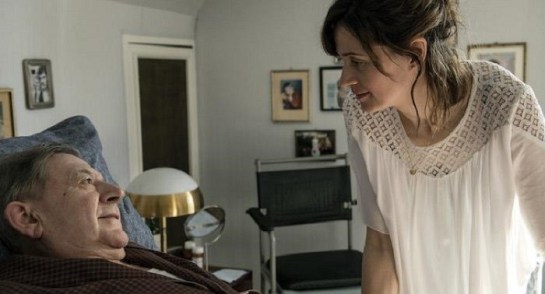
The film revolves around 80-year-old Anthony (played by Hopkins) who is already past the early stages of dementia as the story begins. We first meet him in his swanky London flat after he has just ran off his third home health nurse. “I can manage very well on my own“, he grumbles. But the truth is he can’t. Throughout the film Zeller and his co-writer Christopher Hampton task us with piecing together Anthony’s life from the shards we get from his fragmenting mind. We learn he was a man of art and culture by his love for opera and classical music; by the way he admires a Peirrot painting on his wall (that may or may not be there). We see where he can be sweet and charming but also wily and cantankerous.

FATHER

Image Courtesy of Sony Pictures Classic

But those details of his character seem lost in the swirl of confusion and frustration that is Anthony’s mind. The disease has cruelly chipped away at his memory causing him to forget faces, places, and conversations from only moments earlier. He’s misplacing things spurring accusations that the latest nurse was a thief. And all of this as his daughter Anne (Olivia Colman) informs him that she has a new boyfriend and is moving to Paris. “What’s going to become of me?” Anthony asks in one of several quietly devastating moments.

But remember, the bulk of the story is seen through Anthony’s eyes meaning things often change from scene to scene. Sometimes it’s a little detail like a missing picture on the wall. Other times its far more dramatic (and traumatic) such a new face on someone claiming to be your daughter. Before long we too are questioning what’s real and what’s not. Is this really Anthony’s flat? Is Anne really going to Paris? Who is Lucy, a name mentioned several times and always followed by a sobering hush? The film challenges us to pay attention and parse all of the information we’re given. But it isn’t nearly as daunting as it sounds because Zeller always feeds us just enough reliable truth to keep our bearings and to reach certain conclusions.

One of the most remarkable things about “The Father” is how effectively it blends what is reality with what is in Anthony’s head. It’s a tricky and sensitive balance that if mishandled could go wrong in a variety of ways. Here it’s masterfully done and full of empathy. Take a scene where Anthony hears a noise and follows it to his living room. Their he finds a man (Mark Gatiss) sitting in a chair reading a newspaper. “Who are you? What are you doing in my flat?” a puzzled Anthony asks. The man says his name is Paul, Anne’s husband and that Anthony is actually living with them. It’s a scene sprinkled with bits of truth for us to gather, but from the perspective we share with Anthony they’re scattered and out of place. Ultimately we’re left to determine what’s reliable and what isn’t.

The scene intensifies when Anne returns, this time not played by Colman but briefly by fellow British actress Olivia Williams. And we see it again later when Paul is abruptly played by actor Rufus Sewell and when Imogen Poots arrives as a potential new caretaker with a striking resemblance to the aforementioned Lucy. Suddenly Anthony is questioning everything, uncertain of where he is or who he’s with. These are heart-shattering sequences that evocatively capture Anthony’s mental struggle to make sense of things. How do you put pieces together that simply don’t fit? Much more, how to you communicate something so out of sorts? How do you speak about things that make no sense whatsoever?

FATHER2

Image Courtesy of Sony Pictures Classic

I sat in awe-struck silence watching Hopkins convey these torturous internal conflicts – nearly every expression underlined with cognitive strain; his voice often quivering with uncertainty. I was overwhelmed by how deftly he handled the bursts of rage as well as the tender moments of lucidity; the sudden mood swings, the worsening bouts of forgetfulness, the misguided suspicions, and especially the moments where a subtle terror takes hold of him. It’s a ‘best of career’ caliber performance from Hopkins and anything short of an Oscar nomination would be an insult.

It would be easy for Anne to get lost in a movie with such an intense focus. But Zeller gives Colman some much needed time to convey the anguish felt by family caregivers who can only watch helplessly as their loved ones come apart. My grandfather had Alzheimer’s. My wife’s grandmother lived for years in a healthy physical body but with a mind erased by dementia. So many personally know this story and how it ends which will make Colman’s character resonate with many people in a profound way.

It probably goes without saying that “The Father” is a tough watch. But the bold choices, the emotional honesty, the crisp detailed storytelling, and the tour de force performance from Anthony Hopkins (among other things) make every second worthwhile. Not since Michael Haneke’s brilliant “Amour” has there been a more brutally honest film about terminal disease/failing health. But what sets “The Father” apart is its unyielding yet compassionate ambition to realistically portray a dementia victim’s point-of-view. And it does so while humanizing them in a way I’ve never seen done before. Don’t let its bleak and uncomfortable subject matter scare you away. This truly is essential viewing. “The Father” is scheduled to be released February 26th.

VERDICT – 5 STARS

5-starss

REVIEW: “Lovers Rock” (2020)

LOVERSposter

About midway through Steve McQueen’s compact “Lovers Rock” is a scene sure to be written about in nearly every review you’ll read. Let’s just call it the “Silly Games” scene, a long ten-minute slow dance that encapsulates the entire movie. A room full of young West Indian men and women intimately dance to Janet Kay’s reggae hit “Silly Games”. The camera takes a seductively observational role, slowly weaving between dancers, capturing the euphoria that keeps them singing and dancing well after the song ends. Clearly the characters and the filmmaker are lost in the freedom of the moment and the music. I wish I had been.

If the “Silly Games” scene works for you then I can almost guarantee “Lovers Rock” will too. The film, part two of McQueen’s “Small Axe” anthology series for Amazon’s Prime, is all about observing and immersing. Its aim is to lose its audience in the sumptuous experience of the people we see. Not in a story or even the characters for that matter, but in the experience itself. It’s pretty audacious and at times intensely romantic. But if you aren’t fully in-tune with what McQueen is doing “Lovers Rock” may lose your attention despite only clocking in at a lean 68 minutes.

LOVERS2

Photo Courtesy of Amazon Studios

In its most basic form the story is about a group of friends who throw a house party. That’s it. But McQueen is a crafty filmmaker and he fills in the margins with meaningful subtext and a 1980 London setting that’s ripe for social commentary. Still the movie leaves most of that outside, instead focusing on the party as a place of freedom and release. It’s almost experimental in its disregard for plot or structure. Instead its focus is on simply moving from room to room, soaking in the atmosphere and swaying to the steady reggae beats from the DJ. At times McQueen’s camera creates such an intimacy that you can feel the heat on the dance floor and smell the pot of boiling curry goat in the kitchen.

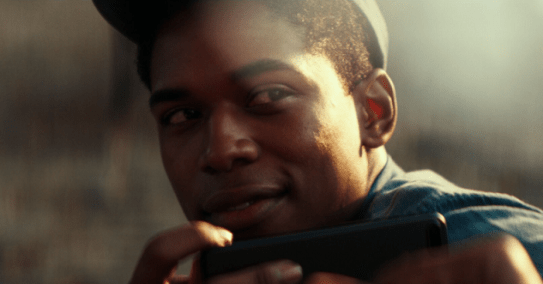
The camera familiarizes us with several faces and checks in on them from time to time. A young woman named Martha (Amarah-Jae St. Aubyn) is about as close as we come to a lead character. Early in the film we see her sneaking out of her parents’ house and meeting up with her bestie Patti (Shaniqua Okwok). The two hit the house party where Martha meets a charmer named Franklyn (Micheal Ward). Several other thinly-sketched but intriguing partygoers come in and out of the roaming camera’s view, revealing just enough personality to leave you wishing you knew them better.

LOVERS1

Photo Courtesy of Amazon Studios

But fleshing out characters isn’t what McQueen is after. It’s not that he isn’t interested in them. Quite the opposite. But he’s content with implying certain things about them, both individually and communally, and leaving the rest to us. It’s a welcome trust of a filmmaker with his audience, but considering how little we’re given it’s a case where filling in the blanks isn’t as satisfying as it should be.

“Lovers Rock” is an easy movie for me to admire but a tough one for me to love. Sometimes it’s sweet and sumptuous. Other times it plays like a music video. The intense closeups and slow pans, the dance floor vignettes, the almost sultry love for hemp and harmony – it all helps create a realistic setting that’s almost tangible to the senses. And you have to appreciate the film as an exploration of cultural identity during a very distinct time in London’s history. But it reached a point where the “experience” began to wear off and the lack of plot grew more and more noticeable. It ended up being like the “Silly Games” scene, bold and heartfelt but stretched well beyond its limits. “Lovers Rock” is now streaming on Amazon Prime Video.

VERDICT – 2.5 STARS

2-5-stars

REVIEW: “No Man’s Land” (2021)

MANposterrr

Brothers Conor and Jake Allyn grew up Dallas, Texas and made frequent trips across the southern border into Mexico with their father. The many visits opened their eyes to a much different side of Mexico and ultimately helped inspire their new film “No Man’s Land”. This modern-day western uses a reverse migration story of sorts to explore the human element at the center of the border crisis, bypassing the politics and looking straight at the people. It may not have the most clear-eyed vision, but it’s heart is definitely in the right place.

“No Man’s Land” was shot in Mexico over the course of 28 days with a predominantly Mexican cast and crew. Conor directs the film with Jake starring and co-writing with Mexican co-screenwriter and executive producer David Barraza. The title is a reference to a gap between the Rio Grande River and the border fence further north. That space in between is commonly referred to as No Man’s Land for migrants attempting to slip into the United States.

MANS5

Image Courtesy of IFC Films

Bill and Monica Greer (Frank Grillo and Andie MacDowell, both really good and underused) own a ranch near the Texas/Mexico border. They work it with their two boys Lucas (Alex MacNicoll) and Jackson (Jake Allyn). The youngest of the two, Jackson has a promising baseball career ahead with the New York Yankees already showing interest. In addition to managing cattle and horses, the Greer’s are increasingly forced to fend off migrants who are crossing their property and getting into their barns looking for food and water.

Meanwhile on the other side of the Rio Grande a widowed father named Gustavo (Jorge A. Jiménez) works as a coyote for the church, helping people intent on crossing the border by providing a way other than through the cartels. Known as “the Shepherd” by the many people he has helped, Gustavo is ready to leave that dangerous life behind. He sets out on a final crossing, this time bringing his mother and two sons, with plans to stay in America to start a better life for his boys.

MANS3

Image Courtesy of IFC Films

The film sets up its pieces nicely and there is an ominous air of tragedy hanging over these early scenes. It inevitably comes in the dark of night as Gustavo and his family are passing through the Greer family’s property. There’s a confrontation and amid the chaos Jackson panics and fatally shoots Gustavo’s youngest boy. The migrants escape into the night while Bill works up a story to protect his son. But Texas Ranger Ramirez (George Lopez) doesn’t buy what they’re selling. Overcome by guilt, Jackson flees across the river into Mexico, avoiding arrest and hoping to find a way to make things right.

It’s here that “No Man’s Land” reshapes into a much different movie as Jackson becomes the migrant in a foreign country relying on the kindness of locals to survive. The underlying meaning behind the role-reversal is pretty obvious and the movie definitely has some meaningful points it wants to make. Thankfully it does so without standing behind a bullhorn or a pulpit. There’s also a “Fugitive” element to the story as Jackson is pursued by the determined Texas Ranger, the Mexican federales and a grief-stricken father thirsty for revenge.

MANS1111

Image Courtesy of IFC Films

There is one character the movie could have done without. Andrés Delgado plays a young hoodlum named Luis whose tattoos, bleached mohawk and switchblade knife shows he’s bad news. Delgado does the best he can, but his character is trapped in that irredeemable ‘bad guy’ void. And he ends up being a loose string that is unfortunately tied up at the worst possible time. I’m keeping it vague due to spoilers, but the character takes away from the story far more than he adds to it.

Still, there’s much to admire about this well-meaning indie. It’s made by a diverse group (both in front of and behind the camera) who set out to emphasize our similarities with our southern neighbors while still acknowledging our differences. The story plows worthwhile themes of guilt, regret, forgiveness, and accepting the consequences for your actions. And it looks great thanks to cinematographer Juan Pablo Ramírez and production designer Liz Medrana. It has some rough patches and it tries to cover too much ground. But the Allyn brothers tell their story with heart and conviction, and it’s hard not to appreciate their ambition. “No Man’s Land” premieres January 22nd on VOD.

VERDICT – 3 STARS

3-stars