REVIEW: “Gunda” (2020)

GUNDApost

I’ve always been amazed by cinema’s ability to take the simplest idea and turn it into something powerful and deeply affecting. It’s a mark of great moviemaking that has impacted generations since the birth of the industry. For a more recent example look no further than the quietly meditative and subtly message-minded “Gunda” from Russian filmmaker Viktor Kossakovsky. The film also sports Joaquin Phoenix as its executive producer.

This Norwegian documentary sees Kossakovsky directing, co-writing, co-editing as well as sharing cinematography duties. Shot in stunning high-contrast black-and-white, “Gunda” opens with a gorgeous still shot of a small wood pigsty. A sow lays on a bed of hay, its head partially out of the sty basking in the sun’s warm glow. The camera sits on the shot, admiring its simplicity and beauty. Then we notice movement in the shadows. Tumbling over its mother and out the doorway is a tiny piglet followed by another and then another. The shot cuts to inside where we get a clearer picture of what’s going on. Gunda, the eponymous sow is giving birth. It’s a beautiful scene and a clear introduction to the kind of film Kossalovsky has for us.

GUNDA1

Image Courtesy of NEON

“Gunda” shrewdly brings us into the farm animal’s world, immersing us in the everyday minutiae of farm life from their distinct perspective. To emphasize their point-of-view Kossalovsky is always shooting from his subject’s eye level. And when mixed with Alexandr Dudarev’s sublime sound design you get the indescribable sensation of not only being present but within arms length. Take an exquisitely captured sequence when Gunda and her piglets go for a stroll in the farmyard. The unintrusive camera subtly follows the rambunctious little ones at ground level, watching as they root and roughhouse while mama keeps a watchful eye. With the extraordinary closeness comes a certain unshakable intimacy and the clarity of the images means we catch every astonishing detail.

There are the occasional shifts to other livestock that almost work as interludes to Gunda’s story. One features a resilient one-legged chicken who refusing to let his disability slow him down. Later we watch cows burst out of a barn and then run across the field like kids on a playground racing to their favorite spot. Neither segment can cleanly escape feeling a little like filler. Yet both are shot with the same equally captivating photography and both feed into the film’s goal of getting its audience to reconsider how they think of farm animals.

GUNDA2

Image Courtesy of NEON

But Gunda and her piglets are the stars and the film always comes back to them after a chunk of time has passed. As the film moves forward and the piglets get older, an impending sense of doom sets in. Interestingly not a single human being is ever seen on screen nor a single voice ever heard. We only see the marks of their presence. But over time the audience is faced with the inevitable realization that it’s the humans who are the determiners of fate. This is shown with heartbreaking clarity in the film’s heartbreaking final moments.

While its message is crystal clear “Gunda” never lectures or browbeats. There’s no music to guide our emotions or narration to explain what we’re seeing. It doesn’t frame or stealthily edit scenes for dramatic effect. Instead “Gunda” asks its audience to observe, absorb and ponder. It’s unflinching dedication to its vision could prove too tedious for some. But for those able to fall in with the movie’s gorgeous poetic rhythm, it’s sure to resonate in a number unexpected ways. All while showcasing what Paul Thomas Anderson could only describe as “pure cinema”. “Gunda” received a limited release December 11th.

VERDICT- 4.5 STARS

4-5-stars

REVIEW: “Sound of Metal” (2020)

METALpost

In filmmaker Darius Marder’s “Sound of Metal” Riz Ahmed plays Ruben Stone, a drummer and one-half of the punk rock duo Blackgammon. The other half is Lou (Olivia Cooke), lead singer, guitarist and Ruben’s girlfriend. The two drive their RV/home from city to city playing small gigs and selling just enough merch to get by. Both were lost and wayward souls but found safety and refuge in each other and the music they make together. And then Ruben lost his hearing.

From its earliest moments “Sound of Metal” brandishes a gritty authenticity in its story, its characters, and even the filmmaking. It all starts with Riz Ahmed and his star-making turn as a recovering heroin addict who has put every bit of himself into traveling across the country with his girlfriend performing gigs and working on a new album. Once the threat of losing it all sets in the richness of Ahmed’s performance really comes out. Anger, bitterness, fear, denial – Ahmed maneuvers through his crumbling character’s emotional cycles with a true and uncompromising fervor. It’s soulful and hard-nosed acting that avoids showiness and other similar trappings.

METAL1

Image Courtesy of Amazon Studios

Ruben’s trouble begins after a show in Missouri when he suddenly loses most of his hearing. Nicolas Becker’s gnarly sound design (easily some of the year’s best) conveys Ruben’s condition by putting us in his head, surrounding us with the same disorienting hums and muffled tones. It’s intensely effective and quite harrowing especially when Marder begins contrasting the normal sounds with what Ruben is actually hearing. Ruben is certain he can fix it despite a doctor telling him his hearing loss is not only permanent but will most likely get worse.

Lou has a better grasp on reality and reaches out to Ruben’s sponsor who finds him a rural rehab facility for the deaf. It’s ran by a kind spirit named Joe (Paul Raci) who immediately gets Ruben into group meetings and starts him learning sign language. After some initial hesitation Ruben begins to make connections, especially with a teacher named Diane (Lauren Ridloff) and her students at a local school for the deaf. At the same time everything he’s doing is to get back to old life instead of learning how to live his new one. It’s a key internal conflict and a central focus of the film’s second half.

METAL2

Image Courtesy of Amazon Studios

“Sound of Metal” tells the kind of story that filmmakers have often struggled to get right. That’s because there’s almost an inherent temptation to ramp up the drama rather than trusting the story and the audience. In “Sound of Metal” there is no condescension and no overwrought sentimentality. The film’s proverbial feet are firmly planted in the real world (maybe too much so in some cases) and the movie benefits from Marder’s willingness to keep things grounded and character-focused. Same with his choice to cast members of the deaf community. It both adds to the authenticity and fairly represents an often underrepresented group.

Despite being underwritten in places “Sound of Metal” is easily one of the more pleasant surprises of 2020. The film’s tough-minded yet thoughtful story plows some heavy ground and asks challenging questions. How do you put aside everything you’ve ever known and carve out a new identity? At what point do you give up on your dream and face a new reality? Marder gives us lots to ponder and Riz Ahmed embodies it with a performance full of grit and raw emotion. It’s hard to take your eyes off of him and he earns our empathy the very moment the terrifying muffled hum first sets in. “Sound of Metal” is now available on Amazon Prime.

VERDICT – 4 STARS

4-stars

REVIEW: “The Midnight Sky” (2020)

SKYposter

No one can doubt George Clooney’s celebrity status nor can they reasonably throw dirt at his work in front of the camera. A quick scan of the Oscar winner’s acting credits shows a career many would envy. It’s when you mention his directing that things get a little shaky. He has hit his mark a few times namely with “Good Night and Good Luck” and “The Monuments Men” (that’s right, I’m an actual defender of that movie. Nice to meet you.). But his misfires have been pretty pronounced with “Leatherheads” and the abysmal “Suburbicon” instantly coming to mind.

His latest film “The Midnight Sky” sees Clooney as both lead actor and director, his first dual-duty role since 2014. The story is adapted by screenwriter Mark L. Smith (“The Revenant”) from Lily Brooks-Dalton’s 2016 debut novel “Good Morning, Midnight”. It’s an interesting choice for director Clooney, bigger in scale and more ambitious than anything he has helmed before. Here he has made a movie that wears its inspirations on its sleeve which may push away demanding viewers hungry for something completely original. But “The Midnight Sky” is no stale uninspired rehash and reducing it to such ignores the film’s more personal aims.

This moody dystopian drama is set in 2049, three weeks after an unspecified global catastrophe (referred to only as “the event”) caused deadly levels of radiation to begin spreading across the earth’s surface. Clooney plays Augustine Lofthouse, a renowned astrophysicist and the last remaining soul at the Barbeau Observatory deep in the Arctic Circle. His colleagues and their families have evacuated, heading south to hole up in underground safehouses. But Augustine stayed behind, unconvinced that leaving was the best course of action and content to live his last days alone with his terminal illness.

SKY2

Image Courtesy of Netflix

Augustine passes his time monitoring the radiation’s rapid spread and attempting to establish communication with the rest of the world. The thick-bearded, gravelly-voiced Clooney gives one of the best performances of his career portraying a somber tormented soul wrestling with feelings of deep-rooted regret (three short but well-handled flashbacks reveal a squandered relationship, the source of his melancholy). He’s the embodiment of loneliness, a man self-condemned and resigned to his fate. But then two unexpected twists change his course.

First he notices the crew of the planet’s last active space mission Operation Aether are returning to earth following a survey mission to a potentially habitable moon. If Augustine doesn’t re-establish contact with the unaware space station and warn them of the earth’s status the five-person crew will be arriving to their own deaths. Second he discovers a little girl named Iris (bright-eyed newcomer Caoilinn Springall) left behind during the evacuation. It sets up the well-worn father-figure/daughter-figure dynamic that actually works thanks to Clooney’s wounded sincerity and Springall’s quiet and unadorned presence.

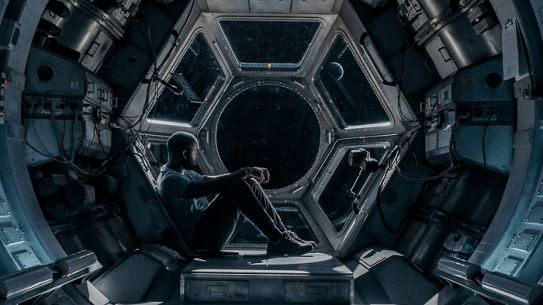
Meanwhile aboard the Aether the crew carries on their daily duties despite growing concerns about losing contact with earth. The diverse and talented group of Felicity Jones, David Oyelowo, Kyle Chandler, Demián Bichir, and Tiffany Boone make up the team of home-sick scientists, some more fleshed out than others but each believable in their role. The visual effects pop off the screen from the imaginative ship design to the simple but foreboding way the movie contrasts the darkness of space with the blinding white of the Arctic tundra. And then there’s the film’s biggest set piece, a stunning spacewalk to repair a communications array that clearly borrows from “Gravity” but packs its own quiet white-knuckled intensity. There is a musical number to Neil Diamond’s “Sweet Caroline” that I could have done without but be that as it may.

SKY3

Image Courtesy of Netflix

The story jumps back-and-forth between the Aether‘s crew pushing through unforeseen dangers and Augustine setting out with Iris across the frozen wasteland to a remote weather station with a stronger antenna. It sounds action-packed, something akin to summer blockbuster material. But while it has its genre moments, this is a much different film. At its core “The Midnight Sky” is reflective and tragic, even poetic; a bleak meditation on humanity’s last days. Some are sure to push back on Clooney’s unrushed approach, but it’s exactly what this type of story needs. Even DP Martin Ruhe’s extraordinary cinematography and Alexander Desplat’s elegant yet aching score support the film’s contemplative framing.

One of the biggest mistakes you could make with a movie like “The Midnight Sky” is falling into the comparison trap. Sure, if you look for it you can see a few story beats from “Interstellar”, a set piece inspired by “Gravity”, and the occasional ruminative rhythm of “Ad Astra”. At times you may be reminded of “The Martian”, “Moon”, “2001”, and “Arrival”. In other words it does what so many sci-fi movies do at this stage in the genre’s history – it embraces its inspirations. But it also has its own story to tell about loss, love and the yearning for what we leave behind.

“The Midnight Sky” is destined to be a divisive movie. For some it will be emotionally cathartic and fitting for a year like 2020. Others will find it to be shallow, derivative and lacking its own identity. For me its issues are considerably smaller. It splits so much time between earth and space that some of its characters get shortchanged. And as a result some of the big emotional moments don’t quite have the punch they should. But thankfully “The Midnight Sky” doesn’t hinge on a scene or two. And I like the fact that George Clooney, both the actor and director, sticks to his vision while tipping his hat to many of his important influences. “The Midnight Sky” is now showing in select theaters and will premiere on Netflix December 23rd.

VERDICT – 4 STARS

4-stars

REVIEW: “Ma Rainey’s Black Bottom” (2020)

MAposterr

When we first see Chadwick Boseman as the ambitious young trumpeter Levee in “Ma Rainey’s Black Bottom” it’s both a smile-inducing moment and a stiff punch in the gut. As most know, Boseman passed away this past August following his private battle with colon cancer. He was just 43-years-old. “Ma Rainey’s Black Bottom” marks his final film appearance which unavoidably brings extra attention and emotion. But don’t think that’s the reason Boseman’s performance has been so well received. This may very well be the best work of his career.

While Boseman is sure to get most of the attention this really is an movie with rich, magnetic performances throughout. It starts with Viola Davis playing the eponymous Ma Rainey. Davis offers up a fierce portrayal, capturing the classic blues icon’s tough and abrasive exterior. The film shows Ma to be a surly hard case, fiery and combative, willing to use her clout to push back on all of the era’s oppressive establishments and frankly anyone else who ticks her off.

MA1

Image Courtesy of Netflix

Set in 1927, the bulk of the story takes place during one scorching hot afternoon at a recording studio in downtown Chicago. By this time Ma Rainey had already been christened the Mother of Blues and she had learned the hard way how the game was played. She knows her agent and the record producer (both white) only want her for her voice and the money it will bring them. That’s why she doesn’t mind making them squirm, wondering if she’s actually going to show up. Meanwhile her band arrives on time and sets up in the basement to practice.

Most of the movie takes place in two rooms, the basement where the band warms up and the recording room. While Ma’s name is stamped in the title, it’s in the basement that we see the film’s star. When Boseman’s larger-than-life Levee arrives he comes with enough charisma to fill the entire room. He’s a force of personality brimming with self-confidence; a bit impetuous and headstrong which stands out most when he playfully butts heads with his older bandmates. There are some terrific dialogue-rich scenes in the basement where generations and philosophies clash. They even differ on music. Levee wants to pep things up while the others keep reminding him “You play Ma’s music when you’re here.”

By the way, those older bandmates are played by the exceptional trio of Colman Domingo, Glynn Turman, and Michael Potts. They cut through the dialogue with a sparkling chemistry and each are given their own scenes that reflect on their experiences as black men in 1920s America. But it always comes back to Levee played by Boseman with a wild-eyed vigor. Levee is far from one-dimensional and as his layers peel away the late actor is given a couple of meaty moments including one big “Hey Oscar!” monologue and a later scene that seems ready-made for awards season consumption. Yet Boseman nails both, unearthing his character’s deep-rooted pain and anger. It’s a stand-out performance.

The focus shifts a bit when Ma and her entourage finally arrive at Hot Rhythm Recordings. A snarling whirlwind of indignation, Ma immediately ups the temperature in the already sweltering studio, locking horns with her antsy agent (Jeremy Shamos) and challenging the patience of the studio head (Jonny Coyne). Even the band gets a taste of Ma’s ire, especially Levee who can’t quite get in line with her strict ways of doing things. It all sets up a combustible third act ending with a final scene that hits like a ton of bricks.

MA2

Image Courtesy of Netflix

While Boseman gets to dig deep into his character’s psyche, Davis is mostly restricted to Ma’s tough-as-nails exterior. She gets to let loose in portraying Ma as an ill-tempered force of nature, but only gets a few lines that hint at who she was underneath. The rest is vaguely implied or expected to be known from history. So it may not hurt to read Ma Rainey’s Wikipedia page before watching. For Davis’ part it’s a fearless and fascinating performance, but the script leaves so much buried within her character and ultimately untapped.

The film is based on August Wilson’s 1982 play which was the second part of his Pittsburgh Cycle series chronicling the black experience in America during the 20th Century. Director George C. Wolfe doesn’t stray from the story’s stage roots but the doesn’t strictly adhere to them either. There are a handful of scenes that pull us out of the studio and energizes the setting. And Ann Roth adds to the period detail with her magical costume design that could have been plucked right out the Roaring Twenties. Yet despite its efforts, chunks of the movie still feel considerably more stagey than cinematic. But that’s hardly a deal-breaker especially when screenwriter Ruben Santiago-Hudson fills his scenes with rich soulful dialogue and you have such flavored performances from a stellar ensemble. And none are better than the late Chadwick Boseman. “Ma Rainey’s Black Bottom” premieres on Netflix December 18th.

VERDICT – 3.5 STARS

3-5-stars

First Glance: “Outside the Wire”

OUTSIDE

It looks like Netflix will be kicking off the new year with a literal bang. Their new futuristic shoot-em-up “Outside the Wire” comes from the studio that made other recent action flicks for the streaming giant, the surprisingly good “Extraction” and the not-so-good “The Old Guard”. Directed by Swedish filmmaker Mikael Håfström, this action and sci-fi blend dropped its first trailer this morning. And while it certainly has a familiar look, it could also be a pretty good time.

The movie stars Marvel alum Anthony Mackie and is set to premiere just before his big MCU Disney+ series “The Falcon and the Winter Soldier”. Mackie plays a seriously tough android who is partnered with an inexperienced drone pilot (Damson Idris) to go into a heavy militarized territory in search of a doomsday weapon. Action ensues as Mackie shows off his action movie lead actor chops. The clips we get are loaded with fisticuffs, gunfire, and even robots. That’s all I needed. I’ll be giving it a look.

“Outside the Wire” premieres January 15th on Netflix. Check out the trailer below and let me know if you’ll be seeing it or taking a pass.

REVIEW: “Promising Young Woman” (2020)

PROMISINGpost

While Carey Mulligan has received her share of accolades and most consider her a good actress, in some sense she remains underappreciated and is rarely considered among the best of her craft. She’s certainly proven herself and her last four lead performances alone should be enough to quell any hesitation. Of the many things likely to come from her new film “Promising Young Woman”, hopefully one will be a deeper and fuller appreciation for just how good the 35-year-old London-born star really is.

“Promising Young Woman” is the feature film debut for director and screenwriter Emerald Fennell. The actress and author (currently appearing as Camilla in the hit Netflix series “The Crown”) has crafted a blistering #MeToo era revenge fantasy that defies all labels and expectations. It’s a wily and rightfully angry thriller soaked in style and with a disarming candy-colored coating. At the same time it’s darkly funny and its humor often hits at the most unexpected times. And all of it is anchored by Mulligan’s fierce and uncompromising lead performance.

Storywise Cassandra Thomas (Mulligan) had everything going for her. She was a college medical student with top-of-her-class smarts and a promising future ahead. But then something happened on campus, a sexual assault involving her childhood friend and med school classmate Nina. It led to both Cassie and Nina dropping out while the perpetrators went unprosecuted, graduating magna cum laude and set for a life of upper-class bliss.

Promising1

Image Courtesy of Focus Features

That was seven years ago. Now the 30-year-old Cassie works at a dead-end coffee shop, still living with her parents (wonderfully played by Jennifer Coolidge and Clancy Brown) and with no ambition or real relationships to speak of. The details of Nina’s fate trickle out over time but they have clearly left Cassie in a dark hole. They also fuel what you might consider her unconventional night job.

Roughly once a week Cassie enters a nightclub dressed to the nines and pretending to be so drunk she can’t stand on her own. Wielding her beauty like a weapon, Cassie lures in self-proclaimed “nice guys” who feign compassion and offer to help her home. To no surprise they magically end up taking her to their apartment. Once their poorly veiled predation reaches a certain point, Cassie snaps out of her faux drunkenness like a bear jolted from its hibernation, forcing the offenders to reckon with their deeds.

Enter comedian Bo Burnham playing Ryan, an old college classmate who has always had a thing for Cassie. He’s a self-depreciating and playfully charming guy; the kind that might actually break through Cassie’s hardened defenses. It helps that there is a tangible chemistry between Burnham and Mulligan. They’re also really funny together. It’s quite the opposite with Cassie’s secret darker side which sees her moving away from catching random slugs in a bar to targeting all those who wronged her friend in school. Fennell digs equally into both sides of the character, leaving us wondering which will ultimately win out.

Promising2

Image Courtesy of Focus Features

But none of it works without Mulligan who is convincing at every turn. Whether it’s a moment of vulnerability revealing glimpses of potential happiness or when she’s the unhinged antihero uncoiling in front of her prey with sociopathic glee. Mulligan never overacts or underplays which isn’t easy with this kind of material. And it helps to be surrounded by such a well-tuned supporting cast. In addition to the terrific Burnham is a number of familiar faces: Adam Brody, Alison Brie, Alfred Molina, Christopher Mintz-Plasse, and Connie Britton to name a few.

“Promising Young Woman” is a movie full of misdirections and ruses. One of my favorites is the film’s undeniable girly aesthetic set atop of its grittier subject matter. Deliciously snide confections like an intentionally corny pharmacy scene playing out to Paris Hilton’s “Stars Are Blind”. It’s a scene that could be yanked from any number of cookie-cutter rom-coms. And how can you not appreciate a film that gleefully kicks in the groin any notion of expectation? One of the real treats from Fennell’s film (much like its main character) is the utter unpredictability. And there are so many fun comedic touches. Such as Cassie’s parents spending an evening watching Robert Mitchum’s “Night of the Hunter”.

Without question Fennell takes her subject seriously but she’s also having a wickedly good time. Occasionally the tones clash a bit, but I do enjoy watching a filmmaker buck conventions and stick with original ideas. And Fennell has plenty of ideas, from the way she shoots the movie to the way her story is told. You also have to admire a movie that can land this many well-placed shots at such a slimy and abusive subculture. “Promising Young Woman” opens December 25th.

VERDICT – 4 STARS

4-stars