

SUNDANCE REVIEW: “Censor” (2021)

CENSORposttt

For many Americans like me the term ‘Video Nasty’ is a new one. Basically it’s exactly what it sounds like – a label in the UK typically designated for low-budget horror and exploitation films. During the VHS boom these flicks were distributed on video cassette and met with harsh criticism by various organizations for their graphic and excessive violence. In “Censor”, the exciting feature film debut for writer-director Prano Bailey-Bond, ‘Video Nasties’ play a central role in this fresh and unconventional slice of horror.

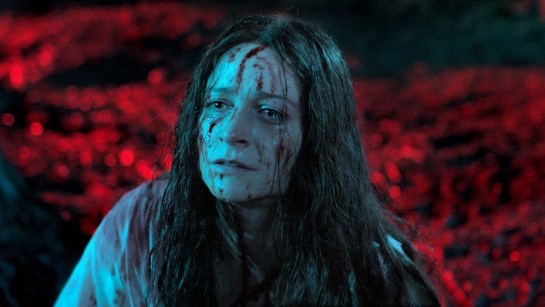
The film is anchored by a strong and layered lead performance from Irish actress Niamh Algar. She plays Enid, a film censor in 1980’s London who spends her days watching VHS movies with her colleagues. I’m talking about hilariously titled flicks such as “Cannibal Carnage”, “Driller Killer”, and “Beast Man”. The censors are tasked with assessing the content of the films and then determining what must be cut before it’s allowed into the public. Enid takes her job seriously, considering it her duty to “protect people“. When asked if the steady diet of blood-soaked violence rattles her she replies “I’m focused on getting it right. Don’t really think about anything else.”

Enid’s life outside of work is practically nonexistent in large part due to the disappearance of her sister Nina some twenty years earlier. Enid is still haunted by dreams of the two of them playing together in the woods shortly before she vanished. But that’s all she can recall and she blames herself for not remembering more. Her parents (Andrew Havil and Clare Holman) have seen the effect it’s having on Enid and they’re ready to declare Nina legally dead and move on. But Enid’s not giving up and holds out hope despite the grim prognosis.
CENSOR

But the truth is Enid’s job combined with the disappearance of her sister is wearing her down. It comes a head when she’s asked to screen a film called “Don’t Go Into the Church” from a notorious filmmaker and provocateur named Frederick North (Adrian Schiller). She’s instantly shaken a scene depicting two young girls in the forest. It triggers flashbacks and soon an unraveling Enid ventures down a twisted rabbit hole of suspicion driven by her past trauma and deep-rooted guilt.

Along the way we get an interesting but shortchanged side-story that nibbles at but never takes a bite of the ‘art versus literalism’ debate. It’s introduced when a maniac gruesomely murders his wife and claims to have been inspired by a violent scene from a film Enid screened. Soon the morally outraged “Save the Children” crowd are camping outside of her apartment and hounding her with nasty phone calls. There’s a lot of soil to plow especially considering Enid considered herself among the morality defenders. But that’s as far as the arc goes and it’s mainly there just to throw gas on Enid’s emotional decline.

“Censor” moves along with a dark psychological pulse, slowly building towards a bloody finish that blurs the line between what’s real and what isn’t. Bailey-Bond clearly loves horror and her open-armed embrace of the genre leads to some eerie yet delightfully nostalgic touches. Add to it a perfectly tuned lead performance, moody claustrophobic cinematography from Annika Summerson, and layers of terrific 1980’s detail. You end up with a fascinating stew, uneven in spots but never dull, and with plenty to say about censorship, media violence, self-blame, and denial. And all with a few coats of blood for good measure.

VERDICT- 3.5 STARS

3-5-stars

SUNDANCE REVIEW: “Judas and the Black Messiah” (2021)

SDjudas

Shaka King’s upcoming biographical drama “Judas and the Black Messiah” sets out to tell the story of Black Panther Party leader Fred Hampton. In the late 1960’s Hampton rose to prominence as the chairman of Chicago’s branch of the Black Panthers. Known for his fiery and persuasive speeches, Hampton helped grow the leftist group’s influence and numbers. All of this was being watched and documented by J. Edgar Hoover’s FBI along with local officials who deemed Hampton a radical threat to their morally corrupt ideals.

On the night of December 4, 1969 Fred Hampton was murdered in his Chicago apartment by members of a Cook County tactical unit during a pre-dawn raid. He was only 21-years-old. Other Black Panther Party members were killed or wounded in what was a coordinated effort between city, state, and federal organizations. FBI informant William “Bill” O’Neal provided detailed layouts of the apartment including where Hampton slept. By the end of the raid law enforcement had fired a total of ninety-nine shots. The lone gunshot from the Panthers was into the ceiling. Hampton was still in his bed, executed at point-blank range.

As the film’s title implies, “Judas and the Black Messiah” focuses on the relationship between Fred Hampton and Bill O’Neal and the betrayal that led to the bloody raid. The film is directed by Shaka King who produces and co-writes the screenplay with Will Berson. Ryan Coogler also gets a producing credit. The film made its world premiere at this year’s Sundance Film Festival and brings with it quite a bit of awards season buzz.

JUDAS1

Image Courtesy of Warner Bros.

The film stars Daniel Kaluuya who plays Hampton in a way that highlights his strengths as an actor while still showing his limitations. The hushed stoicism Kaluuya brings to his characters has almost become a staple. But it often comes at the cost of emotional warmth and complexity. As Hampton, Kaluuya’s quiet intensity comes in handy. He’s really good in the attention-getting scenes where he gives spirited speeches to hungry and frustrated audiences. But Kaluuya really shines when the movie stills and he speaks as much through his eyes as he does with his voice. That’s when we get the greatest sense of who Fred Hampton was.

Unfortunately there is still a coldness to Kaluuya’s performance that undercuts certain elements of the story, particularly his romantic relationship with a young disciple named Deborah (a sweet, delightful, and moving Dominique Fishback). The two meet after a Chicago rally and her admiration for Fred’s activism blossoms into something more intimate. But so much of their relationship is left on the sidelines, and what we do get is emotionally energized by Fishback far more than Kaluuya.

In fairness, Hampton’s romance with Deborah isn’t the film’s main interest. It adds some extra weight to the story but the movie is mostly focused on Hampton and William O’Neal. ‘Wild Bill‘ as he’s occasionally called is played by Lakeith Stanfield, an actor who may not have the steely super-seriousness of Kaluuya, but who brings a wider emotional range. When we first meet Bill he’s attempting to hustle some gang members by brandishing a fake badge and posing as a federal agent. They get wise pretty quick forcing him to escape in a stolen car. But he’s picked up by police and booked for impersonating an officer and grand theft auto.

Enter Jessie Plemons playing FBI Special Agent Mitchell. With consent from a laughably creepy looking Martin Sheen playing J. Edgar Hoover, Agent Mitchell pressures Bill into becoming an informant in exchange for no jail time. Over the course of the film Bill O’Neal joins the Black Panthers, rises through their ranks, and eventually becomes head of security and Hampton’s personal bodyguard. All while reporting back to Mitchell and getting paid by the government. It all inches towards the combustible finale full of heartbreak and anger.

JUDAS2

Image Courtesy of Warner Bros.

It goes without saying King and company have some meaty material to work with. That’s why it’s frustrating to see so much of it slip through the cracks. In the film’s defense there is a lot of ground to cover in a little over two hours, especially when you’re splitting your story and screen time between two main characters. But a few resonating moments aside, we mostly get a surface-level summation of Fred Hampton’s relationship with Bill O’Neal and neither character ends up getting the attention they deserve.

And despite their clear relevance to the story and heavy presence throughout the film, the feds and the police are mostly blank faces – more plot pieces than anything else. Only a dry and predictable Plemons and a wacky Martin Sheen (who mercifully only gets two scenes) give any voice to the animosity and rancor driving their disdain for Hampton and the Black Panthers. And barely a word about how the FBI and Chicago authorities secretly undermined Hampton’s social work and stoked violence between black street gangs. Again, not necessary to the story, but it’s yet another thing that would bring weight and insight.

Though partly true, it would be reductive and overall inaccurate to lump “Judas and the Black Messiah” in with other by-the-books biopics. Shaka King has good intentions and is trying to open eyes not just to history but also to the present day. The performances are generally good and both the cinematography (Sean Bobbitt) and the score (Mark Islam, Craig Harris) capture the right mood and the setting. But sadly the film skirts character depth in order to hit key moments on Hampton’s timeline while at the same time leaving too much out from the textbook version. It leaves the film in a weird place – bold and unflinching yet too broad and missing depth where it needs it most. “Judas and the Black Messiah” opens February 12th in theaters and streaming on HBO Max.

VERDICT – 2.5 STARS

2-5-stars

SUNDANCE REVIEW: “Passing” (2021)

SDpassing

Actress Rebecca Hall makes her directorial debut at Sundance with “Passing”, a movie based on Nella Larsen’s 1929 novel. Set predominantly in the Harlem neighborhood of New York City, “Passing” is an elegant and poignant period drama about biracial identity in 1920’s. Hall, who comes from a biracial family, touches on several other more opaque themes. But the film works best as a story of friendship – one marred by jealousy, obsession, and betrayal.

Noticeable right from the start, Hall’s debut employs stunning black-and-white cinematography. It’s not used as a gimmick or a nostalgic choice. The monochrome images have an intriguing symbiosis with the narrative and is thematically in-tune with the type of story being told. Hall also presents her film in a 4:3 aspect ratio that is both beautiful and evocative while feeding the film’s themes of confinement and boundaries. Some scenes utilize the format to relay the idea of being trapped within the life you’ve created. DP Eduard Grau’s images are a huge strength and practically every visual choice was made with meaning in mind.

The film’s title comes sharply into focus during the opening scene. Irene (Tessa Thompson), a biracial woman, walks into a shop with a hat tight on her head and covering a portion of her face. It’s a shop where she would normally be denied entry simple due to her ethnicity. But by ‘passing’ as a white woman she’s able to make her purchase and get out unnoticed. Immediately the theme of suppressing you racial identity is vividly laid out.

Afterwards a parched Irene stops for a drink at a Manhattan hotel. As she nervously waits for the waiter she’s surprised to see Clare (Ruth Negga), an old friend who she hasn’t spoken to in years. Clare is also biracial but has scrubbed out any hint of her true ethnicity. Now she’s ‘happily’ married to a wealthy and garishly racist white man named John (Alexander Skarsgård) who has no idea she is black. So as Irene ‘passes’ just to enter stores or to get a drink, Clare does it for the lavish white-only high society lifestyle.

PASSING

As the two old friends reconnect they begin reevaluating their lives. Clare’s secret visits to Harlem makes her realize how much she misses her people and her culture. Her free-spirited boundary-less personality quickly makes her a hit in the neighborhood and in Irene’s home. Clare relishes the attention. Irene has done everything by the book. She’s married to a hard-working man named Brian (a terrific André Holland). They have two bright children and a nice Harlem home. But for Irene, seeing Clare’s independence and self-assurance highlights her growing feelings of dissatisfaction.

From there the relationships fester with more complex emotions. Hall handles them all with a surprisingly nuanced approach. She doesn’t spell out how her characters feel from scene to scene, instead trusting her performers to convey to us what we need. Yet despite their great work, the emotions can be murky at times. For example Hall tries to wedge in a muddled sexual tension between Irene and Clare, but outside of a few arbitrary gazes there’s nothing there. These moments feel weirdly out-of-tune but it’s not because of the performances. Both Thompson and Negga dazzle, bringing depth and light to their characters. Thompson is more subdued and internal, her character slowly pulled under by a range of suppressed emotions. Negga infuses Clare with her own unique energy and verve despite being seen solely from Irene’s point-of-view. And both actresses give us plenty to ponder and piece together on our own.

“Passing” is an alluring work with great period detail, a delicate attention to character, and an invigorating trust in its audience. As Devante Hines’ delightful piano chords transition us from one scene to the next, Rebecca Hall uses her story to poke at various weighty issues and social constructs. But at it’s core “Passing” is an intimate look at a complicated friendship energized by two absorbing performances. It’s a slow-moving story, even meandering a bit in the middle, but it really comes together in a powerful way, coated in ambiguity and with a final punch that feels inevitable and earned.

VERDICT – 4 STARS

4-stars

SUNDANCE REVIEW: “I Was a Simple Man” (2021)

SDsimple

“Dying isn’t simple, is it?” It’s a question that echoes throughout the upcoming drama “I Was a Simple Man”. The film comes from writer-director Christopher Makoto Yogi and had its world premiere at this year’s Sundance Film Festival. Through his film Yogi turns something personal into a uniquely ethereal look at mortality, repression, and reckoning with the sins of your past. But it’s the perspective that’s distinct. Yogi tells the bulk of his story through the mind of a dying man.

“I Was a Simple Man” was inspired by Yogi’s personal experiences of being in the room as his grandfather was dying. The filmmaker recalled his grandfather calling out to people from his past and seeing faces in the room who weren’t there. The film is Yogi’s attempt to not only process what he saw, but to visualize what his grandfather might have been going through.

Set in Hawaii and shot with undeniable heart and pride, the movie makes it a goal to authentically portray Hawaiian culture, blemishes and all. Rather than deal in rose-colored idealism, Yogi simply tells a universally human story that’s still very specific to the islander tradition and way of life. Cinematographer Eunsoo Cho’s camera ensures the island’s natural beauty is never lost on us. But it’s his still observational style, especially in the early scenes, that plants our feet in the culture. The film is a visual feast but also very grounded.

SIMPLE1

The story revolves around an elderly man named Masao (a wonderfully reserved Steve Iwamoto). He lives alone, quietly going about his daily routine. Yet there is a sadness in his eyes, an emptiness linked to a rocky past scarred by loss and regret. He has a family, three kids to be exact, but he’s not close to them. Since the death of his wife Grace decades earlier, Masao has given in to his sorrow and has been content to just let his life play out. “I’m going to drink until I’m very old and eventually I’ll die.”

But now he has reached a different stage of his life. He’s found out he is sick and dying. “I’m not ready,” he tells a concerned neighbor as he begins looking back on the years behind him. But the illness quickly takes its toll and Masao begins seeing a ghost from his past, Grace (Constance Wu) in the same beautiful blue flowery dress from the last time he saw her. Bed-ridden and with little time left, Masao’s mind begins parsing through key moments from his life. We get snippets to when he was young (Kyle Kosaki plays teenage Masao) and first met Grace. The more potent flashbacks feature Tim Chiou as adult Masao in 1959. On the same day many in Hawaii celebrated statehood, Masao was burying his wife leading to his eventual disconnection.

At the same time the film is very much a family drama dealing with heavy themes of resentment, forgiveness, and the thorny ground of familial connections. Yogi uses Masao’s daughter Katie (Chanel Akiko Hirai) and his grandson Gavin (Kanoa Goo) to convey similar yet different family points-of-view. “How am I supposed to care for him when he didn’t care for us?”, an embittered Katie asks. Meanwhile Gavin is not only looking death in the face for the first time, but he’s wrestling with how he’s supposed to feel about a grandfather who has never wanted to be a part of his life.

The fact that “I Was a Simple Man” manages to successfully juggle all of these feelings and ideas is pretty impressive. It speaks to Yogi’s vision and his willingness to take risks in bringing that vision to the screen. The results are both haunting and elegant; beautiful to the eyes and soul. And while Yogi’s restraint can sometimes leave you longing for more emotion, his heartfelt attachment to the material and his culture is evident in every frame.

VERDICT – 4 STARS

4-stars

First Glance: “The Courier”

COURIER

Benedict Cumberbatch leads the upcoming historical Cold War drama “The Courier”. Set in 1960, the film tells “the incredible true story” of humble businessman Greville Wynne. He’s recruited by both MI-6 and the CIA to penetrate Soviet ranks and connect with a Russian mole (Mereb Ninidze) in an effort to bring an end to the mounting Cuban Missile Crisis. Dominic Cooke directs from a script written by Tom O’Connor.

Cumberbatch looks to be a great fit but I’m more intrigued by the supporting cast. I’m always up for watching Jessie Buckley and here she plays Greville’s wife Sheila. And Rachel Brosnahan, who was so good in last year’s “I’m Your Woman”, plays a mysterious CIA operative. And the story looks to be an exciting deep-cover spy thriller, but one with a strong human pulse. Shamefully I’m not that familiar with the true story, but the first trailer has me intrigued to know more.

“The Courier” opens in theaters March 19th. Check out the trailer below and let me know if you’ll be seeing it or taking a pass.

REVIEW: “Herself” (2020)

HERSELFposter

Phyllida Lloyd opens her new film “Herself” with an unforgettable scene that goes from sweet to harrowing in a matter of seconds. Two darling little girls put makeup on their mom, softly giggling with each stroke of rosey red lipstick and gold eyeshadow. Before long the three are dancing in the kitchen, the room full of music, smiles and laughter. Then the music stops as the husband and father enters the room. He orders the girls to go outside and then begins a violent, stomach-churning assault on his wife. The images of it haunts her and us for the rest of the movie.

“Herself” is an interesting mix of clear-eyed movie realism and life-affirming drama. It takes an honest and unadorned look at the lasting effects of domestic abuse and confronts the slow-moving legal system that harshly punishes the victim for signing a form wrong but considers putting children in the custody of the abuser despite clear evidence of his crimes. But the film has another side, one that doesn’t write our world off just yet. One that reminds us there is good out there; that compassionate and empathetic people do still exist.

Irish actress Clare Dunne plays Sandra, the victim of the above mentioned domestic assault. After the distressing opening scene, we see she has left her abusive husband and now works two jobs just to put food on the table for her daughters Emma (Ruby Rose O’Hara) and Molly (Molly McCann). She’s also forced to move from place to place, living in hotels and housing that accepts city assistance. Meanwhile she’s required to keep in touch with her abusive husband Gary who wields his visitation rights like a weapon. But through it all, the film stresses Sandra’s inspiring fortitude and her unbending love for her children.

HER2

Image Courtesy of Amazon Studios

Hungry to provide a more stable life for her daughters, Sandra is inspired by an internet video to build her own low-cost home. But she can’t do it alone. This is where the film’s faith in humanity brings a warm and welcomed ray of light. Sandra encounters a series of people sympathetic to her plight who help her in a myriad of ways. It starts with one of her employers, a widow named Peggy (Harriet Walter) who donates a plot of land. A former contractor named Aido (Conleth Hill) agrees to help with the building and before long other people join the project. Meanwhile Sandra has to dodge stupid government regulations that threaten to upend her hopes of having a house of her own.

Dunne not only delivers an incredibly natural performance but is also given story credit and co-wrote the screenplay with Malcolm Campbell. You sense her passion as much in her writing as in her acting. “Herself” has a lot on its mind and it’s not afraid to look at real-world issues with a critical eye. At the same time Lloyd and Dunne clearly have a belief that there is goodness in the world and they show it without becoming mawkish or stumbling into over-the-top melodrama. And even during its more inspiring moments, there are frequent reminders of the hardships lurking in the background for people like Sandra. “Herself” is now streaming on Prime Video.

VERDICT- 4 STARS

4-stars