First Glance: “Bill & Ted Face the Music”

FACE

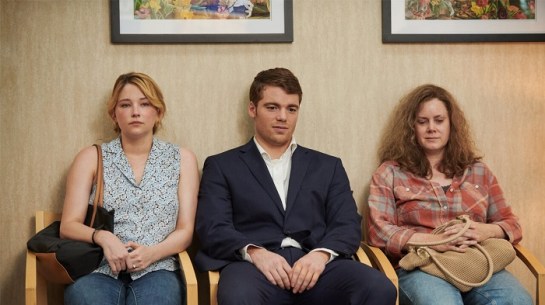
For those needing evidence that absolutely ANY movie can get a sequel, I present to you “Bill & Ted Face the Music”. Now to be fair this is actually the second sequel to the original 1989 “Excellent Adventure”. It was followed by the pair’s “Bogus Journey” in 1991. But when rumors started swirling of a third movie some thirty years later, let’s just say the prospects weren’t what I would call most triumphant.

But yet all the rumors were indeed true and Orion Pictures has dropped their first trailer. Keanu Reeves and Alex Winter reprise their roles as the air-headed but lovable best buds who must go back to their Wyld Stallyns roots to put together one more song that can save the world. Sound preposterous? Of course it does. It’s supposed to. That said, the trailer doesn’t reveal much and what’s there is more nostalgic than impressive. Hopefully they can give us another goofy, light-hearted adventure.

“Bill & Ted Face the Music” is set for release August 21st. Check out the trailer below and let me know if you’ll be seeing it or taking a pass.

RETRO REVIEW: “Escape from Alcatraz” (1979)

ALCATRAZposter

For the past few months I’ve dedicated Wednesdays to doing Retro Reviews. The way it works is I put up three options on my Twitter feed (you can follow me @KeithandMovies). Followers vote, I rewatch the movie, and then post the review the following Wednesday. Whatever film finishes second comes back the next week against two new choices. So basically you pick what I watch and review.

There is something so simple about “Escape from Alcatraz” yet so foreign to much of modern day cinema. It’s the art of quiet visual storytelling. It’s when a filmmaker is so deftly in sync with his camera and the composition of every scene is so keenly utilized that he or she is able to speak volumes with hardly any dialogue.

Take the film’s fantastic opening. A man we come to know as Frank Morris (Clint Eastwood) is escorted by two trench-coated men to a docked boat waiting in the San Francisco bay. He’s handed off to officers who take him below deck and chain him down as the boat heads toward Alcatraz. It’s a pitch-black night and rain pounds the island prison as the boat slowly approaches. The wily camera, ominous score and distinct use of sound brilliantly places us withing the setting. And not a word of dialogue is spoken until Frank is inside the prison being processed.

ALCATRAZ2

Photo Courtesy of Paramount Pictures

“Escape from Alcatraz” was directed by Don Siegel and it was the last of five films he would make with Eastwood. The film was adapted from a 1963 non-fiction book by J. Campbell Bruce. The story begins on January 18, 1960 with Morris arriving at Alcatraz after previously escaping from the Louisiana State Penitentiary. We’re aren’t told much about Frank or his past crimes. Only that he has escaped from other prisons which prompts the stern and confident warden (Patrick McGoohan) to inform him that no one has ever escaped Alcatraz.

Siegel gives great attention to the daily regimen within the maximum security prison. Through these routines Frank befriends several inmates including the embittered and wrongfully incarcerated English (Paul Benjamin), an elderly painter named Doc (Roberts Blossom), and the chatty Litmus (Frank Ronzio). And as you would expect he makes an enemy or two as well.

ALCATRAZ1

Photo Courtesy of Paramount Pictures

Clint Eastwood is a great fit. Tall, athletic, and with plenty of grit, he has the quiet strength that is perfect for Siegel’s approach to this story. But that’s no surprise. Siegel tapped into those same strengths with movies like “Dirty Harry” and “Two Mules for Sister Sara”. But Eastwood brings more to his character than toughness and brawn. Frank is actually a genius and the only thing higher than Alcatraz’s security level is his IQ. And as the movie’s title makes obvious, he instantly begins planning his escape.

Siegel’s storytelling is as precise and methodical as Frank’s escape plan. Even when it appears he’s shooting nothing more than the minutiae of everyday prison life, there are still plenty of details that build the atmosphere and push the narrative forward. After rewatching it I still struggle with one nagging issue – the ending is surprisingly anticlimactic. But even at 40 years old, “Escape from Alcatraz” still holds up as a solid prison thriller sporting a really strong Clint Eastwood performance.

VERDICT – 4 STARS

4-stars

First Glance: “You Should Have Left”

LEFTposter

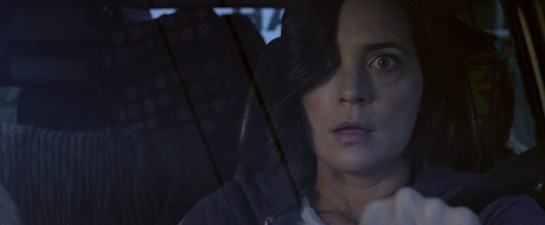
Universal Pictures dropped a nice little surprise for film fans announcing that their new movie “You Should Have Left” will drop direct to VOD in a few weeks. The Blumhouse produced haunted house/psychological thriller is written and directed by David Koepp. What will undoubtedly catch most people’s eye is the film’s star, Kevin Bacon. The film reunites Bacon and Koepp who worked together on the 1999 supernatural horror flick “Stir of Echoes”.

Bacon and Amanda Seyfried play a couple who seek to repair their strained marriage by taking a vacation with their young daughter (Avery Essex). The older screenwriter and his much younger actress wife rent a beautiful country home in Wales and all seems well. But spookiness ensues and bacon’s character slowly begins to unravel, losing his grip on reality and unearthing what looks like some dark secrets in the process. Doesn’t sound especially fresh, but it looks fun and seeing Bacon is a definite plus.

“You Should Have Left” will be released On Demand June 19th. Check out the trailer below and let me know if you’ll be seeing it or taking a pass.

REVIEW: “Shirley” (2020)

ShirleyPOSTER

Acclaimed American author Shirley Jackson, best known for her work in horror and Gothic-styled thrillers, worked for two decades before her untimely death at age 48. Throughout her prolific career she wrote a total of six novels, two memoirs, several books on parenting, and over 200 short stories. Her last few years were spent in seclusion as her health steadily deteriorated. Yet despite her early passing, Jackson left behind a fascinating literary legacy that has recently been discovered by an entirely new audience.

The new movie “Shirley” may sound like a biopic but that label doesn’t really stick. Loosely based on Susan Scarf Merrell’s 2014 novel, the film erases Jackson’s four children and uses the perspective of a fictional young couple among other things. Instead this is more of a biographical sketch that imagines Jackson’s life by placing her in a space that could pass for one of the author’s own short stories. Director Josephine Decker and screenwriter Sarah Gubbins prove to be the right people to tackle this reality versus imagination mindbender.

Often tagged as “experimental”, Decker seems to have an inquisitive and explorative nature that often comes through in her filmmaking. While I’ve often struggled to get in tune with some of her work, here she cunningly melds numerous elements of her movie – narrative with visual, psychological with tangible, genre flavor with stinging social rebuke. It’s such rich and evocative filmmaking. It also doesn’t hurt to have someone like Elisabeth Moss as your lead.

Shirley1

Photo Courtesy of Neon

Moss plays Shirley Jackson at that stage where her health was on the decline and she hadn’t left her North Bennington, Vermont home in two months. Her domineering womanizer of a husband Stanley Hyman (a devilishly good Michael Stuhlbarg) teaches at Bennington College during the day and at night attends numerous faculty ‘gatherings’ often frequented by young co-eds. I’ll let you do the math.

We learn all of this and more through the eyes of Rose (Odessa Young), a freshly married young woman who moves to North Bennington with her husband Fred (Logan Lerman). He’s been hired as a teaching assistant for Stanley while Rose plans on auditing classes at the university. Much to Shirley’s chagrin, Stanley invites the couple to stay with them until they can get their feet on the ground. Rose quickly has her plans dashed after Stanley sneakily puts her in charge of cooking and cleaning while introducing Fred to his college inner-circle.

Meanwhile Shirley observes it all, in one sense keenly aware of what’s happening yet seemingly on the precipice of a mental breakdown. Moss’ frizzy crop of hair and horn-rimmed glasses make her a spitting image of Shirley Jackson, and she brilliantly paints the author as an unsettling enigma. The townsfolk thinks she’s gone sick in the head while Stanley explains away her eccentricities and abrasiveness (such as masking her cutting cynicism as premonitions).

Shirley2

Photo Courtesy of Neon

Meanwhile, Shirley slowly starts finding inspiration in Rose and in the mysterious disappearance of a local college girl. She begins furiously working on a new novel (what would be her 1951 book “Hangsaman”) getting closer to Rose in the process. But in Decker’s wickedly off-kilter sphere Jackson’s motives are always cloudy and we’re constantly wondering whether Rose helping to free Shirley from her isolation and misanthropy or if the seasoned writer is spinning a web and the young woman is trapped inside.

Like much of Shirley Jackson’s work, the film sets you down in a familiar real-world space only to subtly dissolve the boundaries between reality and illusion. Squeezing meaning out of some scenes can be a challenge and at times frustrating. For example, hard to resolve moments of romantic tension (or is it dark eroticism) can feel out-of-the-blue and weirdly disconnected. But Decker paints with expressionistic strokes, infusing scenes with a woozy, hallucinatory quality. Intense closeups, shifts in focus, ghostly gazes, slightly disorienting handheld camerawork – it’s all used to delightful effect.

Aside from its sharp psychological edge, “Shirley” gives a clear-eyed look at women in early 1950’s America and the modern day reverberations. It’s told entirely from the female perspective, showing two women trapped in worlds quietly dominated by their husbands. Moss’ uncompromising and self-contained performance is award-worthy, especially in the scenes with Stuhlbarg where the two vividly bring Sarah Grubbins’ searing dialogue to life. Not every scene gels together seamlessly but the look, tone, and curdling sense of unease keeps you glued to every frame.

VERDICT – 4 STARS

4-stars

REVIEW: “Earth and Blood” (2020)

earthposter

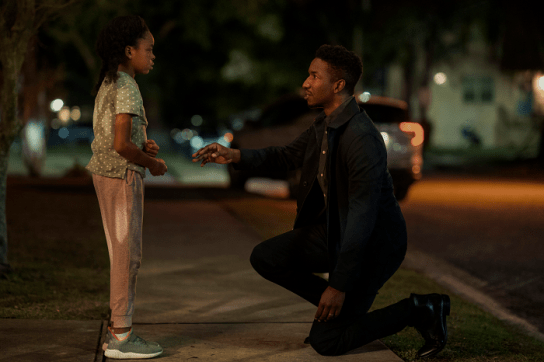
A man in tactical gear sits in his van, a loaded pistol resting on his nervously bouncing knee. Three other men are with him, all armed and staking out a police station. Inside are eight kilos of cocaine confiscated from a drug lord named Adama (Eriq Ebouaney) and he has sent his men to take it back. This tense and well-shot opening is the best scene in the new French action thriller “Earth and Blood”. The scene teases a tough and gritty crime story. Instead we get a surprisingly thin action flick that runs out of ideas despite barely clocking in at 80 minutes.

The film’s biggest asset is Sami Bouajila’s rock solid lead performance. He plays Saïd, a strong silent type who runs a struggling sawmill left to him by his father-in-law. He lives onsite with his hearing-impaired daughter Sarah (Sofia Lesaffre). One of his employees is Yanis (Samy Seghir), a troubled teen out on parole and trying to get his life together. Yanis’ half-brother is Medhi (Redouanne Harjane), one of the gang members from the opening police station scene. Do you follow me so far?

Earth1

Photo Courtesy of Netflix

It turns out Medhi isn’t the sharpest knife in the drawer. He manages to retrieve the drugs but instead of returning them to the drug lord he decides to keep the eight kilos and sell it himself. Brilliant. I mean if the Adama was willing to knock off a police station to get his cocaine back surely he would after one of his goons who double-crossed him. Nonetheless Medhi coerces Yanis to take the getaway car (with the coke in the trunk) and hide it at the sawmill.

Obviously the plan doesn’t pan out. Saïd finds the stashed dope and knows Adama will be coming for it. The film’s second half is basically one long scene – Adama and his henchmen armed with AK-47s hunting Saïd around the sawmill which he knows like the back of his hand. At the same time he entrusts Yanis with getting his daughter to safety. Easier said than done.

Earth2

Photo Courtesy of Netflix

All of that sounds great and you can see the ingredients for a good action movie stew. But director and co-writer Julien Leclercq never gets things above room temperature. There’s no sizzle, no tension, no excitement past that opening sequence. The entire film is shot well and it makes great use of location. But everything is so by-the-book and the action (which is the film’s bread and butter) lacks spark. It doesn’t help that the characters are sketched so thin. We get a couple of early scenes attempting to add depth to Saïd but nothing is really done past that. And outside of one lone instance, any potentially compelling use of Sarah’s deafness never comes into play.

I love that Netflix is reaching out and bringing in films from all over the globe. The international diversity in their portfolio is great to see. “Earth and Blood” had all the markings of a cool French cinema addition and to be honest, there are worse ways to spend 80 minutes. Leclercq knows his way around with the camera and Bouajila’s sturdy lead performance provides us with somewhat of a rooting interest. But so much of its story seems to be missing and its characters never get the depth they desperately need.

VERDICT – 2 STARS

2-stars

YOUR VOICES: On Streaming Versus the Big Screen

your-voices

Your Voices is a simple concept created to encourage conversation and opinions between movie lovers. It’s been a while but it works like this: I throw out a certain topic. After that I’ll make my case or share my opinions. Then it’s time for Your Voices. Head to the comments section and let me and fellow moviegoers know your thoughts on the topic for that day!

One thing the current coronavirus pandemic has shown us is that streaming is a viable option for movie fans when it comes to seeing new films. But what does that mean for movie houses and multiplexes everywhere? With the recent news that AMC theaters may not survive the pandemic-related shutdown, questions naturally arise about the future of watching movies. What does it mean for the movie theater experience? Is streaming an acceptable substitute? Is there a scenario where both can equally co-exist?

Without question I have streamed more new releases recently than I ever have before. Some have been through screeners, but many have been through Vudu, Amazon Prime, etc. The biggest plus to streaming is the instant accessibility and the ability to watch instantly on a wide variety of devices. There is a convenience factor to streaming that is undeniably attractive.

Streaming

But what about movie theaters? Personally I love the seeing movies on the big screen with sharp digital projection and high quality sound. And there is something about joining a group of strangers and watching a movie together (except when they’re constantly chattering or bringing their infant child). And some movies are unequivocally better on a big screen. They are conceived for it, filmed for it, edited for it. In other words they are made for it.

So where do I land? Shamefully on the fence. I want both to be viable options. But I’m not sure if that is realistic. And if so, there are certain to be some business casualties.

But enough of me, now it’s time for Your Voices. Please hit the comments section to share your thoughts.

YOUR VOICES – What are your feelings about the complex issue of streaming versus the big screen?