
The code 7500 is what pilots use to inform air traffic control that their plane is being hijacked. That should give you a good idea of what the new air-thriller from Amazon Studios is all about. The film marks the welcomed return of Joseph Gordon-Levitt (who took over the lead role after Paul Dano dropped out) and he’s asked to put the entire movie on his back.
“7500” is writer-director Patrick Vollrath’s feature film directorial debut. He puts together a tightly-wound and claustrophobic thriller that takes place almost entirely within the cockpit of a commercial airliner. Minus some opening airport security camera footage, the camera literally stays within the cockpit for the duration of the movie. It occasionally looks through the window or out the cabin door, but it always maintains the same close-quartered cockpit perspective.
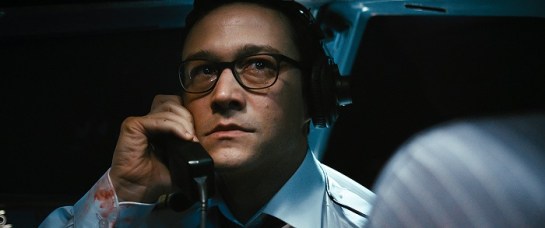
Photo Courtesy of Amazon Studios
The aforementioned airport cameras offer a brief tone-setting introduction to the film’s antagonists. They quietly and effectively show four men making their way through security, a gift shop, the bathroom, and then onboard the plane. We never get much in terms of motivation or purpose. Just a generic splash of Islamist terrorism with no real depth of cause whatsoever. Instead Vollrath seems far more interested in human psychology under extreme duress. How do we respond when pushed to our emotional edge? How do we react in high-anxiety situations? Do we submit to self-control or allow our emotions to drive our actions? “7500” is constantly asking the question “What would you do?”
Gordon-Levitt plays Tobias Ellis, an airman for 10 years who still looks like a college freshman. For this particular flight from Berlin to Paris he’ll be the American first officer for the German Captain Michael (Carlo Kitzlinger). I admit to being really into their pre-flight prep of flipping switches, sharing figures, checking manifests. It’s pretty convincing stuff as they ready the plane and their passengers. These scenes also introduce us to Gökce (Aylin Tezel), a flight attendant who is also Tobias’ fiancé.
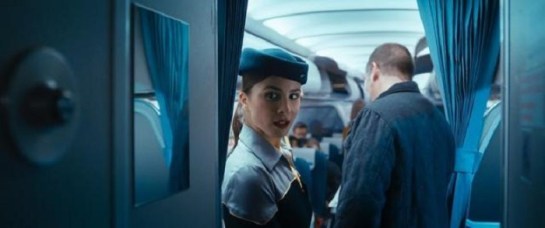
Photo Courtesy of Amazon Studios
Once in the air and at cruising altitude another flight attendant checks on the pilots before locking them in the cockpit. But before she can close the door two men armed with glass shanks knock her aside and rush the cabin. The pilots manage to fight them off and seal the door but not before Tobias is slashed on the arm and Michael is stabbed multiple times. With terrorists threatening passengers and the captain incapacitated, it’s up to Tobias to either follow protocol or give in to the terrorists’ demands.
As the tension ratchets up the choices people make become more of the focus. It’s surprising how much the movie digs into the psychology especially in the third act. That’s also where the drama begins to sputter on its way to an inevitable finish that’s tipped off a few scenes to soon. Still, Vollrath keeps his audience involved and Gordon-Levitt is a solid lead. It all makes for a taut, immersive thriller that may be simple in concept but is crafty in its execution.
VERDICT – 3.5 STARS