
REVIEW: “Shirley” (2020)

ShirleyPOSTER

Acclaimed American author Shirley Jackson, best known for her work in horror and Gothic-styled thrillers, worked for two decades before her untimely death at age 48. Throughout her prolific career she wrote a total of six novels, two memoirs, several books on parenting, and over 200 short stories. Her last few years were spent in seclusion as her health steadily deteriorated. Yet despite her early passing, Jackson left behind a fascinating literary legacy that has recently been discovered by an entirely new audience.

The new movie “Shirley” may sound like a biopic but that label doesn’t really stick. Loosely based on Susan Scarf Merrell’s 2014 novel, the film erases Jackson’s four children and uses the perspective of a fictional young couple among other things. Instead this is more of a biographical sketch that imagines Jackson’s life by placing her in a space that could pass for one of the author’s own short stories. Director Josephine Decker and screenwriter Sarah Gubbins prove to be the right people to tackle this reality versus imagination mindbender.

Often tagged as “experimental”, Decker seems to have an inquisitive and explorative nature that often comes through in her filmmaking. While I’ve often struggled to get in tune with some of her work, here she cunningly melds numerous elements of her movie – narrative with visual, psychological with tangible, genre flavor with stinging social rebuke. It’s such rich and evocative filmmaking. It also doesn’t hurt to have someone like Elisabeth Moss as your lead.

Shirley1

Photo Courtesy of Neon

Moss plays Shirley Jackson at that stage where her health was on the decline and she hadn’t left her North Bennington, Vermont home in two months. Her domineering womanizer of a husband Stanley Hyman (a devilishly good Michael Stuhlbarg) teaches at Bennington College during the day and at night attends numerous faculty ‘gatherings’ often frequented by young co-eds. I’ll let you do the math.

We learn all of this and more through the eyes of Rose (Odessa Young), a freshly married young woman who moves to North Bennington with her husband Fred (Logan Lerman). He’s been hired as a teaching assistant for Stanley while Rose plans on auditing classes at the university. Much to Shirley’s chagrin, Stanley invites the couple to stay with them until they can get their feet on the ground. Rose quickly has her plans dashed after Stanley sneakily puts her in charge of cooking and cleaning while introducing Fred to his college inner-circle.

Meanwhile Shirley observes it all, in one sense keenly aware of what’s happening yet seemingly on the precipice of a mental breakdown. Moss’ frizzy crop of hair and horn-rimmed glasses make her a spitting image of Shirley Jackson, and she brilliantly paints the author as an unsettling enigma. The townsfolk thinks she’s gone sick in the head while Stanley explains away her eccentricities and abrasiveness (such as masking her cutting cynicism as premonitions).

Shirley2

Photo Courtesy of Neon

Meanwhile, Shirley slowly starts finding inspiration in Rose and in the mysterious disappearance of a local college girl. She begins furiously working on a new novel (what would be her 1951 book “Hangsaman”) getting closer to Rose in the process. But in Decker’s wickedly off-kilter sphere Jackson’s motives are always cloudy and we’re constantly wondering whether Rose helping to free Shirley from her isolation and misanthropy or if the seasoned writer is spinning a web and the young woman is trapped inside.

Like much of Shirley Jackson’s work, the film sets you down in a familiar real-world space only to subtly dissolve the boundaries between reality and illusion. Squeezing meaning out of some scenes can be a challenge and at times frustrating. For example, hard to resolve moments of romantic tension (or is it dark eroticism) can feel out-of-the-blue and weirdly disconnected. But Decker paints with expressionistic strokes, infusing scenes with a woozy, hallucinatory quality. Intense closeups, shifts in focus, ghostly gazes, slightly disorienting handheld camerawork – it’s all used to delightful effect.

Aside from its sharp psychological edge, “Shirley” gives a clear-eyed look at women in early 1950’s America and the modern day reverberations. It’s told entirely from the female perspective, showing two women trapped in worlds quietly dominated by their husbands. Moss’ uncompromising and self-contained performance is award-worthy, especially in the scenes with Stuhlbarg where the two vividly bring Sarah Grubbins’ searing dialogue to life. Not every scene gels together seamlessly but the look, tone, and curdling sense of unease keeps you glued to every frame.

VERDICT – 4 STARS

4-stars

REVIEW: “Earth and Blood” (2020)

earthposter

A man in tactical gear sits in his van, a loaded pistol resting on his nervously bouncing knee. Three other men are with him, all armed and staking out a police station. Inside are eight kilos of cocaine confiscated from a drug lord named Adama (Eriq Ebouaney) and he has sent his men to take it back. This tense and well-shot opening is the best scene in the new French action thriller “Earth and Blood”. The scene teases a tough and gritty crime story. Instead we get a surprisingly thin action flick that runs out of ideas despite barely clocking in at 80 minutes.

The film’s biggest asset is Sami Bouajila’s rock solid lead performance. He plays Saïd, a strong silent type who runs a struggling sawmill left to him by his father-in-law. He lives onsite with his hearing-impaired daughter Sarah (Sofia Lesaffre). One of his employees is Yanis (Samy Seghir), a troubled teen out on parole and trying to get his life together. Yanis’ half-brother is Medhi (Redouanne Harjane), one of the gang members from the opening police station scene. Do you follow me so far?

Earth1

Photo Courtesy of Netflix

It turns out Medhi isn’t the sharpest knife in the drawer. He manages to retrieve the drugs but instead of returning them to the drug lord he decides to keep the eight kilos and sell it himself. Brilliant. I mean if the Adama was willing to knock off a police station to get his cocaine back surely he would after one of his goons who double-crossed him. Nonetheless Medhi coerces Yanis to take the getaway car (with the coke in the trunk) and hide it at the sawmill.

Obviously the plan doesn’t pan out. Saïd finds the stashed dope and knows Adama will be coming for it. The film’s second half is basically one long scene – Adama and his henchmen armed with AK-47s hunting Saïd around the sawmill which he knows like the back of his hand. At the same time he entrusts Yanis with getting his daughter to safety. Easier said than done.

Earth2

Photo Courtesy of Netflix

All of that sounds great and you can see the ingredients for a good action movie stew. But director and co-writer Julien Leclercq never gets things above room temperature. There’s no sizzle, no tension, no excitement past that opening sequence. The entire film is shot well and it makes great use of location. But everything is so by-the-book and the action (which is the film’s bread and butter) lacks spark. It doesn’t help that the characters are sketched so thin. We get a couple of early scenes attempting to add depth to Saïd but nothing is really done past that. And outside of one lone instance, any potentially compelling use of Sarah’s deafness never comes into play.

I love that Netflix is reaching out and bringing in films from all over the globe. The international diversity in their portfolio is great to see. “Earth and Blood” had all the markings of a cool French cinema addition and to be honest, there are worse ways to spend 80 minutes. Leclercq knows his way around with the camera and Bouajila’s sturdy lead performance provides us with somewhat of a rooting interest. But so much of its story seems to be missing and its characters never get the depth they desperately need.

VERDICT – 2 STARS

2-stars

YOUR VOICES: On Streaming Versus the Big Screen

your-voices

Your Voices is a simple concept created to encourage conversation and opinions between movie lovers. It’s been a while but it works like this: I throw out a certain topic. After that I’ll make my case or share my opinions. Then it’s time for Your Voices. Head to the comments section and let me and fellow moviegoers know your thoughts on the topic for that day!

One thing the current coronavirus pandemic has shown us is that streaming is a viable option for movie fans when it comes to seeing new films. But what does that mean for movie houses and multiplexes everywhere? With the recent news that AMC theaters may not survive the pandemic-related shutdown, questions naturally arise about the future of watching movies. What does it mean for the movie theater experience? Is streaming an acceptable substitute? Is there a scenario where both can equally co-exist?

Without question I have streamed more new releases recently than I ever have before. Some have been through screeners, but many have been through Vudu, Amazon Prime, etc. The biggest plus to streaming is the instant accessibility and the ability to watch instantly on a wide variety of devices. There is a convenience factor to streaming that is undeniably attractive.

Streaming

But what about movie theaters? Personally I love the seeing movies on the big screen with sharp digital projection and high quality sound. And there is something about joining a group of strangers and watching a movie together (except when they’re constantly chattering or bringing their infant child). And some movies are unequivocally better on a big screen. They are conceived for it, filmed for it, edited for it. In other words they are made for it.

So where do I land? Shamefully on the fence. I want both to be viable options. But I’m not sure if that is realistic. And if so, there are certain to be some business casualties.

But enough of me, now it’s time for Your Voices. Please hit the comments section to share your thoughts.

YOUR VOICES – What are your feelings about the complex issue of streaming versus the big screen?

REVIEW: “End of Sentence” (2020)

EndPOSTER

The Icelandic drama “End of Sentence” is another movie entry which sets out to show that a good road trip can cure all woes, heal all wounds, mend all fences, and so on. Pretty scenery is a balm and the journey’s inevitable speed bumps are sure-fire ways to remedy almost any personal ailment. We’ve seen this before. Yet despite the air of familiarity, “End of Sentence” works because of smart filmmaking choices and two stand-out lead performances.

The movie comes from first-time director Elfar Adalsteins. It works from a screenplay by Michael Armbruster that centers around a father and son at a critical stage in their relationship. The film opens with Frank Fogle (John Hawkes) carrying his wife Anne (Andrea Irvine) to visit their son Sean (Logan Lerman) who’s in an Alabama state prison serving out his sentence for auto theft. Anne, suffering from late-stage cancer, uses the visit to tell her son a final goodbye while Frank, left off the visitors list, waits outside. The father/son tension is obvious from the start.

End1

Photo Courtesy of Berserk Films

A short time later Anne passes away and her dying wish is for Frank and Sean to scatter her ashes near a lake in Northwestern Ireland. But she wants them to do it together. The problem is Sean detests his father (for reasons that come into focus a little later) and he’s quick to turn Frank down once he gets out of prison. Sean has a job waiting for him in California if he can get there in time, but getting there proves tough with no money and no ride. Frank offers to pay for his flight to the west coast if he will help carry out his mother’s last wish. Sean begrudgingly agrees and the two head overseas.

Adalsteins takes the two from Dublin to Belfast and even further north along winding country roads and through small towns. As they travel both characters open up more leading to the inevitable boiling point where secrets are revealed and true feelings are finally laid bare. While the outcome remains predictable, the characters make it worthwhile. Frank is meek, timid, and tightly-wound. He’s cut from the old-fashioned gentleman mold and tends to let people walk all over him. Sean is embittered and full of pent-up anger, harboring deep-seated resentment towards his father.

It makes for a combustible pairing but Adalsteins doesn’t let his story get away from him. “End of Sentence” could have easily spiraled into conventional family drama territory. But it’s kept grounded by good direction that seems keenly aware of the genre trappings and works hard not to fall into them. Even when Sarah Bolger’s Jewel pops up (a character ripe for the third-wheel treatment) the story maintains its humanity and uses her in a smart way. Bolger’s really good and she brings an energy to the movie it really needs.

eos_day25_0122.dng

Photo Courtesy of Berserk Films

It’s Hawkes who is the real standout, delivering yet another performance you can’t look away from. The 60-year-old screen veteran has a career filled with a wide variety of great roles. He’s been a terrifying Ozark mountain meth addict, a frustrated quadriplegic, even a charismatic cult leader. Here he brings a graceful tenderness to a character weighted down by insecurity and grief. Lerman is a solid foil, simmering with acrimony and rage that he often conveys without a word of dialogue. It’s an impressive eye-catching turn.

“End of Sentence” doesn’t veer too far off the formulaic ‘road trip to reconciliation’ path. There’s also a semi-action scene on a ferry boat that feels weirdly out of place. Otherwise there is a lot to like about Elfar Adalsteins’ debut effort, a movie about two hurting souls, past family trauma, and the importance of communication. Along with Armbruster’s intelligent script and a well-tuned cast, Adalsteins never loses sight of the human element either in his characters or his storytelling. It’s a key ingredient the movie embraces to great effect.

VERDICT – 4 STARS

4-stars

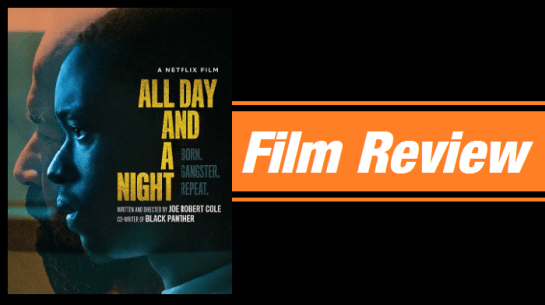
REVIEW: “All Day and a Night” (2020)

AllDay

While watching the new Netflix Original “All Day and a Night” I kept thinking about John Singleton’s “Boyz n the Hood”. That film immersed its audience in the poverty, drug trade, and gang violence of South Central Los Angeles. But those things were never its focus. Instead “Boyz” worked so well because it was all about the people trapped within that hard, violent world. Singleton never lost sight of them for a second.

“All Day and a Night” seems to take inspiration from that 1991 Singleton picture. But I wouldn’t call it a “Boyz” for a new generation. “All Day” (written and directed by Joe Robert Cole) has good intentions and its message is a noble one. Yet despite its propulsive story, I couldn’t get the ring of familiarity out of my ear. From its depiction of urban gangland to the entire narrative path. Even the characters mirror others we’ve seen before. Remember the three friends at the center of “Boyz”: the good kid, the bad egg, and the lead character in between? They’re all here.

AllDay1

Photo Courtesy of Netflix

The movie opens with a double-murder and the rest of the film spends its time bouncing back-and-forth between the lead-up to the homicide and the consequences. Jahkor (Ashton Sanders) guns down a husband and wife in front of their young daughter. In court he sits coldly, defiant and showing no remorse as his guilty conviction is read. Once in prison he begins to reflect on what got him there and what the future may hold.

The flashbacks go as far as 13 years earlier in Oakland, California where young Jahkor (Jalyn Hall) gets picked on in school and then beaten at home by his drug addict father (Jeffery Wright) for not taking up for himself. So instantly we see the seeds of violence and revenge being planted at a young age.

Jump ahead to a few weeks before the murder. Jahkor (Sanders), an aspiring rapper, finds himself at a crossroads. With his music career going nowhere he feels the pull to follow his childhood friend TQ (Isaiah John) working for a local gang leader Big Stunna (Yahya Abdul-Mateen II). On the other hand he and his girlfriend Shantaye (Shakira Ja’nai Paye) are expecting a baby which inspires him to go straight and get a job. But the film goes to great lengths to show that the deck is stacked against Jahkor, and the opening scene leaves little suspense to how things turn out.

All Day And A Night

Photo Courtesy of Netflix

The father-son dynamic and the cyclical nature of street violence is what drives the movie. This is best realized in the prison scenes where Jahkor and his father are both incarcerated. It’s where Wright (thankfully) dials back his performance from an almost cartoonish gangsta caricature to a man reckoning with the life choices he has made. Compare Wright’s portrayal to Isaiah John’s gangbanging TQ who is far more reserved and even more convincing.

Aside from its familiarity the movie is also hampered by a handful of ham-fisted scenes including a heavy-handed exchange in the shoe store where Jahkor works and a weird police interrogation that weirdly and inadvertently makes a case for racial profiling. The opening scene is powerful and starts things off with a jolt, and there are several other good bits scattered throughout the picture. But the connecting narrative tissue just isn’t that strong and it leaves the movie feeling like a lesser version of others that came before it.

VERDICT – 2.5 STARS

2-5-stars

REVIEW: “Mr. Jones” (2020)

JonesPOSTER

The story of ambitious truth-seeker Gareth Jones is one of inspired vigor and rich with modern-day relevance. Jones was a journalist working as a foreign affairs advisor to Prime Minister David Lloyd George. He’s best known for exposing the horrors of the Holodomor, Stalin’s state sponsored man-made famine responsible for the deaths of millions in Soviet Ukraine. Jones was discredited by many of the world’s Soviet sympathizing media but never quit fighting for truth. He was shot to death one day before his 30th birthday.

“Mr. Jones”, a period bio-thriller from Polish director Agnieszka Holland, tells Jones’ story through a ‘cold-hard-facts’ lens. The film takes its time framing its story, spending most of its first half exploring Stalin’s propaganda apparatus and underlining the deception of Soviet stability. But then the movie makes a rather profound shift into gritty, unvarnished survivalism with barely any dialogue but full of haunting, visceral images.

Jones1

Photo: Samuel Goldwyn Films

We first meet Gareth Jones (played by a firmly committed James Norton) in 1933 shortly after his attention-grabbing interview with Adolf Hitler. He stands before a group of British cabinet ministers telling them of Hitler’s ambition and warning that the next Great War is already taking form. The stuffy old men blow off Jones’ claims, hardly ready to plunge their country into another world conflict. Discouraged but not defeated, Jones sticks to his belief that a tectonic shift is underway and the truth is being ignored.

Jones takes notice of some unexplainable changes happening in the Soviet Union. While the rest of the world struggles under a global economic crisis, the USSR is experiencing a surge in growth and modernization. Hungry for an interview with Stalin, Jones is able to get a press visa and heads to Russia. Once there he’s set to meet with his friend and embedded journalist Paul Kleb who has information that could validate Jones’ suspicions.

But first he crosses paths with Walter Duranty (Peter Sarsgaard), a hedonistic Pulitzer Prize winning correspondent for the New York Times with deep connections to the Kremlin. Duranty lives a lavish life in Moscow and is paid handsomely by the Soviet government to persuade the world’s perception of Stalin. Sarsgaard is a perfect fit, slithering from scene to scene, putting off the scent of respectability but every bit of a loathsome snake. A steadily intense Vanessa Kirby plays Ada, a writer for Duranty who doesn’t approve of her boss’ propaganda but is fearful of the power he wields.

From there the movie takes on a much different look, feel, and tone. Jones secures a supervised trip to the Ukraine investigating claims that Stalin had been funneling grain and other resources out of the country leaving the Ukrainian people to starve. He shakes his Soviet chaperone and ventures into the country discovering horrific truths – barren villages, dead bodies in the snow, packs of starving children, and Soviet soldiers with a chokehold on the food supply. It’s a story the world needs to hear, but getting the truth out of the USSR proves to be no easy task.

Jones2

Photo: Samuel Goldwyn Films

“Mr. Jones” feels like a neglected slice of history that’s finally being exposed. It’s story digs into a horrifying period that has been terribly underserved on our screens. And considering our current age of misinformation and biased “news”, this film packs a stinging modern-day applicability. I only wish it had plowed deeper into the Holodomor, specifically Stalin’s twisted motivations and unthinkable justifications. You could make a good argument that it would change this into a different movie altogether. But considering how big a part it plays in the story, it needed a more informative framing.

Still, this British-Polish-Ukrainian co-production does a good job immersing you in its setting and leaves you wanting to learn more. Holland and her screenwriter Andrea Chalupa deserve a ton of credit for the glance they give into Stalin’s propaganda machine and their vivid portrayal of the Soviet atrocities in the Ukraine. The latter is the movie at its most potent, avoiding big screen trappings and allowing the camera and Norton’s well-tuned performance to do the work.

VERDICT – 4 STARS

4-stars