REVIEW: “Welcome to Marwen”

MarwenPOSTER

Inspired by Jeff Malmberg’s fantastic 2010 documentary “Marwencol”, director and co-writer Robert Zemeckis sets out to dramatize the incredible true story of Mark Hogancamp. It’s unquestionably a worthwhile story which Malmberg’s film told well. Zemeckis takes a hearty swing at it but ends up with a pretty big whiff.

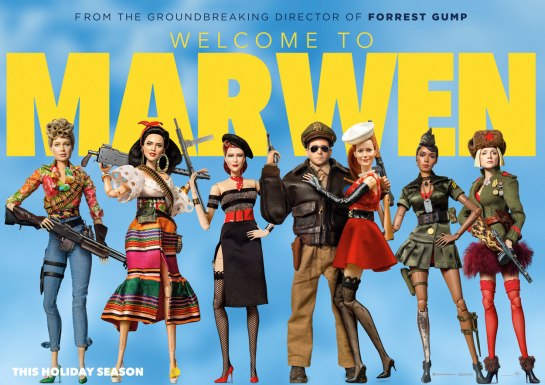
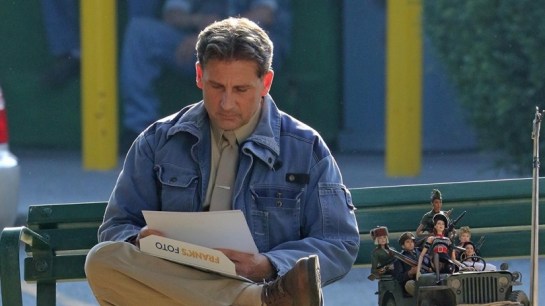
In 2000 Hogancamp was attacked by five men outside of a Kingston, NY bar. He was beaten within an inch of his life  and would spend nine days in a coma. Hogancamp suffered brain damage and severe memory loss. With no means of paying for therapy he lived out a second life within a meticulously crafted miniature town he built modeled after a World War II Belgian village. Within his town of Marwen resides dolls representing those who have influenced his life both for good and bad.
Film Title: Welcome to Marwen

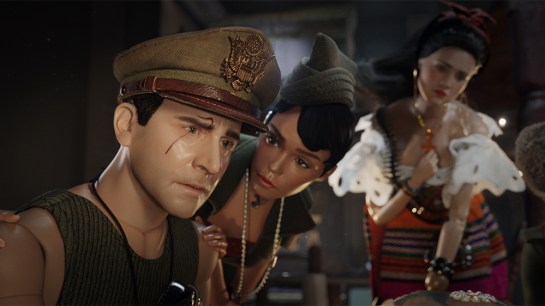
Zemeckis drops us right into Hogancamp’s therapeutic fantasy. Steve Carell stars as both Hogancamp and as Hoagie, Mark’s war hero avatar in Marwen. The two-sided story bounces back-and-forth between his battle to overcome his real world anxieties and the CGI animated Marwen where the dolls come to life and tell stories that mirror his struggles. Problem is neither side is truly fleshed out or given the attention it desperately needs.

The events that led to his state are only covered through flashbacks, newspaper clippings, or gleaned from casual conversations. Instead Zemeckis concentrates on a mundane series of days leading up to the sentencing hearing for Hogancamp’s attackers. Along the way we bump into an assortment of people from his life, several of whom makeup his ‘women of Marwen’. All of them feel brushed over with hardly an ounce of depth. Leslie Mann is the one exception playing a new neighbor. But even she is paper-thin and you know exactly where her story is going.
Marwen2

The animation sequences are cool visually but are often at odds with the other scenes. Zemeckis doesn’t seem to have a grasp of the overall tone he is going for. While these scenes do reflect (to varying degrees) the inner pain and turmoil Hogancamp struggles with, they are often too silly to carry any emotional weight. And too often they rob the other scenes by popping up time the movie could have invested into the real-world story.

Overall “Welcome to Marwen” is a frustrating (and frankly boring) mess. It’s a case of Zemeckis locking into a good concept but not having the clear-eyed vision to see it through. He gets so bogged down in his fictional additions to Mark Hogancamp’s account that he misses what made this strange, heart-tugging story so compelling. Carell certainly gives it his all, but even his good performance couldn’t keep me from constantly checking my watch.

VERDICT – 2 STARS

2-stars

Merry Christmas!!!!

MerryBIG

Just wanted to take a second and wish you all a very Merry Christmas. Thanks for all of the visits, likes, comments, and support this past year. You all truly make this whole movie blogging thing fun.

Here’s to a great 2019!

REVIEW: “Aquaman”

AquaPOSTERsm

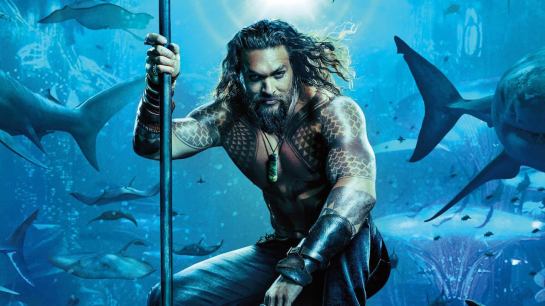
You have to wonder if the Aquaman appearances in the earlier DC Universe films partially served as a taste test for Warner Bros. How would audiences respond to this version of the classic DC Comics character? Could they make a solo film in a way that avoided being as cheesy as a stick of Velveeta? Would Jason Momoa’s beefy, burly charm win over comics fanboys and general DCU skeptics?

Here’s the thing, if you’re already dug in against DC’s refusal to mirror Marvel by doing superhero movies their own way, “Aquaman” probably won’t change your mindset. If you’re a fan of the DCU or if you come at this without a particular bend, then “Aquaman” offers up enough offbeat humor, deep-sea action, and overall craziness to keep you locked in and entertained.

Aqua3

An Aquaman movie has been in various stages of production for nearly 10 years before director James Wan took the helm. Wan’s specialty is horror having made the original “Saw”, two “Insidious” movies, and “The Conjuring” series. But this isn’t the first time he has stepped outside of the genre. In 2015 he directed the seventh “Fast and Furious” installment. “Aquaman” posed a bigger challenge considering the very nature of the character, where’s he’s from, etc. And that’s not counting the $200 million price tag. No pressure.

Wan’s “Aquaman” is incredibly ambitious and he’s juggling a ton of moving parts. Perhaps his best decision was in not making this a traditional superhero origin movie. The backstory of Momoa’s Arthur Curry is told in a few small chunks scattered throughout the film. It’s a sweet and heartfelt tale of a lonely human lighthouse keeper (Temuera Morrison) who rescues and then falls in love with an exiled princess from the underwater city of Atlantis (played by a very good Nicole Kidman). It was a forbidden love resulting in the birth of a child, Arthur, but doomed by Atlantean tradition and intolerance.

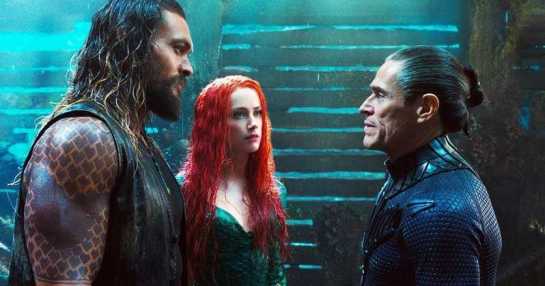
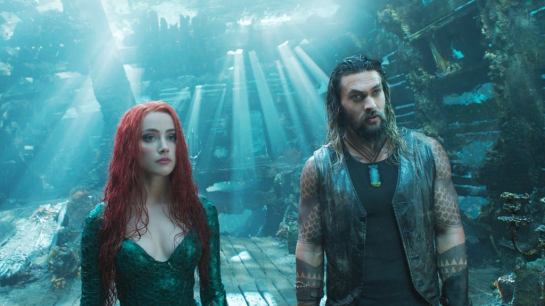
Arthur grew up an outcast among the surface people and shunned as a “half-breed” by the Atlanteans. Along the way we learn of other things that has long fueled his disdain for his ocean-dwelling kin. This makes the appearance of Mera (Amber Heard) hard for him swallow. She tells Arthur of his power hungry half-brother Orm (Patrick Wilson) who works to persuade the seven underwater tribes to wage war against the surface. The only way to stop him? For a reluctant Arthur to return to Atlantis and claim the throne from Orm.

Aqua2

From there the enormous scope of the film is mind-blowing. Is it too big? Yes, probably so. Should it have been trimmed down with a tighter focus? I honestly don’t know. That’s because part of what I liked about “Aquaman” is the sheer audacity of the whole thing. Wan’s story spans the coasts of Maine, the Sicilian seaside (where we get a thrilling and wonderfully shot action sequence – the film’s best), and even the Sahara desert.

And of course there is Atlantis itself, a pulsating world of the ancient and modern; filled with underwater societies, mythical creatures, saddled sea horses and armored sharks, talking crustaceans, and even Dolph Lundgren as a tribal King. It’s so preposterous yet bizarrely remarkable. Wan goes for it full throttle with an unrestrained imagination and a fantastical point of view. He ends up giving us a trademark of good fantasy – a fresh movie landscape, rich with its own history and filled with locations for (potential) future films to explore.

And of course there is the intensely committed cast starting with Momoa. There couldn’t be a better fit for the surly beefcake Arthur – a pain in the butt yet an infectiously enjoyable one. Momoa shines both in personality and physicality. He’s clearly having a good time whether twirling a trident or winking at his sex appeal. Heard, Wilson, and Kidman all manage their characters well. We even get a fun Willem Dafoe as Arthur’s secret Atlantean mentor. Also Yahya Abdul-Mateen II is intriguing as Black Manta, a character I wanted to see more of.

Aqua1

“Aquaman” walks the delicate line between poking fun at itself and treating its story seriously. It’s not an easy thing to do, but when done well it makes for a fun and satisfying genre piece. It’s still very much a superhero movie. You’ll see it hitting several familiar story beats and it doesn’t deviate far from the general structure these films use. But it’s Wan’s attention to his characters and imaginative world-building that makes it work. But those who by nature dismiss or rebel against ‘too much’ CGI, I can see them pushing back against “Aquaman” as well.

The publicity tour for “Aquaman” has been a hoot and no one can say Momoa isn’t comfortable in his own skin. His interviews and appearances have all been fun and lively. The same can be said for his movie. “Aquaman” is an oddly satisfying blast. It’s nothing groundbreaking or highly original, but it is a movie that embraces its weirdness in a way I really appreciated. And while it’s stuffed to gills with action (including what may be my favorite action sequence of the year), it has a little more to say than some will give it credit for. Ultimately “Aquaman” is a sea-worthy DCU installment; the most unlikely superhero to pull off, yet James Wan does just that.

VERDICT – 4 STARS

4-stars

REVIEW: “Roma”

Roma small

From the very first frame of “Roma” you know you are seeing something unique to modern filmmaking. Not necessarily unique to cinema as a whole. As I watched, flashes of Fellini and Tati constantly came to mind. But seeing this level of visual and narrative craftsmanship is a rarity these days.

Alfonso Cuarón’s intensely personal “Roma” is a semi-autobiographical reflection on growing up in early 1970s Mexico City. The film’s title is a reference to the West-Central neighborhood Colonia Roma and Cuarón puts a ton of effort in capturing its energy and vibrancy. It truly is a movie of detail with each gorgeous black-and-white shot framed like a richly detailed memory begging to be examined. It’s a tapestry of individual compositions skillfully woven together by a narrative that has far more heart than it may first appear.

Roma1

The film focuses on Cleo (Yalitza Aparicio), a maid and nanny for a bustling upper-middle class family. Cuarón isn’t as much interested in narrative as he is conveying Cleo’s personal story – her life, her nature, her routines. Much like Xavier Beauvois’ “The Guardians” from earlier this year, Cuarón puts a visual emphasis on her work, capturing every chore and the effort she puts into each of them. It may sound mundane but Cuarón is deftly building her character despite the absence of a traditional narrative.

This family is a significant part of Cleo’s life. In fact there are only a handful of scenes where she is apart from them. Whether taking the kids to school, making an unexpected hospital visit, spending New Year’s at a countryside hacienda, or (in one of the film’s very best scenes) buying furniture in 1971 as the bloody clash between protesting students and Los Halcones erupted. Through Cuarón’s eyes and unknowingly to her, Cleo is a stabilizing force for this family especially when they threaten to unravel after a family crisis. And on a smaller scale the turmoil that festers within their home is an interesting mirror image of the societal unrest outside. It’s a striking metaphor that doesn’t go unnoticed.

ROMA

The Cleo character is inspired by Cuarón’s childhood nanny Liboria “Libo” Rodríguez. She worked for his family for decades and they maintain a close relationship to this day. She has even made cameos in his other Mexican-made films. One of the many things Cuarón’s camera does is accentuate the very essence of her character – her humility, her compassion, her insecurities. But just as important is the way he captures her experience. In many ways Cleo is defined by her experiences and she is much more than simply an avatar for Cuarón’s memories.

Cuarón also uses his cinematic canvas to paint an energetic portrait of the political and social landscape of the time. The film bursts with vibrant street sounds of kids playing, the shouts of vendors, and honking car horns. He uses the canvas to illuminate different areas in and around the city – the family’s cozy residential area, the lively downtown, the muddy slums on the outskirts of the city. And none of these arresting images wastes an inch of the screen.

Roma3

It’s hard to find a beef with “Roma”. It’s such a stunning and intimate work from a filmmaker invested in every facet of the production (Cuarón served as director, writer, cinematographer, co-editor, and co-producer). A couple of scenes did clash for me and felt yanked from another film (the man in a ghillie suit singing in front of a forest fire and a character practicing martial arts with a shower curtain rod while fully nude instantly come to mind). I searched but still haven’t found satisfying answers to those creative flairs.

Mild quibbles aside, you can’t watch “Roma” without seeing the heart of the man behind it. A big deal has been made about Netflix distributing it through their streaming service and limiting its theater run. I would much rather see “Roma” on the big screen, but as with so many films of this type, smaller markets are often left out in the cold. Netflix offers a chance for anyone to see it, and I see that as a good thing.

VERDICT – 4.5 STARS

4-5-stars

REVIEW: “Wildlife” (2018)

Wildbanner

Paul Dano the actor has always been a puzzle to me. While many love his body of work I’ve often felt he requires a very specific type of role. Without it he can seem overwhelmed by the material or lack the range to pull it off. But if the role is just right he can knock your socks off. After seeing his first work behind the camera I can honestly say I have no such reservations about Paul Dano the director.

His new movie “Wildlife” is a mesmerizing bit of filmmaking, so deeply sincere and profoundly human at every turn. What grabbed me early on was how devoted Dano is to his characters – getting them right and never allowing us a moment to doubt their authenticity. His entire focus is on them and the agonizing journeys each of them take. We the audience are simply along for the ride, in the hands of a first-time director telling his story like a seasoned pro.

Wildlife - Still 1

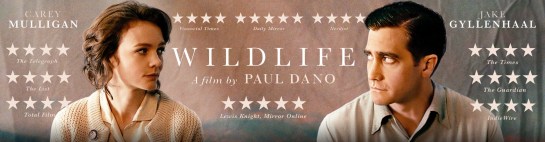
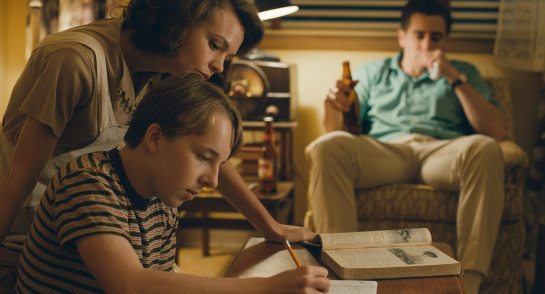
Set in 1960, Carey Mulligan (shamefully overlooked this awards season) and Jake Gyllenhaal play Jeanette and Jerry Brinson. They’re a working-class couple who recently moved to Great Falls, Montana with their bright 14 year-old son Joe (newcomer Ed Oxenbould). Jerry is employed as a greenskeeper at a local country club while Jeanette works to meet the era’s image of a stay-at-home mom. It’s a seemingly idyllic domestic portrait but it doesn’t take long for the cracks to show.

After losing his job Jerry sinks into a mire of depression. He’s battered by self-induced feelings of failure and his ‘man of the house’ pride. It leads him to make a rash decision that leaves Jeanette and Joe to run things until he returns. A bitter Jeanette quickly begins to unravel. Maybe she wishes she could take off like Jerry. Perhaps the weight of being the model housewife and mother has taken its toll. She begins to come apart and her son can only watch.

Review: Wildlife

All of this is told from the perspective of Joe, our moral center for the duration. Through quiet observations he is yanked out of what Dano has called the “Eden of childhood”. His idealized images of his parents are shattered and replaced with the realization that they are real, flawed people. It’s pretty crushing and the slow evolution of Joe’s expressions speaks volumes. Dano doesn’t direct Oxenbould to go big. In fact rarely does the young actor express anything outwardly. It’s through his eyes that we sense his internal struggle to understand what’s happening to his family.

The script was co-written by Dano and his partner Zoe Kazan and is based on a 1990 novel by Richard Ford which Dano instantly fell in love with. The two haggled a bit before landing on where they wanted the story to go. For them it was essential that young Joe be our lens while also evoking some level of empathy for Jean and Jerry . At times I struggled with sympathy for the parents but that’s part of what I love about this film. Dano and Kazan allow plenty of room for us to wrestle with how we feel about these characters and I can see them being read in a myriad of ways.

Wild2

The performances are a critical part of this. From the outset Dano reveals a deep trust in his actors allowing them plenty of room to flesh out their characters. So many shots are framed with this in mind. The camera will sit back, often from Joe’s point of view, and watch Gyllenhaal and most notably Mulligan take charge of the scene. As I’ve said before, there is something intoxicating about watching great actors act. Here Gyllenhaal is somber and restrained, exactly what the role needs. Mulligan steals the show with a performance full of layers and emotional conflict. It could be her best work to date.

“Wildlife” is an impressive first feature from Paul Dano the director. He shows off some good filmmaking impulses and there is a delicate rhythm to his storytelling that I wasn’t expecting. “Wildlife” has such a strong emotional core and even as a fiery metaphor burns on the horizon (I’ll let you discover it for yourselves) the film never loses its heart. It’s tragic and heartbreaking yet through a small sense of hope Dano gives us something to cling to. And as I think on his movie I appreciate that more and more.

VERDICT – 4.5 STARS

4-5-stars

REVIEW: “Hereditary”

Hereditaryposter

It’s probably a good indicator that you aren’t in for a happy two hours when the film you’re watching opens with a newspaper obituary. In “Hereditary” it turns out the obit is for 78-year-old Ellen Taper Leigh. It’s the launching point for this stunning and genuinely creepy filmmaking debut.

Writer-director Ari Aster’s fiendishly disturbing film gets under your skin through slow-boiling horror beats while patiently maneuvering its characters through scenes/stages of grief, mental and emotional instability, and finally full-blown terror. It’s one part a heart-wrenching family story, but as Aster begins carefully peeling away the surface layers of his tale, a dark and deeply unsettling heart is revealed.

Hereditary

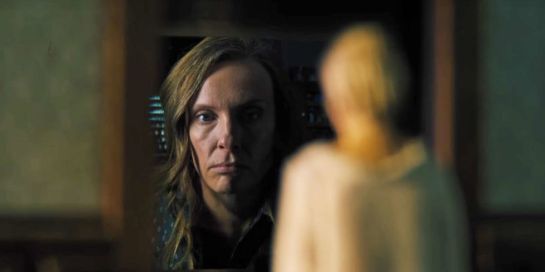
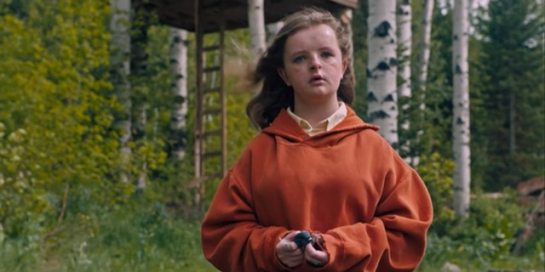
Toni Collette is extraordinary in the film’s lead role. She plays Annie, an artist who specializes in miniatures many of which are based on her own life experiences. She lives in the mountains with her soft-spoken husband Steve (Gabriel Byrne), their 16-year-son Peter (Alex Wolff) and 13-year-old daughter Charlie (Milly Shapiro). She happens to be the daughter of Ellen Taper Leigh. You remember, the woman from the above mentioned obituary?

As Annie eulogizes her mother at the funeral service it becomes clear their relationship was strained. We also learn Annie’s childhood was tough. Her father battled psychotic depression, her mom had dementia and her brother was a schizophrenic. All of it feeds into the estranged Annie’s frame of mind, but it also feeds into the wickedly uncomfortable horror element that simmers at the core of Aster’s film.

Hereditary2

Plot-wise being intentionally vague is pretty essential. The fewer details you have going in the better the effect. It starts a bit slow as its pieces are put into place, but once the psychological terror begins to uncoil the movie methodically grows more and more discomforting. Aster’s examination of grief and mental illness gets darker and more queasy with every scene.

“Hereditary” is a genuinely terrifying movie, not in the gory gruesome or lazy jump-scare sense. Instead it bores deep down under your skin much in the way Robert Eggers did with his exceptional 2016 film “The Witch”. With fine performances, a strong directorial debut, and soaked in the strategically menacing score by Colin Stetson, “Hereditary” slowly pulls you in before giving your nerves and your senses a good working over. That’s the kind of ‘horror’ that lands with me.

VERDICT – 4 STARS

4-stars