
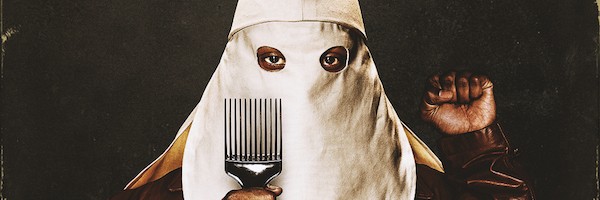
Spike Lee has been called an angry filmmaker and it’s hard to argue otherwise. And that’s not necessarily a bad thing. Throughout his career it’s that anger that has fueled some of his very best scenes. At the same time it’s that very anger that can sometimes drive his movies to be too preachy for their own good. But to his credit I don’t think Lee really cares. He makes the movies he wants and he makes them his way.
“BlacKkKlansman” is his latest hard-nosed socio-political movie and it sports many of the same strengths and frustrations of his past pictures. But what’s most interesting is how “BlacKkKlansman” feels very much its own thing. It’s a bit uneven, yet Lee’s storytelling is thoroughly compelling both in its audacity and its messiness.

“BlacKkKlansman” is loosely based on a hard to believe true story taken from Ron Stallworth’s 2014 memoir. Stallworth was the first African American police officer at the Colorado Springs police department. But his claim to fame was infiltrating a local chapter of the Ku Klux Klan over the phone. Stallworth duped a local KKK recruiter into not only meeting him but offering him Klan membership. He did all his work over the phone posing as a racist white man. A wired white officer stood in for him during any actual meetings.
Lee dolls up this incredible true story with a ton of dramatic dressing which gives him a bigger space to say whatever he wants. His first change was in shifting the time to 1972 (the actual events took place in 1979). This is where we meet Ron Stallworth (played with confidence and gusto by John David Washington, son of Denzel Washington). He is hired to be what one character calls “the Jackie Robinson of the Colorado Springs police force”.
Lee zips through Ron’s early days on the force, quickly elevating him to detective and soon intelligence with barely a hint of struggle or resistance. It feels rushed, even a little sloppy, and leaves behind a lot that could have been explored. One key player we do meet in this segment is Patrice (a very good Laura Harrier), the president of Colorado College’s black student union who Ron meets while undercover. Their playfully combative relationship highlights a great chemistry between Washington and Harrier.
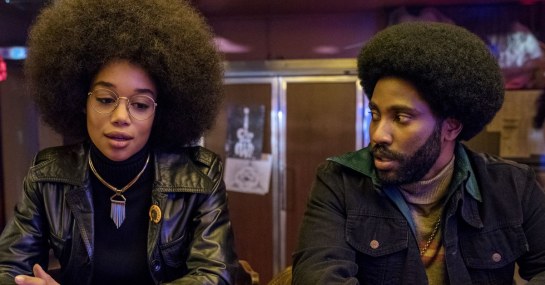
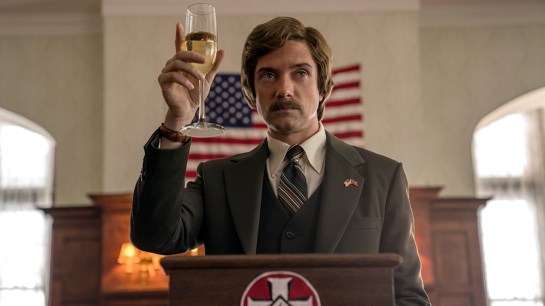
When Ron notices a KKK recruitment ad in the newspaper he calls the number pretending to be white man looking for membership. Chapter prez Walter Breachway (Ryan Eggold) buys the ruse and sets up a meeting. Ron recruits a Jewish narcotics officer Flip Zimmerman (Adam Driver) to join the investigation and build a case against the Klan. Flip stands in as Ron at the in-person meetings burrowing deeper into “The Organization” and eventually meeting the Grand Wizard himself David Duke (a wonderfully calibrated Topher Grace).
The finally act features Lee going full fiction and letting his creative and dramatic imaginations run wild. Most of it (and the movie as a whole) works and offers a bruising indictment of anyone even remotely sympathetic to the disgusting hate-mongering we see. Lee likes stirring the pot and provoking conversation. His piercing portrait of unbridled racism is rightfully uncomfortable and offers up plenty to talk about.
Other parts don’t quite work as well. Finnish actor Jasper Pääkkönen plays the ever suspicious and always maniacal Klansman Felix. He is the movie’s epitome of evil and comes across more as a cartoonish caricature than a thought-out character (perhaps by design?). Also, while the trailer highlights the film’s sense of humor, much of it is lost when slapped against the darker stinging reality which makes up most of the movie. There are a handful of really funny moments, but others don’t land as firmly. You also get a few pretty lazy Trump slams that will resonate with some despite their on-the-nose delivery and some pointlessly crude dialogue which isn’t unusual for a Lee picture.
Yet despite these shortcomings “BlacKkKlansman” is still strikingly magnetic and a fascinating bit of filmmaking. Never a slacker behind the camera, Lee has a fantastic sense of time and space. Every frame drips with early 70’s style and personality. And it’s fed by a stellar soundtrack and Terence Blanchard’s wonderfully jazzy score. Some of my favorite scenes are when Lee sits us down for more personal moments. Take when Ron and Patrice meet up at a predominantly black nightclub. Their sweet ‘get to know you’ conversation ends with a wonderful dance floor sequence to “Too Late to Turn Back Now” by Cornelius Brothers & Sister Rose. It’s a soulful and joyous moment and for them a brief respite from the turmoil of the era.
“BlacKkKlansman” is a skillfully guised epic, far grander in scale than it may appear on the surface. It’s a film rich with metaphors and juxtapositions which we experience through the two main characters, both of whom are carving out their own identities. The entire cast is top-notch led by Washington and Driver who perfectly sink into their multi-layered roles. Lee knows they’re good and utilizes them to the fullest. Of course it’s preachy and at times too on-the-nose. After all it’s Spike Lee we’re talking about. Yet there are still plenty of gray areas which give us room to think for ourselves and reckon with what we see. For me that’s when “BlacKkKlansman” is at its best. “All Power to All People”
VERDICT – 3.5 STARS












 Keith & the Movies