RETRO REVIEW: “The Lord of the Rings: The Two Towers”

Twoposter

Peter Jackson’s “The Fellowship of the Ring” was an extraordinary introduction to his “Lord of the Rings” trilogy. It not only introduced us to its compelling assortment of characters, but it also firmly planted us within J.R.R. Tolkien’s vast enchanting world. But it’s the second installment, “The Two Towers” where the series truly hits its stride.

“The Two Towers” takes the story of its predecessor and expands it in every way. Fascinating new characters, more lands throughout Middle-Earth, and even higher stakes than before. But one of Jackson’s many great accomplishments is how seamlessly he blends these new pieces into the existing fabric. And despite the immensity of his scope, the movie never loses its intimacy.

two3

Picking up where “Fellowship” left off, Frodo (Elijah Wood) and Sam’s (Sean Astin) journey to destroy the One Ring has grown more arduous and the weight of the ring more burdensome. As the two struggle to find a path to Mordor, the sallow, emaciated Gollum (Andy Serkis) secretly follows them. He was the ring’s former owner, consumed by its power and desperate to reclaim it. When Gollum is discovered Frodo shows pity and uses him as a guide against the pleas of a concerned Sam.

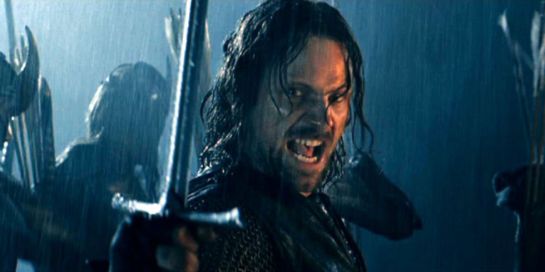
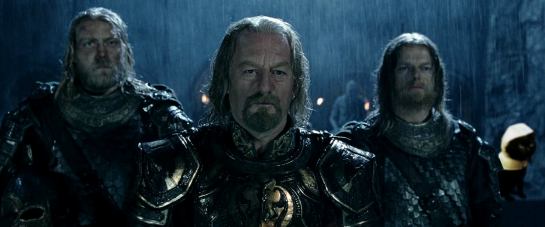
A second story thread follows Aragorn (Viggo Mortensen), Legolas (Orlando Bloom), and Gimli (John Rhys-Davies) as they follow the trail of their abducted Hobbit companions Merry (Dominic Monaghan) and Pippin (Billy Boyd). They are led through the war-torn lands of Rohan whose King Theodin (Bernard Hill) lies under a spell of the wicked wizard Saruman (Christopher Lee).
Two1

And yet a third story thread follows the aforementioned Merry and Pippin who manage to escape their Uruk-hai captors after the Orc soldiers are attacked by Éomer (Karl Urban) and his exiled Riders of Rohan. The two Hobbits hide deep within Fanghorn Forest where they encounter a mysterious tree beings called Ents.

The challenges for this incredible three-headed story are obvious. Huge in scale and with a ton of ground to cover, yet vitally important that it all comes together. Jackson melds together his many moving parts with remarkable precision. And of the several new characters introduced not a one feels wasted or undeserved. Each fit and have a place in Tolkien’s tumultuous world yet have their own personal storylines that take form without ever feeling pointless or intrusive. It’s a remarkable mixture of character and narrative.
Two2

Then there is the genius of Jackson’s technique. From his sweeping camera combing the exquisite New Zealand landscapes to the subtlest of closeups capturing every worry, concern, and pain of the characters. Equally exhilarating are the action scenes both small and epic in size. It’s hard not to be blown away by his framing of the action as well as Weta Workshop’s extraordinary special effects. Jackson really opens it up with the first of the series’ huge battlefield sequences. The Battle for Helm’s Deep remains my favorite segment in the entire trilogy.

Much more could be talked about including Jackson’s knack for not only building tension but maintaining it throughout a sequence. Also “The Two Towers” highlights Jackson’s keen ability to convey to the audience an incredible sense of the mystical and magical. The world he and his teams place us in are rich with imagination and the fantastical. But the greatest thing about the series is that it’s far more than eye candy and sparkly window dressing. It’s the characters and their stories that form the heart of trilogy. That’s especially true for “The Two Towers”.

VERDICT – 5 STARS

5STAR K&M

5-starss

REVIEW: “Operation Finale” (2018)

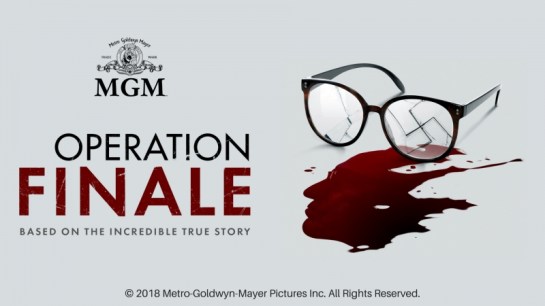
Finale poster

Otto Adolf Eichmann was a high-ranking Nazi SS officer and one of the key architects of Hitler’s “Final Solution”. Decorated and revered among the Nazi hierarchy, Eichmann’s fingerprints were all over the Holocaust. He would organize and oversee the mass deportation of Jewish communities to extermination camps across Eastern Europe during World War II. The hunt and subsequent capture of Eichmann is a fascinating story to behold.

After World War II Adolf Eichmann escaped custody and hid throughout Europe before settling in Buenos Aires. “Operation Finale” from director Chris Weitz spotlights the Israeli intelligence team who located Eichmann and were tasked with bringing him back to Jerusalem to stand trial before the nation.

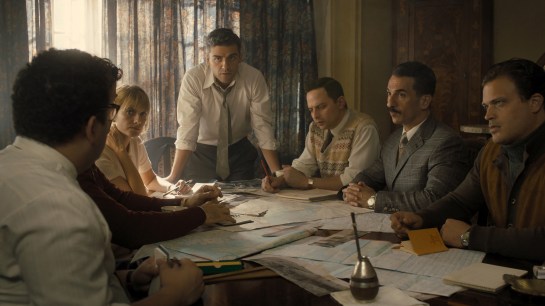
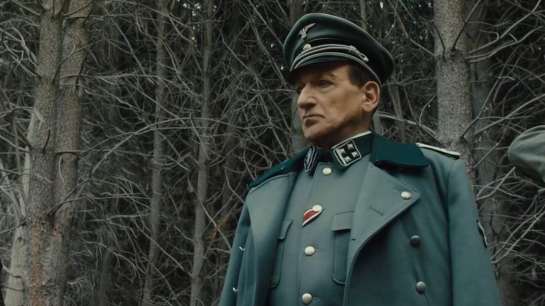
Oscar Isaac stars as Peter Malkin, a secret agent from the more aggressive wing of the Mossad. In 1960 the intelligence agency initially ignores a lead claiming Eichmann had been spotted in Argentina. But fearing public outcry, Malkin and his team are sent to South America to covertly extract Eichmann under the noses of an unhelpful local government and a rising Nazi sentiment. Ben Kingsley plays the enigmatic Eichmann, a queasy mixture of family man and outright monster.

Finale1

First time screenwriter Matthew Orton covers a lot of ground in the film’s two-hour running time. A good chunk is spent peeling back the layers of Eichmann and revealing an unexpected touch of humanity. It’s a tough juggling act particularly for Kingsley who is both unsettling and convincing. His portrayal hides Eichmann’s heinous beliefs behind a veil of good manners and fatherly devotion giving form to what historian Hannah Arendt referred to as “the banality of evil”.

Then you have the Jewish intelligence team whose pain-driven impulses for revenge routinely clash with their sense of duty. It is especially true for Peter who still finds himself haunted by flashbacks of the German atrocities. This adds another level of stress to the already demanding mission. Some good performances fill out the rest of the team – Lior Raz, Nick Kroll, and the always good French actress Mélanie Laurent. She plays a doctor and Peter’s former love interest although their relationship isn’t given a lot of detail.

An integral side story features one of my favorite young actresses Haley Lu Richardson (“Columbus”, “The Edge of Seventeen”). She plays Sylvia, the daughter of Lothar Hermann (Peter Strauss) who secretly feeds information to the Israelis regarding Eichmann’s whereabouts. But her budding relationship with Eichmann’s Nazi-sympathizing son (Joe Alwyn) puts her in a precarious position. It’s an interesting story angle but unfortunately Richardson’s character gets lost in the third act as the film crunches the timeline and focuses more on the extraction.

Finale2

The film’s slow boil may push away those looking for a snappier or more action-oriented thriller. But I appreciated its deliberate pacing and attention to character. As I said about Richardson, not everyone gets the fullest treatment, but there are some fabulous character-driven moments specifically between Isaac and Kingsley. They offer some great exchanges amid two top form performances.

Producers Fred Berger and Brian Kavanaugh-Jones have stated that there is far more truth to their story than dramatic license. That’s one reason you won’t find “Operation Finale” leaning too heavily on routine tropes and gimmicks to amp up the tension. They want it to come from a more authentic place. That gives this film a different feel – patient, even methodical to a point. It wouldn’t appear to be the easiest sell, but a strong backing from MGM Studios ensured its production.

It has been said that as the end of the war drew close Eichmann declared he could “leap laughing into the grave because the feeling that he had five million people on his conscience would be for him a source of extraordinary satisfaction.” It’s that deep-seated wickedness and unspeakable callousness mixed with their own personal losses that drove the Mossad throughout this incredible mission. “Operation Finale” shines a light on their efforts and does so with reverence, patience and with the help of one stellar cast.

VERDICT – 4.5 STARS

4-5-stars

Arkansas Cinema Society, Filmland 2018, and Growing a Local Film Culture

ACS banner

My mind was racing as I walked to my car under the glimmering street lamps of Little Rock’s cozy River Market. It was a late Thursday evening and I had just left a screening of 1998’s “The Newton Boys” followed by a Q&A featuring acclaimed filmmakers Jeff Nichols and Richard Linklater. Needless to say that’s a pretty big deal for any fan of cinema. At the same time I kept thinking of how bigger it was for my home state of Arkansas and its growing movie culture.

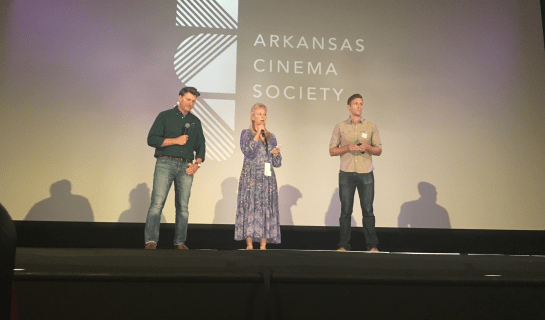
The screening marked the start of Filmland, a four-day event put together by Arkansas Cinema Society. Filmland would feature a day set aside for Arkansas-made movies complete with Q&As with local filmmakers. Other days featured a comedy panel, a documentary screening, and a closing night sneak preview of the upcoming historical drama “Operation Finale”. In addition to Linklater, ACS brought in Will Forte, Mary Steenburgen, David and Christina Arquette, and a host of other writers, directors and producers.

Arkansas Cinema Society’s inaugural event was just last August but in a short one year’s time the organization has seen tremendous growth particularly in local sponsorships and in exposure. This is great news for local filmmakers and cinephiles. Filmland built upon last year’s success and expanded into several intriguing areas. But ACS isn’t just about annual events. Throughout the past year they have featured outdoor screenings, a writing seminar, the introduction of their Homegrown Film Series, and many other activities.

Cinema

The driving force behind ACS is Jeff Nichols. With five stellar feature film credits serving as both writer and director, Nichols has earned the reputation as one of America’s best cinematic voices. Yet his love for his hometown and his desire to see an ever-growing Arkansas film community has driven him to use his resources and connections to bring quality films and talents to Arkansas. His goal for the ACS – to educate, encourage and inspire both filmmakers and film lovers from the Natural State.

But Nichols couldn’t do this alone. Co-founder Kathryn Tucker tirelessly works to make the local events happen and she is always quick to thank her incredible team. Much of the preparing, promoting and running of the events fall in their laps and observing their dedication and enthusiasm is infectious. ACS simply couldn’t function without them. As Tucker herself has stated, “It takes an army.”

The true beneficiaries of all the hard work and effort are us – the Arkansas film fans. Whether we aspire to make movies, write about them, or simply love the art form, Arkansas Cinema Society has given many of us a seat on the inside where the filmmaking process is opened up and made alive. Not only is it enlightening, but it offers opportunities for our love of cinema to be nurtured and expanded. That has certainly been the case for me whether it’s seeing good movies, listening to the artists who made them, or watching those hard at work to make the events happen.

As I was getting closer to my car a big smile spread across my face. I had just watched a movie with a theater full of fellow movie lovers. I had just listened to, met and had a photo with 5-time Academy Award nominee Richard Linklater. That same photo was photobombed by one of my favorite working filmmakers Jeff Nichols, a proud and unashamed Arkansas guy. It was truly a great night and it was only day one! Thanks ACS.

LINK2peg

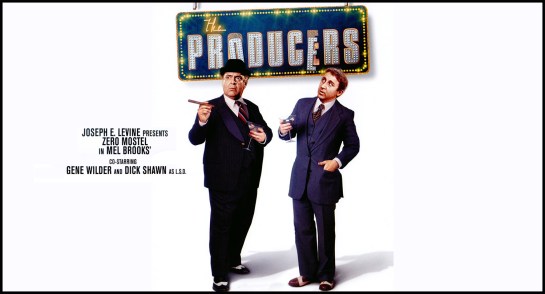
BlindSpot Review: “The Producers”

PRODUCERS POSTER

Mel Brooks burst onto the filmmaking scene in 1967 with his raucous satirical comedy “The Producers”. It was his big screen debut as writer and director. After a wild variety of initial reactions, “The Producers” would eventually earn Brooks an Academy Award for Best Original Screenplay. Not a bad way to start your moviemaking career.

“The Producers” started as a joke, moved to a play and ended up a movie. Initially it was a tough sell for Brooks who had a difficult time finding backers amused by his melding of Hitler and a musical. Once funded Brooks was given $1 million and 40 days to finish his movie. He pulled it off but not without some bumps along the way which mainly stemmed from Brooks’ inexperience as a director. After release initial reviews were all over the map including some that ripped the film to shreds. Yet it still won an Oscar and over time “The Producers” has gained a much more positive following.

PROD1

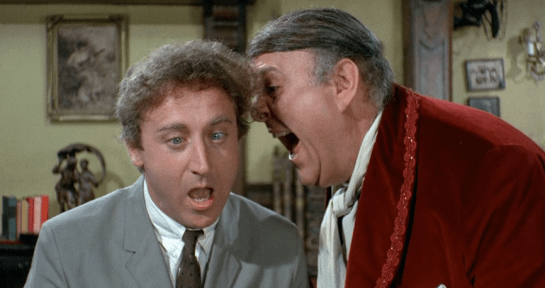
As nutty as they are, the film’s two lead characters are based on actual real-life inspiration. Washed-up Broadway producer Max Bialystock (Zero Mostel) stays afloat by duping wealthy elderly women into supporting his “next big production”. But with his well running dry, he solicits the help of a neurotic and gullible accountant Leo Bloom (Gene Wilder). The two concoct a wacky plan to make the worst play possible. Max will oversell the shares, Leo will doctor the books, the play will bomb, and the swindled money will be theirs. What could go wrong?

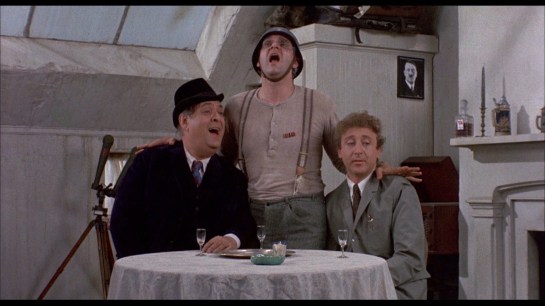
The desperate and dimwitted duo begin by seeking out the worst possible script. They find it in “Springtime for Hitler”, a musical love letter to the Führer sincerely written by a loony ex-Nazi (played by Kenneth Mars). Next they hire a notoriously bad director Roger De Bris (Christopher Hewett) who has a long history of Broadway flops. Finally the lead role of Hitler is given to Lorenzo Saint DuBois, a trippy hippie who fittingly goes by L.S.D. All the pieces are in place for a sure-fire disaster.

PROD2

Brooks takes this goofy band of misfits through the play’s production and eventually opening night. The entire concept screams absurdity and one of the great things about “The Producers” is that it can be delightfully tasteless in its humor. Not crass or vulgar, but unashamedly politically incorrect. It’s almost prodding people to be outraged while at the same time ridiculing the very thing which stirs them up. Lines like “We’re marching to a faster pace. Look out, here comes the master race.” and “Don’t be stupid, be a smarty! Come and join the Nazi Party!” only touches the surface. But it’s all done in such a preposterous fashion it’s impossible not to laugh out loud.

And you can’t say enough about the comic chemistry between Mostel and Wilder. In some scenes Brooks takes off their leashes and lets them run wild. There are moments where it can be a bit much (and a bit loud), yet at the same time it’s fascinating to watch – the deviously deceptive Mostel and always nervous Wilder bouncing their lines off each other. Most important it’s really funny and it serves as a nice introduction to the brand of zaniness Mel Brooks would share over the three decades that would follow.

VERDICT – 4 STARS

4-stars

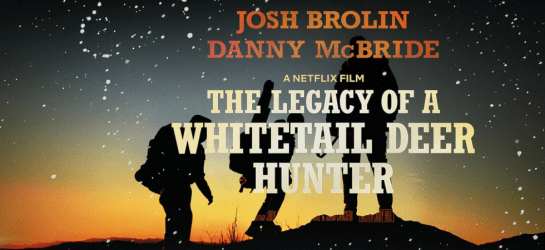
REVIEW: “The Legacy of a Whitetail Deer Hunter”

Deerposter

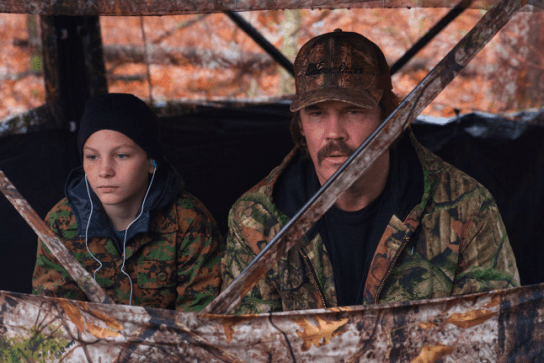
In one very specific way I felt a lot like Josh Brolin’s Buck Ferguson. Where he was looking for the elusive monster whitetail deep in the Appalachians, I was looking for the untapped potential in his movie. I looked everywhere, waited patiently, and after 83 minutes it never came. Well, not completely.

As that bad metaphor falls apart in your mind, let me put it a bit clearer. “The Legacy of a Whitetail Deer Hunter” has so much potential. Pieces are there for a rib-splitting indie classic (and that’s no overstatement). Unfortunately it never quite gets out of first gear. It’s also trapped in a swirling vortex of ideas and identities. Is it a full-blown comedy? Is it a moving character study? Is it a coming-of-age story? A movie can certainly be all of the above, but central to its success is that they work in harmony, at least in some capacity. That just isn’t the case at all here.

Deer1

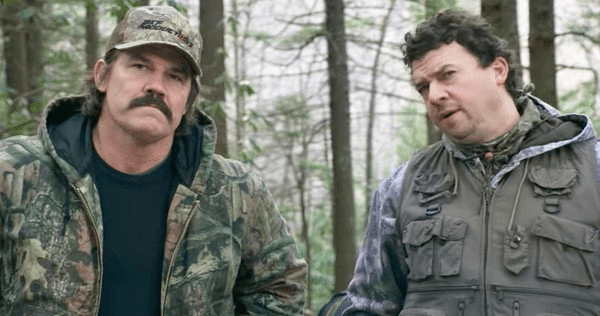
The architects are Jody Hill and Danny McBride of HBO’s “Eastbound & Down” fame. They co-write the script along with John Carcieri, Hill directs, and McBride plays a supporting role. Fans may have a good idea of what to expect, but as someone with little connection to their collaborations, they weren’t the biggest draw for me. Instead it was Josh Brolin and his seemingly perfect fit as Buck Ferguson, a whitetail enthusiast who makes VHS quality deer hunting videos for a living (believe it or not, for a time those things were fairly popular).

Fresh off of a divorce Buck envisions a whitetail deer hunt as an opportunity to mend his relationship with his 12-year-old son Jaden (Montana Jordan). For Buck, killing your first Whitetail is like a rite of passage and he has grown deeply concerned that if his son doesn’t “take to it now he might not ever”. With his loyal cameraman Don (McBride) in tow, the three venture deep into the beautiful Appalachian Mountains in search of what Buck calls the monster “non-typical” (for the uninitiated that mean a huge whitetail deer).

The problem is Jaden has no real interest in deer hunting or being in the woods with his father. He’s much more into Wi-Fi signals, Panini, and checking in with his girlfriend Caroline back home. This not only stymies Buck’s hopes of bonding, but also his plans to shoot a father-and-son episode for his “Buck Fever” series. So again I mention the pieces are here for a ‘good ol’ boy’ southern-fried comedy.

DEER2

Unfortunately “Whitetail” is only an occasionally funny satire. I kind of see what Hill and McBride are shooting for (no pun intended), but it’s never silly enough, never thoughtful enough, or even clever enough to land with much conviction. And the character treatments aren’t much better. Take McBride’s wildly inconsistent Don character. One minute he is a loyal and sympathetic sidekick only to act disgusting two scenes later. I’m sure giving a 12-year-old drags off his cigarette and showing him pornographic Polaroids will be funny for some. I found it to be jarring both with the tone of movie and the character himself. Young Montana Jordan fares a little better although he is never as funny as the movie wants him to be.

Thankfully we get Josh Brolin, so superbly cast to play this ‘type’. Without a hint of parody and a ton of sincerity, Brolin is firm enough in his conviction to make Buck easily the movie’s funniest character. There is no winking at the camera, only commitment which is exactly what the character needs. He’s perfectly positioned for an off-the-rails wacky comedy but Hill never really goes for it. Ultimately Brolin can’t save the movie from spinning its wheels and feeling like a terribly missed opportunity. Not a horrible film, but a needlessly bland one.

VERDICT – 2.5 STARS

2-5-stars

REVIEW: “Ready Player One”

ReadyPoster

In “Ready Player One” the world has become a pretty crummy place. Energy shortages, economic stagnation, and overpopulation has turned many of the world’s cities into slums. Aside from widespread poverty it has also resulted in cases of social unrest (my personal favorite being ‘The Bandwith Riots’).

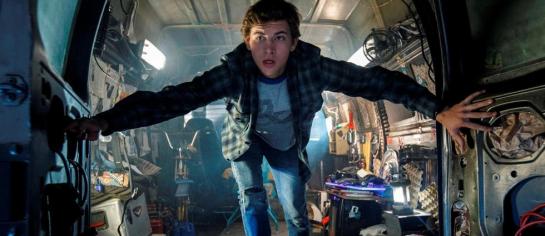
One of the stricken cities is Columbus, Ohio. Orphaned 18-year-old Wade Watts (Tye Sheridan) lives with his Aunt Alice (Susan Lynch) in a poor neighborhood known as The Stacks. Like everyone else, Wade escapes the harshness of life through the OASIS, a massive virtual reality playground of interconnected worlds. It was the brainchild of sheepishly eccentric James Halliday (the always wonderful Mark Rylance) who posthumously reveals that an Easter Egg is hidden deep within the OASIS. Whoever finds the virtual three keys can unlock the Egg and gain full control of Halliday’s fortune and the OASIS.

Ready1

These are the worlds director Steven Spielberg plays in – both real and virtual. It was first conceived through the creative mind of Earnest Cline whose award-winning 2011 novel has been a phenomenon in itself. Cline joins writer Zak Penn in adapting his story to the screen and Spielberg takes it and runs. The CGI is as endless as the opening narration but it does allow Spielberg to do some pretty crazy things. Look no further than an homage to “The Shining” which is nothing short of fabulous. But by the third act CGI fatigue had set in.

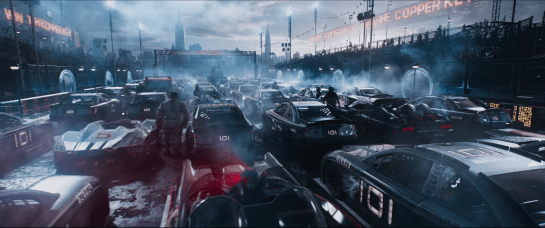
Wade, an unabashed Halliday enthusiast, begins scouting for clues within the OASIS. His hunt for the first key leads to an elaborate vehicle race through virtual Manhattan. It’s an extraordinary sequence featuring Bigfoot (the monster truck, not Sasquatch), the 1933 King Kong, Jurassic Park’s T-Rex, and a DeLorean time machine for starters. Wade encounters and quickly falls for fellow racer Art3mis (Olivia Cooke). The two reluctantly ‘clan up’ to find the keys and keep the Oasis out of the wrong hands.

Ben Mendelsohn provides the story’s antagonist, an evil corporate head who wants the OASIS for himself. Mendelsohn is a good actor who can do these kinds of roles in his sleep. But he feels a little off here. Maybe bland is a better word. I don’t think it’s Mendelsohn’s doing. It’s more of a script issue and indicative of the lack of depth we get in several of the supporting characters.

Ready2

The story delves into several obvious themes: the haves versus the have-nots, self-identity, etc. But it’s most effective as straight-up pop culture science fiction. It’s essentially a virtual treasure hunt where the characters are searching for three keys while I was hunting for as many culture references as I could find. And there are a ton of them. You could say “Ready Player One” is relentlessly nostalgic and that turns out to be a positive. There are moments when the nostalgia is all that keeps the film afloat.

It’s hard not to be impressed by the sheer volume of pop references scattered throughout the hefty 140 minute running time. The Iron Giant, Hello Kitty, Saturday Night Fever, Freddy Krueger, Mortal Kombat, even Buckaroo Banzai! I’m sure someone out there has compiled a list. For me that was the fun of “Ready Player One” and it’s what made the movie stand out. It’s threaded throughout the story just enough to keep me interested. But if you happen to look past the nostalgia for something more, you may have a hard time finding it.

VERDICT – 3 STARS

3-stars