REVIEW: “First Reformed”

First poster

“A world without hope”. It’s an idea wrestled with (in some form or another) by several characters and it’s one of many things on the mind of “First Reformed”, the latest film from writer-director Paul Schrader. This hopelessness feeds a lingering despair that is mirrored in the lives of several key players and is woven into the very fabric of this hypnotic exploration.

I realize that may not be the most upbeat way to introduce a movie, but when honestly dealing with themes of guilt, obsession, self-destruction, and despair the rays of light should be just as difficult for us to find as it is for the characters. And much like the ‘Crisis of Faith’ classics it follows, “First Reformed” is more interested in the spiritual and emotional struggle as well as the toll it takes on the human psyche.

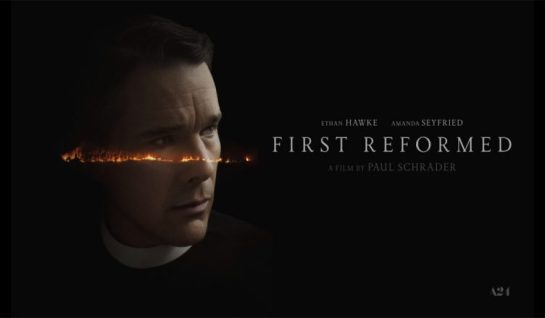
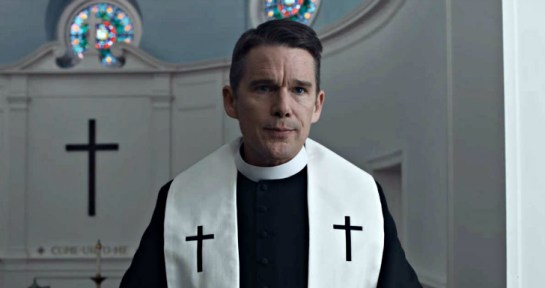
Giving the performance of his career, Ethan Hawke plays Reverend Ernst Toller. He pastors a Dutch Colonial church is upstate New York known more as a historical landmark than a place of worship. First Reformed Church gets by thanks to its parent megachurch, ironically named Abundant Life. It’s ran with a businesslike prowess by Pastor Jeffers (Cedric Kyles, better known as Cedric the Entertainer). Jeffers preaches to packed houses and has big community connections. Toller sees more sightseers than parishioners and struggles in his alone time to reconnect with God.
first1

After a Sunday service Toller is approached by one of his few faithful church members, a pregnant woman named Mary (Amanda Seyfried). She implores him to meet with and counsel her husband Michael (Philip Ettinger) whose environmental fanaticism has driven him into a deep state of depression. Michael questions the “sanctioning” of bringing a child into a world he believes to be doomed and he poses a question that haunts Reverend Toller for the duration of the film, “Can God forgive us for what we’ve done to this world?”

Always a solid actor, Hawke dials back from the type of performances he’s known for. It’s a quiet and reserved portrayal allowing much to be told through expression and even appearance. Deep wrinkles etched in his brow held up by tired, forlorn eyes. You truly get a vision of a man who as Schrader himself put it “has lived a life”. In his case it hasn’t been an easy one. Harboring guilt from his past, unable to connect with God through prayer, and sickly due to a worsening stomach ailment. You can’t help but see shades of the struggling young priest from Robert Bresson’s “Diary of a Country Priest”.

The great French auteur wasn’t the only influence for Schrader. Hints of Carl Dreyer’s “Ordet”, Ingmar Bergman’s “Winter Light”, Tarkovsky, Ozu and Rossellini are everywhere. You even see him pulling from the same thematic toolkit he used in his acclaimed collaborations with Martin Scorsese (“Taxi Driver”, “Raging Bull”).

First2

The cracks in Reverend Toller’s psyche begin to show after an especially troubling tragedy. Add to that pressures from his church’s upcoming 250th anniversary reconsecration ceremony. During his daily duties Toller puts up a good front. But it’s at night, alone with his thoughts and journal, when we see the gravity of his dark inner turmoil. He’s a man mired in self-destruction and self-contradictions, yet at the same time he is yearning for the voice of God. He’s a good man who has lost his way.

The mood of the film is nailed down via Alexander Dynan’s stellar cinematography. The cold gray tones and deep shadows are only occasionally washed with color and those instances aren’t without meaning. There is also the stillness of Dynan’s camera offering very little motion at all. But in the rare scenes where the camera does move, you can be sure the movements are rich with purpose. Add to it the intensely effective score from Welsh composer Brian Williams, minimal yet undeniably foreboding.

In the 27th chapter of Matthew’s Gospel Jesus cries out “My God, My God why hast thou forsaken me?” It’s a cry of anguish from the Son of God calling out to His Father but hearing no response. To an obviously lesser degree, you can imagine the same cry burning in the heart of Reverend Toller. It all builds up to an ending that feels slightly out of tune with the rest of the film (or does it?). And while fascinating to watch and contemplate, I’m still not sure how I feel about it. At the same time I love how I’m still wrestling with it. And when complimented by a bracing career-best turn from Hawke, strong supporting work throughout, and an auteurist presentation, you have a film that I can’t help but love.

VERDICT – 4.5 STARS

4-5-stars

Oscar’s New Category – Best Popular Movie???

IMG_1001-0

Yesterday the Academy of Motion Pictures Arts and Sciences announced the addition of a brand new Oscar category. A mere five months removed from their lowest rated Oscar broadcast in history, the Academy voted in some fairly big changes to their big show. Tops on the list is a new award “for outstanding achievement in popular film.” Really?

First and foremost whether this matters to you will largely hinge upon whether you think the Oscars do. There seems to be a growing number of moviegoers who dismiss the Oscars as a frivolous and pointless entity of no inherent value. They aren’t entirely wrong and I say that as a fan of the Academy Awards. But if you do fall into that group, humor me just a tad.

Much of the early reaction to this has been negative and for good reason. While “eligibility requirements and other key details will be forthcoming“, it’s hard to see this as anything other than desperate pandering. The Academy folks are clearly feeling pressure to increase viewership but come on. Talk about ridiculously transparent.

Don’t get me wrong, I get the logic. There is a chance the broader, more easygoing movie audience will tune in if the big box office blockbusters they love are in the running for a statue (I kinda doubt it, but maybe). And if the blockbusters are there so will their A-list stars. They will be on television strolling down the red carpet and talking about their movies. I get all of that. But does it in any way make ‘Best Popular Film’ anything more than a token award?

In an attempt to possibly quell any negativity, the Academy came out a short time later and clarified that a movie could be nominated as both Best Popular Film and Best Picture. Well that could seemingly snuff out any potential suspense for the new category. Let’s say “Avengers 15” is the only film nominated in both. Since it would be the only ‘popular’ movie worthy of a Best Picture nomination, it’s petty obvious it should win the ‘Popular’ Oscar, right?

And what about the prestige of the Academy Awards? Sure, sometimes they miss the mark (the last two years have shown that), but in many eyes the Oscars have maintained a pretty high standard and stature. While not without their scars, it’s part of what makes the Oscars special. I’m not sure this kind of pandering helps that reputation.

And couldn’t the very existence of this category give Academy voters an out when it comes to these types of movies? Why give them the Best Picture consideration they deserve when you can toss them a bone here? It could make for some easy and not-so-veiled marginalization.

As you can probably tell I’m all in for the Academy giving more consideration to quality box office hits and they’ve done so in the past. But for every “Lord of the Rings: Return of the King” and “Titanic” win you have multiple “The Dark Knight” and “Wonder Woman” snubs. I can’t see a scenario where a Best Popular Film category solves the issue. A little more Hollywood introspection, maybe. But this, nope.

My favorite movie of the year so far is “Mission: Impossible – Fallout”. As of right now do I believe it should be a Best Picture nominee? Absolutely. Would I be remotely excited if it was in the Best Popular Film category instead? Absolutely not. So I’m sorry Academy, your experiment doesn’t work on me. Then again I was already going to be watching, even without a new gimmick award.

What say you? I would love to hear your thoughts on Oscar’s new addition.

5 Phenomenal Cold Weather Movies

I don’t know about where you are, but August heat in the deep south can be pretty brutal. Maybe that’s why I’ve been thinking about (and in some cases yearning for) cold weather. And since I’ve been behind on Phenomenal 5 lists what better summer topic than cold weather movies? I shouldn’t need to say that the number of worthy movies is large. To narrow it down I’ve focused on films where the cold weather plays a significant part. Also no Christmas movies. Now with so many candidates I wouldn’t call this the definitive list. But there is no denying that these five cold weather movies are most certainly phenomenal.

#5 – “Snowpiercer”

Snowpiercer

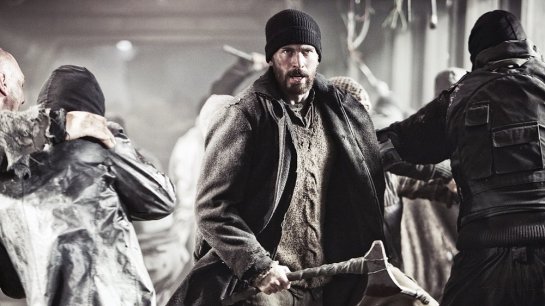
In Bong Joon-ho’s dystopian science-fiction thriller “Snowpiercer” cold weather has a rather huge effect. An attempt to end global warming has turned the planet into a uninhabitable frozen wasteland. As a result the remains of humanity are trapped inside a non-stop globe-trotting train. It sounds silly but the themes it wrestles with and the visual style of the auteur behind it make it an easy choice for this list.

#4 – “The Shining”

Shining

It’s kinda hard to imagine this list even existing without including Stanley Kubrick’s beloved “The Shining”. The film’s iconic setting needs little introduction – The Overlook Hotel high up in the Colorado Rockies. Off-season caretaker and struggling writer Jack Nicholson burrows in for the winter, but as he spirals towards insanity his wife and son are trapped inside with him by the frigid elements. And to say things get a little chilly for Jack in the final act is an understatement.

#3 – “Alive”

Alive

Frank Marshall’s 1993 survival drama “Alive” was based on the true story of a Uraguayan rugby team’s fight to survive following their plane crashing high in the Andes Mountains. Isolated and with no ability to communicate, no food and amid brutally cold conditions, the group was pushed to their limits and the life-or-death decisions they made changed them forever.

#2 – “The Thing”

thing

I adore John Carpenter’s 1982 sci-fi horror classic “The Thing” and cold weather definitely has a role to play. Kurt Russell and his team trudge through snow and sub-zero temperatures to uncover answers to a violent encounter at a research base in Antarctica. Parasitic monsters and paranoia take center stage, but the harsh weather is an ever-present threat that makes for the ideal setting.

#1 – “Fargo”

Fargo

When it comes to the #1 pick how could it be anything other than this Coen Brothers gem. “Fargo” is a movie that encapsulates everything that makes the Coens both unique and extraordinary. This bizarrely delicious crime comedy spans from icy Minneapolis, Minnesota to icier Fargo, North Dakota. And while “Fargo” is all about the characters, the cold weather supplies the perfect backdrop.

Now it’s your turn. How about my choices? See something I missed? Please let me hear your picks in the comments section below.

REVIEW: “Come Morning”

COME poster

The very existence of “Come Morning” is a testimony to a love of cinema that transcends the routine Hollywood formula. It’s the same deep appreciation for film and process that independent filmmakers have been showcasing for decades as they plow their own paths to tell their own stories. For writer, director, cinematographer, and editor Derrick Sims that love for the form oozes out of every frame of his movie.

The film’s production is an inspiring story in itself. It was shot in just twelve days and with a crew of only ten people, many of whom tackled multiple roles. Sims shot on location near his childhood home of Kingsland, Arkansas during a chilly early winter and with the bulk of the scenes taking place at night. Yet despite the limitations of an extremely tight budget, Sims never allows for himself to be handcuffed creatively.

COME1

This Deep South suspense thriller is set in 1973 rural Arkansas. Frank (Michael Ray Davis) prepares to take his grandson D (Thor Wahlestedt) out for an afternoon hunt amid the cryptic protests of his concerned wife (Elise Rovinsky). It’s clear to us that her worries are rooted in something deeper than an old man and a young boy going hunting. But Sims doesn’t tell us everything. Instead he wisely allows up to pick up bits of information along the way.

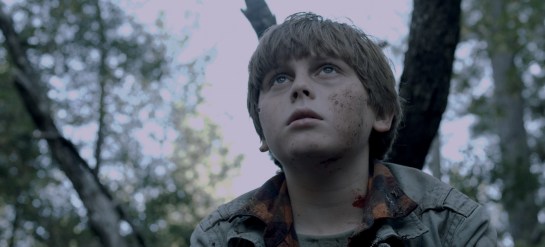
As we stubborn men tend to do, Frank ignores the pleas of his wife and takes D to their spot in the woods. Believing they have shot a deer, the pair discover they have accidentally killed Marion Mitchell (Thomas Moore), a trespassing neighbor with the volatile history with Frank’s family. D wants to call the police, but Frank decides to hide the body deeper into the woods, one of several complex moral decisions with hefty consequences.

As the story pulls Frank and D further from home a sense of dread settles over the film. We know things are not going to go well. As with before, Sims doesn’t spell everything out for us. Instead the backstory takes form through small pieces of conversations and a handful of flashbacks, some more effective than others. And as things steadily grow darker, we watch young D’s innocence being chiseled away in one scene after another.

Come2

Adding to our overall unease is how Sims deftly creates atmosphere and tension. Much of it is through the arresting cinematography. Again, the bulk of the film takes place at night yet despite that potential hurdle Sims is able to create a convincing sense of place. It is especially seen in the landscapes which are visualized in such a way as to be both beautiful and foreboding. And when accompanied by Justin Slaughter’s striking and understated score, it’s all the more effective.

“Come Morning” tells a simple yet compelling story while pulling us into a place shrewdly realized through Sims’ camera. And despite being patient with its reveals, the film maintains a crisp and economical pace throughout within its taut 80 minute frame. There are instances where the money constraints can be felt, but the film shows that even miniscule budgets can’t overthrow a good story especially when it lies in the hands of a confident filmmaker with a clear vision.

“Come Morning” is available on Amazon Prime. Give it a look and tell me what you think.

VERDICT – 4 STARS

4-stars

REVIEW: “Eighth Grade” (2018)

EightPoster

As I prepared to see “Eighth Grade” a sense of terror coursed throughout my body. I was genuinely excited to see the widely adored teen drama while at the same time dreading the very thought. Why all the tension you ask? I’m a father of a wonderful young daughter who is about to enter…you guessed it…the eighth grade. And if the testimonies of the film’s bruising authenticity were true, I knew it would hit close to home.

This is the first feature film for writer-director Bo Burnham. At the risk of exposing my glaring ignorance of modern pop media, I had to do a search to find out more about him. Turns out Burnham has had an interesting rise to fame. He first “went viral” on YouTube in 2006 and his popularity quickly skyrocketed. Now in addition to being a musician, comedian, and actor, Burnham is an intriguing young filmmaker worth keeping your eye on.

eIGHT2

“Eighth Grade” is a striking debut that reveals an astute perspective on middle school life. It’s a movie that I can see speaking to different people in a variety of ways. I can see it profoundly effecting those who find themselves in the lead character’s shoes. I can see it enlightening other groups to the struggles of fellow students. I can see it opening the eyes of parents to the complexities of their kid’s point of view while also giving kids a window into the heartfelt struggles of their parents.

The beating heart at the center of “Eighth Grade” is 15-year-old actress Elsie Fisher. While she did voice work in the first two “Despicable Me” movies, this is Fisher’s first big role but you would never guess it. She tailors a performance that is true and organic in every detail. Each insecurity and anxiety feels strikingly authentic. She’s truly a marvel, even a bit daring in her unflinching commitment to the role.

Fisher plays Kayla Day, a young teen navigating the final week of eighth grade. Middle school was tough, not near what she hoped it would be, but with a timid optimism she looks forward to the next stage in her life. Much to the chagrin of her patient and well-meaning single father (played by Josh Hamilton in just the right key), Kayla soaks her herself and her problems in the world of social media. She fills her follower-less YouTube channel with self-help advice videos in part because of her inherent kindness but also as a subconscious means of self-motivation.

Burnham keenly has his finger on the pulse of the weird middle school years where teens see everything changing both inside and out. It’s even tougher for a kid like Kayla who doesn’t fit neatly within the crude and often ugly social structure we have allowed and have often reinforced. She consistently rejects her own advice to “just be yourself” with awkward attempts to buddy up with the popular crowd. We know it won’t go well. On the flip-side is her relationship with her hapless father, unshakably loving but ill-equipped to handle his daughter’s swirl of emotions. The father/daughter tensions are portrayed with a clear-eyed honesty.

eighth1

I was also drawn to Burnham’s use of perspective. You could be tempted to see his camera as mean-spirited and unsympathetic. It routinely highlights the droop of Kayla’s shoulders, the small rolls around her belly, her scattered acne which clashes with the pristine complexions of the in-girls. But that’s not what’s happening here. The bulk of the film is seen through Kayla’s eyes and often reflects how she sees herself as well as others. Take when she gets an adoring ‘puppy love’ glimpse of the class bad boy (Luke Prael). A hysterical bang of musical chords accompanies his studly slow motion strut across camera. But as with many things, that perspective changes over time.

“Eighth Grade” doesn’t pave an easy path for its lead character. Kayla’s struggles are realistic, relatable and heartbreaking. You could almost call it relentless if not for the welcomed moments of levity strategically sprinkled throughout. At the same time, Burnham offers an insightful critique of social media and internet identity, the very thing that launched his career. Yet beyond the slew of Snapchat and selfies is a strong message about believing in yourself and moving forward. That’s something I think we all need to hear.

VERDICT – 4.5 STARS

4-5-stars

REVIEW: “The 12th Man” (2018)

12poster

Some brief opening text lays out the setting for director Harald Zwart’s astounding “The 12th Man”. Nazi Germany occupied Norway on April 9, 1940. Three years later in Scotland British forces trained Norwegian soldiers to carry out sabotage missions in their homeland. On March 24, 1943 twelve Norwegian resistance fighters were sent to target German airfields in Operation Martin Red. Only one would come back alive.

This Norwegian historical thriller is based on the extraordinary true story of Jan Baalsrud, the lone survivor of that doomed operation. The film is based on a biography by Tore Haug and Astrid Karlsen Scott. It’s not the first movie based on a book of Baalsrud’s life. The 1957 drama “Nine Lives” received an Oscar nomination and remains a highly regarded picture.

12one

The grueling role of Baalsrud is played by Thomas Gullestad. Zwart starts quickly with Baalsrud and his team crawling out of the icy arctic waters onto the northern shores of Norway amid a hail of bullets. We learn that a costly mistake blew their cover and a German vessel attacks as they approach the mainland. Forced to scuttle their shot-up fishing boat, the twelve struggle ashore where German troops await them. Eleven are captured, Baalsrud escapes.

One of the first things I noticed was Zwart and cinematographer Geir Hartly Andreassen’s striking perspectives. Their camera placements and the fluidity of its movements offer one penetrating visual after another. Then you have the shots of the stunning Norwegian landscapes which in context are both beautiful and ominous. These images add a menacing dimension as the wounded and battered Baalsrud trudges through the frigid snow and ice.

“The 12th Man” spotlights Jan Baalsrud’s resilience as he makes his way towards neutral Sweden’s border, fighting treacherous terrain, excruciating cold and the doggedly determined Gestapo. But as he slowly succumbs to snowblindness, hypothermia, and gangrene the true crux of the story comes into focus. The film is just as much about the people he meets throughout his harrowing journey. Jan’s strength and heroism is matched, often exceeded, only by the Norwegian patriots helping him at every step – civilians routinely risking their lives to save his. In many ways they form the emotional core of the movie.

12two

Equally fascinating is when the movie shifts focus to that of a Gestapo officer named Kurt Stage (played by Jonathan Rhys Meyers). No one has ever escaped Stage’s pursuit and he takes Baalsrud’s flight personally. He persistently hunts Jan rejecting the skepticism and needling of an ambitious fellow officer (Martin Kiefer). Myers offers a charismatic antagonist pushed more by ego and obsession than duty.

Some may say the film’s biggest surprise is in Harald Zwart’s direction. Perhaps known more for his misfires (“Agent Cody Banks”, “The Pink Panther 2”, “The Karate Kid” remake), but don’t let that dissuade you for a second. His portrayal of this unbelievable true story is riveting both visually and narratively. Whether he is capturing Jan Baalsrud’s intense and sometimes brutal attempts at survival or creating genuine moments of levity with the men and women risking everything to aid him. It makes for truly inspirational cinema.

VERDICT – 4.5 STARS

4-5-stars