The Movie Trailers of San Diego Comic-Con 2018

COMIC

The huge entity that is San Diego Comic-Con came and went like a flash but not before dropping several movie trailers worth talking about. Superheroes and monsters made up the bulk of the conversation. Some of them were pretty exciting, one specific one not so much. Below are the biggest trailers from SDCC 2018. Give them a look and tell me what you think.

I’m Sold

“Godzilla: King of the Monsters”

https://youtu.be/wVDtmouV9kM

This thing looks wild. It’s the third film in Warner Brothers’ MonsterVerse and a sequel to the 2014 Gareth Edwards film. With quick but stunning images of Mothra, Ghidorah, and the King himself, it looks to be a super ambitious undertaking. I can’t wait to see it.

“Glass”

https://youtu.be/95ghQs5AmNk

I hope by now everyone has seen “Split” and the really cool curveball M. Night Shyamalan threw at us. I never saw it coming. Now we get our first look at “Glass”, the crazy, unexpected result and it looks great. Fingers crossed that M. Knight can pull this off.

Very Interested, Want To See More

“Aquaman”

https://youtu.be/WDkg3h8PCVU

Warner Brothers and DC really need this one to work. So far I’m onboard. Jason Momoa has a big, beefy charm and it goes a long way in selling the “Aquaman” trailer. The world itself looks intriguing and the story has genuine potential. Lots of CGI and armored sharks have me slightly concerned, but so far so good.

No Thanks!

“Shazam!”

https://youtu.be/go6GEIrcvFY

The rumblings of a “Shazam!” movie have been around for a while and we finally got a glimpse. It looks like they are all-in on making this a goofy spoof which doesn’t bode well for fans of the character’s long history. That aside, comedy can work. But that brings up a second problem – what we see isn’t that funny. Hopefully a second trailer can leave a better impression.

REVIEW: “Leave No Trace” (2018)

LeavePoster

It’s hard to believe it has been eight years since director Debra Granik’s last narrative feature. That movie was “Winter’s Bone” and it portrayed a distinct slice of America as foreign to most people as a distant alien planet. Her latest is “Leave No Trace” and while not nearly as grim as her previous film, it’s a movie that once again explores a segment of our population on the fringes.

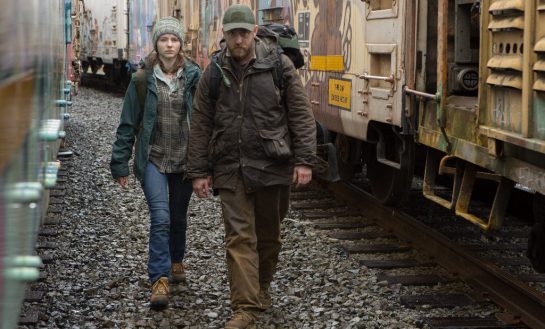
Granik and co-writer Anne Rosellini base their script on Peter Rock’s 2009 novel “My Abandonment”. It tells the story of a father and daughter living off the grid in a National Forest outside Portland, Oregon (beautifully visualized through Michael McDonough’s camera). Ben Foster gives the performance of his career as Will, a beaten-down veteran and father to his 13-year-old daughter Tom. She’s played by New Zealander Thomasin McKenzie, a relatively fresh new face who matches Foster’s brilliance scene for scene.

Leave1

With the exception of necessary trips into the city for supplies and to pick up Will’s check from the VA, the pair survive off the land. By nearly every societal standard they are homeless (as a case worker later explains “It’s not a crime to be unhoused, but it’s illegal to live on public land”), but for Will living on their own provides his only sense of freedom. Foster is known for playing intense characters on the edge, but here he so naturally falls into the role with a quietness and restraint that conveys a surprising amount of insight into his character.

Take Will’s struggles with PTSD. He’s haunted by nightmares and flashbacks but we never see any of them, only the effects. Ultimately it’s up to Foster to show the weight of the trauma. It’s a tricky role that the seasoned actor nails.

The story takes a significant shift when Will and Tom are discovered and taken into custody. They are met with compassion and given a place to stay. For Tom this opens up the possibility for stability, to make friends, and to be part of a community (something Granik has a true knack for portraying). Will attempts to adapt but ultimately feels smothered in society’s cage. For the rest of the way the film wrestles with the idea of ‘home’ and what that means to both Will and Tom.

I’ve read some comparisons, but this is no “Captain Fantastic” scenario. If you remember, in that film Viggo Mortensen raises his family to the wilderness as a hippie’s statement against the evils of modern culture. “Stick it to the man!” was their battle cry. There is none of that in “Leave No Trace”. Will has no idealistic stand he’s making. He loves his daughter and is raising her the best way he knows how. The movie makes no harsh judgements on him, but Tom is our conduit and her experience brings us to some inevitable conclusions. She loves her father and wants to be with him. But she’s also becoming her own person. In one of the film’s most powerful scenes Tom lovingly tells her father “The same thing that’s wrong with you isn’t wrong with me.”

Leave2

Much like she did for Vera Farmiga in 2004 (“Down to the Bone”) and Jennifer Lawrence in 2010 (“Winter’s Bone”), Debra Granik has developed a star-making role for Thomasin McKenzie. The young actress is such a vital piece of the movie – gentle and earnest but with a quiet strength. And you won’t catch a false line in her entire performance. Every soft-spoken word comes from a place of pure sincerity. She’s really good and this is a name you’ll be hearing a lot of.

“Leave No Trace” struck a chord with me early and I could feel its emotional tug all the way till the end. It’s not a movie deeply concerned with plot. Instead it is all about character. Granik’s biggest investment is in creating two people we can care about and can connect with. Maybe not with their specific circumstances but on a deeper human level (while subtly opening some eyes along the way). It certainly worked for me.

VERDICT – 4.5 STARS

4-5-stars

REVIEW: “Pacific Rim: Uprising”

PACposter

Five years ago revered filmmaker Guillermo del Toro added one of the weirdest additions to his already strange and eclectic filmography. The movie was “Pacific Rim”, a big-budget sci-fi monster mashup that drew comparisons from Transformers to Rock ‘Em Sock ‘Em Robots. Sporting a whopper of a budget, the movie didn’t exactly burn up the box office, but it did gain a cult following and was successful enough to encourage a sequel. But that doesn’t mean we needed one.

“Pacific Rim: Uprising” had only a slightly smaller budget but made significantly less money. Not a good sign for fans of the aspiring franchise. Aside from a producer credit, del Toro is out of the picture. And while his first installment was far from pure greatness, it did a number of things this sequel just doesn’t pull off.

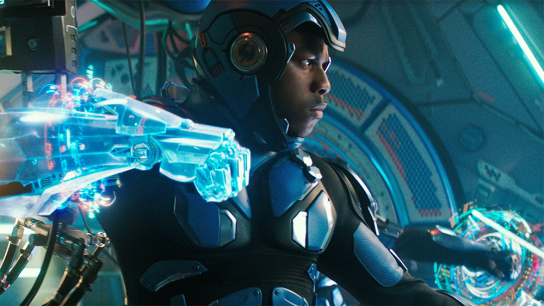
As you recall, giant monsters known as Kaiju emerged from a portal at the bottom of the Pacific Ocean. To combat these city-leveling threats mankind constructed huge mech-like machines called Jaegers. “Uprising” takes place ten years after the events of the first film. John Boyega plays Jake, an ex-Jaeger pilot and son of inspirational Commander Stacker Pentecost (Idris Elba’s character from the first picture). Jake shuns his father’s legacy instead choosing to sell Jaeger parts on the black market.

Pac2

While scavenging Jake encounters a young teen and Jaeger admirer named Amara (Cailee Spaeny). As the two duke it out for a power core it draws the attention of the Pan-Pacific Defense Corps who take them both into custody. Jake is given the choice of prison or returning to the corps as an instructor with his former co-pilot Nate (Scott Eastwood). Amara is among the new cadets he is tasked with training.

But as you would expect things get bad. During a tech exercise in Sidney, Australia a rogue Jaeger attacks increasing calls to shelf the program and replace it with Shao Corporation’s drone technology. To make matters worse a new Kaiju threat surfaces thrusting Jake and his green recruits to the frontlines where the must save the world from enemies big and small.

First time feature-film director Steven S. DeKnight (mostly known for his television work on “Spartacus” and “Daredevil” among others) takes the helm and steers the ship the best he can. The visuals in “Uprising” can be stunning at times and it’s hard not to be impressed by the massive-scaled battle sequences between machine and monster. Even a guy like me who has grown a little numb to the CGI devastation of major world cities in movies found the battles sometimes exhilarating. And the film’s explosive ending is absurdly fun and entertaining.

Pac1

Where “Uprising” stumbles is in its story and its characters. A team of four writers (including DeKnight) are credited with navigating the screenplay through a series of rewrites. Minus a handful of small twists, it’s really a basic story that has little to offer thematically. For example there is only a shell of the first film’s central theme of togetherness. The whole ‘drifting” and ‘neural handshake’ thing is still an intriguing idea but not much is done with it. And we are only given a perfunctory treatment of teamwork and camaraderie. It all feels so lightweight.

And the characters aren’t much better. So often the attempts at human moments are as mechanical as anything we see in Jaeger form. Boyega and Eastwood are the only remotely convincing as pilots but offer little else in terms of character. And other than Amara, the younger pilots are hard to buy into and utterly forgettable.

Guillermo del Toro’s movie was no masterpiece. I would even say it’s somewhat overrated. But it was fun and even a bit nostalgic. Also its message of coming together was effective even in its simplicity. “Uprising” doesn’t match its predecessor in any of those areas. It does have its moments most notably the giant-sized battle sequences. But with so little else to offer, it’s tough to embrace it as anything more than forgettable blockbuster fluff.

VERDICT – 2 STARS

2-stars

REVIEW: “Annihilation”

Annihilationposter

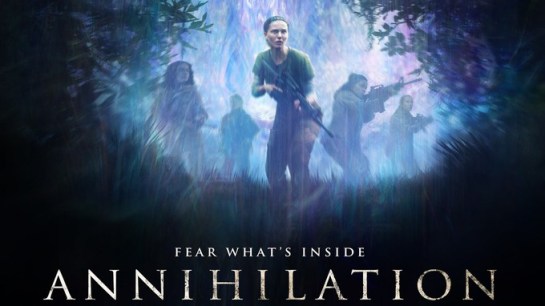
Around the midway point of “Annihilation” one character says to another “We’re all damaged goods here.” This seemingly inconsequential line of dialogue is one of several keys to unlocking the secrets of Alex Garland’s trippy science-fiction mindbender. It’s one of several statements or conversations that offer meaning to what we see, yet unraveling the mystery is a bit tougher than it sounds.

Garland’s previous film 2015’s “Ex Machina” was his directorial debut and showed an affection for toying with sci-fi genre norms and conventions. Garland considers himself a writer first and his genre roots actually go back a bit to his time as a novelist and screenwriter. As with “Ex Machina”, “Annihilation” sees him handling both the writing and directing duties.

The film is loosely adapted from the first volume of Jeff VanderMeer’s 2014 Southern Reach Trilogy. Garland has called it an “adaptation of atmosphere” with a “memory of the book”. He takes concepts from the novel and gives each a good twist making his film very much its own thing. I also couldn’t help but see shades of Tarkovsky’s “Stalker”, Kubrick’s “2001: A Space Odyssey” and more recently Villeneuve’s “Arrival” just to name a few.
Annihilation1

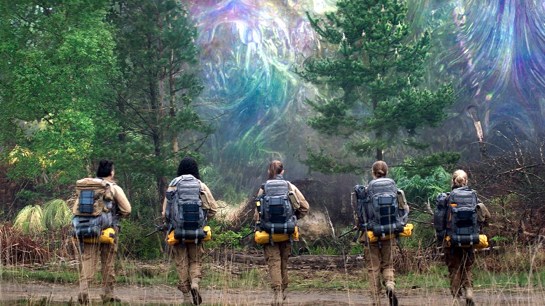
Giving an introduction to the story seems almost pointless since the meat of it is found in the mystery and metaphors. But here goes: Shortly after a mysterious object from space crashes along the United States coastline, an amorphous anomaly forms. For three years the U.S. government have watched it expand and every military expedition into the anomaly has failed. The soldiers who enter immediately lose communication with the outside and have no sense of time or place. Even worse, none of the teams have returned.

Enter Lena played by Natalie Portman, a biology professor emotionally detached following the disappearance and presumed death of her military husband Kane (Oscar Isaac). After a year away Lena is stunned when Kane suddenly shows up. But something is about him is off. He has no recollection of where he has been or how he got home. He quickly becomes violently ill. On the way to the hospital in sweeps the U.S. government to take Lena and Kane to a top-secret facility near the anomaly.

Lena is briefed by a psychologist named Dr. Ventress (Jennifer Jason Leigh). She learns the anomaly is called ‘The Shimmer’ and is slowly engulfing unpopulated swamplands. But concerns are that its growing blob-like borders will eventually swallow cities, states, and so on. Therefore a new team prepares to enter with the mission of reaching ground zero, acquiring data, and making it out alive. Learning of a connection between the Shimmer and her husband, Lena joins the expedition in hopes of finding some answers.

This time the team is made up mostly of scientists instead of soldiers and women instead of men. It’s an interesting assortment of characters. In addition to Lena and Ventress we get Gina Rodriguez as a Chicago paramedic, Tessa Thompson as a timid physicist, and Tuva Novotny as a protective geologist. Each woman fits the above description of “damaged goods” and each come into the Shimmer with their own unique perspective and purpose.

The film’s non-linear structure adds to the overall puzzle. Flashbacks and flash-forwards rich with meaning not only fill in story gaps but reveal some of the key themes. And it toys with time, not to make it needlessly complex, but to feed us narrative and thematic clues. I’m not sure how mainstream audiences will respond to the demand for attention and contemplation. It’s unashamedly cerebral and Garland isn’t interested in playing by genre rules. Sometimes he even breaks his own. For me that was a real strength.

Annihilation2

I found discovery to be a fundamental component both for us and the characters. Take the Shimmer itself – Garland and his crew visualize a truly fascinating off-kilter creation. The exterior emanates both beauty and menace. Think of light being bent through a detergent bubble. The soapy glow offers a stunning effect yet at the same time it’s both ominous and foreboding. The same contrast is seen inside – beautiful albeit unnatural flora mixed with terrifying animal mutations.

I really don’t want to say more because (as cliché as it sounds) this is a movie best experienced. The atmosphere alone was enough to suck me in from the gorgeously discomforting visuals and effects to Ben Salisbury and Geoff Barrow’s unsettling score filled with moody tones and occasional strums of a folksy guitar. It’s all quite effective. Garland has said his intent was to make the Shimmer “truly alien”. Mission accomplished.

But it all gets back to the movie’s meaning, something Garland (thankfully) is unwilling to spoon-feed us. Some have pointed out its dealings with depression, grief, guilt, and the meaning of being human. I believe it speaks to all of those things. More than anything else I heard it speaking the loudest about mankind’s penchant for self-destruction. But one of the truly great things about “Annihilation” is the ambiguity, not for the sake of being ambiguous, but to allow us to mediate and consider what it is saying to us. That’s a special trait the movie has in common some of the very best science fiction.

VERDICT – 4.5 STARS

4-5-stars

REVIEW: “The First Purge”

PurgePoster

The success of James DeMonaco’s “Purge” franchise comes from a fairly simple formula. Make a good and well-received first film and then ride its name for countless sequels. Oh, and this is key – maintain small budgets making it next to impossible to lose any significant money. I would say it has been pretty effective. The four films have a combined budget of around $40 million but have taken in close to $375 million so far. The math is pretty easy.

For me the “Purge” series has been a guilty pleasure – movies with an undeniably absurd concept yet an attractive hook that kept me coming back. But the franchise has steadily evolved to where there is practically no resemblance to the tense Ethan Hawke original. That’s not a good thing. Throughout the course of the movies the horror element has become less and less pronounced. In this newest installment it’s all but gone.

The First Purge” is a prequel aimed at showing how the whole ’12 hours of legal violence’ began. Amid a collapsing U.S. economy a third political party, The New Founding Fathers of America (NFFA), have risen to power. Backed by the NRA (as silly as it sounds) and profoundly white, the NFFA is DeMonaco’s biggest hammer. Of the many he uses, it’s the one he bludgeons us with the most. But at this point in the franchise it’s pretty clear DeMonaco isn’t interested in subtly or craftiness.

Purge1

A non-partisan and naïve behavioral scientist Dr. May Updale (Marisa Tomei) devises a social “experiment” in which for 12 hours all crime including murder will be legal and emergency services are unavailable (it’s still as preposterous as it sounds). Updale’s idea is that people will have the opportunity to unleash their anger and hate (to Purge them if you will) leading to less crime and a more stable society. To use the film’s terminology, it is intended to be a “societal catharsis”. It’s an idea that remains both ludicrous and narratively fascinating.

But as followers of the franchise know, the devious NFFA have much bigger ideas for the “experiment” – population control, ethnic cleansing, economic class suppression, etc. Pick a vile, reprehensible position and DeMonaco probably has them booked for it. Most of this is conveyed through a barely registering Patch Darragh playing the President’s Chief of Staff (and looking far too similar to former White House Press Secretary Sean Spicer to be a mere convenience). They’ve chosen Staten Island for the “experiment” with hopes that it could be rolled out nationwide. To encourage maximum participation, the government offers $5000 to residents, specifically low income residents, who agree to stay on the island during the “experiment” with even more incentives for participation.

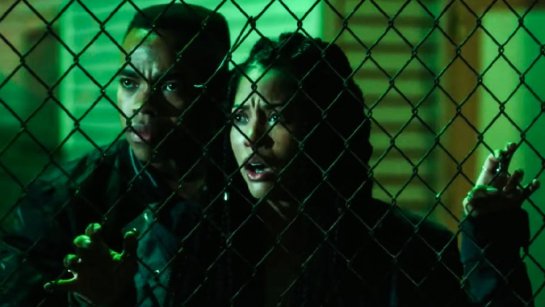
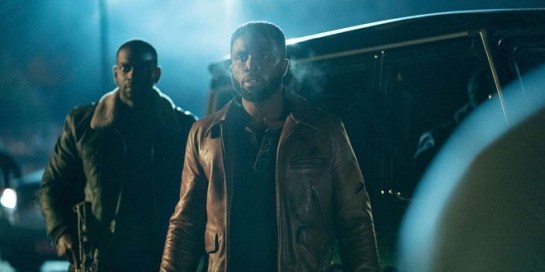
The bulk of our time is spent in an impoverished Staten Island neighborhood with an interesting assortment of locals played by a cast of relatively unknowns. Among them is an intriguing young actress Lex Scott Davis. She is very good as an inspired activist named Nya who is committed to her community and to her impulsive young brother Isaiah (Joivan Wade) who is being tempted down the wrong path. There is also Dmitri (Y’lan Noel), Nya’s ex-boyfriend and (how should I put it) a local drug kingpin with a heart of gold. Noel is another new face who offers a real presence on the screen despite some real logic issues with his character. Once the haunting sirens wail initiating the start of the “experiment”, Nya, Dimitri, and Isaiah must not only survive but defend the community the hold dear.

Purge2

The First Purge” marks the first installment written but not directed by DeMonaco. Gerard McMurray takes the directing reigns and in terms of visuals and tone his take is pretty much indistinguishable from the last two “Purge” films. What he does do is amp of the violence. By the final act it has hypocritically morphed into a crazy, bullet-riddled action movie, relishing much of what the film is supposedly speaking against. And aside from feeling weirdly disconnected from the rest of the movie, the big blood-soaked finale (think Rambo laced with The Crow) was almost unbearable in my theater due to a cool but headache-inducing strobe light effect.

Speaking of violence, the “Purge” movies seem to have a growing fascination with white versus black warfare. The race/class warfare theme has been hammered home for the entire series, but an argument could be made that this movie ratchets it up. It’s uncomfortable to watch but not in the smart, provocative or thought-provoking way. In this film it’s hard to tell whether they are pandering to a current political angst or exploiting it.

Despite its goofiness and inflated sense of relevance “The First Purge” is serviceable throwaway entertainment. In other words there is enough in terms of functional characters (thanks to a couple of interesting new performers) to salvage it from disaster. But it’s still not a movie to recommend. It’s more of the same in slightly (and I do mean slightly) different packaging. Oh, and if you’re worried this will be the last “Purge” movie, fear not. Look for several shameless endorsements of fellow Blumhouse production “Halloween” and a mid-credits commercial for their upcoming “Purge” television. They definitely have plans for this franchise. I just wish it was heading in a better direction.

VERDICT – 2 STARS

2-stars

REVIEW: “Whitney” (2018)

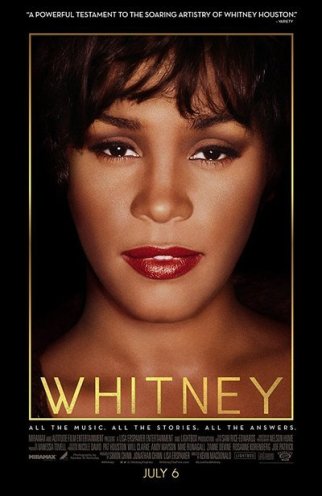
Whitney posterOn February 11, 2012 Whitney Houston was found dead at the Beverly Hilton in Beverly Hills, California. She was 48 years-old. The superstar’s death sent shockwaves throughout the entertainment industry and among her millions of fans. But while her death was a stunner, signs of her spiraling out of control were both obvious and everywhere.

Kevin Macdonald’s “Whitney” is a captivating new documentary chronicling the extraordinary rise and heartrending fall of this immensely talented and internationally acclaimed singer and actress. Macdonald was given the approval by Houston’s estate along with never-before-seen footage, rare performances and exclusive interviews.

Macdonald’s portrait begins by delving into Whitney’s childhood. Raised in Newark, New Jersey, she knew by the age of thirteen she wanted to be a singer. She was affectionately known as “Nippy” by those close to her and that sweet, innocent nickname would represent a certain childlike side of her personality for the rest of her life.

Whitney was born into a family of singers and we are told there was always music playing in the home. Her adoration for song also showed itself at New Hope Baptist Church in Newark. Through her own words we hear how much she loved it there. Macdonald includes a video of a young teenaged girl effortless showcasing that magical signature voice. Just a few years later she would become a breakout megastar shattering records and paving the way for others. These were among the happier times of Whitney Houston’s life.

There have been several times the devil tried to get me.” – Whitney Houston

Whitney Houston’s life was one of unimaginable highs but also some troubling lows. Early on as a child she was bullied because of her lighter skin. Later she was deeply effected by her parents divorce, her mom’s infidelity and her father’s corruption. After her meteoric rise to stardom she endured questions about her sexuality and racially-fueled attacks by Al Sharpton among others.

But Macdonald makes a strong case that the most devastating influences came from those Whitney loved the most. She was first introduced to drugs by her brothers, the same ones who proclaimed themselves to be her protectors. It would lead to an addiction she was never able to shake. She was heartbroken by revelations that her father had been stealing from her for years. Then there are the shocking allegations of child molestation which have made headlines since the documentary’s release.

Whitney1

And of course there is her tumultuous 14-year marriage to Bobby Brown. Friends share that Whitney loved Bobby but it proved to be a damaging relationship. Despite popular sentiment, the film shows her drug abuse didn’t begin with Brown, but it certainly became more pronounced and grew worse over time. The two quickly became tabloid fodder. During their time together Brown had frequent run-ins with the law for domestic assault, sexual harassment, and a plethora of other high-profile arrests. When interviewed for the film Brown refused to speak of his or Whitney’s drug abuse, but Macdonald shows several painful videos of the couple that paints pretty clear pictures for us. What’s worse are the horrific effects their stormy marriage had on their young daughter Bobbi Kristina Brown.

She was always a little girl wishing upon a star” – Cissy Houston

But as sad and tragic as the film is, it also gives us some of her high moments – welcomed reminders of the incredible singer Whitney Houston was. Moments like the 1991 Super Bowl where she delivered perhaps the most beautiful and moving rendition of the Star-Spangled Banner of all time. Macdonald makes it a little jarring by giving it a modern political spin, but it was an amazing moment for Whitney and the country. As was the slice we get of her 1994 post-apartheid performance in Johannesburg. And of course there is her venture into acting with “The Bodyguard”, a film and soundtrack that catapulted her into the stratosphere.

“Whitney” could probably use a few more of those high marks. Some fans are sure to long for more of a celebration of her music. But Kevin Macdonald manages to make a film that’s both a tribute and a tragic tale of the cost of fame. He also shatters many popular perceptions of this tremendous talent whose love and trust were exploited by many of the key people in her life. Yet despite how somber the movie is, the echoes of that breathtaking voice and the reflection of that sparkling young woman from Newark remains etched in the back of my mind. I think it always will be.

VERDICT – 4 STARS

4-stars