REVIEW: “Won’t You Be My Neighbor”

Fredposter

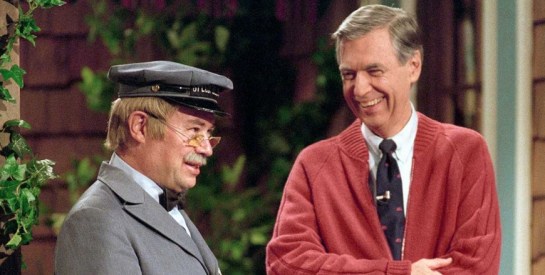
Like millions of others, “Mister Rogers’ Neighborhood” is forever etched into my childhood memories. For me it was sitting in my grandmother’s living room watching as the show’s unassuming and unlikely star walked through the door of his low budget set and welcomed me into his world. Day after day I would watch him, even as an older kid outside of what some might call the target audience. That’s because I really liked Mister Rogers himself and I genuinely loved being in his neighborhood.

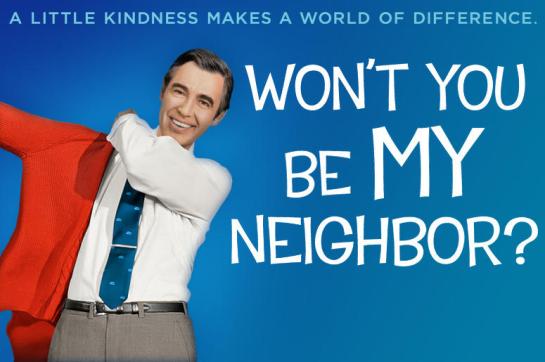
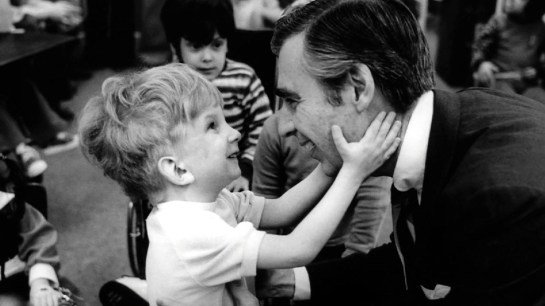
It was that type of relationship Fred McFeely Rogers yearned to establish with children over the course of three decades of programming. The new documentary “Won’t You Be My Neighbor” is an insightful and heartwarming portrait of this remarkable man who had an authentic heart of gold and would become a truly unique television and cultural icon.

Academy Award winning documentarian Morgan Neville offers us the chance to gaze into the life and legacy of Fred Rogers (1928-2003). Neville’s film is a near perfect mix of biographical sketches and ministerial philosophies which guided Rogers. The film moves swiftly and fluidly between the two, revealing much through Rogers’ own words. We also hear from his family, particularly his wife Joanne and his two sons James and John, along with several of those who worked close with him.
Fred1

One of my favorite elements of the film is seeing the genesis of Rogers’ almost otherworldly compassion. We learn he was born into a wealthy household but his life was far from trouble-free. As an overweight child he was often the target of bullying. He also experienced a lot of illness, much of which left him in quarantine. During these times of loneliness he retreated into his imagination which helped him deal with his feelings. He never forgot these childhood experiences and they ultimately fed his uncanny abilities to sympathize and relate to children on levels few could.

The roots of “Mister Rogers’ Neighborhood” dates back to 1953 when he started a show on Pittsburgh public television station WQED. It would eventually become a national broadcast and a signature show on PBS. In its most popular form the half-hour program ran from 1968 until 2000 with only a three year hiatus between 1976 and 1979.

Neville highlights Rogers’ conviction that with television children were treated more as a marketing demographic than young people with their own complex feelings. Therefore his shows often addressed troubling topics or events – the Vietnam War, the assassination of Bobby Kennedy, racism, depression, etc. Rogers believed children shouldn’t be left to their own devices when trying to comprehend these issues. He sought to engage them in ways unseen in most children’s television entertainment.
Fred2

The film also shows Rogers’ advocacy for public broadcasting. In 1969 and facing serious budget cuts, Rogers appeared before the United States Senate Subcommittee on Communications. In six short minutes of testimony, Rogers so moved hard-nosed Rhode Island Senator (and subcommittee chairman) John Pastore that he granted the funding on the spot. Neville includes this entire exchange in one of the film’s most inspirational segments.

When I think of the political discourse of today, the incivility and lack of respect, it feels as if Fred Rogers and his vision are from a different planet and foreign from anything we see today. In that way “Won’t You Be My Neighbor” is both sad and beautiful. It highlights this special man’s uniquely rare empathy and sincerity, only occasionally projecting interpretations. It’s hard to watch the film and not yearn for the kind of compassion and spirit he exuded.

After watching the documentary I spent quite some time mulling over my feelings. The one thing that kept coming to mind was that I really miss Mister Rogers. I was reminded of how easy it was for me to forget the impact he had on my childhood. He was an ordained Presbyterian minister, a lifelong Republican, a devoted husband and a loving father. But also, for over 900 episodes, he was my friend, my teacher, and my television neighbor.

VERDICT – 4.5 STARS

4-5-stars

REVIEW: “Ant-Man and the Wasp”

ANTposter

Three years ago Marvel Studios ended ‘Phase 2’ of their cinematic universe with “Ant-Man”. It was a surprising investment considering Ant-Man isn’t what you would consider a top-tier Marvel superhero. What surprised me even more was how well it was received. “Ant-Man” wasn’t a bad movie, but its constant hit-or-miss humor along with its silly, paper-thin villain left me wanting more.

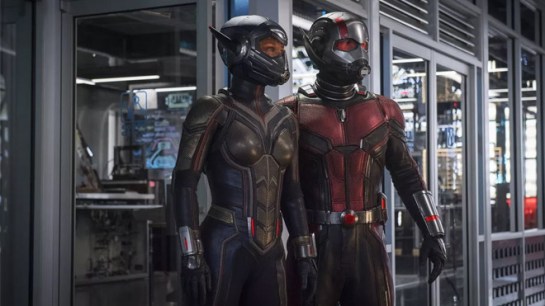
Film #20 in the MCU is “Ant-Man and the Wasp”, a sequel that had me curious and surprisingly optimistic. An entirely new group of screenwriters handle the script, but ringmaster Peyton Reed returns to the director’s chair doling out plenty of humor and unique superhero action. Both work better this time around. The sequel is funnier and the action has a delightfully playful flavor. And the stakes here are more personal. It’s a welcome departure from the normal catastrophic global threat we get in these movies.

ANT1

Paul Rudd returns as the immensely likable con-turned-superhero Scott Lang. He’s serving the final days of his house arrest sentence for helping Captain America during the “Civil War” storyline. Not only did he get in trouble with the government, but he also alienated Hank Pym (Michael Douglas) and his daughter Hope (Evangeline Lily) by sneaking off with Hank’s Ant-Man suit and exposing the tech to the world. With so many bad people hungry for the technology, Hank and Hope sever ties with Scott and are forced into hiding.

During their time in seclusion, Hank and Hope work on a contraption they believe can rescue their long-lost wife/mother Janet (Michelle Pfeiffer) from the quantum realm. But to do so will require them to mend fences with Scott. Their work also attracts a lot of unwanted attention. Walter Goggins is a hoot playing a black market peddler of quantum energy. He has a $1 billion buyer anxious to get their hands on Pym’s lab. Hannah John-Kamen plays Ghost, a woman whose ability to phase through objects is slowly killing her and Pym’s quantum research may be all that can save her life. Toss in the FBI and Scott’s dogged parol officer (played by a very funny Randall Park) and you have a lot of conflicts and storylines.

Thankfully Reed and company handle these numerous plot-strings nimbly and with smarts. They have no qualms with their movie being light, breezy and smaller scaled – all perfect fits for this kind of story. They know the type of film they are making and they seem to embrace the sillier side of the whole thing. That’s one reason Michael Peña’s character can work. He returns as Luis, Scott’s one-time cell mate and now close friend who basically serves as the never-ending comic relief. He was spotty at best in the first film, even annoying at times. This time he isn’t given as much room for improvisation and his dialogue feels more natural and unforced. He doesn’t land every joke, but he has some very funny moments.

Ant2

But the real highlights are Rudd and Lily. The two have a remarkable chemistry and it’s a lot of fun watching them bounce off each other. Both performances and characters nicely balance out – Rudd’s lovable, self-deprecating Scott, Lily’s fiercely determined Hope. Their personalities even carry over into the action. Hope’s Wasp is tough and tenacious. Ant-Man’s irresistible goofiness can’t help but bleed over into his action scenes.

While “Ant-Man and the Wasp” benefits from its lightheartedness, in a weird way it’s also held back by it. With the exception of the expected mid-credits scene at the end, the film does little to raise the stakes in the MCU. It also doesn’t clearly answer a big question I had going in: Where was Ant-Man during Infinity War? But let’s be honest, does it have to do these things to be a good movie? Certainly not. For my money there is plenty of room in Marvel’s every-growing big screen universe for smaller more tightly-knit pictures like this. I would even call them refreshing.

VERDICT – 4 STARS

4-stars

REVIEW: “Sicario: Day of the Soldado”

SICARIO poster

I’ve read a handful of rather perplexing reviews of “Sicario: Day of the Soldado”, the new sequel to Denis Villeneuve’s exceptional 2015 border thriller. It seems the film’s perceived politics has stirred the ire of a segment of moviegoers. Perhaps it’s the byproduct of Trump-era baggage being projected onto every frame. It’s surprising because my political takeaway (much like its predecessor) saw “Soldado” as something far more than a slanted, one-sided critique of the U.S./Mexico border situation.

Several significant names from the first movie are missing – director Villeneuve, lead actress Emily Blunt, cinematographer Roger Deakins, and the late composer Jóhann Jóhannsson. That’s a ton of important, top-tier talent to replace. This could be why “Soldado” was such a wonderful surprise. It doesn’t just succeed at being a really strong movie despite these absences, but it also manages to capture much of the look, tone and intensity which made the first film so great.

Sicario1

A key reason for its success is returning screenwriter Taylor Sheridan. His recent film credits have been impressive – “Hell or High Water” and “Wind River” in addition to the two “Sicario” pictures. You could call Sheridan the premier architect of the modern American Western, bringing a new flavor to his frontiers which are full of lawlessness and violence. “Soldado” fits perfectly into that mold.

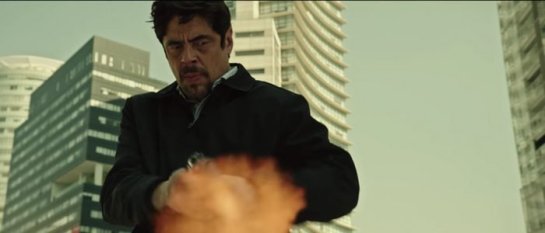
Sheridan’s story is more of a spin-off than a straight sequel and it’s anchored by the returning Benicio del Toro and Josh Brolin. Both were key supporting characters in the first film who had enough intrigue and/or depth to head a new chapter. Toss in the ugliness of the current border situation over the past few weeks along with the shameful politicization of the issue and you have an unintended added relevancy.

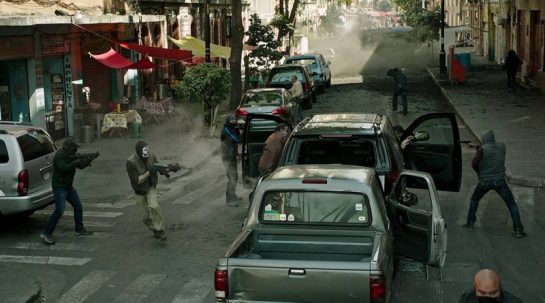
The film’s opening sets the table. A coyote for a Mexican cartel is smuggling immigrants across the border when the U.S. border patrol swoops in. During the roundup a suicide bomber masquerading as an immigrant detonates himself among the agents. It and a subsequent attack leads the White House to declare Mexican cartels to be terrorist organizations.

Sicario2

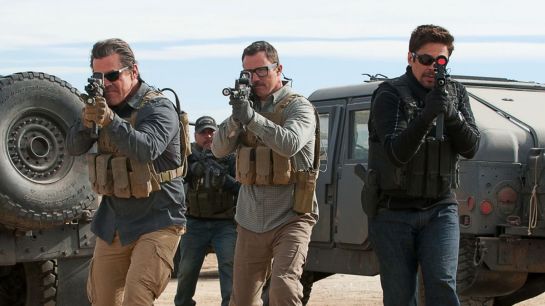
Enter Brolin’s Matt Graver, a CIA black-ops agent who specializes in doing the government’s dirty work. The irresolute Defense Secretary (Matthew Modine) tasks Graver with making things messy between the cartels. To do that Graver lets loose hitman-turned-rogue operative Alejandro Gillick (del Toro). They organize a plan to kidnap Isabela Reyes (Isabela Moner), the daughter of a powerful kingpin and frame a rival cartel for the abduction. But when Graver’s war spills over to involve the Mexican government, Washington loses its nerve and orders Matt to “clean the scene”. This drives a wedge between Graver and Gillick with Isabela caught in between.

Italian director Stefano Sollima helms the “Soldado” ship and some have stated he is no Villeneuve. Maybe so, but that kind of comparison is pointless. Sollima more than holds his own showing an impressive knack for building tension-soaked sequences and effectively experimenting with different perspectives. Accomplished cinematographer Dariusz Wolski (known best for his worth with Ridley Scott and on Gore Verbinski’s “Pirates” movies) peppers the film with imagery that stays in sync with Deakins’ Oscar-nominated work from the first picture.

Sicario3

Sollima also does a good job managing Sheridan’s numerous moving parts and intersecting storylines. One such angle involves a McAllen, Texas teen (Elijah Rodriguez) lured into the world of drug smuggling and human trafficking. It’s a poignant side story given room to breathe by Sollima until it converges with the main narrative. It also helps to have two actors like Del Toro and Brolin. Both are so perfectly cast and portray their characters with such energy and conviction.

“Day of the Soldado” is a strong, formidable second chapter of the “Sicario” series. As its many layers of compelling story unfolded, I found myself once again caught up in its dark and uncomfortable world. I also found unique and unexpected human elements which sets things on an interesting course for the third film they clearly have in mind. And with relatively modest budgets, we should get it. I’m onboard.

And for those struggling with the political meaning of “Soldado”, I can only share what I think it’s saying – There is no easy answer to the border issue. The solution is neither black or white. One thing is for certain, many people are benefitting at the cost of others. From cartels to governments; politicians to traffickers. But caught in the middle are desperate people who get lost in the wrangling. At one point in the film, a character tells another “They’re just Sheep. Treat them like it.” It’s an ugly sentiment, one of many “Soldado” challenges us to wrestle with.

VERDICT – 4.5 STARS

4-5-stars

REVIEW: “Jurassic World: Fallen Kingdom”

JURPoster

If anyone wondered if moviegoers still had an interest in big screen dinosaurs, 2015’s “Jurassic World” seemed to provide the answer. With a $1.6 billion worldwide box office take, these huge CGI Mesozoic monsters showed they can still draw a crowd. Now we get “Jurassic World: Fallen Kingdom”, a nearly $200 million sequel that may be stretching those affections to their limits.

With “Fallen Kingdom” J.A. Boyana directs a screenplay written by Colin Trevorrow and Derek Connolly, both of whom worked on the first “Jurassic World” script. And you can tell. It doesn’t take long to recognize a couple of rehashed and repackaged plot points from the previous film. And my issues with “Fallen Kingdom” don’t stop there. Perhaps its biggest problem is that it lacks that sense of awe and wonder we get from the better “Jurassic Park” pictures. That’s not good for a movie about massive dinosaurs.

JUR1

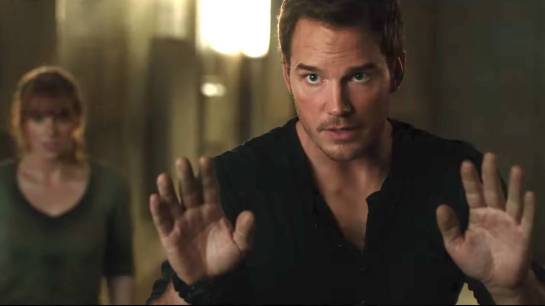
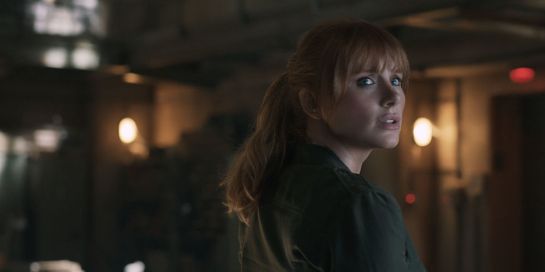
Both Chris Pratt and Bryce Dallas Howard return from the first film. It’s three years since the events of “Jurassic World”. Pratt’s Owen is a hermit living out of a camper and building a remote cabin in the mountains. Howard’s Claire now works for a dinosaur protection advocacy group. Yep, you read that right.

The two are brought back together by gazillionaire Benjamin Lockwood (James Cromwell), the former partner of John Hammond (Richard Attenborough’s character in the original films). Lockwood tasks Claire and Owen with assisting a team in the rescue and relocation of the dinosaurs that remain on the island. With the inevitable eruption of a powerful volcano threatening the dinos, Lockwood locates a new uncharted island that can serve as a sanctuary. But as you can probably guess, things don’t exactly go as planned and sure enough Owen and Claire find themselves right in the middle of both human and reptilian threats.

JUR3

To say the story strays from its roots is a bit of an understatement. The wonder and mystery of the island is quickly tossed as the filmmakers clearly seek to take the series in a different direction. To try something new is certainly admirable and in a way I like the goofiness of what’s going on. But “Fallen Kingdom” tries to be a lot of different things and does none of them particularly well. While goofy in idea, it still takes itself far too seriously. Attempts at being scary fall well short of Boyana’s past efforts (see the much better “The Orphanage”). It doesn’t work as a thriller as there is practically no suspense whatsoever. It’s predictability is disappointing. To the film’s credit it does attempt to once again wrestle with the moral implications of ‘playing God’. But even that gets lost among everything else the movie tinkers with.

Another issue is with the film’s handling of its characters, especially the two main people we are supposed to care about the most. “Fallen Kingdom” doesn’t take Owen and Claire in any new direction whatsoever. They are the same bland people at the end as at the beginning. You could argue that more happens to Claire in the three years between films than in this movie. She’s in an entirely different place than when we last saw her (how she got there is all but ignored). Pratt rarely gets an opportunity to show off his strengths – humor and charm. The material he is given leaves his character stuck in neutral for the entire movie.

JUR2

There are several other paper-thin characters that do little more than fill in roles – the antagonist, the comic relief, the disposable military dudes, etc. And the mandatory kid role belongs to Isabella Sermon. She plays Lockwood’s granddaughter Maisie and lets just say her story-thread teases something weird and fun. Unfortunately (like so much) the movie doesn’t capitalize on it.

I know it sounds like I’m brutalizing this film. It’s because sometimes being painfully mediocre is a bigger disappointment. “Fallen Kingdom” isn’t an egregiously bad movie. It’s just a glaringly flat and seemingly rudderless one. The perplexing ending all but sealed that for me. Here’s the thing, I was never bored and I never checked out of the movie. But at the same time I found myself constantly puzzled by the creative decision-making and lack of aim. Overall I guess there is enough here to satisfy series devotees, but I’m not sure. Take my son, a professed “Jurassic” fan. As we walked out of the theater he looked at me and said “I don’t know what to think about that one.” I’m with him.

VERDICT – 2 STARS

2-stars

REVIEW: “It Comes At Night”

Comes poster

“It Comes At Night” has some intensely personal roots for its writer and director Trey Edward Shults. The film’s genesis can be found in Shults’s sorrow following the death of his father. After ten plus years of estrangement fueled by his father’s addictions, the two reconciled on his deathbed. Shults began writing “It Comes At Night” two months later as a way to cope with his grief.

Shults’s familial connection to his film is not unlike his previous movie, 2015’s “Krisha”. In it we witness a character’s relapse and ultimate breakdown – something inspired by a real-life family incident. In “It Comes At Night” the opening scene is the emotional release point for Shults. It shows a daughter giving words of comfort to her dying disease-stricken father. Shults has stated these are the words he shared with his dad.

COMES1

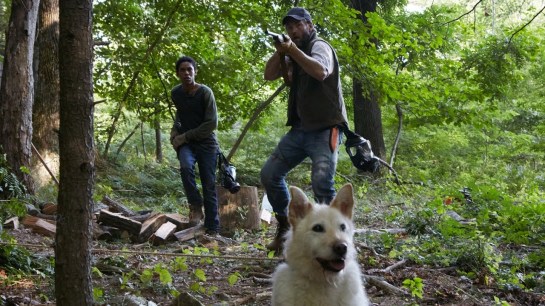
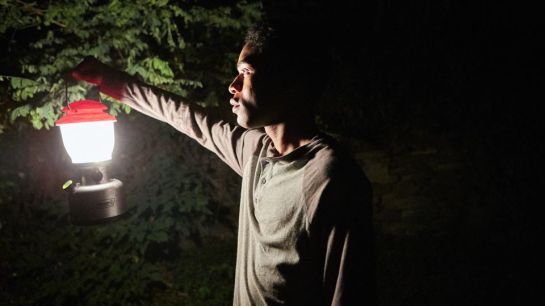
We quickly learn the infected man’s name is Bud (David Pendleton) and the consoling daughter is Sarah (Carmen Ejogo). The disease’s effects on Bud are obvious – nasty boils, milky eyes, pale skin, the works. Sarah’s husband Paul (Joel Edgerton) and their son Travis (Kelvin Harrison Jr.) take Bud outside, Paul shoots him and then burns the body. For the remainder of the film’s running time this disturbing mercy killing haunts this family, especially 17-year old Travis.

The film tells us very little about the epidemic, how it started, or even how its contracted. Frankly all that stuff is unimportant. Instead we are dropped into this already contaminated and chaotic world. And despite the impressions left by the trailers, the tension and suspense is drawn more from what lies within the characters than what may be lingering outside in the night.

Paul and his family live in a boarded up house deep in the forest. Their closed-off lives are shaped by survivalist protocols and justifiable paranoia. Their feelings of isolation and security are broken when their home is discovered by a man named Will (Christopher Abbott) who is seeking supplies for his family. A hesitant Paul agrees to take in Will, his wife Kim (Riley Keough), and their young son Andrew (Griffin Robert Faulkner). For a time a sense of social normalcy returns, but ultimately the human responses to fear and anxiety are too much to shake.

Comes2

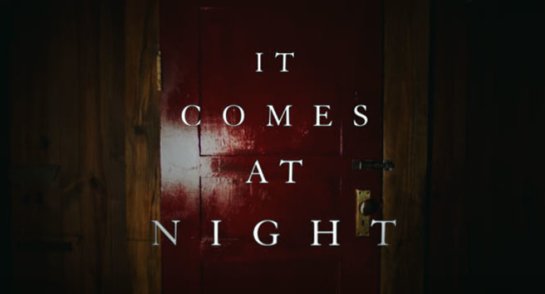
It would be easy to see this as a conventional horror film – a deadly virus, a cabin in the woods, a spooky red door at the end of a hall, and the ominous title. But there is a surprising psychological depth that transcends any genre expectations. There are a handful of jump scares and the shadowy claustrophobic setting is indeed creepy. But the film’s true intensity comes from its cliché-free handling of the inner demons gnawing away at these characters.

“It Comes At Night” is many things. It’s an unconventional horror picture. It’s a deep emotional treatment of loss. It’s a troubling, unorthodox coming-of-age story. The cool thing is how well Trey Shults packages all these things together without an ounce of conflict. It is a meticulously paced and tightly focused story that does a good job utilizing its stellar cast. It is unshakably bleak – maybe too much so for some, but if you can get in tune with its unique rhythm and are willing to dig deeper under it’s surface, you’ll find more to this film than the trailers would have you believe.

VERDICT – 4 STARS

4-stars

REVIEW: “Paris Can Wait”

PAris poster

Maybe a road trip filled with beautiful sites and great food is the only way to experience a country (as we are told). But the buoyant road drama “Paris Can Wait” proves that you need a little more than fancy dishes and lovely scenery to make an egaging movie. Don’t get me wrong, this is a film that has its moments. But it’s also a movie that leans way too heavily on its culinary and scenic fascinations.

“Paris Can Wait” is written, directed, and co-produced by 81-year old Eleanor Coppola. An accomplished documentarian and wife of Francis Ford Coppola, this is her first fictional drama and her first film of any kind since 2007. Here she creates a simple and lighthearted premise that should feature plenty of fun and charm. Sadly there isn’t enough of it.

paris1

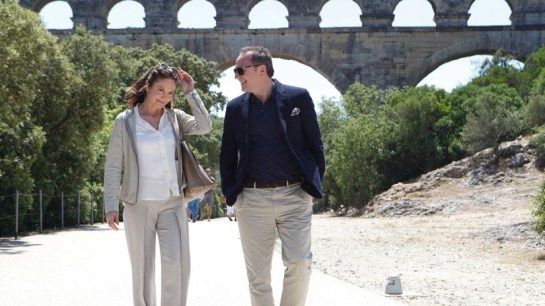
Diane Lane plays Anne, a woman living in the shadow of her pompous movie producer husband Michael (Alec Baldwin). The two were set to fly from Cannes to Paris until Michael is called away to a movie set and Budapest. He agrees to let his production partner, a charismatic Frenchman named Jacques (Arnaud Viard), drive Anne to Paris. Along the way Jacques takes one diversion after another introducing Anne to an assortment of French locales and cuisine.

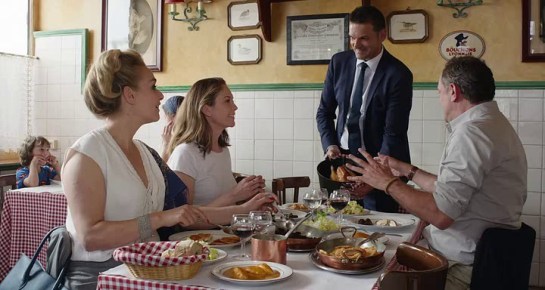
There are plenty of beautiful locations to catch your eye and the food looks delish. The story playful hints at Jacques’ intentions as the two share one conversation after another in the car or around the table. But it doesn’t take long to realize the film has little to offer past that. It’s repetitive formula goes something like this: they visit a cool site, find an expensive place to eat, and then Jacques lectures Anne on enjoying life the French way. It remains stuck in this one gear for the entire trip.

Paris2

That wouldn’t be such a bad thing if the characters and their conversations were appealing. Viard doesn’t project the irresistible French charm the movie needs him to portray. But the bigger frustration revolves around Diane Lane. There’s nothing glaringly wrong with her performance. It’s just that Anne is such a shallow, naive character who spends the bulk of the film doing whatever she is told. Unquestionably Coppola wants to speak to empowerment, but she doesn’t pull it off. The movie’s last shot all but solidifies that idea.

I really wanted to fall for “Paris Can Wait”. I have a soft spot for these types of movies and I’m a Diane Lane fan. But the majority of the picture leaves Lane in the passenger seat and the scrumptious photography can only carry it so far. If only Coppola would have let her star take the wheel and given her a meatier role to work with. Instead I grew tired of their monotonous conversations and the utter lack of dramatic tension. I found myself annoyed at Jacques’ cloying banter and Anne’s wistful obedience. And I kept wondering who would ever fall for this guy? If that’s your main question you can expect to have some issues with this film.

VERDICT – 2 STARS

2-stars