

Say what you want to about the film, but you can’t deny that the man behind it certainly went with an attention-grabbing title for his feature film debut. Robert D. Krzykowski’s “The Man Who Killed Hitler and Then the Bigfoot” screams low-budget pulp. Who knew it was actually a meditative character study full of deep feeling and pathos. Don’t let it’s peculiar title fool you.
The film had a much different shape when Krzykowski begin writing the script some twelve years ago. His original concept was more of a playful exploitation film that fell in line with the quirkiness of its title. Over time it took on a more pensive form in large part due to real-life emotions Krzykowski was dealing with.
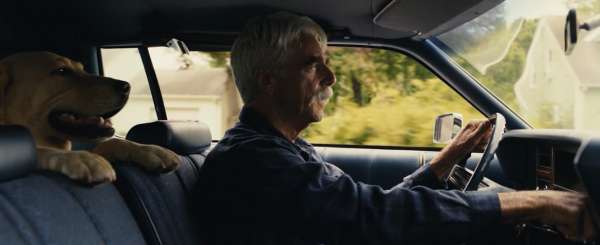
It instantly makes a good impression by casting Sam Elliott as its lead. He has always been an actor who could instantly grab the audience’s trust. He’s effortlessly charismatic and consistently great. Krzykowski hands him a role tailor-made for his down-to-earth and quietly rugged strengths.
Elliott plays a melancholy World War 2 veteran named Calvin Barr. He’s a man coming to terms with his old age and still reckoning with past choices that he either made or in some cases didn’t make. Krzykowski gives us several of Calvin’s simple day-to-day moments. To be honest I would enjoy watching Sam Elliott walk his dog or get a haircut for a full 90 minutes. But these moments actually give some meaningful insight into his character and what makes him tick. He’s a lonely man who has an occasional conversation with his little brother Ed (Larry Miller) or his bartender friend George (Alton White). But his closest confidant is Ralph, his faithful Golden Retriever.
Interestingly there is a second timeline which follows young Calvin (Aiden Turner) both during and surrounding WW2. Several of the things we see there get to the roots of old man Calvin’s state of mind. They include him falling for a charming young school teacher named Maxine (Caitlin FitzGerald) and of course the covert military mission alluded to in the title. Krzykowski clearly wants to give both timelines space to have their own identity but it’s almost unavoidable that we find ourselves wanting to getting back to Elliott. Still the flashback timeline works.

While the film is fully aware of the absurdity it dangles in front of its audience, it manages to take itself seriously mainly because it takes Calvin seriously. It treats him in a way that both demands and earns our empathy. Whether he’s sifting through his feelings of remorse and regret or wrestling with the ideas of heroism and being an unheralded legend. So when Calvin in approached by government agents seeking his help in hunting down the plague-spreading Bigfoot, we strangely care about his decision despite the sheer nuttiness of it all.
That gets to what I love most about “The Man Who Killed Hitler and Then the Bigfoot”. It’s unashamedly preposterous yet so earnest where it counts most. There is a crazy yet fascinating harmony to these two seemingly opposites and the movie has a much deeper core than you might think. And it doesn’t hurt to have a fabulous Sam Elliott performance at the center. It’s a movie certain to clash with some people’s expectations, but once I got in with its unusual rhythms I was completely hooked.
VERDICT – 4.5 STARS






 Now with three movies under his belt screenwriter-turned-director Dan Gilroy has shown a keenness for creating and developing characters who march to the beats of their own unique and often idiosyncratic drums. We got that in 2014’s “Nightcrawler” and in 2017’s “Roman J. Israel, Esq.” Two very different movies concentrated on two very unusual personalities.