REVIEW: “The Shape of Water”

SHAPE poster

No one can deny Guillermo del Toro’s willingness to utilize every trick in the cinematic playbook to create a magnificent visual experience. He has built worlds through several genres including dark fantasy, gothic horror, superhero, and even creature features. Yet despite his keen eye, vivid imagination, and a consistent backing from critics, “Pan’s Labyrinth” is his only film I would call truly great.

His latest movie “The Shape of Water” has generated a ton of awards buzz and is even being compared by some passionate del Toro fans to 2006’s “Pan’s Labyrinth”. Regardless of some things it does well, “The Shape of Water” is no “Pan’s”. But enough with counterproductive comparisons. The point is “The Shape of Water” has a big following and a ton of momentum heading into Oscar season.

SHAPE3

“The Shape of Water” could be called many things – an offbeat fairytale, a political fable, an unconventional love story, an allegory for del Toro’s view of the world today. All of those descriptions fit to some degree or another, and del Toro plays with them with varying levels of success.

Del Toro’s story, with its pulsating Cold War vibe, takes place in 1962 Baltimore. The wondrously expressive Sally Hawkins plays Elisa, mute since birth, who lives in an apartment above an old movie house. She and her next door neighbor Giles (Richard Jenkins) spend their time together watching old musicals and sharing their struggles. Both fit into one of del Toro’s more obvious themes – the plight of the marginalized.

Elisa works the night shift as a janitor at a secret government facility along with her close friend Zelda (a very good Octavia Spencer) who also fits within the marginalized theme. The facility has just acquired an “asset” pulled from a South American river – a tall, gilled amphibian-man accompanied by Colonel Richard Strickland (Michael Shannon). He is there to oversee the study of the creature and he’s clearly the film’s chief antagonist. Shannon is great and it’s a role he could probably do in his sleep. And as you would expect he is completely committed.

SHAPE2

But while undeniably menacing, Shannon (of no fault of his own) is also terribly on the nose. Much of del Toro’s more cynical point of view is encapsulated in Shannon’s character. He’s written to fit the mean old-fashioned Red State stereotype and through him del Toro gets to comment on religion, race and a host of other topics. But there is no subtlety whatsoever. You can practically hear del Toro beating his pulpit through much of Shannon’s dialogue.

Elisa’s curiosity and empathy help her to form a bond with the creature (yet another among the marginalized). She sneaks in the labratory and shares her lunch with the creature and plays it music on a portable record player. How is she able to have so much unguarded access to what is called “the most sensitive asset to ever be housed in the facility” and something we find out the Russians are after? There’s not a good answer to that, but they form a bond nonetheless. And after Elisa overhears talk of dissection, she knows she needs to bust the creature out.

As you watch you can’t help but see allusions to “The Creature From the Black Lagoon”, “King Kong” and even “Beauty and the Beast”. But del Toro pushes his creature fantasy further than any of those pictures. For some the film is genuinely romantic but I never had that sensation. The pacing doesn’t give the relationship time to germinate. And there are other things that get in the way – del Toro’s weird use of sexuality; a brief but bizarre dance number (I’ll leave it at that); and one scene which some have called the most beautiful moment in the film yet I couldn’t get over the sheer absurdity of how it played out. For me all of this underserved the romance the movie is trying to establish.

SHAPE1

While it has it’s narrative imperfections you can’t help but love the world del Toro visualizes. Inside the laboratory has a cold, harsh, metallic look. But outside the film takes on a gorgeous glow. Many images stand out for their beauty. It may be a bead of water dancing down a bus window or a brief camera pan across a movie house marquee right after a rain. The creature itself (played by long-time del Toro collaborator Doug Jones) is a fantastic creation made from traditional effects over CGI. Then you have Alexandre Desplat’s lovely, waltzy, heart-warming score which may be the best of the year. And of course the performances which are top-to-bottom fabulous.

It’s tough to know where to land on “The Shape of Water”. On one side you have a world so beautifully visualized, an enchanting classic movie vibe, top-notch performances, and a score that swept me away. On the other hand you have some glaring storytelling issues – an underserved romance, heavy-handed messaging that spells out instead of engaging, peculiar injections of nudity and graphic violence (sorry kids), and key scenes undercut by their goofiness. Yes, I know this is a fantasy picture and maybe I should be more imaginative, but when I’m thinking about these things as the movie plays – that’s a bummer. But did I mention how pretty the world is?

VERDICT – 2.5 STARS

2-5-stars

REVIEW: “Three Billboards Outside Ebbing, Missouri”

BLLposter

Playwright turned screenwriter Martin McDonagh is three movies into his feature film career – “In Bruges”, “Seven Psychopaths” and his latest “Three Billboards Outside Ebbing, Missouri”. While each film has their differences they also also have their similarities. All three are black comedy crime pictures and each prominently feature McDonagh’s brash writing style. You can decide whether that last part is a good thing or not.

McDonagh’s inspiration for “Three Billboards” came as he was driving in southeastern United States and noticed some billboards speaking to an unsolved crime. He began filling in his own elements to the story and “Three Billboards” was born. As he began penning the script, two characters were written with specific performers in mind. The lead character of Mildred for Frances McDormand and the key supporting character Dixon for the always entertaining Sam Rockwell.

BILL1

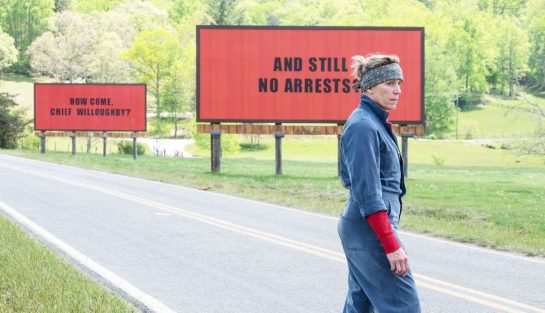
The story begins seven years after the brutal rape and murder of a teenaged girl around Ebbing, Missouri. The girl’s mother Mildred (McDormand), angered by the sheriff department’s lack of progress on the case, rents three abandoned billboards just outside of town and plasters messages calling out the local authorities. The billboards read “Raped while dying”, “And still no arrests?” and “How come, Chief Willoughby?”

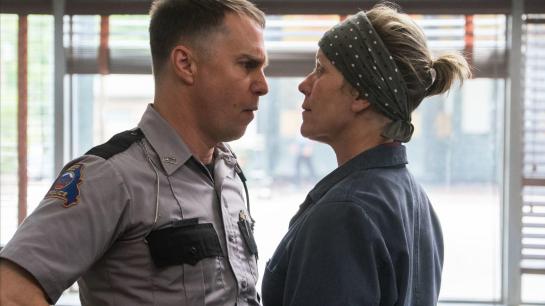
Mildred’s billboards spark the ire of the townsfolk including Sheriff Willoughby (Woody Harrelson), his dense and racist deputy Dixon (Rockwell), and even her depressed son Robbie (Lucas Hedges). But Mildred (a fitting reflection of McDonagh’s abrasive writing style) pushes forward which leads to a series of conflicts that make up a bulk of McDonagh’s problematic story.

BILL3

“Three Billboards” is such a mixed bag. McDonagh wildly swings from absurdly goofy to deeply emotional with no real gauge for tone. A scene of oddball humor can shift to a scene of startling violence on a whim. Often the characters are the biggest victims. One minute a man is brutally beating another man and punching a woman in the face. Only a few scenes later we are asked to buy into his moral transformation. Even Mildred suffers from McDonagh’s erratic treatment. She’s an inspirational crusader and a sympathetic mother. She’s also a verbally abusive, dysfunctional parent and can sometimes be needlessly hateful and vile. McDormand goes all in and her performance is solid, but her character (like most in the film) is all over the map.

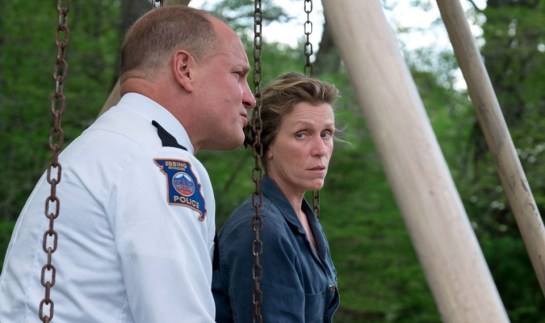
Funny enough the movie is most effective when it turns down the volume and focuses on the quieter dramatic moments. Many of these involve Woody Harrelson, an actor often known for being big, silly, and showy. His Sheriff Willoughby is probably the film’s most tempered character, but even he’s not immune to McDonagh’s occasional jarring dialogue. And it seems we are meant to be at least a little sympathetic towards him. But the movie ignores some gaping moral holes and expects us to do the same. Sorry, I can’t.

BILL2

Several other things keep “Three Billboards” from reaching the potential it teases. There’s McDonagh’s weird vision of small town America. He nails how the effects of a horrible tragedy can ripple through a rural tight-knit community. And visually the North Carolina location is a nice stand-in for the fictional town of Ebbing. But his wonky cast consists of racists, sexists, bigots, abusers, child molesters, and several other offensive classes of miscreants. Is this his rural perception? Give me a Coen brother’s version any day.

And then you have McDonagh’s insistence on being blatantly and often pointlessly vulgar and crass. I get that it’s his thing, but forcing it into the bulk of the dialogue becomes obvious and distracting. I have no problem with a writer bringing their own style and sensibility. But it’s never a good thing when a writer’s self-reverence overshadows his material. Mix that with the seismic tonal shifts and uneven and often incomprehensible characters, and you have a frustrating movie built on a good idea but undermined by problems too big to dismiss. Ultimately it’s a film that acts like it has something to say, but you quickly learn it’s little more than an empty hull.

VERDICT – 1.5 STARS

1-5-stars

REVIEW: “Molly’s Game”

MOLLY's POSTER

Jessica Chastain already had one knockout 2017 performance under her belt with the World War 2 drama “The Zookeeper’s Wife”. Now you can make it two with her latest film, the biographical crime drama “Molly’s Game”. It’s an adaptation of the 2014 memoir of Molly Bloom, once an Olympic hopeful in freestyle skiing but later the runner of exclusive underground poker games.

Chastain plays Molly Bloom and is given an incredibly meaty role by screenwriter Aaron Sorkin. This also marks Sorkin’s feature film directorial debut. Much like his Oscar-winning script for “The Social Network”, “Molly’s Game” slickly weaves together a current day legal drama with flashbacks that tell of Molly’s rise and decade-long run as the “poker princess” which eventually leads to her arrest by the FBI.

Mollys2

Sorkin’s signature dense, fast-paced dialogue zips us through the backstory with the help of Molly’s narration. It comes in spurts and covers a lot of ground – her time at home with her hard-nosed father/coach (another fine supporting turn by Kevin Costner), her move to Los Angeles after a horrible skiing accident, and her high-stakes poker games that start in LA and end in New York.

Throughout these flashbacks we meet an interesting lot of characters. Take Michael Cera who plays a movie star simply known as Player X. In Molly’s memoir she named several A-listers who frequented her games – movie stars Leonardo DiCaprio and Ben Affleck, rapper Nelly, and baseball star Alex Rodriguez to name a few. Many believe Cera’s smarmy Player X is an amalgam of these big named celebrities who helped draw billionaires to Molly’s games. But it seems Player X represents one particular movie star who the book paints as particularly reprehensible – Tobey Maquire.

The dialogue also shines in the current day scenes with Molly and her lawyer Charlie Jaffey. He’s played by Idris Elba, so perfect in tone and intensity. Delivering Sorkin’s words can’t be easy. It demands a quick tongue and even quicker wit. Elba’s delivery is smooth as silk and he shares a well tuned chemistry with Chastain. At times there is a fierce energy between the two but there are also quieter moments which offer a unexpected amount of warmth and levity.

MOLLY's1

All of it is kept in sync through Sorkin’s impressive direction. He deftly manages his mile-a-minute language and structural hopscotch while giving his performers plenty of space to work. The film also packs a surprising visual punch that matches the spirit and vigor of the dialogue. It’s nothing eye-popping but it’s as sharp and snappy as it’s lead character. And most importantly Sorkin keeps himself out of the way, trusting his material and his actors.

Aaron Sorkin has shown a fascination in self-made success stories as evident by his last four movies. “The Social Network”, “Moneyball”, “Steve Jobs”, and now “Molly’s Game” all tell of individuals who bucked systems and against all probability propelled themselves to success. “Molly’s Game” may be the best of the bunch. It’s one part invigorating character study and one part stunning expose. It features a trifecta of top-notch performances from Elba, Costner, and especially Chastain. It does feel long at 140 minutes yet it’s never dull nor does it run out of gas. Sorkin has too much to say to ever allow that to happen.

VERDICT – 4.5 STARS

4-5-stars

Random Thoughts: 2018 Golden Globes

RANDOM GLOBES

It’s hard to believe the Golden Globes have (once again) come and gone and the Oscars are right around the corner. As always there were funny moments, some not so funny moments, some surprises, and some disappointments. As usual I have a few random thoughts I cant help but share. So here we go…

  • There was definitely a theme of the night. Women rising up from Hollywood inequality seemed to make its way into every speech and in many awards. Some of the language was beautiful and inspiring. Others seemed a bit out of place. For example…
  • Natalie Portman’s slam at the Best Director category. Presenting the award she said “And here are the all male nominees”. Now I have to admit it was a glorious shot. But it also felt a little dirty and demeaning to what the nominees accomplished. But they’re big boys. They’ll get over it.
  • Another thing on the womens theme, did anyone else sense Hollywood saying great things about moving forward but very little about their culpability? It was Hollywood that allowed and maintained the sexist (and in many cases) abusive environments. I would have loved to see more of that introspection.
  • And lastly let’s hope Hollywood is serious about moving forward and that this isn’t simply their “Cause of the Year”. The women of the industry deserve so much better.
  • It was great seeing Daniel Day-Lewis there and heartbreaking to know it’s for his last film. Simply put he is one of the greatest actors of all time. In many ways I would have loved to see him win Best Actor but…
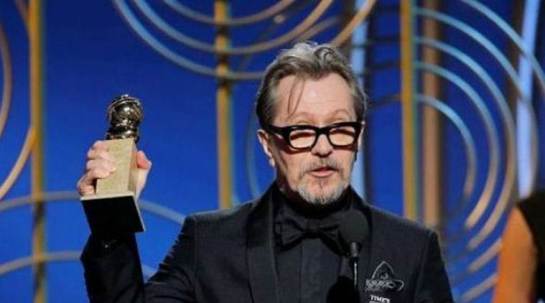
  • Gary Oldman absolutely deserved it. Talk about an amazing performance. In his long line of great performances this could be his best and it was great to see him get recognition for it.

OLDMAN

  • Seth Myers was fine. Nothing bad. Nothing special. Simply okay. But did he have to yell practically every syllable of his monologue?
  • As I watched winner after winner from the television categories I couldn’t help but notice the slew of ‘movie stars’ taking home statues. It just shows how television has changed. Big screen stars committing to 7-10 episode seasons. Seems weird.
  • Oh, and I realized I haven’t seen one single episode of one single nominated TV show (pathetic, I know). I guess that’s why it’s called “Keith & the MOVIES”.
  • “Three Billboards Outide Ebbing, Missouri” left the big winner and potentially the Oscar frontrunner. With all due respect to the great ensemble, the Globes love blew my mind. So many better films.
  • I’m still shaking my head at Martin McDonagh’s Best Screenplay win for “Three Billboards”. How it beat Aaron Sorkin’s blazing script in “Molly’s Game” or Greta Gerwig’s “Lady Bird” is beyond me.
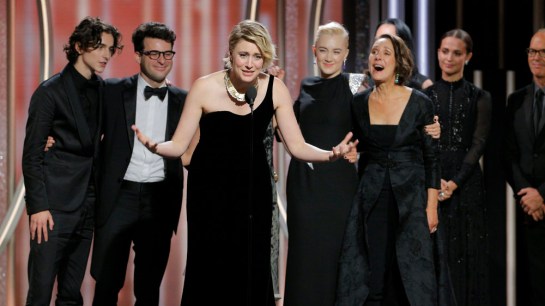
  • Speaking of “Lady Bird” what a great win in the Best Musical or Comedy category. I’m so proud for Gerwig who was the true architect of that film.
  • And speaking of “Lady Bird” again, Saoirse Ronan! I squealed when her name was announced. She’s been great so many times and it’s wonderful to see her get some much deserved recognition.
  • But can Ronan knock off Frances McDormand who won the Best Actress Drama award? McDormand was good in “Three Billboards”. She always is. But I would have taken Chastain over her in a heartbeat.
  • Speaking of always good, Allison Janney won for Best Supporting Actress Comedy. It’s really hard to argue that win but man I was rooting for Laurie Metcalf. Of the eccentric overbearing mothers, Metcalf moved me so much more.
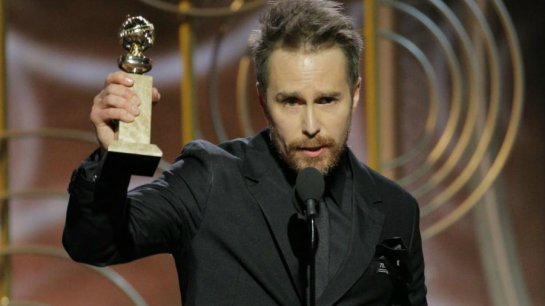
  • Sam Rockwell winning for Best Supporting Actor? Sure. It’s hard not to like Rockwell. But there were so many omissions from that category.

rockwell

  • The Hollywood Foreign Press must not care much for music. Did you see them fly through the nominees and winners for Best Original Score and Best Original Song?
  • Gal Gadot and The Rock. Yes please.
  • I can’t bark too much because I’ve only seen two of the nominees in the Best Foreign Language category. But may I say (again) that Angelina Jolie’s “First They Killed My Father” is one of the best film’s of the year? There, I said it.
  • “Get Out” was shut out and I have to say (don’t crucify me) I was glad to see it. I know I’m practically alone but I just can’t see the fascination. Some cool ideas but far from awards-caliber execution.
  • Speaking of “Get Out” I saw some interesting tweets insinuating the movie’s bad night may have racial foundations. I don’t buy that. “Get Out” isn’t good enough. But then I wonder where is Idris Elba, Dee Rees, and Rob Morgan? Hmm.
  • Think about this – both Tommy Wiseau and Tonya Harding were celebrated in the same Golden Globes show.
  • And James Franco winning Best Actor Comedy was okay I guess. It may see him at least get an Oscar night invite. But does anyone really think he has a shot at winning? Nope.
  • “Coco” wins for Best Animated Feature. The most predictable win of the night in what turned out to be a very bland group of nominees.
  • Let’s face it, Christopher Nolan apparently doesn’t make movies that appeal to these voters and I love him for it. Obviously they “appreciate” them but not enough to award them. That’s a shame. “Dunkirk” is phenomenal.
  • Which brings me back to Best Director and its winner, Guillermo del Toro. There were some big omissions among the nominees. But of those listed, Christopher Nolan’s accomplishment was unlike any other. But see previous point.

75th Annual Golden Globe Awards - Season 75

  • Another happy Greta Gerwig moment – how about her speech for the big “Lady Bird” win. Talk about humble, unscripted, and pure appreciation. It made me happy.
  • I can’t tell you whether he deserved it or not, but Sterling Brown being the first black actor to win Best Actor in a TV Drama. Let that astounding fact sink in for a second.
  • And Oprah. I’ve always been mixed on Oprah but never downplayed her cultural impact. Sure, parts of her speech were inspiring. But I still love it when these speeches focus on the art and the person’s accomplishment within the art. I know, but that’s just me.
  • Those Kevin Spacey jokes…WOW!
  • Speaking of Tommy Wiseau, did you notice how Franco, Rogan and company didn’t let him sit at their table? It looked like he was stuck in the back somewhere.
  • Remember when Seth Myers introduced “TV Legends” Carol Burnett and Jennifer Aniston? TV Legends??? Carol Burnett absolutely. But Jennifer Aniston. Hmmm.

Well that’s enough randomness. Lets do it again next year!

REVIEW: “Darkest Hour” (2017)

DARKESTPOSTER

Lest anyone be confused (and I highly doubt they will be) this is not a review of the atrocious doomsday alien invasion thriller from 2011. Instead this is director Joe Wright’s biographical wartime drama based on Winston Churchill’s early days as England’s Prime Minister. Quite a difference, right?

In early May of 1940 Hitler’s army has made major advances and now stands at the Belgian border preparing to push through in their efforts to conquer what remains of Europe. On May 9th a frustrated British Parliament demands the resignation of Prime Minister Neville Chamberlain due to his weakness in the face of the rising Nazi threat.

DARKEST1

Behind the scenes Chamberlain (Ronald Pickup) and his followers are still pulling the political strings. With the backing of King George (played by a perfectly tempered Ben Mendelsohn), Chamberlain seeks to put in someone who will continue to push his agenda. But it becomes clear there is only one man the divided parties will accept – Winston Churchill (Gary Oldman).

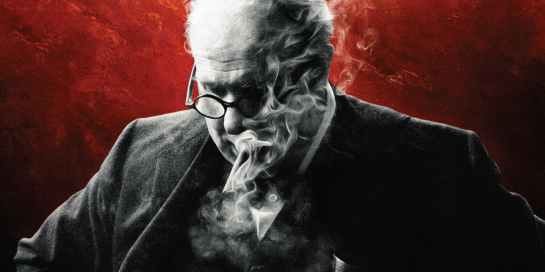
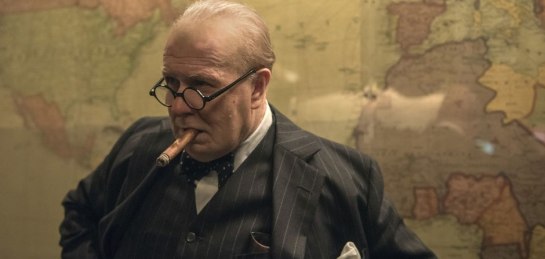
By now there should be no one doubting Gary Oldman’s tremendous range. He’s played a drugged-out dirty cop, a Russian terrorist, and a corrupt U.S. congressman. He’s played Sid Vicious, Lee Harvey Oswald, Count Dracula and now Winston Churchill. Thanks to the miracle of makeup and prosthetics as well as Oldman’s innate attention to detail, you instantly buy into this particular portrait of Churchill. The barely recognizable but thoroughly captivating Oldman delivers an Oscar-ripe performance that draws from his varied skill set.

The script is from Oscar-nominated screenwriter Anthony McCarten whose previous work was the acclaimed Stephen Hawking biopic “The Theory of Everything”. Here he pours everything into his lead character. He gives Oldman plenty of opportunities to sink his teeth into the role without resorting to gimmicky “Awards-worthy” big moments. Also McCarten is smart enough not to overextend his story. This isn’t meant to be a comprehensive biopic and the film’s tighter focus works.

DARKEST2

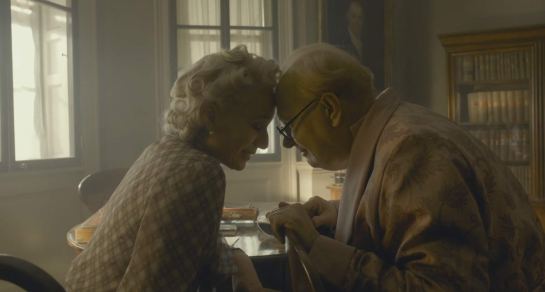
A good chunk of the movie highlights the political wrangling Churchill faced by his opposition who desperately wanted peace talks with Hitler. It begins to feel a bit drawn out but most of it is pretty fascinating. And I really enjoyed the personal moments we get especially between Churchill and his wife Clementine (wonderfully played by Kristin Scott Thomas). There is also the relationship between Churchill and Elizabeth Nel (Lily James), a young typist who eventually became his personal secretary. Their scenes are nicely done and offer a window into a different side of Churchill.

“Darkest Hour” maneuvers through Churchill’s appointment to Prime Minister, the political tensions that undoubtedly wore him down, the looming Nazi threat, and Operation Dynamo which saw the evacuation of over 300,000 troops stranded on the beaches of Dunkirk. But the movie never loses sight of the personal side of this larger than life character. At the same time Joe Wright offers up compelling and timely lessons on conviction, persuasion, and the power of bipartisanship – all things our current governments could learn from.

VERDICT – 4 STARS

4-stars

REVIEW: “The Bachelors”

BACHposter

Kurt Voelker’s “The Bachelors” opens with a father walking into his son’s bedroom in the middle of the night. He sits on the edge of the bed and says to his groggy son “I can’t stay here anymore.” Even without context this simple line of dialogue packs the emotional heft that is threaded throughout this entire film.

“The Bachelors” is a movie about grief which is nothing spectacular or especially new. But Voelker (who both wrote and directed the picture) does something many of these explorations miss. He never loses sight of the human element or the importance of conveying truth in every relationship. Whether he’s juggling drama or comedy, his characters and their emotions always feel genuine.

Bacheors1

The father is Bill (J.K. Simmons) who recently lost his wife to cancer after 33 years of marriage. It’s an extraordinary performance by Simmons who maintains a steady heartbreaking tenderness. It’s not nearly as flamboyant or showy as his Oscar-winning performance in “Whiplash” but just as impressive in a much more measured way.

Bill packs up and moves with his son Wes (Josh Wiggins) to southern California where he hopes a change of scenery will do him good. Wes is equally sympathetic as a teenager who not only loses his mother but also his father to a worsening state of depression. On top of that he’s forced to move to a new town and a new school with new friends. There is an almost natural shyness to Wiggins that comes through in his acting. We saw in “Walking Out” from earlier this year and now here. His understated approach is serves his character which make later scenes when his emotions boil over more effective.

The coming-of-age side of Voelker’s two-headed story has its moments. Many of them are between Wes and a beautiful but troubled wild-child named Lacy. She’s portrayed by Odeya Rush who played a similar role in Greta Gerwig’s “Lady Bird”. The two are designated homework partners which allows their unconventional relationship to take form. Wes’ time with his two new outsider friends is a little more hit-or-miss. Some of their banter is funny but other times seems too contrived for the moment.

BACH2

The other side of Voelker’s story consistently surprised me especially in how deep it was willing to dive into the area of depression. I wasn’t expecting it. There are no soft perspectives or dulled edges. Simmons doesn’t ‘go big’ to add a dominating dramatic effect to the issue. His performance is mannered yet emotionally rich and always believable. There are some wonderful and revealing scenes between Simmons and Harold Perrineau who plays his therapist. And also with Julie Delpy who plays a math teacher who takes an interest in Bill.

The film’s ending could be misconstrued as too tidy, but I was never left with that impression. I think the struggles still ahead of this father and son are implied but Voelker offers us hope. And we want that for these characters. We want it to work out. We want them to heal. We want all of this because Voelker does such a good job making us care for them. That sympathetic and emotional connection he creates is more than enough to carry us through this delightful yet poignant story.

VERDICT – 4 STARS

4-stars