

It’s always interesting when a movie arrives on the scene to immeasurable praise. Your anticipation builds and your expectations rise. And then you see the film and you get to see for yourself if the product warranted the enormous hype. That has certainly happened with “The Brutalist”, a 215-minute arthouse epic that has been heralded as a “masterpiece” by more than a few enthusiastic early viewers.
“The Brutalist” certainly had my attention with Academy Award winner Adrien Brody in the lead role and the criminally underappreciated Guy Pearce getting a meaty supporting part. I loved the idea of a immigrant saga beginning in the latter days of World War II and spanning several decades. And I loved that it would attempt to examine the post-war Jewish experience through a fresh and compelling lens.
All of those things speak to the strengths of “The Brutalist”, and for a while they were working in such harmony that I wondered if I too would be throwing out the “m” word to describe director Brady Corbet’s work. But over time you begin to notice that its brilliance is too often dimmed by his ambitions. There’s no denying the excellence of “The Brutalist” when Corbet is working in rhythm, which he does for most of the film. At the same time, there are nagging issues that he just can’t shake. More on those in a second.
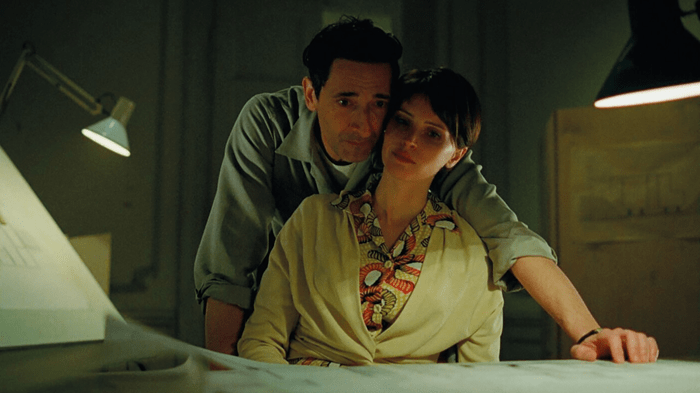
Beginning in 1947, Brody plays László Tóth, a Hungarian-Jewish architect and Holocaust survivor who manages to escape his home country and emigrate to the United States. Once established there, he hopes to find and bring over his wife, Erzsébet (Felicity Jones) and his niece Zsófia (Raffey Cassidy) who he was forcibly separated from during the Nazi roundups.
After arriving in New York City, László takes a bus to Philadelphia where he’s put up and given a job by his immigrant cousin Attila (Alessandro Nivola) who runs a furniture store with his American wife Audrey (Emma Laird). Lázsló gets his first real chance to show his architectural skills after the pampered children of a wealthy industrialist, Harrison Lee Van Buren (Pearce) hire him to turn their father’s dated study into a modernized library. László’s renovation is phenomenal, yet the job doesn’t go as planned and he’s forced to head out on his own.
Years pass and László is living in a homeless shelter and working whatever jobs he can get. That’s when he gets a surprise visit from Harrison whose new library has been making the rounds in popular architecture magazines. It prompted Harrison to do some research where he discovered László’s renowned work while in Budapest. Now the enamored Harrison wants to hire László to build a community center on his property in the small borough of Doylestown. He will be well compensated and allowed to stay in the guesthouse on the grounds. László accepts the offer and immediately gets to work.
Jump ahead to 1953. The construction of the community center is slowly consuming László. But he gets a reprieve when Erzsébet and Zsófia arrive in Philly. Their reunion is sweet, but before long László is back focused on his work. Meanwhile his growing addiction to heroin is becoming hard to keep secret. It all points towards an inevitable collision, but the road to it is slowed by narrative potholes. It’s as if Corbet and his co-writer Mona Fastvold have built two avenues of self-destruction that rarely intersect.

This speaks to one of the movie’s most frustrating issues. It feels as if we’re navigating two different movies telling two different stories. One is a captivating feature film about a Jewish immigrant crushed under the weight of an unforgiving new country and his own ambition. The other is an erratic short film about a man’s drug-fueled psychosexual foray into prostitution and pornography. If you squint hard enough you can find connections. But they’re too threadbare to have any impact.
Regardless, the performances from Brody and Pearce never falter and both should be shoo-ins for Oscar nominations. Brody powerfully emanates a similar raw humanity as he did in “The Pianist” while Pearce convincingly balances ego and charm, right up until an out-of-the-blue action jarringly strips away anything resembling nuance. Jones doesn’t fare as well. She is handcuffed by a one-note role that leaves her frustrated and victimized despite being the most clear-eyed of the bunch.
“The Brutalist” is the latest in the parade of films aimed at demythologizing the American Dream. When Corbet is his most focused, it’s an utterly captivating feature. It’s a visually engrossing film with many of cinematographer Lol Crawley’s images leaving you in awe even as some are glaringly on-point. And Daniel Blumberg’s score is rich and resonating. But Corbet’s efforts at making something momentous becomes an impediment. Though brilliant in lengthy stretches, his storytelling suffers, from László’s clashing storylines to the flimsy ending that fails to give characters the send-offs they’ve earned.
VERDICT – 3.5 STARS















 Keith & the Movies