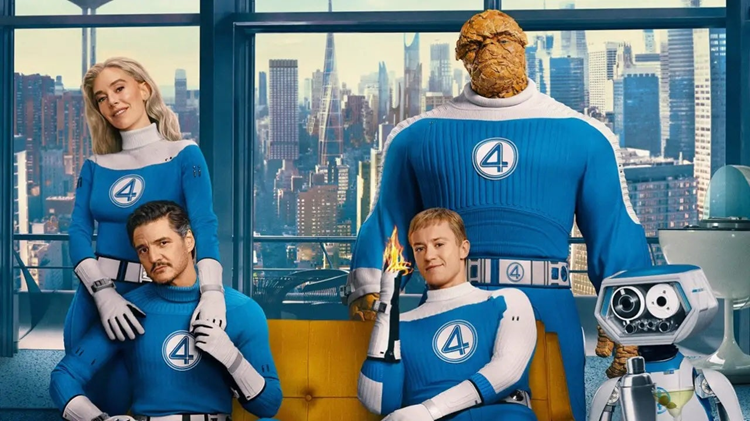
Say what you want about the state of the now unwieldy Marvel Cinematic Universe, but the folks at Marvel Studios have done a bang-up job promoting what is easily the most compelling movie on their release schedule. “The Fantastic Four: First Steps” has the potential to overcome the MCU fatigue that has grown due to the oversaturation of subpar big screen and television projects. The film looks genuinely intriguing and the brilliant promotion is a big reason so many of us are looking forward to it.
“The Fantastic Four: First Steps” is the second reboot for Marvel’s First Family. Directed by Matt Shakman and written by a team of SIX, this 37th entry into the MCU is set on a 1960s-inspired retro-futuristic Earth somewhere in the seemingly never-ending multiverse. Bypassing another retelling of their origin story, the family (played by Pedro Pascal, Vanessa Kirby, Joseph Quinn, and Ebon Moss-Bachrach) are forced to defend their world against a planet-devouring cosmic entity known as Galactus (Ralph Ineson).
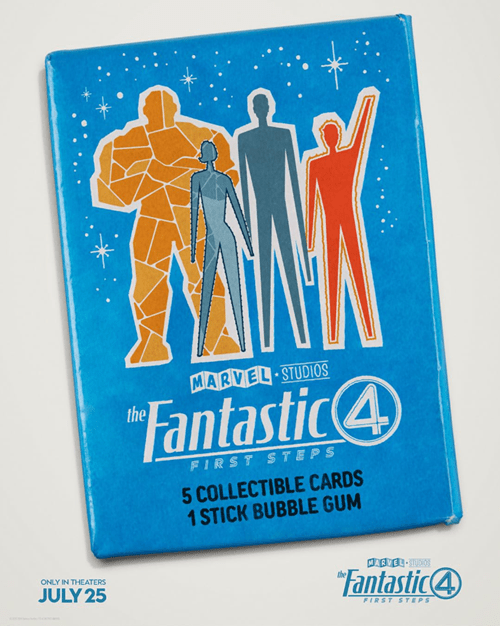
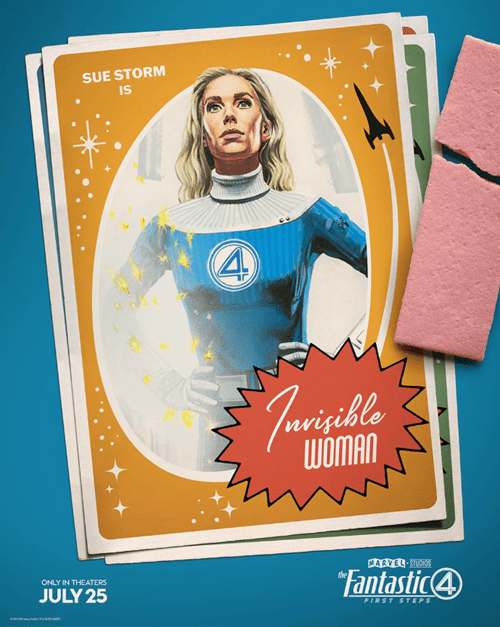
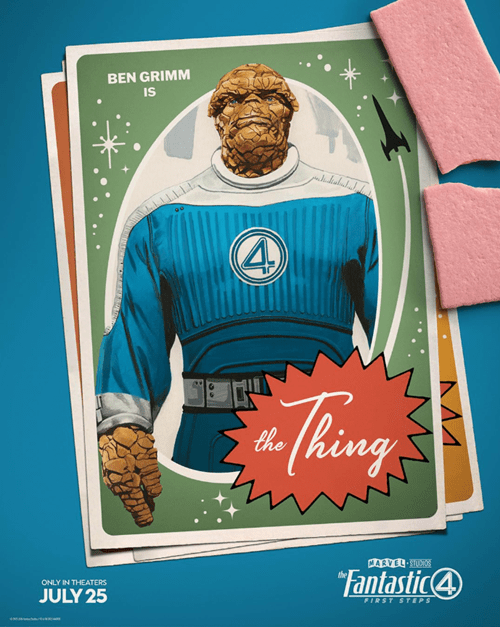
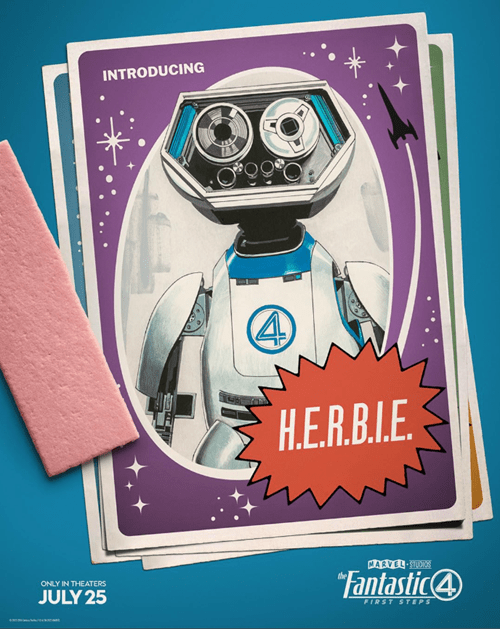
The marketing has been fantastic from the early teases to the full trailer releases. But best of all may be the retro-styled poster campaign. Since the early days of the movie’s announcement Marvel Studios has delivered a series of cool posters and they’re still going strong. Recently they dropped new character posters inspired by classic bubblegum card packs. Check them out below and tell me what you think.
“The Fantastic Four: First Steps” releases exclusively in theaters on July 25th.
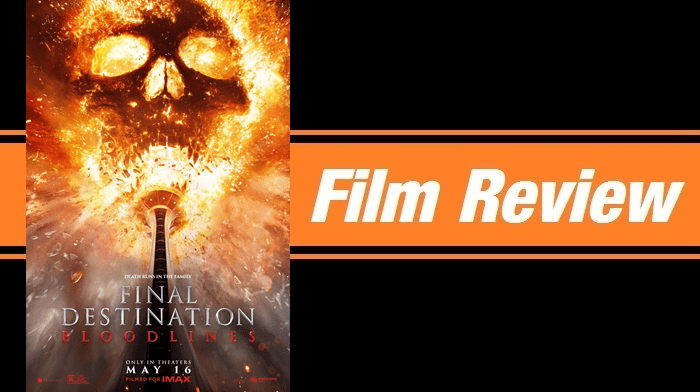
I openly admit to not being well-versed in the “Final Destination” franchise. In fact, it legitimately surprised me to find out this was the SIXTH movie in a film series that began twenty-five years ago. “Final Destination 5” released in 2011 and was a modest commercial success. Enough so that plans for a sixth installment were quickly set in motion. It took fourteen years, but now we have “Final Destination Bloodlines”.
So did we really need another “Final Destination” movie? Was anyone really asking for one? Those are two questions that are often thrown around with movies like this and I’ve never liked them. Why restrict creatives with arbitrary ideas of what we “need” or limit them to giving us strictly what we want. Here’s a better question – Does the movie bring enough fun ideas and/or fresh energy to make it entertaining? To my surprise, “Bloodlines” does just that.
Image Courtesy of New Line Cinema
The movie kicks off with a bang. In 1968 Paul (Max Lloyd-Jones) surprises his girlfriend Iris (Brec Bassinger) with opening night reservations at the swanky Skyview Restaurant. It sits atop a staggeringly tall tower that’s only reachable by a cramped glass elevator or an endless spiral staircase. Once at the top, the privileged patrons are met with top-quality dining, a fancy bar, a dance floor, and an energetic band. Paul is planning to propose while Iris is hiding that she’s pregnant. But any dreams for their future are crushed after a chain of events causes the tower to collapse, killing everyone inside.
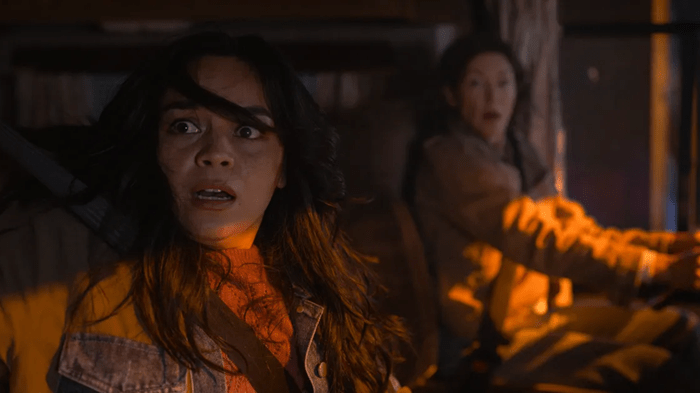
Some 50 years later, college student Stefani (Kaitlyn Santa Juana) suffers from gruesomely detailed reoccurring nightmares about the Skyview catastrophe. She hasn’t been able to sleep which leads to her being put on academic probation. Stefani ends up leaving school and going home in hopes of finding out what may be causing her terrifying dreams. But first she needs to reconnect with her family who she hasn’t been close to since she left for college.
But Stefani faces a bigger and far deadlier problem with the revelation that her family has a direct link to the Skyview incident. Without giving away too much, her estranged and reclusive grandmother (Gabrielle Rose) cheated death on that day and later had a family who should never have existed. Now death has come to collect and it has Stefani’s family in its grisly crosshairs.
Image Courtesy of New Line Cinema
Of course the movie’s gimmick is in how it shows the chain of seemingly chance events that can lead to a person’s fatal end. Co-directors Zach Lipovsky and Adam Stein lean into the anxiety-ridden, gore-drenched craziness of it all, delivering some shockingly gnarly deaths that are often laced with twisted dark humor. Death proves to be a devilishly crafty antagonist with Lipovsky and Stein stoking our paranoia through tense and cleverly envisioned buildups before delivering some savagely satisfying payoffs.
I would be lying if I said I knew how all of the story stuff works. And I can’t say I found the characters all that compelling. But they’re defined well enough to make good victims for the merciless Death. It all makes for a morbidly fun and inventive horror feature that can make you laugh and grimace, often at the same time. And to top it off, we’re gifted with seeing the late Tony Todd in his incredibly fitting final big screen role. His brief scene alone makes the movie worth seeing. Rest in peace Mr. Todd.
The first season of “Andor” caught many people by surprise. While it was very much a Star Wars installment, creator Tony Gilroy’s interests lied beyond lightsaber duels and spaceship battles. His vision was intensely character-driven, focusing on the human element at the center of the Empire’s tightening grip on the galaxy and the fledgling rebellion’s rise against their authoritarian oppressors. The results were pretty great.
Season Two featured a much different (and notably better) release schedule than its predecessor. The show’s twelve episodes take place over the course of four years. Each week a block of three episodes were dropped. The show would jump ahead one year from week to week, leaving us with four blocks set over four years and leading directly into the 2016 Gareth Edwards feature film “Rogue One”. While I loved the three episodes per week cadence, the show’s attempt at covering four years left some significant gaps. More about them later.
Image Courtesy of Lucasfilm
Season One featured a single line of dialogue that really speaks to the heart of the series – “Oppression breeds rebellion.” Season Two attempts to explore that idea through the inner workings of the established Empire and the struggles of a young Rebellion. While it is named “Andor”, the series follows a number of characters who are cogs in a rapidly changing galaxy. Some are Imperial loyalists, some are rebels in the making, some are politicians, some are militant insurgents. The breadth of characters allow the show to explore a wide range of perspectives.
As for the storytelling, “Andor: Season Two” takes its time kicking into gear with the majority of its first six episodes dedicated mostly to table-setting. Without question there is some good character building as Gilroy and company reacquaint us with old players and introduce us to several new ones. Many (if not most) are spies, conspirators, or simply living double lives of some kind. And the majority are given plenty of screentime to develop.
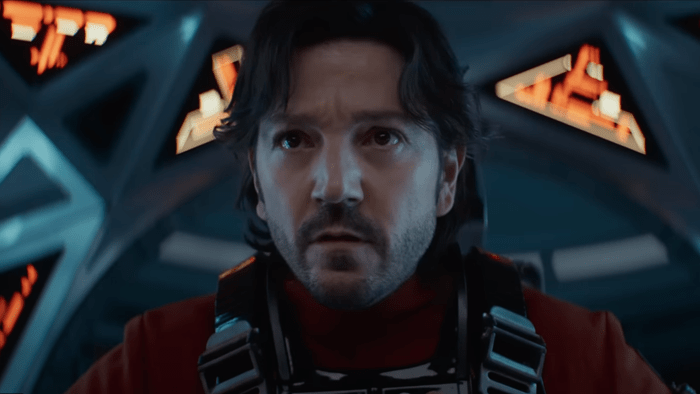
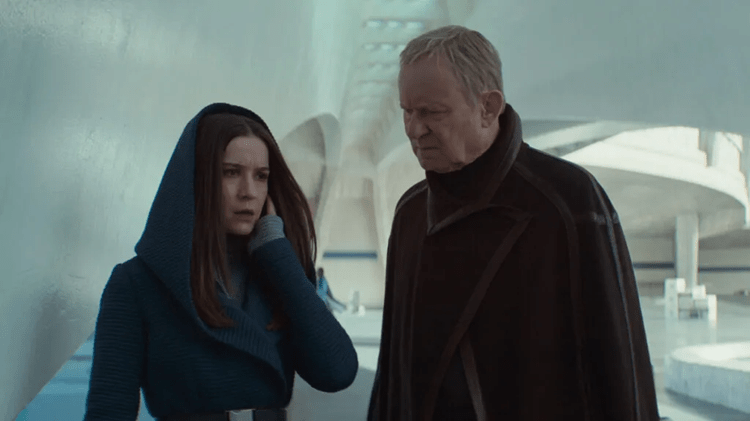
Diego Luna reprises his role as the show’s namesake, Cassian Andor, a thief turned rebel who discovers his destiny over the course of the series. Following the tragic events of the first season, Cassian is still (sometimes reluctantly) carrying out missions for Luthen Rael (Stellan Skarsgård). When he’s not secretly igniting fires in the name of the nascent rebellion, Luthen poses as a high-end antiquities dealer on Coruscant. But as we see over the course of the season, Cassian’s relationship with Luthen is complicated at best.
Image Courtesy of Lucasfilm
Luthen remains one of the show’s most fascinating characters. He’s very much a behind the scenes power-player who is pulling the strings from the shadows. His actions and decisions sometimes color him cold and callous. And his tight control of information often puts him at odds with those he relies on. But it’s all out of necessity. He knows the stakes and is focused on the endgame. He also understands the hard choices and their consequences. He has sacrificed everything and is resigned to his fate as he knows it.
Luthen is one of many interesting characters who grow or evolve throughout the second season. Bix (Adria Arjona) takes an emotionally wrenching journey, haunted by trauma yet determined to find her place in the galaxy. We see a new phase in the relationship between Dedra Meero (Denise Gough) and Syril Karn (Kyle Soller). She is still an ambitious member of the Imperial Security Bureau and he is still a naively willing pawn in desperate need for acknowledgment. They make for a bizarre and darkly funny couple whose lives take a dramatic turn.
Of course among the show’s biggest players is Mon Mothma, played again by the wonderful Genevieve O’Reilly. Every facet of Mon’s life changes in season two, both at home and in the senate, as she moves from secretly funding the underground to leading the rebellion. O’Reilly gets lost in some of the earlier episodes as Gilroy and company slowly move all of their pieces into position. But she is a captivating force in the second half, giving one of the show’s several Emmy-worthy performances.
So many other superb faces fill out the incredible cast. Benjamin Bratt (filling in for Jimmy Smits) as Bail Organa; Ben Mendelsohn reprising his role as Orson Krennic; Forest Whitaker back as insurgent leader (and personal favorite) Saw Gerrera; Anton Lesser as ISB Commander Partagaz; the great Kathryn Hunter as Syril’s mother Eedy; Elizabeth Dulau as Luthen’s capable assistant Kleya; and so many others. It is a truly tremendous ensemble.
Image Courtesy of Lucasfilm
The first block of three episodes are a little erratic and struggle to find cohesion or momentum. And they’re hampered by the only case of on-the-nose writing in the entire season (specifically in episode one). The second block slowly begins pulling together the wandering storylines while giving us a strong sense that the show is building up to something big. And that ‘something big’ comes in the form of the Ghorman Massacre.
The third block is dedicated to the Ghorman Massacre and its massive fallout. It features some of the finest television in the Star Wars franchise and beyond, offering exhilarating yet horrifying storytelling through a brilliant mix of visuals, writing, and performance. The seed for the massacre was planted as early as episode one with the Empire’s interest in Ghorman centering around a precious rare mineral near the planet’s core. It’s needed for the secret construction of the Death Star, but mining the mineral would make the planet unstable and uninhabitable.
So the Empire ruthlessly goad the Ghorman people into rebelling, portraying them as unruly insurgents in an effort to justify their gouge-mining of the planet for resources. Ironically Luthen also wants rebellion on Ghorman but for a much different reason. He wants the Empire to overstep which will expose their oppression, causing them to lose support as other planets rise up against them. The brutal massacre that follows reverberates across the galaxy and changes the lives of nearly every character involved.
Image Courtesy of Lucasfilm
The final block brings most things to a fitting conclusion as it attempts to tie up loose ends and put things in place for “Rogue One”. With so many characters and story threads it’s inevitable that some are shortchanged. But Tony Gilroy has made it clear he’s not concerned with connecting every dot. This proves to be a strength of the show but also its one big weakness. It certainly affords Gilroy a certain creative freedom. But some characters and arcs needed more than a small spot in a final montage.
Regardless, the second season of “Andor” is an exceptional Star Wars entry that will be talked about for years to come. The thrilling spycraft, the array of compelling characters, the sublime worldbuilding – it all fuels this rousing accomplishment. As with the first season, it sometimes lacks the ‘feel’ of Star Wars which may appeal to the lukewarm casuals while being an adjustment for die-hard fans. And it takes its time out of the gate, slowly laying the groundwork for what’s to come. But (again) as with the first season, the payoff is well worth the wait. It not only brings together all the early table-setting, but it adds even more weight to “Rogue One” which you’ll immediately want to revisit once the “Andor” credits roll.
We’ve seen teasers and a first trailer for the upcoming film “F1”. Yesterday we were given what Warner Bros. has called the “Main Trailer”. And just like before, this thing looks terrific. Apple Studios has poured a ton of money into this action sports drama centered around the world of Formula One racing. Some have estimated as much as $300 million which is a lot of money to make back. I’m hoping it pays off because it would be nice to see a successful blockbuster that isn’t linked to existing franchises.
Brad Pitt gets top billing playing Sonny Hayes, a former Formula One driver who retired following a horrible crash. He’s convinced to return to racing after an F1 team owner and old friend (played by Javier Bardem) offers him a spot mentoring a hotshot prodigy (Damson Idris). The always compelling Kerry Condon also stars. The film is directed by Joseph Kosinski who’s coming off the enormous success of “Top Gun: Maverick”. There’s no way “F1” does those kinds of numbers. But hopefully people will give it a shot, especially after seeing the killer new trailer.
“F1” races into theaters on June 27th. Check out the trailer below and let me know if you’ll be seeing it or taking a pass (awful pun intended).
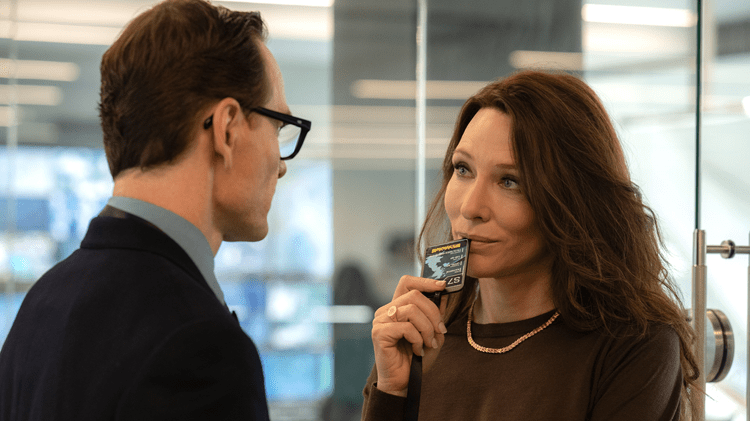
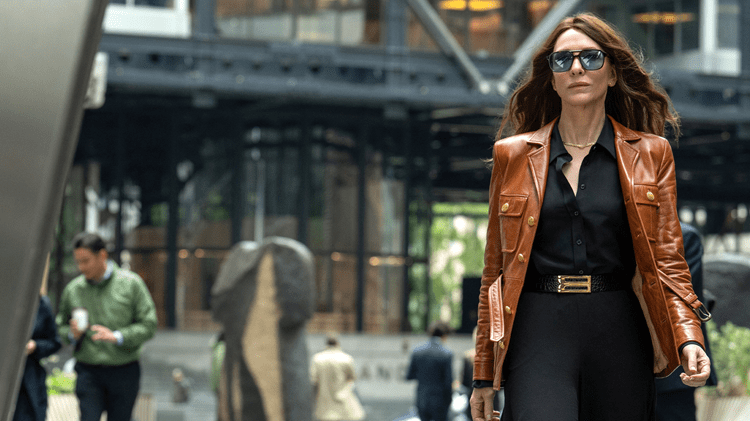
Universal Pictures Home Entertainment is bringing Steven Soderbergh’s exhilarating spy thriller “Black Bag” to home video. Released in theaters in mid-March, “Black Bag” remains one of the best films of 2025 thanks to David Koepp’s razor-sharp script and two dynamic lead performances from Michael Fassbender and Cate Blanchett. But ultimately it’s Soderbergh, whose signature style and pinpoint precision energizes every facet of the storytelling. And now you can bring this gem home.
This new Blu-ray edition of “Black Bag” comes with a digital copy and will be available to purchase on May 13th. See below for a full synopsis of the film as well as release info including a list of special features.
About the Film:
Year: 2025
Runtime: 94 Minutes
Director: Steven Soderbergh
Screenwriter: David Koepp
Cast: Michael Fassbender, Cate Blanchett, Pierce Brosnan, Regé-Jean Page, Marisa Abela, Tom Burke, Naomie Harris, Kae Alexander, Ambika Mod
Rating: R for language including some sexual references, and some violence
From Academy Award-winning Director Steven Soderbergh, “BLACK BAG” is a gripping spy drama about legendary intelligence agents George Woodhouse (Michael Fassbender) and his beloved wife Kathryn (Cate Blanchett). When she is suspected of betraying the nation, George faces the ultimate test – loyalty to his marriage or his country.
Special Features:
Deleted Scenes
“The Company of Talent” – In the world of spies, there are no small players. Join the ensemble cast and learn about their distinct character motivations, secrets, and overall creative approach to bringing each role to life under the direction of Steven Soderbergh.
“Designing BLACK BAG” – Enter the world of espionage and collect intelligence on the production design, costumes, makeup, and special effects that came together to embody the looks of each character and the aesthetic of each space they inhabit.
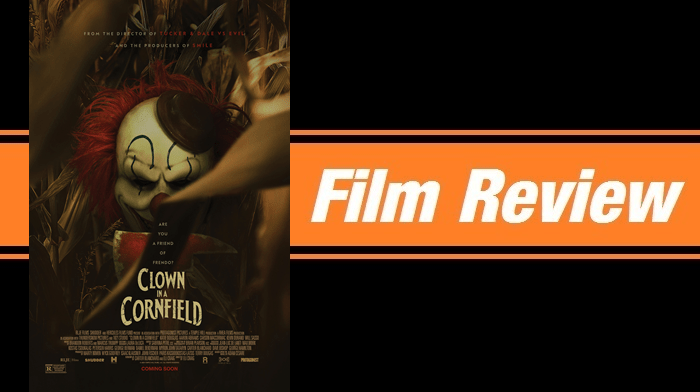
As its title so openly reveals, “Clown in a Cornfield” features two things that have held prominent spots in horror movies for decades – clowns and cornfields. The film comes from director Eli Craig who first made a splash with his hilarious 2010 horror-comedy “Tucker & Dale vs. Evil”. While it’s certainly absurd, his latest isn’t nearly as self-aware or as bonkers as his debut. And that’s a big reason “Clown in a Cornfield” frustratingly falls short.
“Clown in a Cornfield” is based on Adam Cesare’s 2020 young adult novel of the same name. After a rather meaningless prologue, the story (written for the screen by Craig and Carter Blanchard) introduces us to 17-year-old Quinn Maybrook (Katie Douglas) and her father, Glenn (Aaron Abrams). The two have just moved to the small country town of Kettle Springs, Missouri looking for a new start following a family tragedy.
Image Courtesy of RLJE Films
Quinn’s relationship with her father follows a blueprint that we often see in modern movies. Of course there is a disconnect between them which Craig does a good job tempering. But she’s often portrayed as brighter, more sensitive, and the one most in touch with their reality. To no surprise all of that goes out the window once she falls in with a group of pampered upperclassmen from her high school. None of the five teens stand out with the slight exception of Cole (Carson MacCormac) who immediately catches Quinn’s eye.
Most of the adults around town see Quinn’s new friends as troublemakers. And Cole certainly doesn’t leave the best first impression with her father. But Quinn enjoys hanging out with them and learns a lot about the town’s history in the process. She learns that Kettle Springs was once prosperous thanks to the thriving Baypen corn syrup factory. But the factory was forced to shut down after a fire that many believe was started by the partying teens.
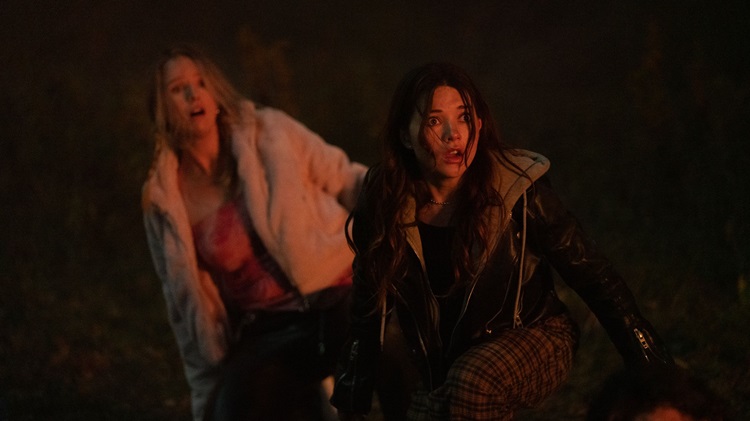
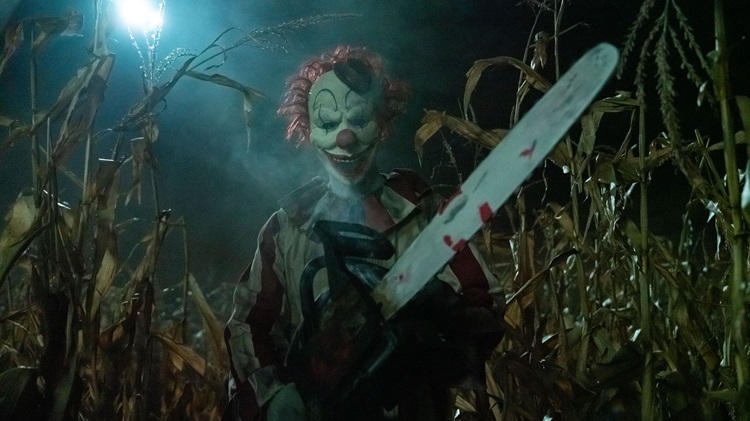
Adding to their friction with the townsfolk, the group runs around the county filming slasher vignettes for their YouTube channel, often using the old factory and its mascot, Friendo the clown. But as you can probably guess, their horror movie fiction turns to reality when an actual killer in a Friendo costume begins disposing of the young fodder in a variety of gruesomely violent ways. The kills are among the film’s strengths. They’re impressively creative and wonderfully realized through mostly practical effects.
Image Courtesy of RLJE Films
Unfortunately the characters and some of the story choices aren’t as effective. While her friends and most of the people around town leave little impression, Quinn herself is a frustrating character. At times she seems noticeably smarter and more complex than most slasher movie protagonists. But she routinely undermines that notion with her boneheaded decisions and hare-brained actions. As a result, we go from rooting for her to not even caring.
The further you get into its story the more you pick up on the countless small town stereotypes. In fact, the film is almost snooty in its use of rural America cliches. It all feeds into a clunky final act where the movie tries to present something resembling a theme. It ends up being a messy mix of intentional and unintentional laughs, where neither the town’s small-minded adults or its (supposedly) more enlightened youth are believable enough for its message to hit home.