REVIEW: “A Real Pain” (2024)

Writer, director, producer, and star Jesse Eisenberg has made a splash with “A Real Pain”, an emotionally rich and organically funny dramedy that follows two Jewish cousins on a trip to better understand their late grandmother’s past. In the process, the two end up learning more about themselves and each other. It may sound like a fairly conventional premise. But Eisenberg infuses his film with such humanity that he has no trouble earning our empathy.

The film opens with the two cousins meeting at the airport in New York City. Within seconds its easy to see that they couldn’t be more different. First is David (Eisenberg), an buttoned-up and tightly wound digital advertising specialist who lives in a comfy Manhattan brownstone with his wife and young son. And then there is Benji (Kieran Culkin), a crass but naturally charming free spirit who flies by the seat of his pants and has no problem sharing whatever is on his mind.

Image Courtesy of Searchlight Pictures

Like many cousins, David and Benji grew up close but drifted apart as their lives took different paths. But they’re brought back together by the recent passing of their grandmother. Both loved her very much, but we learn she had an especially close relationship with Benji. Now they are coming together to fulfill their grandmother’s dying wish – to take money she left them and travel to Poland to learn about where she came from.

After the pair reunite in New York, they fly to Warsaw where they join a small but intimate tour group led by a knowledgeable British guide named James (Will Sharpe). Filling out the group is a recently divorced middle-aged New Yorker named Marcia (Jennifer Grey) who is there to honor her mother, an African-born Jewish convert named Eloge (Kurt Egyiawan) who survived the Ruwandan genocide and now seeks to better connect to his faith, and a somewhat stuffy retired couple, Mark (Daniel Oreskes) and Diane (Liza Sadovy).

Image Courtesy of Searchlight Pictures

One of the film’s biggest strengths lies in Eisenberg’s impressive ability to balance the heaviness of his movie’s themes with moments of levity. Culkin’s Benji brings an irreverent and rambunctious energy to the Holocaust tour group. And while that may sound incredibly insensitive, Eisenberg’s humanizing touch ensures sensitivity and pathos. The humor is organic to the characters and it compliments their arcs while helping to better define them.

“A Real Pain” has received a lot of buzz since premiering earlier this year at Sundance. In that time Culkin has garnered most of the attention and he certainly earns it. But his character (and by extension his performance) wouldn’t have the impact without the sturdy and on-point Eisenberg as his foil. Together they get to the heart of the movie which turns out to have more on its mind than just remembrance. It’s also a movie about reconnection, understanding, and finding your way forward. It asks several questions that have no easy answers. But it leaves us thinking about them which testifies to Eisenberg’s prowess.

VERDICT – 4 STARS

REVIEW: “I’m Still Here” (2024)

Firmly planted as one of the year’s best films, “I’m Still Here” roots us within its tense and turbulent setting as good as any other movie you’ll see in 2024. Brazilian director Walter Salles, working from a screenplay by Murilo Hauser and Heitor Lorega, tells the powerful true story of Eunice Paiva, a wife and mother navigating through and eventually rising above a harrowing political whirlwind.

Based on Marcelo Rubens Paiva’s 2015 memoir “Ainda Estou Aqui”, “I’m Still Here” is set in Rio de Janeiro during the early 1970s amid an oppressive military dictatorship. In the Spring of 1964 the Brazilian Armed Forces carried out a coup d’état to overthrow embattled president João Goulart. The dictatorship that followed lasted 21 years and was marked by numerous human rights abuses including forced disappearances, torture, and executions.

Image Courtesy of Sony Pictures Classics

Salles earns our investment early by dedicating a lot of screen time to developing the Paiva family. Eunice is the heart of the film and played with such emotional force by a brilliant Fernanda Torres. She shares a loving marriage with Rubens (Selton Mello), an engineer and former congressman. Together they have five kids – a son and four daughters, and all live in a lively two-story home near the beach.

The Paiva’s are a fun and vibrant family with members full of their own character, from the staunchly activist-minded Vera (Valentina Herszage) who heads off to London to study sociology to the intensely observant and news-conscience Eliana (Luiza Kosovski) whose grasp of their troubled world is beyond her years. Not only are they incredibly well written, both individually and as group, the performances are full of energy and heart.

But the family’s happy existence is interrupted one evening when a group of mysterious armed men show up demanding Rubens come with them to give “a deposition”. As he is escorted away, three men stay behind to keep watch over Eunice and their kids. A day passes without news from either Rubens or the government sanctioned agents who took him. As Eunice pushes for information, more men arrive and take her and Eliana, subjecting them to draining and abusive interrogations.

Image Courtesy of Sony Pictures Classics

Eunice and Eliana are finally released but are left without any word on Rubens. The authorities play dumb to the point of denying Rubens was ever taken into their custody. The rest of the film follows Eunice’s search for the truth about her husband‘s abduction while at the same time doing everything she can to support and protect her children. It’s a powerful story based on true events and galvanized by Torres’ sublime performance – one of the year’s best.

Positioned as Brazil’s entry for Best International Feature at the upcoming Academy Awards, “I’m Still Here” is a historical drama that is worthy of every consideration. It tells an intense, enlightening, and heart-wrenching story of a family’s survival under the watch of an oppressive regime. It’s expertly brought to life by Salles who makes several candid statements on Brazilian history while maintaining an affecting focus on human resilience amid great suffering. Don’t miss it.

VERDICT – 4.5 STARS

REVIEW: “Mothers’ Instinct” (2024)

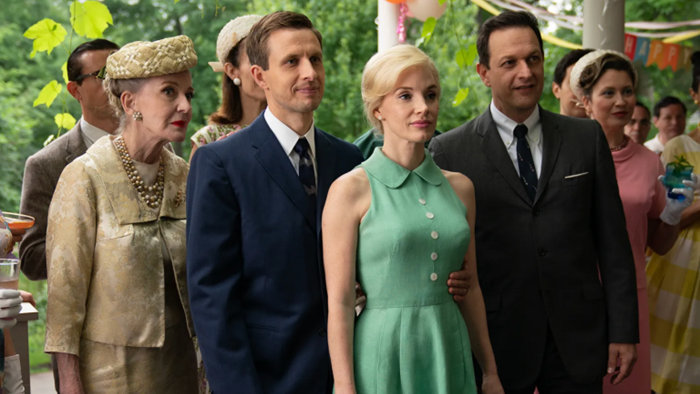
The top-tier teaming of Jessica Chastain and Anne Hathaway drive “Mothers’ Instinct”, a pulpy and fun suburban thriller from director and cinematographer Benoît Delhomme. The two luminous stars sink right into their roles as neighbors, best friends and mothers who watch their relationship crumble following a horrific tragedy. Anders Danielsen Lie and Josh Charles add sturdy supporting roles, but this is Chastain and Hathaway’s show and their magnetism makes the film’s blemishes a little easier to get past.

With “Mothers’ Instinct” Delhomme plays with a premise that could have been plucked straight out of Hitchcock’s oeuvre. His film is a remake of Olivier Masset-Depasse’s 2018 Belgian thriller that was an adaptation of Barbara Abel’s 2012 novel of the same name. The screenplay is by Sarah Conradt who does a good job playing with our perceptions of her characters. But it shows cracks as plot holes begin to add up, specifically in the film’s second half.

Image Courtesy of NEON

Set in the 1960s, Alice (Chastain) and Celine (Hathaway) are best friends and next-door neighbors living in a sunlit and tree-lined suburbia. Their almost matching two-story homes sit pristinely on immaculately manicured lawns that are separated by one long green hedge. Both have 8-year-old sons who are best buddies and spend much of their time together. And both have husbands who leave early for work while the wives stay behind and manage the home. It’s a glossy snapshot of a segment of 1960s society.

Alice and Celine’s relationship forever changes after Celine’s son Max (Baylen D. Bielitz) falls from his home’s top-floor balcony and is tragically killed. Alice could see Max from her yard but couldn’t reach him in time. Celine, who had been cleaning house in another room when her son fell, plunges into a deep depression while her husband Damian (Charles) sinks into the bottle.

In the days that follow, Celine goes out of her way to avoid Alice which causes the anxious Alice to worry that Celine may blame her for Max’s death. But things really take a more twisted turn after Celine starts showing extra attention to Alice’s son, Theo (Eamon Patrick O’Connell). Alice’s husband Simon (Lie) brushes it off as Celine’s way of coping with her grief. But Alice isn’t so sure which leads to a mounting tension between the former best friends.

Image Courtesy of NEON

But here’s the movie’s big trick – which woman is coming unglued? Is it Celine, Alice, or both? Delhomme gives us ample reasons to question both, shifting our suspicions from one to the other until everything comes into focus during the final act. As the drama unfolds, Conradt uses social norms of the time to divert our attention and mask where the story is really going. It doesn’t all gel as intended, but it certainly makes following along a lot of fun.

That said, the movie still wobbles under the unfortunate weight of obvious plot holes and lapses in logic. Several seemingly meaningful elements of the story turn out to be little more than devices that are utterly forgotten once they move the story to its next point. It’s a nagging issue that keeps this otherwise well acted and visually striking psychodrama from being as memorable as it could have been. But it’s still Chastain and Hathaway – two actresses who make everything they’re in worth seeing. It’s no different here.

VERDICT – 3.5 STARS

REVIEW: “Thelma” (2024)

How am I so late getting to one of the biggest treats of the movie year? Much like its titular lead character, “Thelma” is an absolute delight. Writer, director, and editor Josh Margolin took inspiration from his very own grandmother, Thelma Post, who turned 104 earlier this year. Margolin based his lead character on her, and the early setup to his story is taken from a real situation his grandmother experienced.

Who better than the effervescent 95-year-old June Squibb to play Thelma Post, an infectiously charming elderly woman who spends her days cross-stitching, watching YouTube videos, and trying to figure out the Facebook app on her cellphone. She has a tight-knit relationship with her sweet and caring grandson Danny (a very good Fred Hechinger) who happily comes over to help her around the house and take her wherever she needs to go.

Image Courtesy of Magnolia Pictures

Thelma’s adventure begins when she gets a strange phone call from a man claiming Danny has ended up in jail. The man needs $10,000 cash mailed to a certain address in order to get him out. In a panic, Thelma pulls money from her hidden stash and drops it in the mail. But when she finally gets in touch with Danny she realizes she has been scammed. She goes through all the proper channels but can’t get her money back.

Instead of sitting idle and accepting her losses, an inspired Thelma sets out to reclaim what is hers. But she’ll need to do it without her disapproving family knowing. And since she can’t drive, she will need a little help. So she seeks out her old friend Ben (the late, great Richard Roundtree) who lives in a nearby retirement center and happens to own a shiny red two-seat mobility scooter. After some reckless convincing, Thelma and Ben are putting across Los Angeles to Van Nuys to confront the scammers face-to-face.

Image Courtesy of Magnolia Pictures

Squibb and Roundtree are such an enjoyable pairing, bringing ample amounts of personality, warmth, and humor to both of their characters. Adding to the fun is Parker Posey as Thelma’s fussy daughter Gail and Clark Gregg as Gail’s tightly wound husband Alan (Clark Gregg). Together they are reasonably concerned yet slyly amusing helicopter parents to Danny and take a similar approach to shepherding Thelma. It leads to several funny back-and-forths.

But at the end of the day this is a June Squibb joint and she brings all the energy, charm, and playfulness necessary for an entertaining crowdpleaser. The movie provides her with everything she needs to keep us rooting for Thelma and laughing most of the way (wait till you see the hilarious Tom Cruise / “Mission: Impossible” bit). And Margolin’s love for his real grandmother comes through in the clear affection he shows for the Thelma he puts on screen. That love proves to be the secret sauce that makes “Thelma” such a joy.

VERDICT – 4 STARS

REVIEW: “Blitz” (2024)

Director, writer, and producer Steve McQueen brings his incisive real-world filmmaking back to his home city of London in “Blitz”, an impeccably well-made historical drama set in the early days of World War II during what many called “The Blitz”. Named after Germany’s Blitzkrieg, The Blitz was an eight-month period when Hitler’s Air Force unleashed a major bombing campaign over British cities. During that time over 1.2 million people were evacuated from ravaged British targets with more than half being children.

That bit of history sets the table for McQueen’s heart-rending story. After a truly harrowing four-minute opening that features firefighters battling raging infernos caused by German bombs, we’re introduced to the film’s two main characters, a devoted mother named Rita (Saoirse Ronan) and her good-hearted 9-year-old biracial son, George (Elliott Heffernan). Their unshakable bond is the emotional linchpin that secures McQueen’s story.

Image Courtesy of Apple Studios

McQueen drops us into September of 1940. It’s only one year into World War II, but the impact of Hitler’s aggression is being felt all across England. Rita and George live in a London flat with her piano-playing father, Gerald (Paul Weller) who has a strong attachment to his dear grandson. But outside of their small but loving home is a much harsher and troubled world.

As the Nazi bombings intensify, Rita is convinced to send George to the countryside on a train full of other kids being evacuated. The two don’t part on the best of terms as the frustrated George shuts out his heartbroken mother. But as the train nears its destination, a remorseful George jumps off and heads off on an ill-advised adventure back to London in hopes of reconciling with his mother.

The majority of the story follows George’s dangerous journey which opens his young eyes to the terrible realities of his world. He meets an assortment of people along the way, some vile and opportunistic while others show much needed compassion. McQueen shows us both sides through George’s naive and innocent eyes which offers a raw and forthright perspective. Young Heffernan (making his feature film debut) is terrific, quietly conveying everything we need to understand what George is feeling. It’s a potent first performance.

Image Courtesy of Apple Studios

As George tries to find his way home, Rita goes to work in a factory making bombs for the war effort. She also volunteers at a shelter for displaced locals. But once she gets word that George didn’t arrive with the other children, she sets out on her own mission to find her son. Ronan has always possessed a near effortless grace. Here she combines it with a fraught motherly intensity resulting in a warm yet steely performance that’s crucial to McQueen’s vision.

As “Blitz” moves forward, flashbacks offer some needed context and depth especially involving George’s father, Marcus (CJ Beckford). They’re well done and informative though not particularly original in where they go. And as McQueen is known to do, his film takes moments to examine racial prejudice. Some of the scenes are powerful while others feel framed for the audience rather than organic to the story. They can be a little too on-the-nose and even clumsy at times, lacking the storytelling finesse we’ve come to expect from the filmmaker.

But those are such small quibbles for a movie this stirring, heartfelt, and well crafted. Steve McQueen remains a fascinating filmmaker. With “Blitz” he embraces an old-fashioned classicism yet isn’t afraid to add his own creative flavor. His film is very much a lavish wartime drama, illuminated through the period-piece lensing of DP Yorick Le Saux. But as with most of McQueen’s projects, it’s a human drama at its core. There are moments of inspiration but even more that shatter us. And then McQueen hits us with something like the film’s Café de Paris nightclub sequence – the kind of technically brilliant and emotionally sobering scene that makes his movies must-see experiences.

VERDICT – 4 STARS

REVIEW: “Gladiator II” (2024)

It has been a lengthy journey (24 years to be exact), but Ridley Scott has finally delivered “Gladiator II”, the long-rumored sequel to his 2000 Oscar-winning epic “Gladiator”. I’m a massive fan of the Russell Crowe led original and wasn’t convinced we needed a sequel to such a brilliant all-timer. But Scott has been working on a second film since 2001, parsing through ideas, shaping and reshaping scripts, and getting the right people onboard.

That brings us to “Gladiator II”, Ridley Scott’s return to the Roman Empire although without the rugged star-power of Russell Crowe. But stepping into his sandals is rising star Paul Mescal who pours every ounce of himself into the role of Lucius Verus. Fans of the first film might recognize that name as he was the young grandson of Emperor Marcus Aurelius (originally played by Spencer Treat Clark). Lucius’ story is the centerpiece of this spectacular sequel that delivers everything you want from a big budget blockbuster.

This time around the screenplay is handled by David Scarpa who just recently worked with Scott on “Napoleon”. Scarpa dusts off several story threads from the 2000 film and reuses them with mostly new characters. But this isn’t some lazy rehash of its predecessor. Scott and Scarpa add several new threads of their own, often braiding them with the old to make something fresh. It results in a film that proudly honors the original while creating an identity very much its own.

Image Courtesy of Paramount Pictures

“Gladiator II” opens with one of the most exhilarating battle sequences Ridley Scott has ever put to screen. In 200 A.D., under the leadership of General Marcus Acacius (Pedro Pascal), the Roman army invades Numidia, the last free city in Africa Nova. Helping defend the city is Lucius who has been living under the alias Hanno. During the brutal and bloody battle, Lucius’ wife Arishat (Yuval Gonen) is killed and he is enslaved.

Lucius is taken to the outskirts of Rome where he and other captives are thrown into an arena to fight feral baboons in front of potential buyers. Lucius impresses Macrinus (Denzel Washington) who buys him to add to his stable of gladiators. Macrinus is a mysterious but clearly ambitious man who sees the rage in Lucius as a means to fulfill his bigger plans. As he does with every film he’s in, the charismatic Washington makes “Gladiator II” better. He has the time of his life playing Macrinus, a shrewd and politically savvy manipulator who has his eyes focused on one thing – unbridled power.

Meanwhile General Acacius returns to Rome where he is greeted by the depraved and corrupt twin emperors, Geta (Joseph Quinn) and Caracalla (Fred Hechinger) who immediately plan games in the Colosseum to celebrate Rome’s victories. But secretly the war-weary Acacius has grown disillusioned with the direction of Rome under the two Emperors. So much so that he and his wife Lucilla (a returning Connie Nielsen) are secretly organizing an insurrection with 5,000 soldiers loyal to Acacius making their way towards Rome.

Image Courtesy of Paramount Pictures

As the city gathers for the upcoming gladiator games, the Machiavellian Macrinus seizes his opportunity to get closer to the throne. He convinces a reluctant Lucius to fight as his gladiator, promising him an opportunity for vengeance against Acacius if he wins enough fights in the Colosseum. And much like Crowe’s Maximus in the first film, Lucius will need to earn the trust of his fellow gladiators and win the Roman crowd if he is ever to have his chance at revenge.

Scarpa’s script is loaded with political intrigue and family revelations. But its the blood and brawn of the Colosseum that will drawn the most excitement. The action scenes are electric, combining intense choreography with brute spectacle. They’re wild, brutal, and extravagantly staged. Just as impressive are the magnificent costumes and the stunning production design, both of which benefit greatly from the film’s hefty budget. A shaky digital effect or two aside, the film is a dazzling visual achievement.

For some, comparing “Gladiator II” with its superior predecessor will be immediately yet fruitlessly tempting. The sequel may not reach the same heights or have the same impact, but it’s a worthy successor in nearly every regard. Rome lives and breathes through Scott’s bravura filmmaking and Scarpa’s incisive script, both of whom create a colossal Empire on the brink. And while there’s no shortage of juicy melodrama, underneath it simmers strong statements on power and oppression. Throw in a fiery Paul Mescal and a Denzel Washington performance for the ages, and you have the most entertaining big screen blockbuster of the year.

VERDICT – 4.5 STARS